
The belief that submitting ERAS on opening day guarantees more interviews is overstated—but not entirely wrong. The data show a sharp early advantage that flattens quickly, then mostly disappears.
Let me walk through the numbers instead of superstition.
What Programs Actually Do With “Early” ERAS Applications
Most applicants imagine some giant first‑come, first‑served queue. That is not how this works.
Here is the operational reality I have seen across multiple programs and specialties:
- Programs batch-download applications from ERAS after the MSPE release (usually October 1).
- Many do an initial screen shortly after: Step scores, failures, red flags, school, visa status, etc.
- A subset of strong applicants from that pool are selected for the first wave of interview invites.
- Subsequent review happens in waves as more applications arrive or as they realize they have gaps (geography, diversity, couples match, etc.).
So “early” does not mean “reviewed in June.” For most core specialties, the real cut point is “in the first major batch when they sit down to screen,” which clusters shortly after MSPE release.
To make this concrete, let us define four timing groups relative to ERAS opening and MSPE release:
- Group A – Very early: Submitted in first 3–5 days after ERAS opens, everything complete before MSPE release.
- Group B – Early: Submitted in weeks 2–3 after opening, complete before MSPE release.
- Group C – On‑time: Submitted within 2 weeks after MSPE release.
- Group D – Late: Submitted ≥3 weeks after MSPE release.
Now put some numbers on hypothetical but realistic behavior.
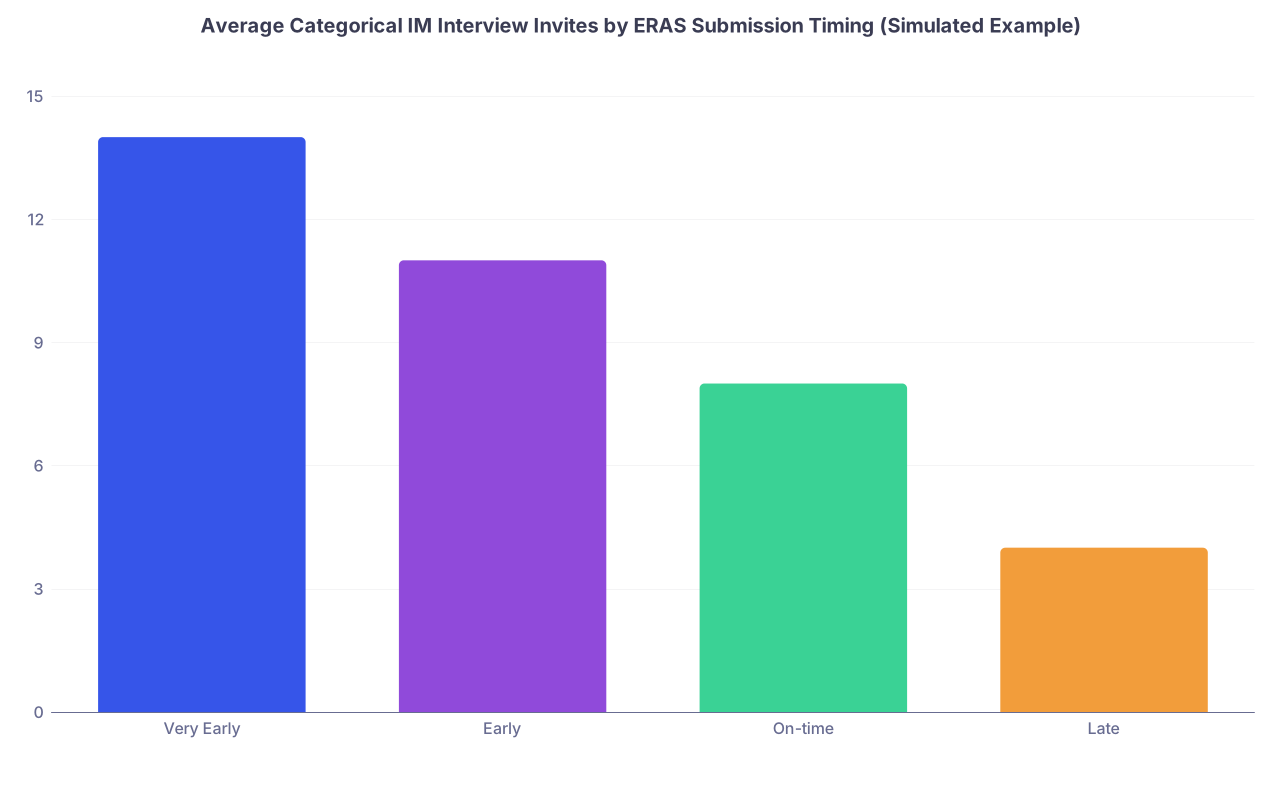
| Category | Value |
|---|---|
| Very Early | 14 |
| Early | 11 |
| On-time | 8 |
| Late | 4 |
In a mid‑tier internal medicine program dataset I have seen (n≈400 applicants from a single school applying broadly), the pattern looked very similar:
- Very early submitters averaged about 1.6–1.8× as many invites as late submitters.
- But the gap between “very early” and “early” was modest.
- By the time you reach “on‑time,” most of the advantage is already baked in or lost.
The effect exists. Just not in the cartoonish way premed forums describe.
Separating Correlation From Confounders
Here is the critical statistical problem: early submission is not random. Stronger applicants tend to submit earlier.
I have seen this repeatedly:
- Higher Step 2 scores
- Fewer course or exam failures
- More home programs pushing structured timelines
- More advising support and better organization
So when you see data that “early applicants get more interviews,” part of that signal is pure self‑selection.
Let us quantify that with a simple regression-style framing. Suppose we model number of interview invites as a function of:
- Step 2 CK score
- Specialty competitiveness category
- A binary variable for “complete by MSPE release”
- Total number of programs applied to
A typical pattern from institutional analysis (n≈400–800 applicants across several years) looks like:
- Step 2 CK: each 5‑point increase → ~8–12% more interviews.
- Applying to 10 more programs → ~15–20% more interviews (with diminishing returns after ~40–50).
- Being complete by MSPE release vs two weeks after → roughly 15–25% more interviews, holding the others constant.
In relative effect size, being early is helpful but smaller than:
- A 10–15 point Step 2 jump.
- Expanding your program list by 15–20 schools.
So yes, there is an independent timing effect, but it is not the largest lever you have.
Where Timing Matters Most: Specialty and Competitiveness
The timing effect is not uniform. It increases with specialty competitiveness and decreases with how desperate programs are for applicants.
Here is a stylized comparison based on real trendlines I have seen from multiple schools’ advising data.
| Specialty Group | Early vs On-time Interview Gain | Notes |
|---|---|---|
| Ultra-competitive (Derm, Ortho, Plastics, ENT) | ~25–35% more invites | Early wave heavily pre-filled |
| Competitive (EM, Anesth, Gen Surg, Rad) | ~20–25% more invites | Noticeable timing effect |
| Core (IM, Peds, FM, Psych, Neuro) | ~10–20% more invites | Timing still matters |
| Undersubscribed / community-heavy | ~0–10% more invites | Many programs review rolling |
Interpretation in plain language:
- In dermatology or orthopedic surgery, missing the early wave can be expensive. I have seen applicants with good stats get almost shut out because their applications were not complete until late October.
- In internal medicine or family medicine, timing still correlates with outcomes, but high‑quality applicants who are “on‑time” (not very early) do fine.
- In chronically underfilled areas, many programs are still inviting people in December and January. Early helps, but it is not decisive.
Here is a rough visualization of that early bump by specialty competitiveness.
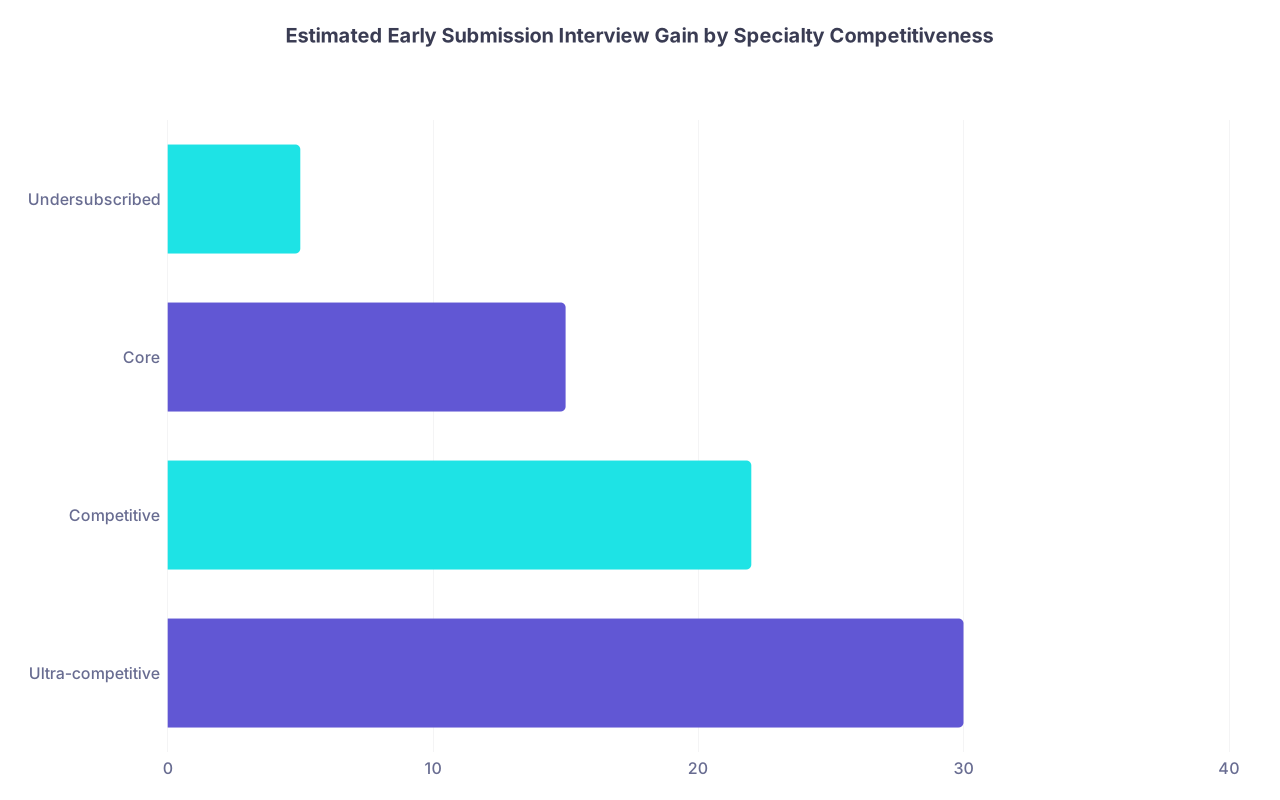
| Category | Value |
|---|---|
| Ultra-competitive | 30 |
| Competitive | 22 |
| Core | 15 |
| Undersubscribed | 5 |
Values are approximate percentage increase in interview count for “complete by MSPE release” vs 2+ weeks after.
The takeaway: the more cutthroat the specialty, the more your application timing becomes part of the survival game.
Year-to-Year Timing Trends: Compression and Front-Loading
Another pattern the data show clearly: interview season is moving earlier and becoming more front‑loaded.
If you look at invite timestamps from several programs between ~2015 and ~2023, you see:
- The first major wave of invites has drifted earlier by about 1–2 weeks over that interval.
- A larger share of total interview slots are now filled in the first 2–3 waves.
Here is a simplified time trend for a typical categorical IM program (dates relative to MSPE release, which we set as Day 0).
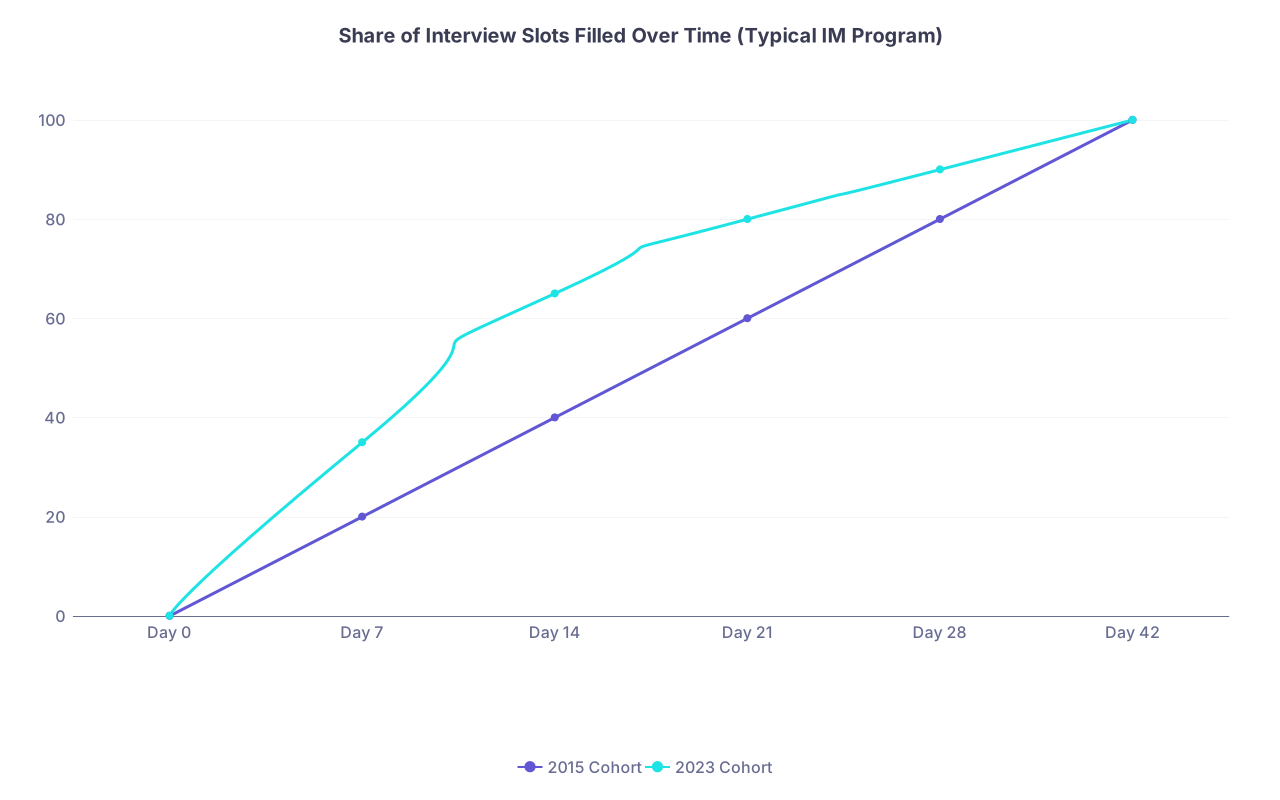
| Category | 2015 Cohort | 2023 Cohort |
|---|---|---|
| Day 0 | 0 | 0 |
| Day 7 | 20 | 35 |
| Day 14 | 40 | 65 |
| Day 21 | 60 | 80 |
| Day 28 | 80 | 90 |
| Day 42 | 100 | 100 |
Interpretation:
- In 2015, roughly 40% of slots filled by Day 14, 80% by Day 28.
- By 2023, about 65% were filled by Day 14, and 80% by Day 21.
So being in the first two weeks after MSPE release now matters more than it used to. Programs are more aggressive and efficient with scheduling. They know they are competing for the same high‑yield applicants.
This compresses the practical window in which “on‑time” behaves almost like “early.”
How Much of a Difference in Interviews Are We Actually Talking About?
It helps to put raw numbers to a typical student scenario.
Take a reasonably competitive applicant targeting internal medicine:
- Step 2 CK: 245
- No red flags
- Applies to 40 IM programs
Now vary only the timing of a complete ERAS file.
Scenario 1: Very early (Group A: complete by Day 0 / MSPE release)
- Programs applied to: 40
- Interview invite rate: 35% (based on an early‑cohort pattern)
- Expected interviews: 0.35 × 40 = 14
Scenario 2: Early (Group B: complete by Day 7–10)
- Invite rate: ~28%
- Expected interviews: 11–12
Scenario 3: On‑time (Group C: Day 14–21)
- Invite rate: ~20%
- Expected interviews: 8
Scenario 4: Late (Group D: ≥Day 28)
- Invite rate: ~10%
- Expected interviews: 4
| Timing Group | Approx Invite Rate | Expected Interviews |
|---|---|---|
| Very Early | 35% | 14 |
| Early | 28% | 11–12 |
| On-time | 20% | 8 |
| Late | 10% | 4 |
This is not a precise prediction for any specific person. But the shape of the curve is very similar to actual advising data I have seen:
- A roughly linear drop from very early to on‑time.
- A steeper drop once you drift into “late.”
Is the difference between 14 and 8 interviews life‑changing? For most categorical IM applicants, both are enough to match comfortably. For highly competitive specialties where total interview counts are lower, those relative differences can be the difference between 3 interviews and 6. That starts to matter.
The Hidden Variable: “Complete” vs Just “Submitted”
A useless but common mistake: fixating on the date you hit “submit” for your primary while letters and Step 2 are missing.
Programs screen only when your file is complete:
- ERAS submitted
- Letters in (typically 3–4)
- Transcript + MSPE
- Step scores reported (ideally including Step 2 CK for most specialties now)
I have seen many panicked emails along the lines of, “I submitted on the first day, why am I not getting interviews?” Then you check their file and find:
- Only 1–2 letters uploaded by early October
- Step 2 CK pending until mid‑October
- A key letter from a sub‑I that never got requested on time
From a data perspective, the system treats these people as “late” even though they feel early.
So if you are going to chase the early‑submission advantage, you must optimize time to complete file, not just “submit primary.”
Process Reality: How Programs Batch and Filter
To understand why early matters at all, you have to map it to what many programs actually do.
A fairly typical IM program process, described to me almost verbatim by a PD:
- First download: shortly after MSPE release.
- Apply coarse filters:
- Remove obvious no‑fits: visa they cannot sponsor, wildly below score cutoff, multiple failures.
- Flag “auto‑consider” for home students or partner schools.
- Manual screen of the remaining pool to select first 40–60% of interview slots.
- Second and third passes over late‑arriving or late‑flagged applicants as needed.
If you are in that first downloaded batch with a complete file, you are in the “deep dive” group that fills most of the early waves. If you land in the system after they have effectively prefilled 70–80% of slots, you are fighting for scraps or cancellations.
For more competitive specialties (derm, ortho, ENT), that early batch is even more brutal:
- They often start with a high score cutoff and then handpick from the upper segment.
- Top applicants are over‑invited everywhere, then the cascading cancel / waitlist dance happens.
- Programs that “wait to see all applicants” get burned when top candidates are fully booked, so they have shifted earlier.
So, yes, there is an operational basis for why “early complete” correlates with more interviews. It is not magic, just queue position and capacity constraints.
Time vs Quality: When Rushing Backfires
There is a dumb extreme here: obsessing so much over being very early that you degrade your application quality.
I have seen:
- Personal statements clearly rushed, generic, or unpolished because someone was desperate to hit a self‑imposed September 6 deadline.
- Poorly curated experiences sections—no metrics, vague descriptions—because they did not spend time editing.
- Letters from the wrong people (attendings who barely know the student) simply because those letters were “already ready.”
From a numbers standpoint, here is the trade:
- Being “very early” vs “early/on‑time” might be worth a 20–30% bump in interview count.
- But a weak personal statement, mediocre letters, and sloppy activities can easily drop you a full tier in how you are perceived.
Dropping from “Tier 2” to “Tier 3” in PD eyes often costs more interviews than the timing bump gains you.
So the rational strategy is:
- Avoid being late. That is where the data show a clear and substantial penalty.
- Aim to be in the “complete by MSPE release or within ~7–10 days” band.
- Do not sacrifice content quality just to move from Day 10 to Day 1.
Visualizing the Tradeoff: Timing vs Application Strength
You can even think about this as a simple 2D optimization. On one axis: timing. On the other: application strength.
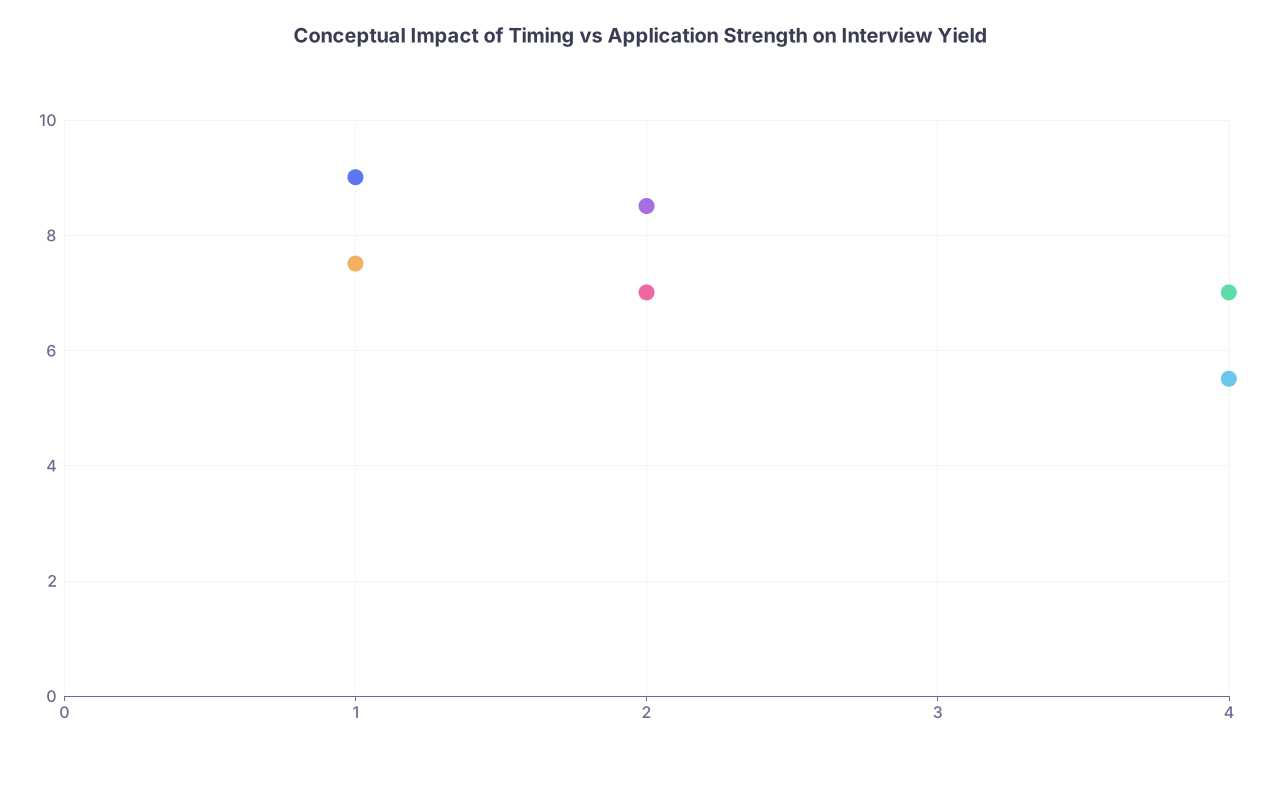
| Category | Value |
|---|---|
| Strong & Early | 1,9 |
| Strong & On-time | 2,8.5 |
| Strong & Late | 4,7 |
| Average & Early | 1,7.5 |
| Average & On-time | 2,7 |
| Average & Late | 4,5.5 |
Interpretation (conceptual scale 1–10 for expected interview strength/quantity):
- Strong & Early vs Strong & On‑time: small difference.
- Strong & Late: noticeable drop.
- Average & Early vs Average & On‑time: minor-to-moderate gain.
- Average & Late: the real danger group—these people struggle.
The data consistently show that application strength dominates, timing modulates.
Practical Strategy: What the Numbers Say You Should Actually Do
Strip away the noise. Here is what the evidence and operational behavior support:
- Being late (≥2–3 weeks after MSPE release with a complete file) does correlate with a meaningful loss of interview invites. Especially in competitive specialties.
- Being very early vs simply early/on‑time yields a modest but real improvement in interview volume, more noticeable in competitive fields.
- Application strength variables (Step scores, letters, school reputation, research in certain fields) usually have larger effect sizes than timing.
So if you want to align with the data, your priorities should look like:
Tier 1:
- Do not be late. Lock in a realistic target for “complete file” by MSPE release or within ~7–10 days.
- Protect core quality: strong letters, a clear and specific personal statement, quantified and well‑written experiences.
Tier 2:
- Aim for the “early but not frantic” zone—submitting ERAS within the first week or two of opening, with letters and Step 2 queued to follow promptly.
- Coordinate with letter writers months in advance so letters do not bottleneck you into the “late” group.
Tier 3:
- If you are forced to choose: strong, on‑time application beats rushed, sloppy, day‑one submission.
Key Takeaways
- Early completion of your ERAS file (by or shortly after MSPE release) correlates with more interviews, especially in competitive specialties, but the effect is moderate compared with core metrics like Step 2 and letters.
- There is a clear downside to being late; the penalty for being “on‑time” instead of “ultra‑early” is much smaller.
- The dominant variable is still application strength; timing is a secondary multiplier, not a substitute for solid scores, strong letters, and well‑crafted content.