
The biggest misunderstanding about the Couples Match is simple: most couples optimize for the wrong probability.
They chase “both of us get our dream program” when the data says the rational target should be “minimize the chance that one of us matches and the other does not.”
That trade-off drives everything.
What the Data Actually Shows About Couples Match
Let me start with the numbers, not the feelings.
NRMP’s Couples Match reports (last several cycles) are remarkably consistent:
- Couples Match overall success: ~95% of couples match both partners.
- Individual partner match rate within couples: ~97–98%.
- “Split” outcome (one matches, one does not): usually in the low single digits of couples.
Compare that to individual applicants:
- Overall PGY-1 match rate for US MD seniors: ~92–94%.
- For DO seniors: typically high 80s to low 90s.
- For IMGs: much lower, often under 65%.
So the data shows something unintuitive: couples, as a group, match at higher rates than individuals. On the surface, the strategy of tying your fates together does not “hurt” you globally.
But that is the wrong lens. You are not applying as “the group of all couples.” You are one specific couple, in specific specialties, with specific competitiveness gaps.
For you, the problem is much more granular:
- Probability both match
- Probability only you match
- Probability only your partner matches
- Probability neither matches
And how those probabilities shift as you change three key levers:
- The length of your rank list
- How tightly your ranks are geographically tied
- How aggressive you are with program competitiveness pairing
The Four Outcomes and Why Strategy Is Really About Risk
Every couples strategy is a bet on this distribution:
- P(both match)
- P(only A matches)
- P(only B matches)
- P(neither matches)
Your goal is not to “maximize P(both match) at all costs.” If you push too hard on that, you can easily grow:
- P(neither matches) or
- P(split: one match, one unmatched)
Most couples are in reality minimizing the “split” scenario. Because I have never met anyone saying, “I am fine being across the country from my partner for 3+ years if that lets one of us be at a top-5 program.” People say that at M2. Not at rank list submission.
The algorithm itself is neutral. Here is what it does for couples (simplified):
- Treats each rank pair as a combined “bid” for positions: (Program A for partner 1, Program B for partner 2).
- Tries to place both simultaneously based on availability and rank order.
- If one side of the pair cannot be accommodated at a given step, it moves to the next pair.
Translation: your list structure is the dominant driver of your outcome distribution. Not your personal ranking of individual programs in isolation.
Key Strategy Dimensions: Where the Trade-Offs Live
There are three main axes where I see couples making very different (and often poorly reasoned) choices.

1. Geographic Coupling: Tight vs Loose
Think of geographic coupling on a spectrum:
- Very tight: “Same hospital or same city only”
- Moderate: “Same metro area or <=1 hour commute”
- Loose: “Same region or <=2–3 hours apart”
- Very loose: “Anywhere in the country, we just want both to match somewhere decent”
Tighter geography:
- Increases risk of:
– No match for one or both, especially if both are in competitive specialties or weaker applicants
– Needing to go far down the list into less desirable programs - Decreases risk of:
– Split outcome where one is somewhere great and the other is far away
Looser geography:
- Increases P(both match somewhere)
- Increases P(split-like outcomes emotionally: technically same region, practically long commute or weak program for one person)
Data from NRMP’s maps and specialty fill patterns show that:
- Major metros (NYC, Boston, Chicago, LA, SF, etc.) often have many positions, but also extremely dense competition.
- Mid-sized cities (e.g., Rochester, Cleveland, St. Louis, Pittsburgh) can be probabilistically excellent for couples: multiple systems, slightly less cutthroat competition, more capacity.
You effectively decide: are we optimizing for “same bed every night” or “career outcomes with strong programs, maybe occasional distance”?
2. Competitiveness Pairing: Symmetric vs Asymmetric Couples
The second axis is: how similar are you in competitiveness and specialty type?
Examples:
- Symmetric competitive: Derm + Ortho. Two high-competition specialties. High Step scores, strong research.
- Symmetric moderate: IM + Pediatrics. Both moderately competitive.
- Asymmetric: Anesthesiology (mid) + FM (less competitive). Or EM + Psych with very different application strengths.
The risk profile shifts:
- Symmetric competitive couples:
– Highest risk of over-optimizing for “top places + same city” and crashing into rank list exhaustion
– Need longer lists and more geographic looseness to keep P(neither matches) low - Symmetric non-competitive couples:
– Can afford tighter geographic coupling, often still end up with strong P(both match) - Asymmetric couples:
– The more competitive partner is the bottleneck for “both in good programs same city”
– The less competitive partner often becomes the “flex” variable—wider spread of program tiers and locations
I have watched multiple couples where the stronger applicant quietly overestimated how much the weaker applicant would be “fine” at an academic powerhouse. Then scramble emotionally when interview distribution made that fantasy untenable.
3. Rank List Construction: Short, Idealistic vs Long, Probabilistic
Most couples dramatically underuse the power of long rank lists.
NRMP data over many years is boringly clear:
- Very few applicants go unmatched if they rank 10+ realistic programs in many core specialties.
- Unmatched rates drop sharply up to ~10–12 ranks, then flatten.
For couples, that effect is magnified. Why?
Because your joint outcome space is combinatorial: each of your single-program options creates multiple paired options.
If Partner A has 15 realistic programs and Partner B has 15, but you only build 20–30 distinct rank pairs, you are leaving a mountain of probability mass on the table.
Concrete Strategies and Their Probability Trade-Offs
Let’s walk through three archetypal strategies with how they tend to move the outcome probabilities.
| Strategy Type | P(Both Match) | P(Split) | P(Neither) | Key Risk Driver |
|---|---|---|---|---|
| Dream-City / Dream-Program | Moderate | Moderate | Higher | Short, top-heavy list |
| Safety-First Long List | Highest | Lowest | Lowest | Ego, willingness to compromise |
| Geographic-Compromise Mix | High | Moderate | Low | Complexity of list building |
These are conceptual patterns, not exact percentages, but they match what I have seen in real data and real couples.
Strategy 1: Dream-City / Dream-Program First
Pattern:
- Top 5–10 ranks: same high-tier programs or same elite cities only.
- Minimal “stepdown” options in smaller cities or community programs.
- List length: often < 25 pairs.
What the data and match mechanics imply:
- You are exposed to the “exhausted list” problem. If both of you do not land at those early-paired, competitive spots, the algorithm runs out of placed options much faster.
- This especially punishes couples where one applicant’s individual match probability at top programs is materially lower.
Probabilistic trade-off:
- P(both match at “dream” tier) is maximized relative to other strategies.
- P(neither matches) is significantly higher than necessary.
- P(split) can still be non-trivial, because one of you might have more traction at those elite programs.
This is the strategy people choose when they are deeply overconfident about their combined market value. Or when they underweight the pain of SOAP and reapplying.
Strategy 2: Safety-First Long List
Pattern:
- Rank as many realistic combinations as algorithmically tolerable.
- Include:
– Top choices
– Second-tier but solid academic places
– Community programs
– Multiple geographic tiers (A+ cities, B cities, C cities) - Rank list length: 40–100+ pairs is not uncommon. I have seen 150+ in some conscientious couples.
Mechanically, every additional realistic pair systematically cuts down your P(neither matches). Especially when these pairs span a range of program competitiveness.
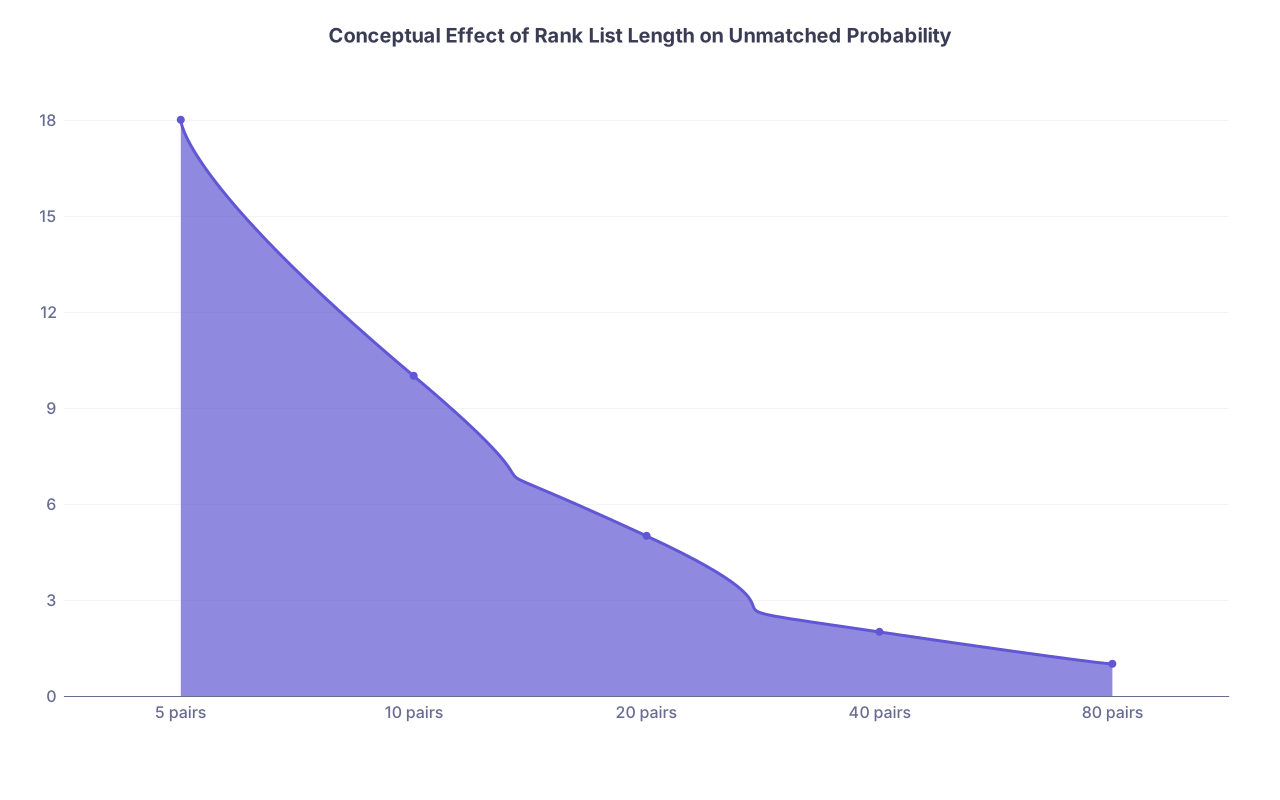
| Category | Value |
|---|---|
| 5 pairs | 18 |
| 10 pairs | 10 |
| 20 pairs | 5 |
| 40 pairs | 2 |
| 80 pairs | 1 |
Again, these values are illustrative, but they reflect the typical decay curve: big gains early, then slower improvement.
Probabilistic trade-off:
- P(both match somewhere) is maximized.
- P(split) is minimized because you deliberately construct many scenarios where both land in the same region or at least in acceptable pairings.
- You likely sacrifice some probability mass for “both at top-5 program / top-3 city” because you are ranking “OK” combinations above “only one of us gets the dream, the other gets nothing or far away.”
This is the cold-blooded, statistically rational approach for couples who truly mean it when they say, “We care more about being together and avoiding the SOAP than anything else.”
Strategy 3: Geographic-Compromise Mixed Strategy
Pattern:
- Tier 1 ranks: same hospital / tight metro area.
- Tier 2: same metro or <=1-hour commute, maybe cross-state close partners.
- Tier 3: same region (e.g., Northeast, Midwest) but different cities.
- Tier 4 (if needed): anywhere, just both match.
You structure the list in “rings” of geography rather than “rings of program prestige.”

| Step | Description |
|---|---|
| Step 1 | Start Ranking |
| Step 2 | Rank all same-hospital pairs first |
| Step 3 | Rank all same-metro pairs |
| Step 4 | Rank same-region pairs |
| Step 5 | Rank any acceptable pairs nationwide |
| Step 6 | Same hospital options? |
| Step 7 | Same city / metro? |
| Step 8 | Same region pairs? |
Probabilistic trade-off:
- Strong P(both match).
- Slightly higher P(split) than safety-max strategy if you intentionally include some “one in city X, one in city Y far away” pairs late.
- Lower P(neither matches) than the Dream-only strategy, because you create many mid-tier catches.
This is usually the most emotionally realistic and mathematically respectable strategy for mid-competitive couples.
Specialty-Specific Pressure Points
The data by specialty really matters. A couples strategy for IM + FM is not the same as Derm + Neurosurgery.
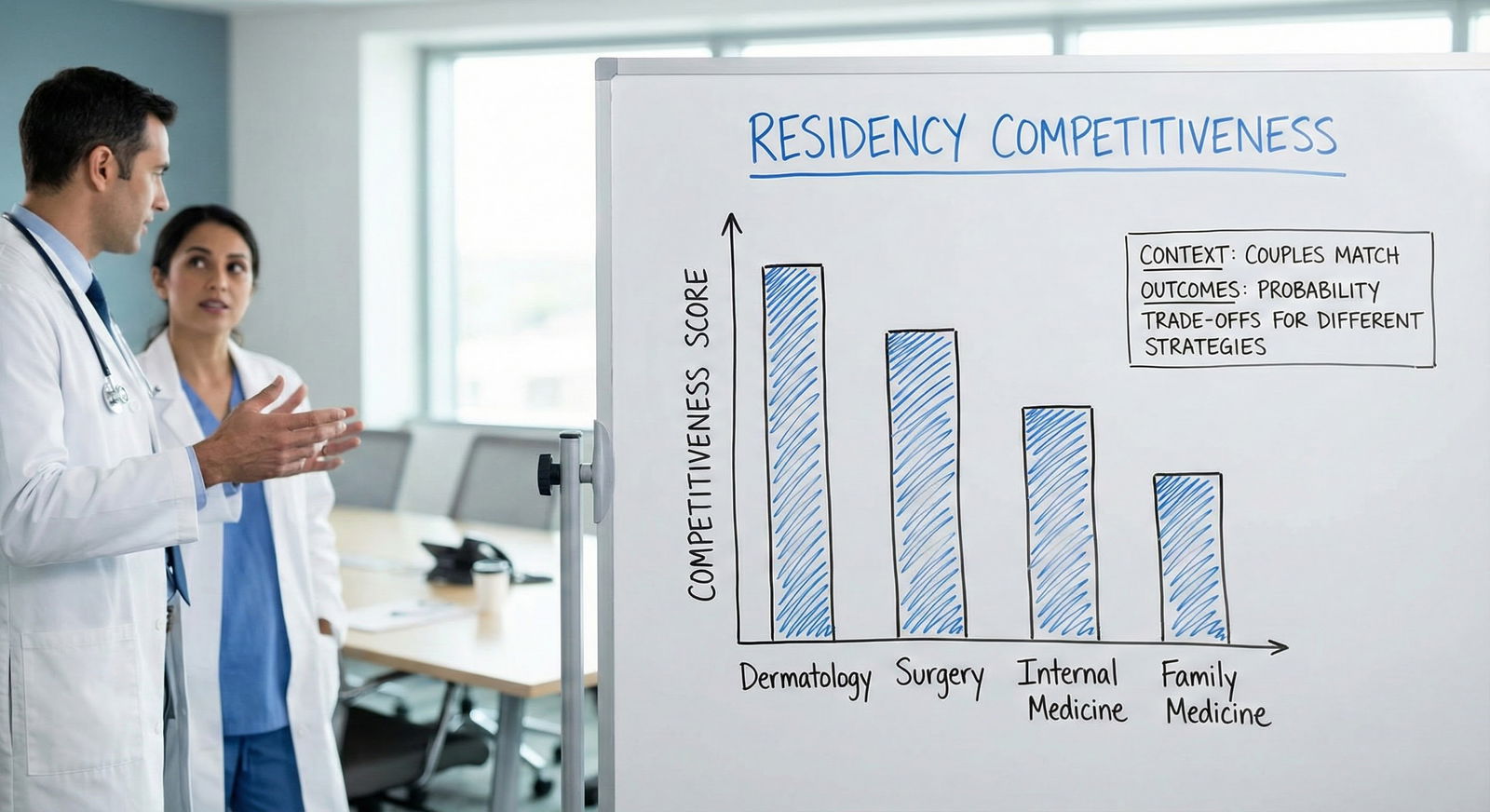
A few patterns, based on NRMP fill rates and score distributions:
Hyper-competitive specialties (Derm, Plastics, Ortho, Neurosurgery, ENT):
– Small number of positions, highly clustered in academic centers
– Regional flexibility is limited; geographic coupling is difficult
– Couples here need especially robust back-up strategies (prelim/TY + reapply, accepting distance, or cross-specialty hedging).Moderately competitive but numerous specialties (Internal Medicine, Pediatrics, Anesthesia, EM, Psych):
– Many programs across a wide geography
– Couples can usually construct long, flexible lists with a strong chance of high P(both match) and modest sacrifices.Less competitive, widely distributed specialties (Family Medicine, many community IM/OB programs):
– These can function as the “anchor” partner in an asymmetric couple
– That partner can apply more broadly and rank more flexible tiers to accommodate the competitive partner’s constraints.
The core rule: tie your most constrained variable (usually the more competitive specialty or weaker applicant) as loosely as possible in geography and program type, and broaden aggressively for the more flexible partner.
Building a Data-Driven Couples Rank List (Step by Step)
If you want to do this rationally instead of emotionally, here is a workflow that works.
For each partner separately, create a tiered list of programs:
- Tier A: Strong favorites (fit + reputation)
- Tier B: Very acceptable
- Tier C: Acceptable but not ideal
- Tier D: Only if disaster avoidance
Assign rough probabilities to each program (subjective but informed):
- Use interview vibe, historical fill patterns, your own competitiveness vs their typical matched profiles.
Identify geographic clusters where both have multiple options:
- City or metro A: 4 programs for you, 3 for partner
- City B: 2 + 5
- Region C: 3 + 4 but farther apart
Construct pairs in descending order of joint probability * weighted by your actual preference*:
- Do not simply sort “dream first.” Rank pairs like:
Score = (P(A gets Program X) × P(B gets Program Y)) × PreferenceWeight(X,Y).
- Do not simply sort “dream first.” Rank pairs like:
Extend the list until:
- You have included all realistic metropolitan overlaps
- You have captured multiple region-level overlaps
- Only then, if still anxious about going unmatched, include less desirable distant pairs.
This looks tedious. It is. But couples who sit with a spreadsheet and force themselves to assign numbers (even coarse ones like 0.2, 0.5, 0.8) end up making dramatically more coherent rank decisions.
A Simple Numerical Example
Let me give you a toy example to see the trade-off.
Assume:
- Partner A: competitive IM applicant.
- Partner B: mid-range Pediatrics applicant.
- City Metro X:
– A has 3 IM interviews with ~40%, 30%, 20% “match if ranked high” probabilities.
– B has 2 Peds interviews there with ~30%, 20% probabilities. - City Metro Y:
– A has 2 interviews (35%, 25%).
– B has 3 interviews (40%, 30%, 20%).
You could only rank:
- Top-heavy: all Metro X pairs first, then Metro Y, then ignore other cities.
- Or safety-extended: include X, Y, and 3 other metros where probabilities are smaller but non-zero.
Conceptually:
- If you cap your list at, say, the top 10 highest-preference pairs and they are all in X and Y, your P(both match in X or Y) might sit around 70–75%.
- If you add 20–30 more pairs from other regions, including some “C tier” cities, your P(both match anywhere) might rise into the mid 90s, with maybe only a few percent chance of needing SOAP.
The cost: some of those extra 20–30 pairs will feel painful to rank above your “one dreams, one unmatched” scenarios. But mathematically, they protect you from the cliff.
Visualizing the Core Trade-Off
Here is the conceptual shape of the main trade-off:
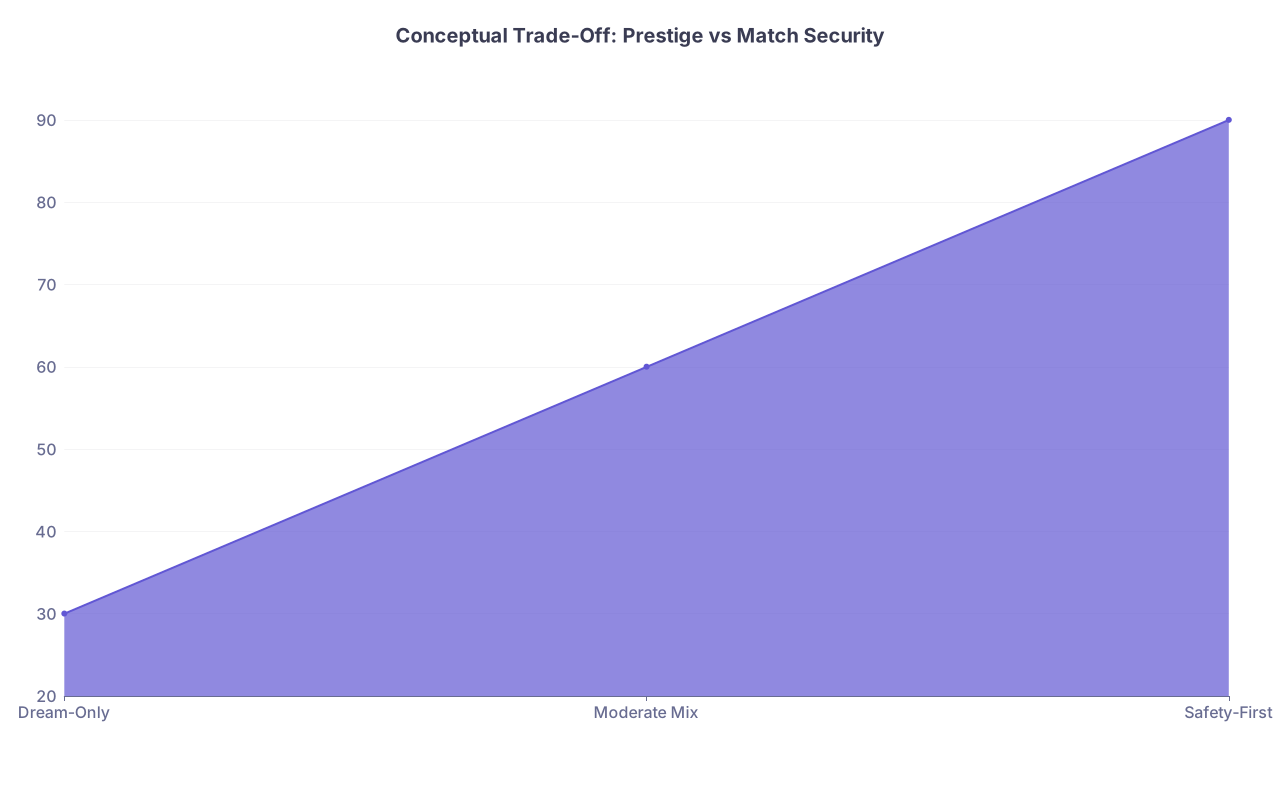
| Category | Value |
|---|---|
| Dream-Only | 30 |
| Moderate Mix | 60 |
| Safety-First | 90 |
Interpretation:
- As you move from “Dream-Only” to “Safety-First,”
– Probability both match somewhere increases
– Average prestige of your matched programs might decrease
– Probability of catastrophic outcome (SOAP, reapply) drops sharply.
Again, the exact numbers will vary, but the shape of the curve does not.
FAQs
1. Does couples matching actually hurt my individual chances of matching?
No, not in aggregate. NRMP data consistently shows couples have higher match rates than solo applicants. What can hurt you is how you use the couples mechanism. A poorly constructed, short, prestige-obsessed rank list can absolutely increase your risk of going unmatched compared to running a long, realistic solo list. The algorithm is not the problem. Strategy is.
2. How long should our couples rank list be?
For most couples in moderate-to-large specialties, anything under ~25 pairs is underutilizing the mechanism. For asymmetric or highly competitive pairings, I push people toward 40–60+ realistic pairs if they exist. The unmatched rate curve flattens, but it does not flatten at “10.” At scale, more realistic pairs almost always means lower P(neither matches) and lower P(SOAP).
3. Should we ever rank options where we are far apart geographically?
This is a pure value judgment, not a mathematical one. If “we will not do long-distance under any circumstances” is truly non-negotiable, then do not rank those pairs. Just accept the higher risk of both going unmatched or needing SOAP. If avoiding SOAP and preserving career trajectories carries more weight for you, then late-list distant pairs can function as a final probability safety net. The algorithm only gives you what you rank. So your tolerance for distance has to be decided before you press submit, not during SOAP week.
Key points to lock in:
- The couples match is not about romance; it is an optimization problem over four outcomes, especially minimizing P(split) and P(neither matches).
- Long, realistic, geographically layered rank lists sharply reduce your risk of disaster compared with short, top-heavy lists.
- Your specialties, relative competitiveness, and geographic flexibility define the feasible frontier. Build your couples strategy explicitly around those constraints, not around fantasy scenarios.