
It’s mid-January. You’re sitting there refreshing your email between cases, waiting for your Step 2 CK score that you took in late November. Interviews are mostly done. Your ERAS has been out for months. Programs told you, “No problem, just send it when it comes out.”
You’re thinking: “It’s probably fine. They’ve already met me. How much can a late Step 2 really matter now?”
Let me tell you exactly what happens in that rank meeting when your late Step 2 lands in their inbox. Because I’ve sat in those rooms. I’ve watched applicants rise and get quietly buried over one PDF that arrived in January.
The public story is: “We look holistically.”
The private reality: the timing and direction of your Step 2 changes the conversation people have about you in that room. And the conversation is everything.
First: How Rank Meetings Actually Work (Not the PR Version)
Before we talk about late scores, you need to understand the battlefield.
Most programs do some version of this: the coordinator prints or projects a list of all interviewed applicants with columns—name, school, Step 1 (if applicable), Step 2, class rank/quartile, AOA, research, red flags, and some kind of “interview score” or faculty rating.
Then the faculty go row by row, in tiers or clumps. I’ve seen three main patterns:
Big academic IM or surgery programs (think: academic university hospitals)
They usually stratify into buckets early: “highly likely to rank high,” “middle,” “lower tier,” “do not rank.” Within those, Step 2 is used as a tiebreaker and risk check.Mid-size community or hybrid programs
They care a lot about Step 2 because they’re scared of board pass rates. These are the programs where PDs will literally ask mid-meeting, “What’s this person’s Step 2? We can’t have another board failure.”Competitive specialties (ortho, derm, ENT, etc.)
Step 2 becomes a way to separate a stack of 260+ Step 1 types. Late scores here are looked at with suspicion unless there’s a good narrative.
Now, where do late Step 2 scores show up? Right in the middle of this chaos, in three specific moments:
- When faculty ask: “Do we ever get their Step 2?”
- When the coordinator says: “Their Step 2 just came in last week.”
- When someone sees a “low” or “surprising” number and says, “Whoa, what happened here?”
The timing changes whether you’re discussed as a known quantity or a question mark. Programs hate question marks.
Why Late Step 2 Is a Red Flag in Some People’s Heads
No one will say this in a webinar, but in the room you’ll hear versions of these lines. I’ve literally heard every one of these:
- “Why did they wait so long to take it?”
- “Were they trying to hide a drop?”
- “Did they delay because Step 1 was weak?”
- “Are they going to have trouble with boards?”
Here’s the mental math faculty do, very quickly:
If you took Step 2:
- Early (summer): “Confident. Organized. We’ve seen the score since interview invites.”
- On time (Aug–Oct): “Normal. No story here.”
- Late (Nov–Jan): “Why?”
They won’t always punish you. But they will talk about you differently.
Two things shape that conversation more than anything:
- Your Step 1 context (high, average, pass/fail with no score, or low)
- The direction of your Step 2 (up, flat, or down compared to expectation)
Let’s walk through the real scenarios I’ve seen in rank meetings.
Scenario 1: High Step 1 → Late Step 2 That Drops
This is the one that really gets whispered about.
Imagine you’re a 250+ Step 1 from a decent US MD school. You took Step 2 in late November, score shows up in January: 234.
On paper, still a solid score. But the story in the room shifts:
“So Step 1 was 254, Step 2 is 234. That’s a pretty big drop.”
“Do we know why they took it so late?”
“I liked them on interview, but that’s a little concerning for boards.”
What actually happens to your rank?
If you’re at a program that loved you: you probably stay on the list, but you may move down a tier from “top of the middle” to “bottom of the middle” or from “top 10” to “somewhere in the 15–25 range.”
If you’re borderline to begin with: the drop is the excuse to slide you into “lower rank” or even “do not rank” depending on how ruthless they are and how full the list is.
The key thing: the direction of change is what spooks them. Faculty anchor on your Step 1. A 20-point drop late in the season feels like evidence of something—burnout, poor clinical reasoning, test-taking issues—even when that’s not fair.
I’ve watched a PD look at a list and say:
“We’re getting killed on board pass rates. I can’t take the risk on big Step 1 → Step 2 drops.”
That’s the fear you’re fighting with a late lower score.
Scenario 2: Mediocre or Unknown Step 1 → Late Step 2 That Saves You
Flip side: late Step 2 can absolutely help you. I’ve seen it.
Think: Step 1 was average or pass/fail with no number. Your school isn’t top-tier. Your application looked “fine” but nothing flashy. Then in early January your Step 2 lands: 250.
Here’s how that plays in the room:
“Oh, we just got their Step 2—250. That’s actually really good.”
“Their interview was solid too, remember? They were quiet but thoughtful.”
“We should bump them up a bit, that score reassures me for boards.”
At mid-tier IM, peds, FM, EM programs especially, a strong Step 2 that comes in before the main rank meeting can move you. Not to the very top if others already have strong scores and big-name letters, but from “meh” territory to “we’d be very comfortable matching this person.”
For programs living in terror of ACGME board pass thresholds, a 245–255 Step 2 coming in late on a meh file is like a life raft. Risk goes down. PD gets less anxious. You become a safer bet than someone with a better interview but unknown board strength.
Timing matters here: if the score comes before the big rank meeting, people do bring it up and do use it as a reason to push you up.
If it hits after the main meeting (some programs lock early), it might not move you at all. More on that later.
Scenario 3: Step 1 Weak → Late Step 2 That’s Just OK
This is the quiet death scenario.
Let’s say your Step 1 was 215–220 range, or you barely passed. You tell yourself: “I’ll crush Step 2 and prove I can do better.” But you take it in December. Score in mid-January: 226.
The sound you hear in the rank meeting?
Silence. Then:
“So Step 2 didn’t really fix it.”
“They improved technically, but they’re still on the lower side.”
“I think we have enough safer options above them.”
What happens: you get stuck in the lower half or third of the list. At programs with limited rank depth, that’s effectively a soft “do not rank” for anything but very low-competition specialties or lower-demand programs.
Nobody hates you. They just decide to use their ranking “slots” on people who don’t make them nervous about boards. A late, modest Step 2 doesn’t create optimism; it confirms their risk model.
And here’s the harsh truth: if your score like this comes in late, there’s very little emotional bandwidth to advocate for you. The PD and APDs are tired, the residents in the meeting barely remember you, and no one is going to fight to elevate a borderline file that doesn’t clearly improve with new data.
Scenario 4: Missing or Pending Step 2 at the Rank Meeting
Yes, this absolutely happens. Especially with very late test dates.
Here’s what people in the room say when Step 2 is blank or “pending”:
“No Step 2 yet?”
“That makes me nervous.”
“We had a board failure last year, I’m not comfortable ranking them high without a score.”
Programs broadly fall into a few camps:
| Program Type | Typical Reaction to Missing Step 2 |
|---|---|
| Big academic, high volume | Rank lower but still rank |
| Mid-tier community | Push down list substantially |
| Very board-sensitive | Often move to do-not-rank |
| Chill, less competitive | Rank but with caution |
Some PDs will say bluntly:
“If Step 2 is not in by rank meeting, I’m not putting them anywhere near the top.”
I’ve watched a candidate with a great interview and good letters fall from “we like them” to “let’s put them somewhere in the 40s” purely because nobody knew if they’d pass Step 2.
Programs are judged brutally on board pass rates. There are PDs who’ve lost their job over sustained low pass rates. You think they’re going to gamble their job on your unreported Step 2? Not likely.
How Timing Shifts the Power You Have in the Room
Programs don’t update your ERAS magically in real time. There are a few choke points where your late Step 2 actually matters:
1. Before Interviews Start
If your late Step 2 is still pending when invitations go out, some programs never even see your file again deeply. The filter hit already happened. This is less about rank meetings and more about even getting in the door.
2. During Interview Season
If your score releases in November/December and you send it promptly, some PDs will actively incorporate it into their post-interview scoring.
I’ve watched a PD say after interviews:
“They just emailed their Step 2—a 252, by the way. That reassures me after that marginal Step 1.”
That’s how you move from “maybe” to “solid.”
3. Right Before Rank List Finalization
This is where the late January scores land. What happens depends on the program’s culture:
- Some will re-open files briefly and adjust tiers.
- Some have an unofficial policy: “If no Step 2 by X date, do not rank high.”
- Some are already mentally done and won’t bother reshuffling unless the PD is very data-driven.
The more organized and competitive the program, the earlier they lock their mental list. By the time your late score comes in, the inertia is against big moves.
What Actually Gets Said About You in That Room
You want the real language? Here’s the actual behind-closed-doors commentary patterns.
Late Step 2 with a Strong Score
“They took it a bit late, but 250 is 250.”
“This makes me feel much more comfortable.”
“Let’s bump them up a bit; they’re clearly fine for boards.”
This is where your score rescues an average or concerning record. Faculty stop worrying in that moment. That’s powerful.
Late Step 2 with a Drop
“Big drop. I wonder what happened.”
“They scheduled late, maybe they weren’t prepared.”
“We have enough 240–250s without that kind of step down.”
This is where your score becomes the excuse to push you down the list. People love to have “objective” justification for a gut feeling of risk.
Late Step 2, Still Pending
“I really liked them, but we can’t keep doing this to ourselves with unknowns.”
“Let’s keep them on the list, but low.”
“I’d rather take someone we know can pass our boards.”
You become the “unnecessary risk” candidate.
How Different Specialties Weaponize Late Step 2 Differently
Not every field cares the same way.
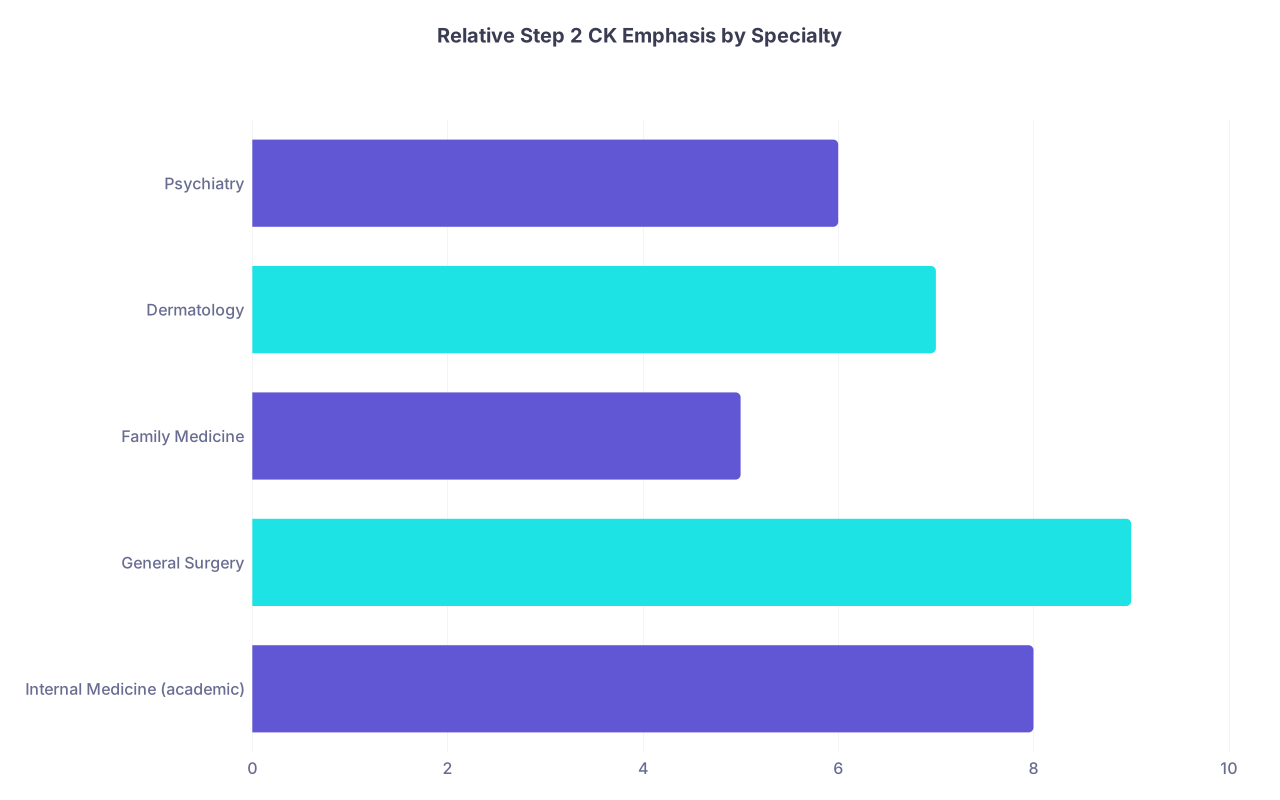
| Category | Value |
|---|---|
| Internal Medicine (academic) | 8 |
| General Surgery | 9 |
| Family Medicine | 5 |
| Dermatology | 7 |
| Psychiatry | 6 |
(Scale 1–10: how aggressively Step 2 shapes rank discussions.)
Surgery, EM, and Procedural Fields
I’ve seen general surgery PDs go down a list and circle the Step 2 column like it’s an EKG strip.
“Anyone under 230 is a hard sell for me.”
Late scores that come in low or dropping get punished more in these fields. They see Step 2 as a proxy for handling high-intensity call, fast-paced decision-making, board-style thinking. Fair or not.
Internal Medicine (especially academic)
They care a lot because ABIM pass rates are public and painful. At big IM programs, Step 2 is an actual ranking variable in spreadsheets. Late scores get slotted in—if they’re strong, they move you up a bit; if they’re weak, they push you down or to a different “tier” of risk.
Psych, Peds, FM
They’re kinder. But don’t misread that as “they don’t care.” They still worry about repeated test struggles. A very late, missing, or obviously low Step 2 will quietly slide you down the list, but it’s less cutthroat than surgery.
How to Handle a Late Step 2 (If You’re Already in This Boat)
You can’t rewrite history, but you can manage how your score lands.
If you haven’t taken it yet and you’re late
- Be realistic. A rushed, underprepared Step 2 taken in December that you bomb is worse than asking your advisor whether to push graduation or change your timeline.
- Some PDs actually prefer you delay graduation and pass comfortably rather than scrape by late and come in with a weak score.
If you just got the score and it’s strong
Email programs once, succinctly. No novel, no drama.
“I wanted to share my Step 2 CK score, which was 252. I remain very interested in your program and would be honored to train there.”Your goal: make it easy for the coordinator to drop that into your file so the PD sees it in the one moment they’re scanning before rank meeting.
If you just got the score and it’s lower than you hoped
- You still send it if they asked for it. There’s no hiding once they require it.
- What you do not do: send long explanations. Rank meetings are not the time for your 4-paragraph story about your sick relative and test anxiety. That’s not how decisions are made.
If a PD really wants the story, they’ll ask. Most don’t, unless you’re right on the cusp and someone in the room is already championing you.
One More Thing Nobody Tells You: Residents in the Room Remember Vibes, Not Numbers
At many programs, there are residents in the rank meeting. They don’t obsess over exact scores as much as faculty. They say things like:
“She was great on rounds during her AI.”
“He seemed kind of arrogant.”
“They handled the case discussion really well.”
But then: a late Step 2 appears, projected on the screen during the meeting. That number instantly becomes concrete in everyone’s mind. A resident who liked you might hesitate to advocate hard if your Step 2 looks shaky, especially if they’ve lived through remediation drama.
So the combination is what matters: interview impression + resident vibe + Step 2.
A high Step 2 arriving late can reinforce good vibes. A low or missing Step 2 can undercut them.
The Quiet Reality: Rank Lists Are Built on Avoiding Regret
Most applicants think rank meetings are about choosing the “best” applicants. That’s naïve. What actually drives decisions is: “How do we avoid regretting this?”
Late Step 2 scores plug directly into that fear:
- Strong Step 2 → less future regret about boards → safer to put you higher.
- Big drop / low Step 2 → potential future regret → safer to slide you down.
- Missing Step 2 → unknown regret → not worth the risk high on the list.
This risk-avoidance mode is why timing matters. By January, everyone is tired, the PD is thinking about duty hours, clinic schedules, ACGME reports, and not about microscopically optimizing your position on the rank list. They want clear, simple signals.
Step 2 is one of the clearest signals they get that late in the game.

| Step | Description |
|---|---|
| Step 1 | Late Step 2 Score |
| Step 2 | Less risk - possible upward move |
| Step 3 | Confirms existing tier |
| Step 4 | More risk - downward move |
| Step 5 | Discussed during ranking |
| Step 6 | Ranked cautiously or lower |
| Step 7 | Score Direction |
| Step 8 | Score Available at Meeting |
FAQ (Exactly 4 Questions)
1. If my Step 2 CK comes out after programs submit rank lists, does it matter at all?
Usually, no. Once the official rank list is certified with NRMP, they’re done. Some PDs will glance at late scores out of curiosity, but they legally cannot change the list after the deadline. Any impact is purely on their future impression of your reliability, not on that year’s Match.
2. Should I delay taking Step 2 to wait until after interviews so a bad score doesn’t hurt me?
That strategy backfires more often than it helps. Programs get very uneasy when there’s no Step 2 in sight, especially if Step 1 was modest or pass/fail. For many programs, “no score” at rank meeting time is treated more negatively than a solid-but-not-amazing score you took earlier.
3. If my Step 2 is significantly lower than my Step 1, should I address it in a personal statement or email?
Usually no. A long preemptive explanation reads like an excuse and draws more attention to the drop. The only time a brief explanation helps is if you had a very concrete, time-limited event (hospitalization, documented emergency) and a PD or advisor specifically suggests you mention it. Otherwise, let your letters, clerkship comments, and interview performance carry your narrative.
4. Can a strong late Step 2 CK get me moved from “do not rank” to “ranked”?
Occasionally, but don’t count on it. If a program has already mentally or formally put you in “do not rank” territory based on major concerns (poor interview, professionalism issues, bad letters), a good Step 2 won’t resurrect you. Where it can help is moving you from “ranked low” up into the main body of the list if the only big concern was academic risk.
Key takeaways:
A late Step 2 CK doesn’t just change your numbers; it changes the story people tell about you in the rank room. Programs are far more afraid of board pass problems than applicants realize, and they use Step 2—especially late scores—as a blunt risk filter. If your score is coming late, your best move is to make it strong, get it in promptly, and understand that the direction and timing will shape how hard anyone is willing to fight for your spot on that list.