
The biggest unspoken filter in residency right now is not your Step 1. It is when and how you take Step 2 CK.
Program directors will rarely say this outright. But I have watched applicants with perfectly good scores quietly slide down rank lists or off them entirely simply because they mis-timed Step 2 CK. Not because they were lazy. Because they were strategic in the wrong way.
Let me walk you through the 7 timing mistakes that quietly wreck strong applications every year—and how to avoid joining that group.
1. Taking Step 2 CK After ERAS Submission “To Have More Study Time”
This is the classic self-sabotage move.
You feel behind. Third-year clerkships were rough. Your UWorld percentages are not where you want them. So you push your Step 2 date to September or October, thinking: “I will submit ERAS now and send my great Step 2 score later. Programs will be impressed.”
No. Many will never even see it when it matters.
Here is what actually happens behind closed doors on most selection committees:
- Initial screening is done fast. Often in a single afternoon per specialty.
- Filters are set: Step 1 (now P/F, but they still look), Step 2 CK if available, home/affiliate status, school reputation.
- Files without Step 2 CK in moderately competitive applicants often drop into “maybe later” or “low priority” piles.
By the time your amazing October score arrives, interview slots are already mostly gone. Your application is dead in the water, it just has not realized it yet.
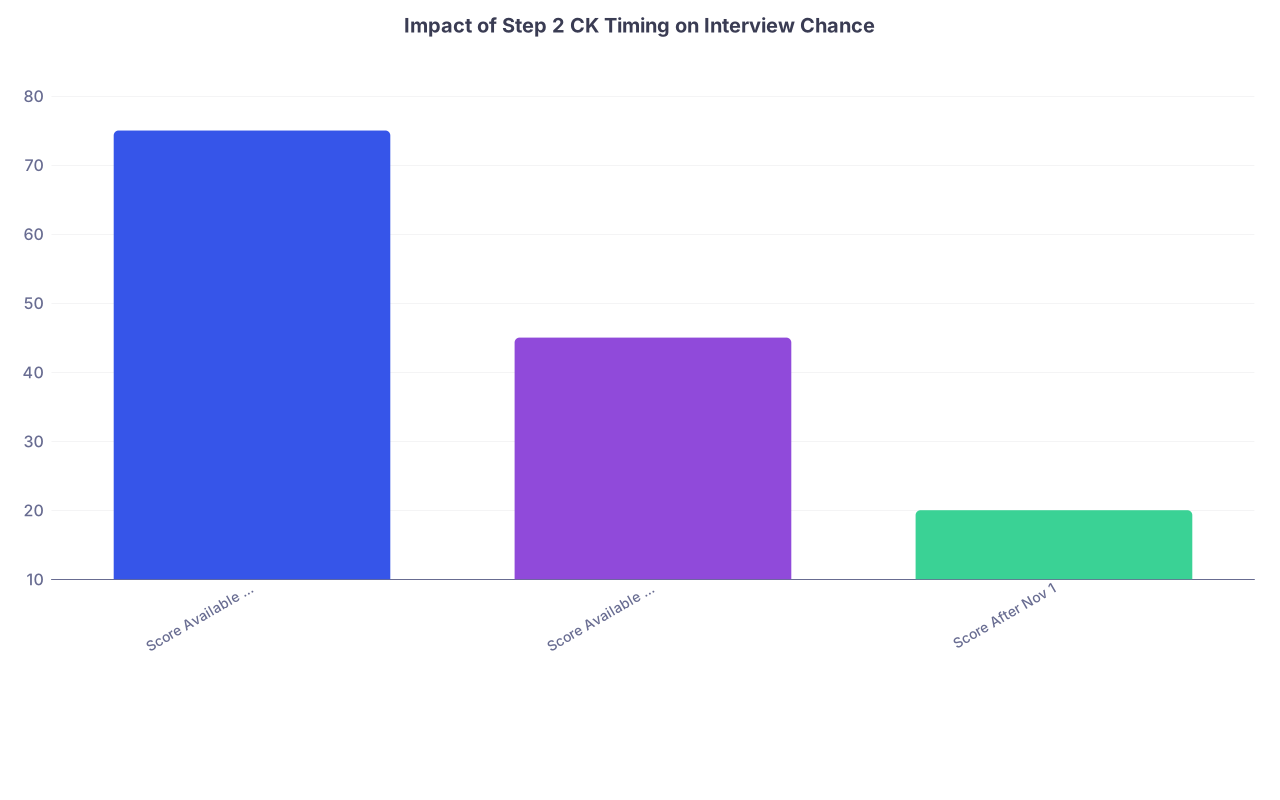
| Category | Value |
|---|---|
| Score Available by Sep 15 | 75 |
| Score Available by Oct 15 | 45 |
| Score After Nov 1 | 20 |
(I am not exaggerating those proportions. I have sat in meetings where the coordinator literally said, “We will not go back and re-review all the ‘no Step 2 yet’ files.”)
The mistake: Prioritizing a hypothetical score boost over being fully ready by the time programs first see your file.
Avoid it by:
- Targeting a test date that gives you a score back before ERAS submission or within 1 week after.
- Only delaying beyond that if there is a serious, documentable reason (medical issue, major life event) and you accept that this will limit interviews.
- Remembering: a slightly lower score on time usually beats a perfect score too late.
2. Waiting for Step 2 CK to “Fix” a Weak Step 1… and Testing Too Late
If you had a marginal Step 1, you know the narrative: “I will crush Step 2 CK and prove I can handle residency-level material.”
That reasoning is correct. The execution usually is not.
Here is the trap:
Students with a 2-digit Step 1 equivalent in the 210–220 range (or just “pass” with a shaky preclinical record) often push Step 2 CK back to September–October because they feel pressure to absolutely destroy it. They want a 250+. They build their timeline around perfection.
Programs, meanwhile, are doing something else. They are sorting you into three buckets when ERAS opens:
- Step 1 weak / No Step 2 yet → risk
- Step 1 weak / Strong Step 2 already in file → rescued
- Step 1 weak / Step 2 pending but interview spots filling fast → ignored
Here is the brutal part: a good but not amazing 235 Step 2 in September does far less for your application than a solid 225 Step 2 in July that is sitting there, visible, reassuring, when screens first run.
You are not competing with theoretical scores. You are competing with the data programs see on the day they sort you.
The mistake: Obsessing over maximizing the Step 2 number and forgetting the timing reality: weak Step 1 applicants need their rescue score in the file early, not perfect.
Avoid it by:
- Setting an honest baseline. Take an NBME by early May of third year. If you are in the low 210s equivalent, you have time to improve—but you must plan.
- Targeting a late June–July exam date, not September, to allow growth and timely reporting.
- Accepting that a strong, on-time 230+ that rescues your application is worth more than a hypothetical 245 that show ups after interview decisions.
If you are truly far behind (NBMEs under 200 equivalent in May/June), that is a different conversation. But betting your entire match on a last-minute miracle score in October is a dangerous fantasy.
3. Racing to Take Step 2 CK Too Early After Core Clerkships
The opposite problem is just as deadly: rushing Step 2 for the sake of “checking the box early” and producing a weak score that drags everything down.
I have seen this frequently:
- Student finishes last core in late May
- Takes Step 2 CK in mid-June
- Barely finished one pass of UWorld
- Started NBMEs only 2 weeks before the exam
- Scores 218–225 with a Step 1 in the same ballpark
They are now locked into being “average” on paper, at best, for nearly every specialty. Some will not recover from that, especially in anything even mildly competitive.

Here is where people lie to themselves:
“I will just retake if I do badly.”
No, you probably will not. And if you do, some programs will count that against you. Multiple attempts are a real red flag in some specialties.
“I test well under pressure.”
Step 2 CK is not a random shelf. It is 8+ hours of highly integrative questions, and programs look at it as evidence of MCQ stamina and clinical reasoning.
The mistake: Treating Step 2 CK like a checkbox instead of a capstone. Testing as soon as the calendar says you are “technically done” with clerkships rather than when your practice data say you are ready.
Avoid it by:
- Requiring a minimum NBME threshold before locking your date (for most students this is roughly: NBMEs consistently ≥ your target minus 5–7 points).
- Giving yourself a true 4–6 weeks of focused, not fragmented, dedicated time after your last core.
- Not compressing all your practice exams into the last 10 days. Those are diagnostic tools, not just “more questions.”
Over-correcting for mistake #1 (too late) by committing mistake #3 (too early) is how people end up with permanently mediocre Step 2 scores that follow them for years.
4. Ignoring How Long Score Reporting Actually Takes
You would think by now schools would drill this into every student. They do not. So people keep repeating the same timing error: misjudging when scores actually hit.
Step 2 CK scores are typically released on Wednesdays, about 2–4 weeks after the exam, but this interval can stretch, especially around major system updates or changes in reporting.
What kills applicants is not the typical wait. It is three specific errors:
- Testing during the late summer high-volume period (July–August) and assuming the usual 2-week turnaround. Then getting burned by a 4-week delay.
- Ignoring USMLE’s posted reporting delays around June–July (they often warn that scores for exams taken in a certain window may be held).
- Scheduling the exam within 7–10 days of ERAS opening and assuming the score will be in by then. It rarely is.
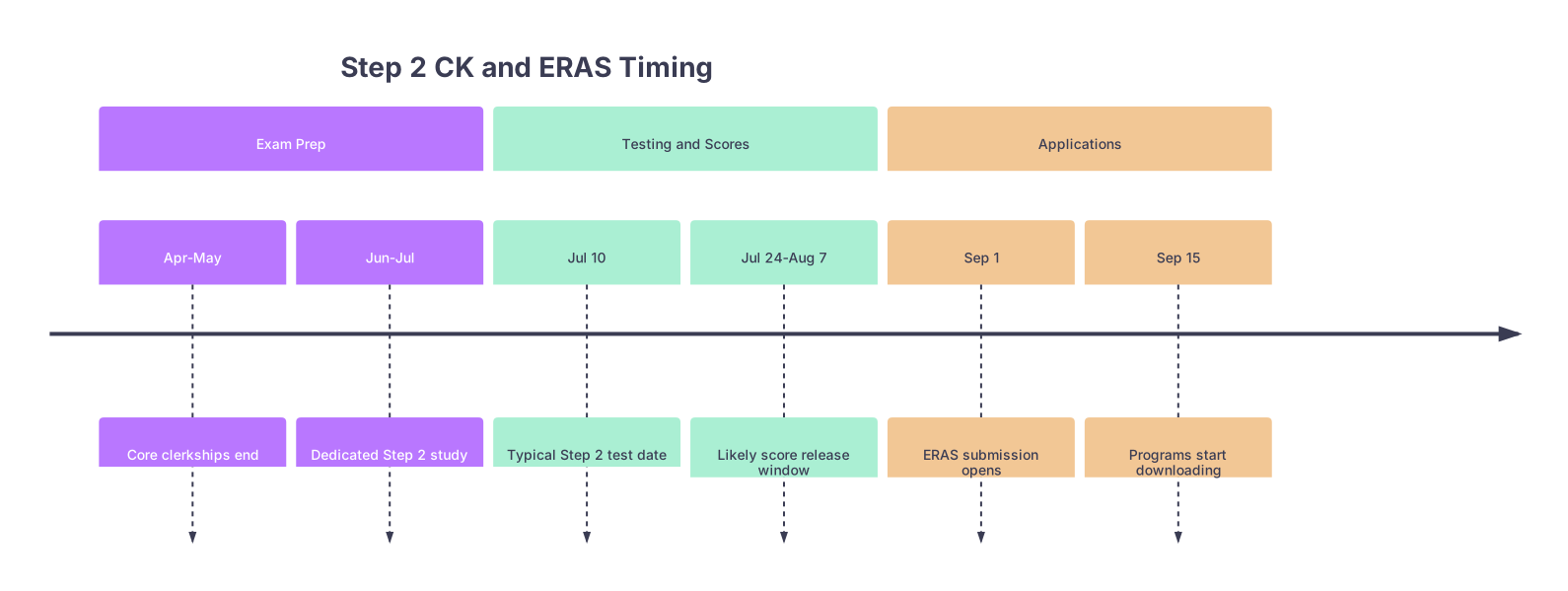
| Period | Event |
|---|---|
| Exam Prep - Apr-May | Core clerkships end |
| Exam Prep - Jun-Jul | Dedicated Step 2 study |
| Testing and Scores - Jul 10 | Typical Step 2 test date |
| Testing and Scores - Jul 24-Aug 7 | Likely score release window |
| Applications - Sep 1 | ERAS submission opens |
| Applications - Sep 15 | Programs start downloading |
If you take Step 2 on August 25 assuming you will “barely make it,” and your score posts October 2, you just moved from competitive to invisible in many places.
The mistake: Planning around ideal score-release timing instead of worst-case realistic timing.
Avoid it by:
- Working backwards. Decide when you want your score visible in ERAS (ideally by the time programs first download). Then count back 4–5 weeks and put your exam before that.
- Checking the official USMLE site every spring for any announced reporting delays and building them into your plan.
- Treating the 2-week score return as a gift when it happens. Do not bet your entire match on it.
If your timeline is so tight that a 1–2 week reporting delay destroys your strategy, your strategy is flawed.
5. Not Aligning Step 2 CK Timing with Specialty Competitiveness
Timing that is “fine” for family medicine is not fine for dermatology. Or ortho. Or ENT. Yet many students use the same generic schedule template regardless of what they plan to apply to.
That is reckless.
Highly competitive specialties often do one or more of the following:
- Screen aggressively on Step 2 CK, especially post–Step 1 P/F.
- Fill interview slots early. Many interview invites for derm, ortho, neurosurgery, plastics go out in October–early November.
- Have more applicants per spot than anyone has time to carefully review.
If you apply to a competitive specialty with Step 2 “pending” in September, you are effectively asking them to:
- Trust that you will score well
- Revisit your file later
- Possibly displace someone they already interviewed
They will not do that. They do not need to.
| Specialty Level | Example Fields | Step 2 Available By |
|---|---|---|
| Highly Competitive | Derm, Ortho, ENT | Before Sep 1 |
| Moderately Competitive | EM, Anesth, OB/GYN | Before or by Sep 15 |
| Less Competitive | FM, Psych, Peds | By early October |
The mistake: Using a one-size-fits-all Step 2 schedule that does not match your specialty’s interview and screening patterns.
Avoid it by:
- Being honest about your target field’s competitiveness. If you are even considering a competitive specialty, you must time Step 2 more aggressively.
- Talking to recent grads in your field, from your own school, and asking them when programs seemed to expect Step 2 to be in.
- If you are dual applying (say, derm + IM prelim or ENT + gen surg), planning Step 2 for the stricter timeline, not the more forgiving one.
I have seen otherwise strong derm applicants test in October “to get a few more points” and then spend Match season explaining why they had 3–5 fewer interview invites than their classmates. That is not bad luck. That is timing.
6. Letting Fourth-Year Away Rotations Hijack Your Step 2 CK Window
This one ruins more good plans than anything else.
Students build beautiful Step 2 study schedules for June/July—then accept two away rotations back-to-back in exactly that window. Or worse, they add an ICU sub-I right in the middle “so I am more prepared for intern year.”
Here is what actually happens:
- You move to a new hospital. New EMR. New expectations.
- You spend 10–12 hours a day trying not to look incompetent.
- You come home exhausted. Your “4 hours of UWorld per night” fantasy collapses on day 3.
- You keep pushing your exam date back by 1–2 weeks at a time until you are staring at September.

Away rotations are essentially month-long auditions. You cannot half-do them. And you cannot truly do Step 2 dedicated at the same time.
The mistake: Double-booking your cognitive bandwidth. Treating away rotations, sub-Is, and Step 2 CK dedicated as if they can occupy the same mental and calendar space.
Avoid it by:
- Blocking a protected 4–6 week window for Step 2 where you are not on a demanding away or sub-I. Light electives or research are fine. A malignant trauma month is not.
- Scheduling away rotations after your Step 2 date whenever possible. If you must do one early, do it in May/June, then Step 2 in July.
- Refusing to let “prestige” rotations destroy your board prep window. A great away that tanks your Step 2 score is not a win.
If your school is pushing heavy fourth-year clinical requirements into your ideal Step 2 window, you need to have an uncomfortable conversation early. Not in June when your calendar is already full and your exam is 3 weeks away.
7. Hiding a Mediocre Step 2 CK Score and Hoping Programs Will Not Notice
The last timing mistake is more psychological than logistical.
You took Step 2 CK late July. Score: 225. You were hoping for 240+. You feel crushed. Your classmates start posting 250s in the group chat.
So you convince yourself: “I will just not release this to ERAS initially. Programs will invite me based on my letters and experiences. Then maybe I can somehow explain it later.”
This is magical thinking.
Programs know Step 2 CK exists. They know when you should reasonably have taken it. When they see an application with Step 2 “not reported” in October, they do not assume you are brilliant and private. They assume you are hiding something.
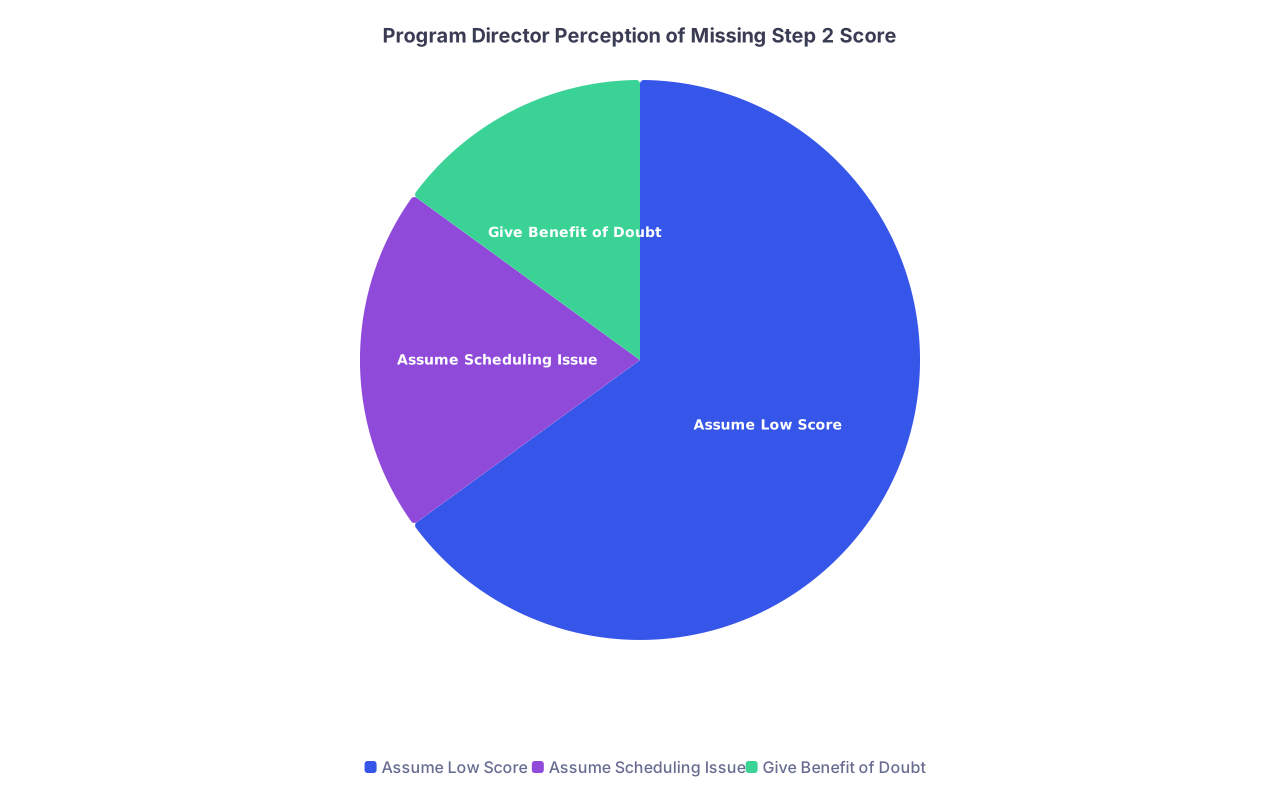
| Category | Value |
|---|---|
| Assume Low Score | 65 |
| Assume Scheduling Issue | 20 |
| Give Benefit of Doubt | 15 |
I have heard this exact sentence in a selection committee:
“Missing Step 2 at this point usually means a weak score; unless something else is exceptional, move on.”
The mistake: Trying to “time” disclosure of a mediocre Step 2 score as if you can outsmart the filters and suspicions of people who review thousands of applications a year.
Avoid it by:
- Accepting that a so-so but honest Step 2 on file is often safer than a mysteriously missing score once interview season is underway.
- Discussing with your dean’s office or advisor whether there is any legitimate reason to withhold the score briefly (rare). If not, release it and focus on the rest of your application.
- If your score truly undercuts your original specialty choice, adjusting your target field or dual-application strategy rather than playing games with timing.
If you are going to take Step 2 CK at all before match (you should), plan to own whatever number you get—and plan the timing so that number helps you instead of haunting you.
Putting It Together: A Safe, Non‑Self‑Sabotaging Step 2 CK Timeline
Every school calendar is different, but a sane structure for most U.S. students looks something like this:
- Cores finish: April–May of third year
- Light elective or research: late May–early June
- Step 2 CK dedicated: 4–6 weeks in June–July
- Test date: late June to late July
- Score release: mid-July to mid-August
- ERAS opens for submission: early September
- Programs start downloading: mid-September
That sequence avoids:
- The “post-ERAS rescue” fantasy
- The rushed “3-week blitz after your last shelf” disaster
- The away rotation / Step 2 scheduling collision
- The panic around missing or suspiciously delayed scores
You adjust from there based on your realities: weaker Step 1, competitive specialty, personal responsibilities. But if your plan deviates drastically from that rhythm, you had better have a very clear reason.
Final Takeaways
Keep these three points firmly in your head while you plan:
- Programs judge you based on what is in your file when they first screen, not on the score you think you might get later.
- Step 2 CK needs a protected window and realistic reporting buffer; away rotations and sub-Is are not compatible with serious dedicated study.
- Hiding, delaying, or over-optimizing the score number while ignoring timing is how strong applicants quietly tank their match odds.
Plan like someone who understands how the other side actually works, not like someone hoping the calendar will bend to their anxiety.