
The myth that Step 2 CK is just “Step 1 but clinical” is wrong. Program directors are using it as a crude but very real proxy for your medical judgment. And they are reading that score with a much more specific checklist in mind than most students realize.
Let me break this down specifically, because this is where strong applicants differentiate themselves from the pack.
What PDs Actually Mean By “Medical Judgment”
People throw around “clinical reasoning” and “medical judgment” like they are interchangeable. They are not.
When a PD looks at your Step 2 CK score, they are trying to answer four brutally practical questions:
- Will this person make dangerous decisions at 3 a.m. when I am not standing over their shoulder?
- Will they slow down my team because they cannot prioritize or choose the right plan?
- Will they pass our in-training exams and boards so I do not have to explain their failure to my chair?
- Will they be safe with the pager… or will nurses start avoiding them?
“Medical judgment” in this context is not philosophy. It is pattern recognition plus prioritization plus execution under constraints.
Step 2 CK has become the shorthand for that.
To see why, look at what Step 2 CK actually tests when it is doing its job correctly.
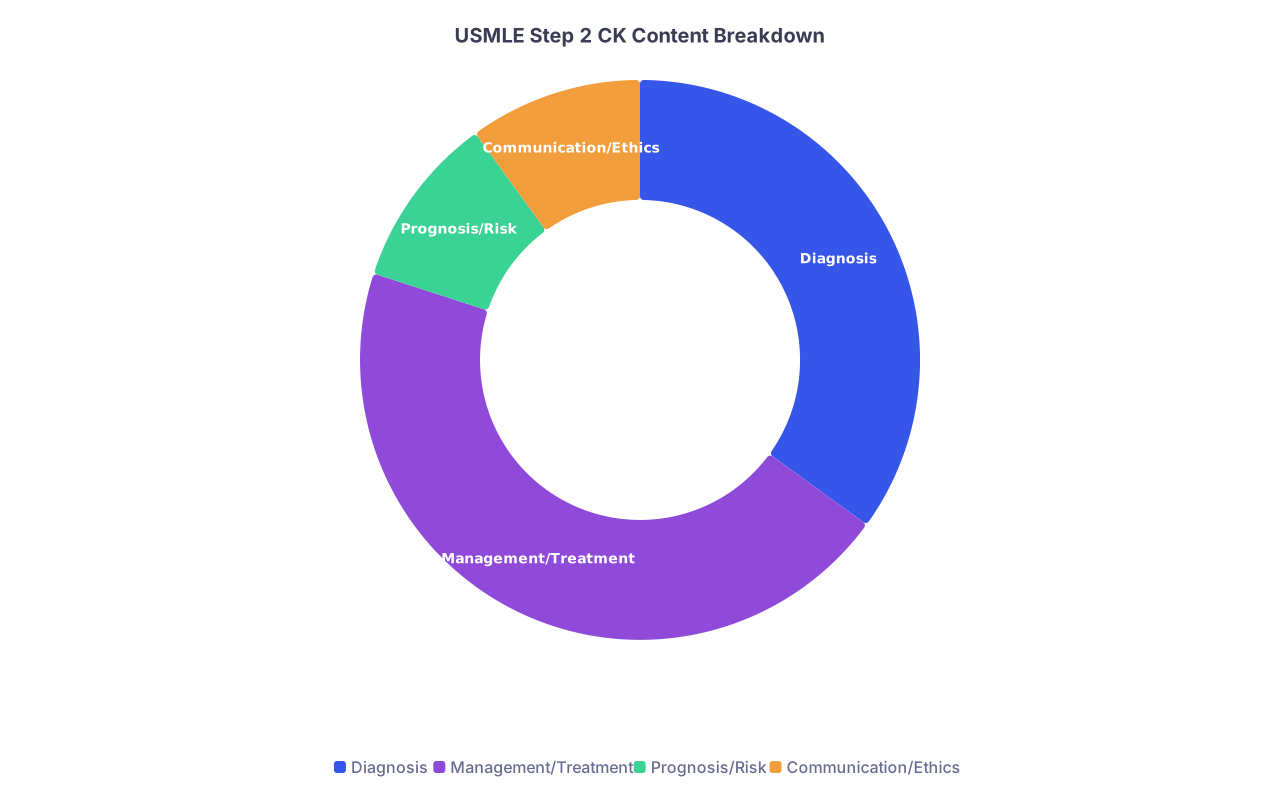
| Category | Value |
|---|---|
| Diagnosis | 35 |
| Management/Treatment | 45 |
| Prognosis/Risk | 10 |
| Communication/Ethics | 10 |
That 80%+ that is diagnosis + management is exactly where PDs see (or do not see) your bedside judgment.
How Step 2 CK Signals Judgment: Domain by Domain
We will go system by system, but not in the usual way. I will point out the specific item styles that quietly reassure (or alarm) PDs who understand the exam.
1. Acute Triage and “Sick vs Stable” Thinking
If there is one pattern that screams “this student has shaky judgment,” it is missing acuity.
Step 2 CK repeatedly asks a simple but vicious question: did you see how sick this patient is?
Common patterns:
- Hypotension + altered mentation + fever → do you press “sepsis bundle / fluids / broad-spectrum antibiotics” or do you wander off ordering imaging first?
- New chest pain + hemodynamic change → do you stabilize and call cath lab, or do you schedule an outpatient stress test like a robot?
The exam tests:
- Recognizing decompensation early: hypotension, tachypnea, altered mental status, oliguria.
- Prioritizing airway, breathing, circulation before anything else.
- Initiating the right emergent intervention quickly.
When PDs see a high Step 2 CK score, they assume you consistently picked the right immediate action in those scenarios. A mediocre score suggests you miss those subtle but life-or-death acuity cues.
On the wards, this is the intern who:
- Pages “FYI” instead of “STAT” for a MAP of 50.
- Orders CTPE before giving heparin in a classic high-prob PE with low bleeding risk.
- Verbally says “he looks okay” while the nurse is staring at a BP of 80/40.
Step 2 CK punishes that thinking. So do attendings.
2. First-Line vs “What You Saw On Rounds”
Program directors care a lot about something most students shrug off: choosing guideline-concordant first-line management.
Step 2 CK is relentless about this.
- New-onset atrial fibrillation with RVR in a normotensive, symptomatic patient → beta blocker or diltiazem, not amiodarone, not digoxin, not “cardiology consult.”
- Uncomplicated cystitis in a non-pregnant woman → nitrofurantoin or TMP-SMX if local resistance is acceptable, not fluoroquinolones “because that’s what I saw.”
- NSTEMI → antiplatelet + anticoagulation + statin + beta blocker, not “schedule echo” as the primary move.
The exam is not only asking “Do you know what to do?” It is asking “Will you default to evidence-based care, or random attending anecdotes?”
PDs care because this predicts:
- How much they will have to “unteach” bad habits.
- Whether you can handle admission order sets with thousands of options.
- Whether your clinical decisions will line up with QI metrics and hospital guidelines.
Weak Step 2 CK performance usually shows up in:
- Overuse of broad-spectrum antibiotics.
- “Consult reflex” instead of decisive initial management.
- Weird, second- or third-line choices in stable patients.
Strong Step 2 CK scorers almost always have tight internal algorithms: first-line, what if contraindicated, what to do if fails.
3. Risk–Benefit and Harm Minimization
This is where “judgment” stops being just memorized treatment lists.
The exam quietly forces you to weigh:
- Benefit of diagnostic certainty vs radiation / contrast / invasive risk.
- Aggressive treatment vs side effect profile in vulnerable populations.
- Medication interactions and iatrogenic harm.
Examples:
- Elderly patient with delirium → avoid benzodiazepines for “agitation,” think haloperidol in specific situations, or non-pharmacologic first.
- Young woman with low-risk chest pain and normal vitals/ECG → avoid CT angiography, consider no imaging or outpatient workup.
- Chronic pain patient with snoring, obesity, and opioids → recognize risk of respiratory depression and maybe adjust meds instead of escalating.
Programs hate residents who are “trigger happy” with interventions. Too many:
- Contrast CTs in renal insufficiency “just to be safe.”
- Unnecessary MRIs that clog access for truly urgent cases.
- Polypharmacy that spirals out of control.
Step 2 CK assesses if you can avoid that. Do you see harms? Or do you reflexively click “do more”?
4. Time Course and Disease Trajectory
Poor medical judgment often shows up as confusion about timelines:
- What should get better in hours vs days vs weeks?
- When is “no improvement yet” acceptable vs alarming?
Step 2 CK tests:
- When to escalate care: CAP not improving after 48–72 hours → broaden coverage or hunt for complications.
- When to not panic: SSRI started 1 week ago, still depressed → continue, adjust expectation, not immediately switch to another drug.
- When to repeat imaging vs accept normal evolution.
A high Step 2 CK score implies:
- You understand that not every deviation from perfect recovery is failure.
- You know when persistent symptoms imply missed pathology (e.g., persistent fever after 5 days of appropriate antibiotics → think abscess, resistant organisms).
PDs see this on the wards with:
- Interns ordering repeat CTs every 24 hours “to check progress.”
- Distracted work-ups for side effects that are expected transient issues.
- Missing subtle clinical decline because “the labs are okay.”
The exam drills this into you with scenario after scenario. If you are weak on timeline thinking, your score reflects it.
5. Breadth of Reasonable Differential — Then Narrowing
None of this matters if your differential is garbage.
Step 2 CK is not Step 1-style pathophysiology recall. It is:
- Generate a realistic, ranked differential diagnosis based on demographics, risk factors, and presentation.
- Use the highest-yield next test to distinguish between the top two or three.
- Not chase zebras on day one.
So PDs are implicitly asking: can this person move from “collecting rare diagnoses” to “ranking likely conditions and testing rationally”?
Breadth with discipline. Not scattershot ordering.
Examples of good Step 2 CK judgment:
- 20-year-old with mono-like symptoms, lymphocytosis → think EBV/CMV/HIV, not leukemia as #1.
- 60-year-old smoker with hematuria → bladder cancer and kidney stone high on the list, UTI not your only thought.
- 30-year-old woman with joint pain, rash, renal involvement → SLE very high, not immediate lymphoma work-up.
Bad judgment is “everything is possible all at once,” which on exam and in real life translates to:
- Over-ordering batteries of tests.
- No clear primary hypothesis.
- No sense of pre-test probability.
That is what PDs are trying to avoid—because this person kills productivity on rounds and buries teams in useless data.
The Specific Step 2 CK Question Types That Map Directly To PD Concerns
Let me pull this apart by item style, because PDs who are in the weeds of education understand this. And you should too.
A. “Next Best Step in Management” – The Core Judgment Item
These are the backbone of the exam. Long stem, lots of noise, then:
“What is the most appropriate next step in management?”
These questions test:
- Do you stabilize before you investigate?
- Do you treat the most dangerous likely diagnosis, not the most exotic?
- Do you respect contraindications?
On programs’ side:
- Consistently getting these right = intern who does not freeze when an unstable patient arrives.
- Getting these wrong = intern who presents a beautiful differential but forgets to call for blood in a GI bleed.
If your CK prep centers around mechanistic trivia instead of mastering these management pathways, you are training the wrong muscle for residency.
B. “Most Appropriate Next Diagnostic Test”
This exposes your thinking about:
- Pre-test probability.
- Stepwise work-up.
- Cost, invasiveness, and specificity.
Examples:
- Suspected PE: very low probability → D-dimer; high probability → straight to CT angio; pregnancy or contrast allergy → V/Q scan.
- Stable GI bleed: colonoscopy or EGD vs CT angiography vs tagged RBC scan based on hemodynamics and suspected source.
- Suspected aortic dissection: immediate CT angio or TEE depending on stability, not outpatient MRA.
PD equivalents:
- Will you blow through the hospital’s imaging budget?
- Will you delay critical diagnoses waiting on minor tests?
- Will you call radiology with nonsense consult questions?
Step 2 CK performance here correlates frighteningly well with real-world ordering patterns. PDs know it.
C. “Most Likely Diagnosis” in Multi-System Presentations
These force integration: labs + imaging + physical exam + risk factors.
High-quality test writers design these to differentiate between:
- People who chase single abnormal labs.
- People who recognize syndromes.
For example:
- Hyponatremia + high urine osmolality + small cell lung cancer history → SIADH, not “psychogenic polydipsia” because sodium is low.
- Elevated ALP + normal GGT + bone pain → Paget, not cholestasis.
- Fever + murmur + embolic phenomena in an IV drug user → infectious endocarditis, not just “sepsis of unknown source.”
PD concern: can you actually integrate information, or do you latch onto the first abnormal lab and anchor?
Step 2 CK hammers that anchor bias. A strong score means you usually avoided the traps.
D. Prognosis, Next Counseling Step, and Ethics
This is the “soft skills as test items” part, but it is not really soft. It is judgment about people.
- When to stop aggressive care and discuss hospice.
- When to tell a family that further chemo will not change outcome.
- When to respect patient autonomy even when family disagrees.
These questions are often lumped into “ethics,” but what they are really measuring:
- Can you recognize when more medical intervention has become harm?
- Do you understand the structure of surrogate decision making?
- Can you deliver care that matches patient values, not your ego?
PDs are not delusional. They know Step 2 CK is a blunt tool for this. But they have also seen that residents who tank these sections often:
- Fight every palliative care consult.
- Do poorly in family meetings.
- Have endless conflict around code status.
So yes, your Step 2 CK performance indirectly signals whether you will create drama around end-of-life care.
How Programs Actually Use Step 2 CK in Selection
This part is ugly but you need to hear it plainly.
| Program Type | Typical Step 2 CK Use |
|---|---|
| Competitive academic (Derm, Ortho, ENT) | Hard thresholds and heavy ranking weight |
| Mid-tier IM/FM | Screen for risk of failing boards; moderate ranking weight |
| Community programs | Basic screen for safety and test-taking ability |
| “Lifestyle” specialties (Rads, Anes) | Used to differentiate in crowded high-score pools |
| Categorical vs prelim surgery | Often higher cutoffs for categorical spots |
If Step 1 is pass/fail, Step 2 CK becomes:
- The filter for interview offers.
- The tie-breaker for rank lists among similar applicants.
- The red flag detector for “will this person pass our board pass-rate metrics?”
Score Thresholds and “Safe Zones”
These are not universal, but patterns repeat across institutions:
- 260+: PDs assume very strong clinical reasoning and test-taking. You get the benefit of the doubt almost everywhere. They expect you to be at the top of the class academically.
- 245–259: Solid to strong. For most IM, Peds, EM, Anes, you are in a good range. For derm/ortho/ENT, this keeps you viable if the rest of your app is strong.
- 230–244: Adequate for many programs, concerning for very competitive ones. PDs start looking closely at your clinical grades and letters to see if judgment is better than the score suggests.
- 220–229: Now they are checking for patterns: Step 1 fail? Shelf failures? Remediation? They worry about board pass risk.
- <220: This becomes a liability at many academic programs unless offset by very strong narrative evidence of growth and performance.
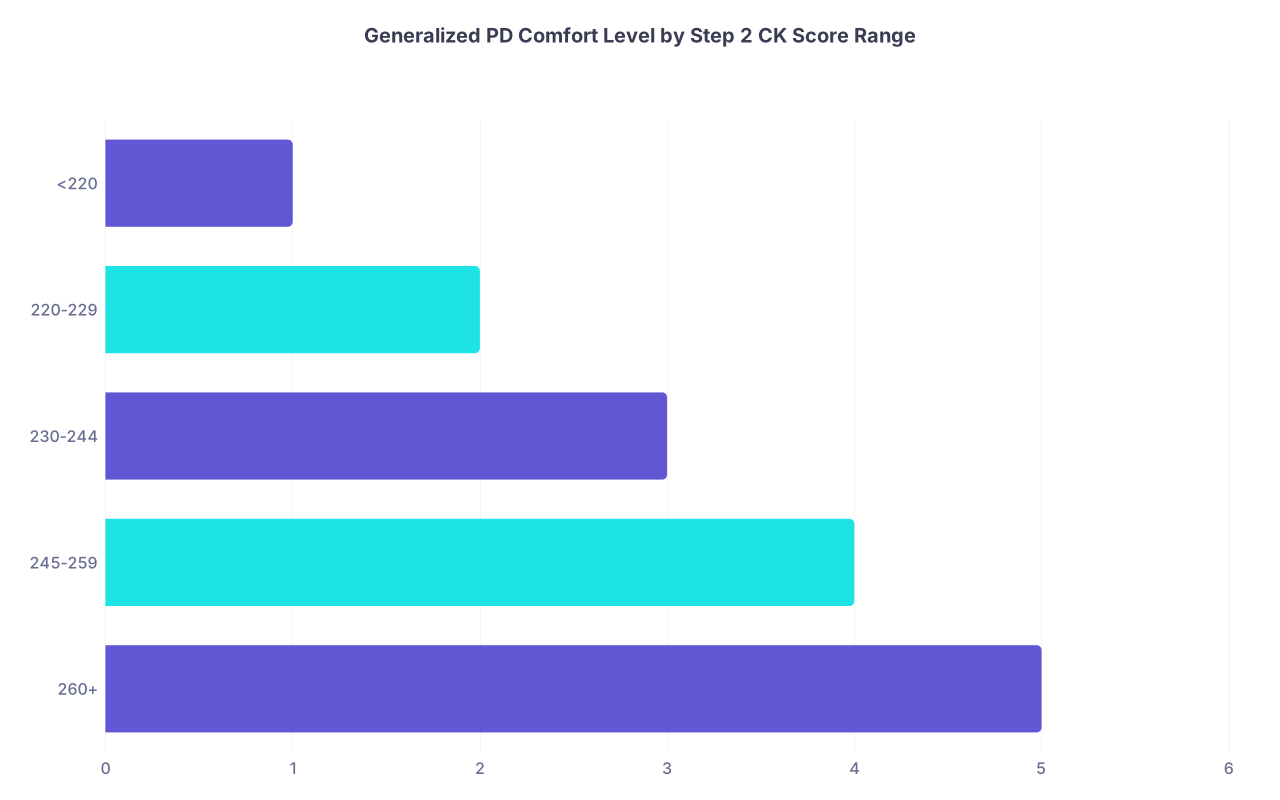
| Category | Value |
|---|---|
| 260+ | 5 |
| 245-259 | 4 |
| 230-244 | 3 |
| 220-229 | 2 |
| <220 | 1 |
(5 = very comfortable, 1 = high concern. Obviously not every PD uses a scale, but this is how it feels in their heads.)
How PDs Combine Step 2 CK with Other Signals of Judgment
Nobody serious looks at Step 2 CK in isolation. Here is the real calculus:
- High CK + strong medicine/surgery clerkship comments: “Excellent judgment, ready for high-responsibility rotations early.”
- High CK + lukewarm or concerning comments (“needs supervision,” “frequently misses clinical cues”): PDs get suspicious you are a test-taking machine with poor bedside translation.
- Mid CK + glowing evaluations highlighting judgment: Many PDs would rather take this person than the 260 who melts in real time.
- Low CK + mixed comments: This is where apps quietly fall off rank lists.
In other words, Step 2 CK sets the floor. Narrative sets the ceiling. But if your floor is unstable, some PDs never bother to look up.
What “Medical Judgment” Looks Like On Your Application Beyond the Number
If you want PDs to see you as someone with strong medical judgment, you cannot just rely on the score. You need the rest of your file to say the same thing.
1. Clerkship Narratives
You want phrases like:
- “Recognizes acutely ill patients quickly and escalates appropriately.”
- “Prioritizes patient safety and demonstrates sound clinical judgment.”
- “Makes management plans that are evidence-based and well-reasoned.”
You do not want:
- “Hard worker, very thorough, continues to improve” with nothing about decisions.
- “Enthusiastic and eager to learn” (code phrase for: nice but not clinically strong).
- “Requires close supervision with acutely ill patients.”
Those comments are the textual version of your Step 2 CK management questions.
2. Sub-I / Acting Internship Performance
This is where you are essentially auditioning as an intern. Your behavior under pressure reveals your:
- Triage sense.
- Willingness to own decisions.
- Ability to ask for help at the right time.
If your CK is solid and your Sub-I eval says “I would trust this student to take primary call on our service,” that is a powerful alignment signal to PDs.
3. Letters from People Who Care About Judgment
The best letters do not do personality fluff. They say things like:
- “She anticipates decompensation before it happens; she called for transfer to ICU on a patient that later required pressors. That is judgment.”
- “He correctly identified a potentially unstable PE and initiated appropriate therapy before my arrival. Many interns do not do that.”
That language is what PDs are scanning for, consciously or not. They want to know what you do at 2 a.m., not just how you look on morning rounds.
How to Train the Kind of Judgment Step 2 CK Rewards (and PDs Trust)
Studying for CK only with review books is like trying to learn to drive by reading about engines. You will miss the feel.
You need deliberate practice in three specific directions.
A. Turn Every Question into a Mini-Algorithm
When you do UWorld or NBME questions, do not stop at “correct answer is B.”
Force yourself to articulate:
- What made this patient “sick” or “stable”?
- What is my algorithm for this chief complaint?
- What would I do first, second, third in real life?
Write it out for the big presentations:
- Chest pain.
- Shortness of breath.
- Abdominal pain.
- Fever.
- Headache.
- Altered mental status.

| Step | Description |
|---|---|
| Step 1 | Chief complaint |
| Step 2 | Assess vitals and mental status |
| Step 3 | ABCs and immediate resuscitation |
| Step 4 | Focused history and exam |
| Step 5 | Targeted emergent treatment |
| Step 6 | Generate differential ranked by likelihood |
| Step 7 | Choose highest yield next test |
| Step 8 | Reassess diagnosis and management plan |
| Step 9 | Stable or unstable |
Train that flow until it is automatic. CK questions are simply variations on this backbone.
B. Practice Saying “No” to Bad Tests and Treatments
On questions, before clicking an answer, ask:
- Does this test/treatment change management now?
- Is there a lower-risk, cheaper, or more informative option?
- Am I doing this for the patient, or because the stem made me nervous?
On the wards:
- Watch attendings who almost never over-order. The ones who say “That test does not change what we do today” and move on. Emulate that thought process.
- Be very suspicious of “more is always better” thinking.
You want your brain to reflexively consider harm and yield, not just “can I do this?”
C. Match Question Practice with Real-World Reflection
The students who get scary good at Step 2 CK (and impress PDs later) do this:
- After a complicated admission, they go home and pull up UWorld questions on that condition.
- After a near-miss or patient decomp, they review algorithms for that scenario and ask “What did I miss in the first 30 minutes?”
- When they see an unusual attending decision, they check the guideline later: was that evidence-based, or idiosyncratic? They treat guidelines as primary, attendings as variable.
That feedback loop—ward → resource → ward again—is what builds real judgment. CK just happens to be the first standardized measurement of it.
The Bottom Line PDs Care About
You can dress this up in rhetoric, but residency is brutally simple in one respect: did you make my unit safer and more efficient, or not?
Step 2 CK is currently the best standardized surrogate for that question. It is not perfect. Some brilliant clinicians underperform, and some test savants fall apart at the bedside. PDs know that.
But if you want to align your Step 2 CK prep with what they truly care about:
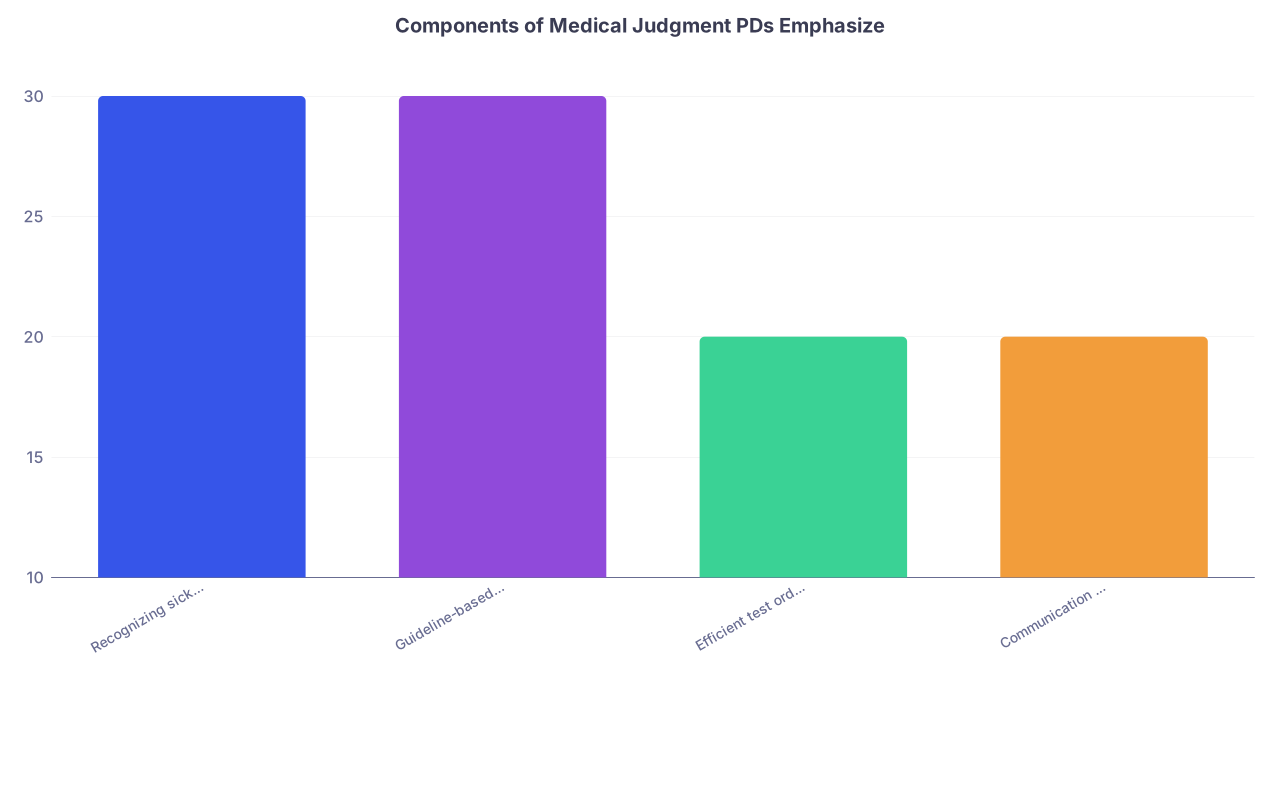
| Category | Value |
|---|---|
| Recognizing sick patients | 30 |
| Guideline-based management | 30 |
| Efficient test ordering | 20 |
| Communication & ethics | 20 |
Focus hardest on:
- Recognizing sick vs stable instantly.
- Choosing correct first-line management rooted in guidelines.
- Ordering tests that meaningfully change next steps.
- Respecting risk–benefit and patient values in your decisions.
Do that, and your Step 2 CK score will not just be a number. It will be a believable signal that your medical judgment is already at an intern level.
And PDs care a lot about that.
Key takeaways:
- Program directors read Step 2 CK primarily as a proxy for your real-time medical judgment: acuity recognition, first-line management, and risk–benefit thinking.
- High-value prep is not “more facts,” but training explicit algorithms for common presentations and consistently practicing “next best step” reasoning.
- The strongest applications line up the Step 2 CK score with clerkship narratives and letters that all say the same thing: this person makes safe, efficient, evidence-based decisions when it counts.