

What if your barely-passing Step 2 CK score quietly kills your application… and no one tells you?
That’s the fear, right?
You passed, but you didn’t crush it. Maybe you were aiming for 245+ and landed at 214. Or worse, you were sure you failed and somehow got a 205. Technically a pass. Emotionally a punch to the gut.
And now the question stuck in your head is:
“Do residency programs see me as ‘barely competent’… or do they not care as long as it’s a pass?”
Let me be blunt: some programs will care, some won’t, and it depends heavily on your specialty and the rest of your file. But a narrow Step 2 CK pass is not an automatic death sentence unless you let it be the only thing that defines you.
Let’s pick this apart like you’re staring at ERAS at 2 a.m. panicking.
What a “Narrow Pass” on Step 2 CK Actually Signals to Programs
Programs don’t see “barely passed” as a separate category. They see a number and a pass. The drama around it is mostly in our own heads.
Programs roughly use Step 2 CK in three ways:
- Screening filter – “Do we even look at this application?”
- Risk assessment – “Will this person pass the boards on first try?”
- Tie-breaker / reassurance – “Does this score make sense with the rest of their file?”
A low-but-passing step score pokes at #2 the most.
Here’s what flashes through a PD’s mind when they see a low Step 2 score (especially if it’s just above the passing line):
- “Is this an outlier or a pattern?”
- “Can this person handle in-training exams and the specialty board?”
- “Are they going to need academic support?”
- “Is this score going to hurt our board pass statistics?”
That last one is harsh, but very real. Programs care about board pass rates because ACGME and applicants use those as quality metrics. They don’t want to rank people they think are likely to fail their boards.
But notice: that’s about risk, not “this person is dumb” or “we hate them.” If the rest of your app screams stability and competence, a borderline Step 2 doesn’t automatically tank you.
How Much Does a Low Step 2 CK Matter by Specialty?
Some specialties stare at Step scores. Others shrug.
Here’s a blunt overview:
| Specialty | Step 2 CK Weight | Comment |
|---|---|---|
| Dermatology | Very High | Score hawks |
| Orthopedics | Very High | Extremely competitive |
| Internal Medicine | Moderate-High | Depends on program |
| Pediatrics | Moderate | Look at whole person |
| Family Medicine | Moderate-Low | Passing matters most |
This is simplified, obviously, but you get the pattern. Competitive fields (Derm, Ortho, ENT, Plastics, some Rads, some Anesthesia) use Step 2 CK as a sharp sorting tool, especially now that Step 1 is pass/fail.
Less competitive or more holistic specialties (FM, Psych, Peds, some IM, PM&R) care more that you pass reliably and less that you’re scoring in the 260s.
So if you’re sitting on:
- A 205–215 step score and applying Derm — yeah, that’s a problem. You’re fighting uphill.
- The same 205–215 and applying FM or Psych — more programs will still seriously consider you, especially if the rest of your app is strong.
And program tier matters too. A “low” score hurts way more for MGH IM than for a solid community IM program in the Midwest.
How Programs Actually Use Your Step 2 CK Score
Let me cut through the rumors.
Most programs use Step 2 CK like this:
Initial screen
They set a soft or hard cutoff. Something like:- 230+ strong
- 220–229 okay
- 210–219 maybe, depends on rest
- <210 needs justification
These numbers vary a lot, but that’s the general feel in many core specialties.
Cross-check against Step 1
Since Step 1 is pass/fail, Step 2 is often the only standardized objective metric they have.- If you barely passed Step 1 and barely passed Step 2 → they see a consistent pattern of struggles with standardized tests. That’s when alarms ring.
- If Step 1 was fine and Step 2 dipped → they’ll wonder about life issues, burnout, or a bad test day, but they’re more forgiving if there’s no pattern of academic failure.
Compare to your school and class
They mentally compare you to other applicants from your school. If everyone else from your school is sending 240–250s and you’ve got a 208, that contrast doesn’t help.Line up with your clinical performance
- Strong clerkship grades + good narratives + low Step 2: they might see you as a strong clinician but bad standardized test taker. That’s survivable.
- Mediocre clerkships + weak narratives + low Step 2: that’s when they assume academic risk.
This is why two people with the exact same 210 Step 2 score can have very different outcomes. Context matters way more than people admit.
How Harmful Is a Low-but-Passing Step 2 Really?
Let’s talk worst-case, because that’s probably where your brain is anyway.
Scenario 1: You’re in a competitive specialty
If you’re aiming for something like:
- Dermatology
- Ortho
- ENT
- Plastics
- Neurosurgery
…and your Step 2 is barely above passing, you’re not “slightly disadvantaged.” You’re in serious trouble on paper unless:
- You have insane research (multiple pubs, first-author, big-name mentors).
- You’re dual applying.
- You have strong home support and connections who are explicitly advocating for you.
Programs in these fields are flooded with people with 250s, honors in everything, research, leadership, etc. A low score is one more reason to move your file to the “no” pile instantly.
Scenario 2: You’re in a mid-competitive or holistic specialty
IM, EM (though EM is weird right now), Peds, Psych, FM, etc.
Here, a low Step 2 usually narrows your options, it doesn’t erase them.
What it might do:
- Take you out of contention for the “brand name” academic programs.
- Make some mid-tier programs nervous.
- Force your application to rely more heavily on letters, clerkship performance, and fit.
What it does not automatically do:
- Guarantee you won’t match.
- Mean you’re unsafe to practice.
- Erase all your other strengths.
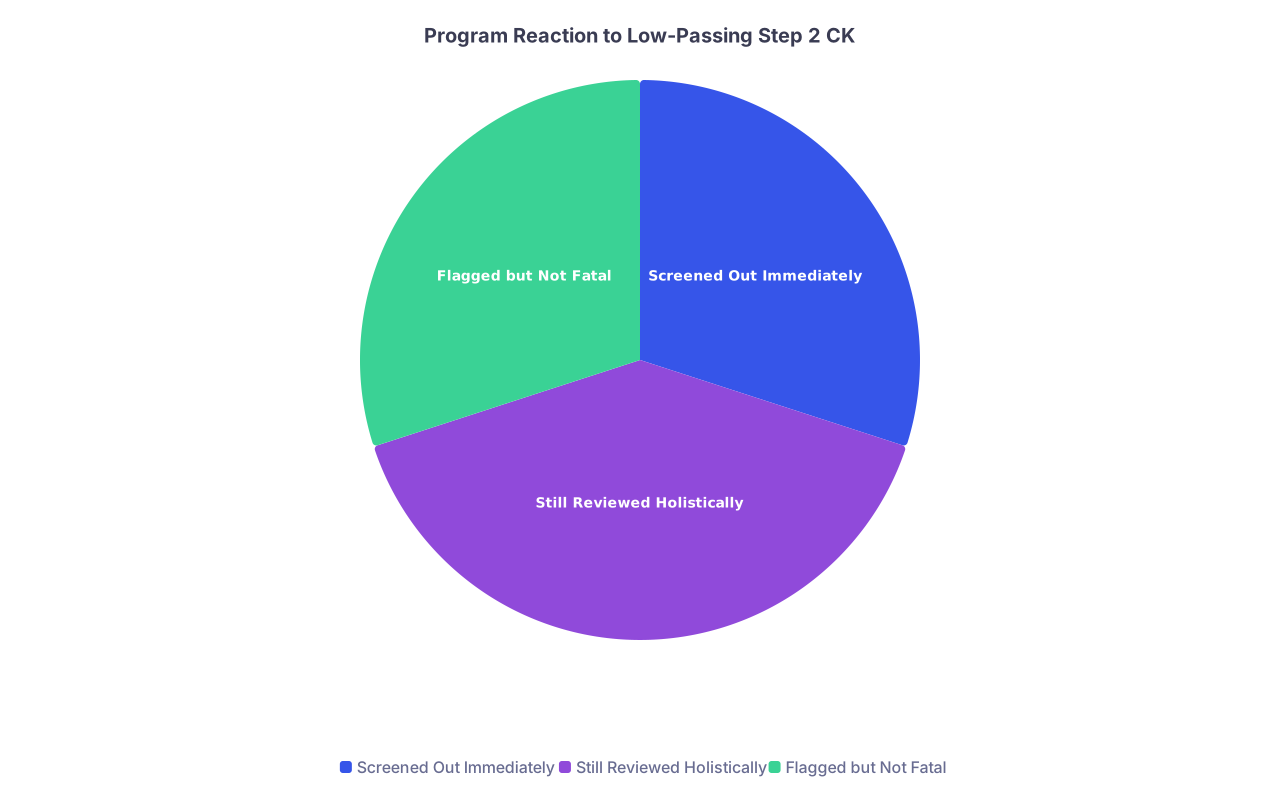
| Category | Value |
|---|---|
| Screened Out Immediately | 30 |
| Still Reviewed Holistically | 40 |
| Flagged but Not Fatal | 30 |
This isn’t exact data, but it’s a realistic split from what I’ve seen and heard from residents and faculty: some programs will toss you right away, some will still look, and some will keep you but flag the score as a concern.
What Matters More Than Your Exact Number Now
Here’s the part nobody tells you because everyone’s obsessed with the score report: the damage (or lack of it) is already done. The number is locked.
So what actually matters now?
1. Your story around the score
Not a long sob story. A controlled narrative.
If your low score comes up in an interview or a personal statement addendum, something like:
- “My Step 2 CK score doesn’t reflect my true clinical performance. During that period I was dealing with [brief specific issue: major family illness, personal health, clinical scheduling nightmare], and I didn’t manage my prep as well as I should have. Since then, I’ve [done X to improve: excelled on in-training exams, sought academic support, performed strongly in core clerkships].”
Short. Owning it. Not blaming the universe.
2. Your letters of recommendation
Glowing, specific letters can override a lot of anxiety about a single test score.
Programs will trust:
- “I’ve worked with this student directly on wards. They’re responsible, teachable, and safe. I would trust them with my own family.”
Way more than:
- “This student scored 209 on Step 2 CK but I don’t know them well.”
If you’ve got a low Step 2, your LORs need to be weapons, not formality.
3. Your actual clinical evaluations
If your MSPE and clerkship comments say:
- “Always prepared, took ownership of patients, excellent clinical reasoning.”
that acts as a buffer around your score.
If instead it’s:
- “Pleasant, quiet, needed supervision, slow to pick up tasks.”
combined with a low Step 2… yeah, that’s when things really start to hurt.
Concrete Damage Control: What You Can Do Now
You can’t retake Step 2 just to get a higher score. So the question becomes: how do you keep this from dominating your application?
Here’s where your energy actually helps, instead of just spiraling.
1. Adjust your list honestly
If you’re applying this cycle: widen your net.
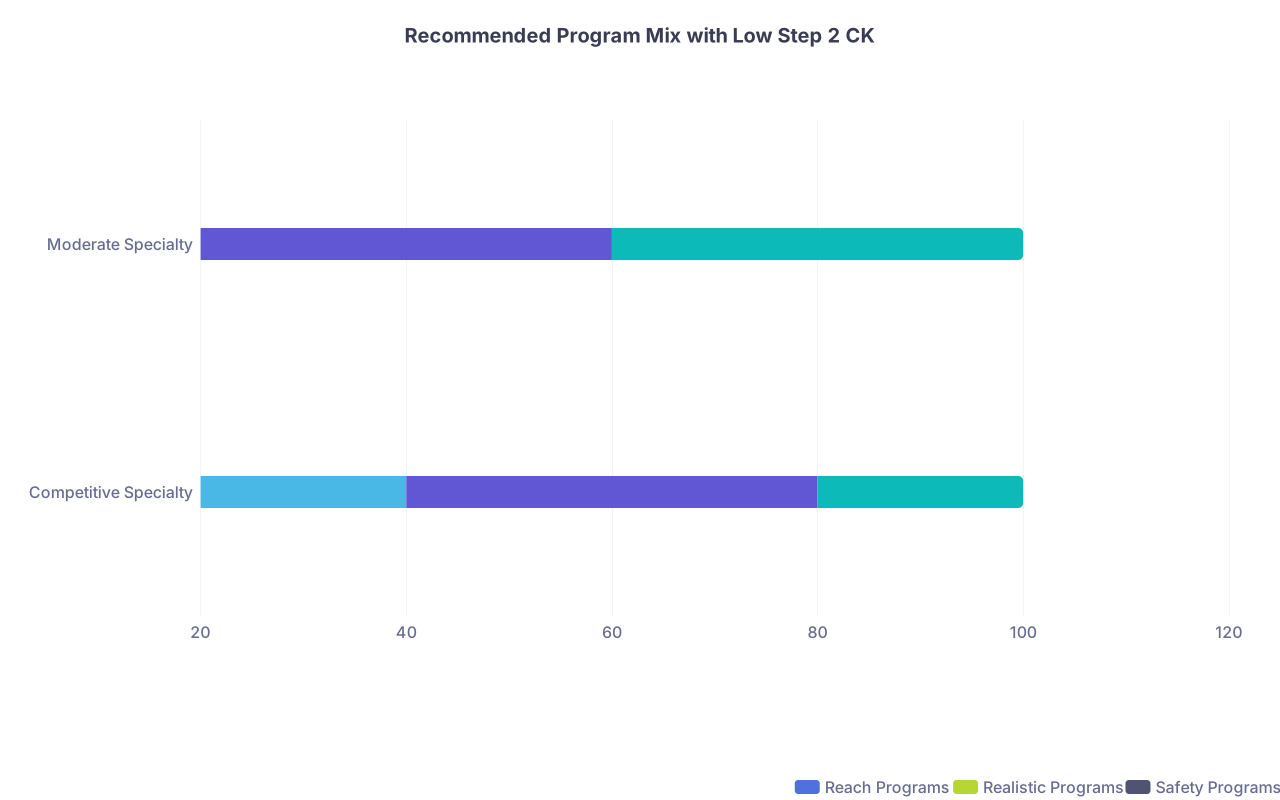
| Category | Reach Programs | Realistic Programs | Safety Programs |
|---|---|---|---|
| Competitive Specialty | 40 | 40 | 20 |
| Moderate Specialty | 20 | 40 | 40 |
Translation:
- Competitive specialty: you need more realistic and safety programs than usual, and maybe a backup specialty.
- Moderate specialty: keep some reaches, but beef up the realistic and “safer” community or mid-tier programs.
Pretending your score doesn’t matter at all is just another way of sabotaging yourself.
2. Lean hard on mentorship
Talk to:
- Your home program PD or APD (yes, scary, but necessary).
- A trusted faculty member in your desired field.
- Residents who recently matched with non-stellar scores.
Ask them plainly: “With my Step 2 score of X, what types of programs and how many should I target to stay realistic?”
You need someone who actually sees match data, not Reddit.
3. Strengthen everything you still control
You still have real levers to pull:
- Rotations: Show up early, read, be reliable, volunteer for work, follow up. You want people saying, “I was surprised when I saw their score because they perform so well clinically.”
- Personal statement: Don’t center the whole thing on Step 2, but you can gently frame your strengths so your score feels like an outlier, not your whole identity.
- ERAS: Make your activities sound like real impact, not bullet-listed fluff.
- Interviews: Be prepared, thoughtful, and humble. Programs will forgive a lot in someone they’d actually enjoy working with at 2 a.m.
4. Be ready with a calm explanation (if asked)
If a PD says, “Talk to me about your Step 2 score,” this is not your doom moment. It’s a test of how you handle weakness.
The worst moves:
- Sounding defensive.
- Blaming the exam.
- Blaming your school / clerkships / “the system.”
- Having no insight.
A solid answer is:
- Brief context (if there is one).
- Personal responsibility.
- Action steps you’ve taken.
- Evidence since then that you’re stable.
How Bad Is It Really If You Just Barely Passed?
Here’s the part you’re probably too scared to say out loud:
“I’m terrified they’ll think I’m unsafe or incompetent.”
Programs do not equate “low score” with “dangerous clinician” by default.
They use scores as proxies. Imperfect shortcuts.
But what actually convinces them you’re competent?
- Observed performance on rotations.
- How you present a patient.
- How you respond when you don’t know something.
- Whether nurses and residents say, “They’re solid” vs. “They’re a mess.”
A low Step 2 might lower their initial trust a bit, but your behavior and evaluations can rebuild that trust fast.
I’ve seen residents who:
- Barely passed Step 2.
- Constantly stressed about being “the weak link.”
- Then quietly became rock-solid, beloved, dependable residents who everyone trusted on nights.
Nobody on the team talks about their old score. It fades. It really does.
But it only fades if you stop treating it like your entire identity and start acting like a resident who belongs.
Quick Reality Check
Let me be brutally honest and then reassuring:
- Yes, a narrow Step 2 pass will shut some doors.
- Yes, a few programs will toss your app without blinking.
- Yes, for ultra-competitive specialties, it might be close to fatal unless everything else is exceptional.
But also:
- No, it does not mean you won’t match anywhere.
- No, it does not mean you’re unsafe or incapable of being a good doctor.
- No, it does not mean every PD will look at you and think “failure risk.”
You’re allowed to be disappointed. You’re allowed to be scared. You’re not allowed to give up on the entire profession over one number.

FAQ: Narrow Step 2 CK Pass and Residency
1. Should I address my low Step 2 CK score directly in my personal statement?
Only if there’s clear context and you can do it briefly and maturely. One or two sentences, max. Something like: “My Step 2 CK score does not reflect my clinical performance; during that time I was managing [brief, real issue]. Since then, my clerkship evaluations and in-training performance have reflected my true capabilities.” Don’t turn your statement into a justification essay.
2. Will programs automatically reject me if my score is just above passing?
Some will, yes. Many won’t. Especially in less competitive specialties and at community or mid-tier academic programs. It usually moves you from “easy yes” to “needs a second look” rather than “auto-reject” across the board. That’s why building a wide, strategic program list and strong letters matters so much.
3. Should I change specialties because of my Step 2 CK score?
If you were aiming for a hyper-competitive field and your score is significantly below typical ranges, you should at least seriously consider a backup specialty and talk to mentors who know your full application. But don’t panic-switch solely out of shame. Look at actual match data, your overall strengths, and whether your dream specialty is still even remotely plausible with research, connections, and realistic expectations.
4. What’s one concrete thing I can do this week to help offset my low Step 2 score?
Get at least one strong faculty member in your desired specialty to really know you. Ask to work closely with them on a rotation, project, or clinic day. Then explicitly ask if they’d be willing to write you a detailed letter. A single high-impact letter from someone respected in the field can do more to counterbalance your Step 2 CK than another week of spiraling on Reddit.
Open your ERAS (or draft) right now and look at your program list. Add 3–5 more realistic or safety programs that you’d genuinely be willing to attend. That one adjustment today will do more for your match chances than rereading your score report another ten times.


