
Does a 260+ Step 2 CK Guarantee Interviews? What History Shows
What do you actually get when you score 260+ on Step 2 CK—automatic interviews from every program on your list, or a very expensive lesson in how naive that assumption was?
Let me be blunt: a 260+ Step 2 CK is elite. It opens doors that stay locked for most applicants. But the myth that it “guarantees” interviews—especially at top-tier or hyper-competitive programs—is lazy, dangerous, and not supported by what’s happened in the Match over the last several years.
Programs like MGH, UCSF, Penn, Mayo, Hopkins are not sitting around saying, “Well, this applicant failed multiple courses, has creepy LORs, no professionalism track record—but look, 263! Auto-invite.” That’s not how this works. That’s never been how this works.
Let’s pull this out of fantasy land and into actual data and patterns.
What a 260+ Step 2 CK Really Means in the Current Era
Step 1 turned Pass/Fail. Predictably, a lot of people decided Step 2 CK is the new God metric.
That’s half-true.
Programs do lean harder on Step 2 CK now. It’s one of the only standardized, cross-school numbers left. And yes, a 260+ puts you into rare air—depending on the specialty, you’re in roughly the top 5–10% of serious applicants.
But here’s the problem: people confuse correlation with guarantee.
Applicants with 260+ Step 2 CK usually have other things going for them:
- Strong clinical evals
- Honors in key clerkships
- Decent research, especially in competitive fields
- Decent letters
- Usually not massive professionalism red flags
So when they match at good programs, everyone says “See? 260 guarantees it.” No. The whole package did.
We can at least sketch how Step 2 CK scores distribute by specialty.
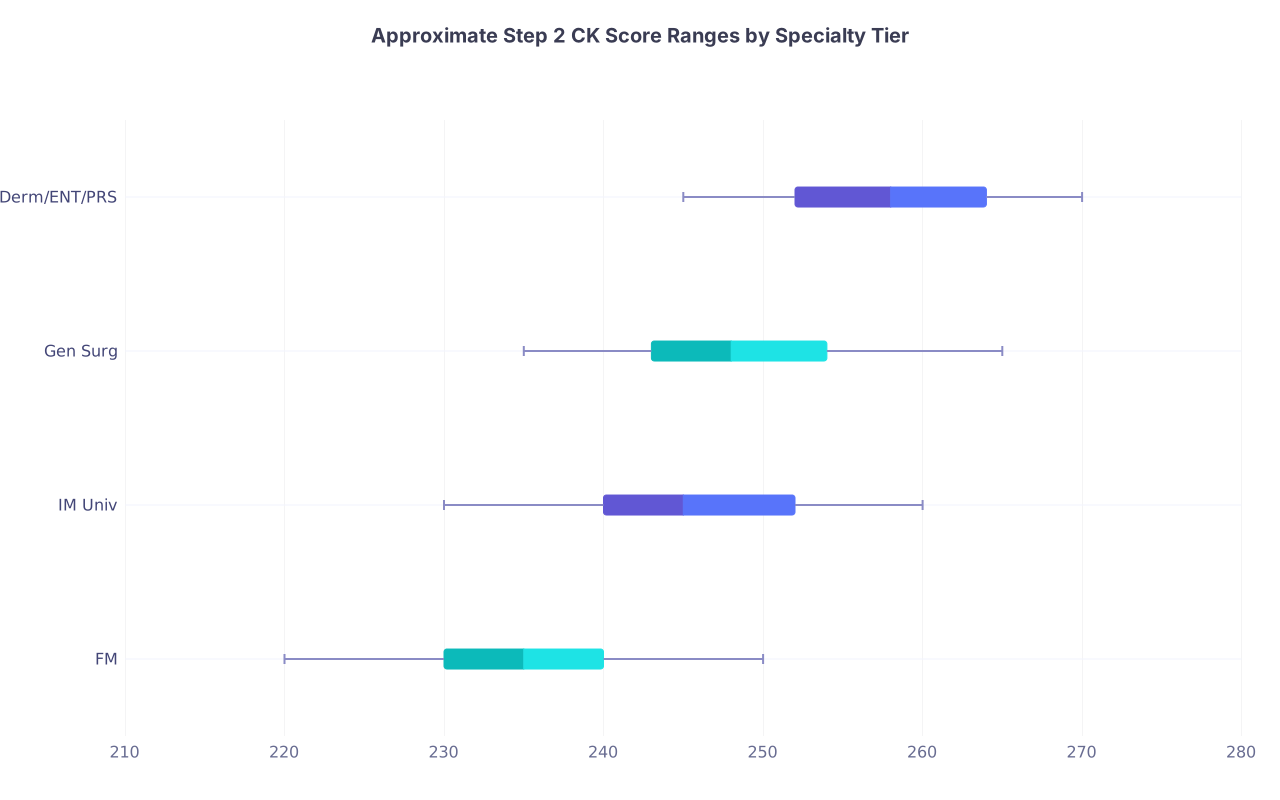
| Category | Min | Q1 | Median | Q3 | Max |
|---|---|---|---|---|---|
| FM | 220 | 230 | 235 | 240 | 250 |
| IM Univ | 230 | 240 | 245 | 252 | 260 |
| Gen Surg | 235 | 243 | 248 | 254 | 265 |
| Derm/ENT/PRS | 245 | 252 | 258 | 264 | 270 |
Legend for that:
- Family medicine: 260 is wildly above typical
- University IM/Gen Surg: 260 is upper-spectrum but not unheard of
- Derm/ENT/Plastics: 260 is very strong but not unicorn level anymore
So yes, you're above the median. Often well above. But "above median" is not "bulletproof."
What the Data Actually Shows About “High Scores” and Interviews
No, there isn’t a magical chart labeled “260+ = 100% interview rate.” But there is hard data from NRMP and specialty organizations that tells you what Step 2 does and does not buy.
Look at broad patterns from NRMP Program Director Surveys (pre-Step 1 P/F, but the hierarchy still matters):
- USMLE scores are among the top factors for granting interviews across specialties.
- But they’re consistently ranked alongside:
- Letters of recommendation
- MSPE/Dean’s letter
- Clerkship grades
- Perceived “fit”
- Professionalism and communication
Even before Step 1 went P/F, Step 2 CK was already heavily used by many programs, especially in IM, surgery, EM, and competitive subspecialties. After Step 1 went P/F, programs shifted more attention to Step 2… but they did not discard everything else.
Let’s visualize how programs conceptually weight factors for interview decisions in competitive specialties (approximate, aggregated across PD survey responses and specialty recommendations).
| Factor | Relative Weight (Approx.) |
|---|---|
| Step 2 CK score | 20–25% |
| Clinical grades/evals | 20–25% |
| Letters of recommendation | 20–25% |
| Research & scholarly work | 10–15% |
| MSPE/Dean’s letter | 10–15% |
Even if Step 2 CK were at the top of that list at 25%, that still leaves 75% of the decision driven by everything else. A 260+ gives you an advantage in one domain.
Not the whole file.
Historical Reality: High Scores Who Still Struggled
I’ve seen:
- A US MD, Step 2 CK 265, applying Ortho. Mediocre home LORs, no away rotations, only one small Ortho project. Applied to 70+ programs. Interviews? Around 10. Did he match? Yes—but not at the brands he thought the score “guaranteed.”
- An IMG, Step 1 250s (pre-P/F), Step 2 CK 262, with no US clinical experience and generic letters from abroad. Applied IM. Interviews were shockingly sparse for that score. Multiple programs literally told him afterward, “Your score was great, but we had concerns about lack of US-based evaluations.”
- A US MD, Step 2 CK 261, applying derm. Strong numbers, average research, okay but not stellar derm letters. Got interviews, but nowhere near “everywhere.” Matched—but into a solid, not “trophy,” program.
What torpedoed people with 260+?
Patterns show up fast:
- Weak or vague letters: “Pleasure to work with,” “Good medical knowledge,” nothing distinguishing.
- Mediocre clinical narratives: MSPE phrases like “requires direction,” “can struggle under pressure,” “inconsistent follow-up.”
- Unimpressive or irrelevant research for uber-competitive fields.
- No home department support in that specialty.
- Social/professional red flags whispered between PDs.
And let’s not pretend away bias:
- DO and IMG applicants with 260+ still often trail US MDs with lower scores
- Some academic programs quietly screen harder on school name than anyone likes to admit
Same score. Different context. Different outcomes.
The Screening Myth: “Score Above the Cutoff, You’re In”
One of the laziest myths: “Programs screen out by score first. If you’re above the threshold, you’re safely in the interview pile.”
Sometimes true. Sometimes not.
Yes, many programs use minimum cut scores to handle volume. But they do not then interview everyone above that line.
Here’s a more accurate flow for many academic IM or Gen Surg programs:

| Step | Description |
|---|---|
| Step 1 | All Applications |
| Step 2 | Auto screen out |
| Step 3 | Initial file scan |
| Step 4 | Reject despite score |
| Step 5 | Holistic review |
| Step 6 | Offer interview |
| Step 7 | No interview |
| Step 8 | Below Step 2 cutoff |
| Step 9 | Red flags present |
| Step 10 | Strong overall fit |
Notice the key step: “Reject despite score.”
Programs absolutely do this with 260+ applicants:
- Poor narrative comments? Out.
- Sketchy professionalism comments? Out.
- No perceived interest in the specialty? Out.
- Applications clearly shotgun with zero connection to program’s strengths? Out.
On the flip side, they keep plenty of 240–250 applicants with stronger letters, better fit, real ties to the program, or killer research.
So yes, a 260+ helps you clear basic filters. It doesn’t keep you safe from deeper review.
Specialty Matters: Where 260+ Helps a Ton vs. Where It’s Just “Good”
Let’s stop treating “residency” like a monolith. Step 2 CK behaves very differently across fields.
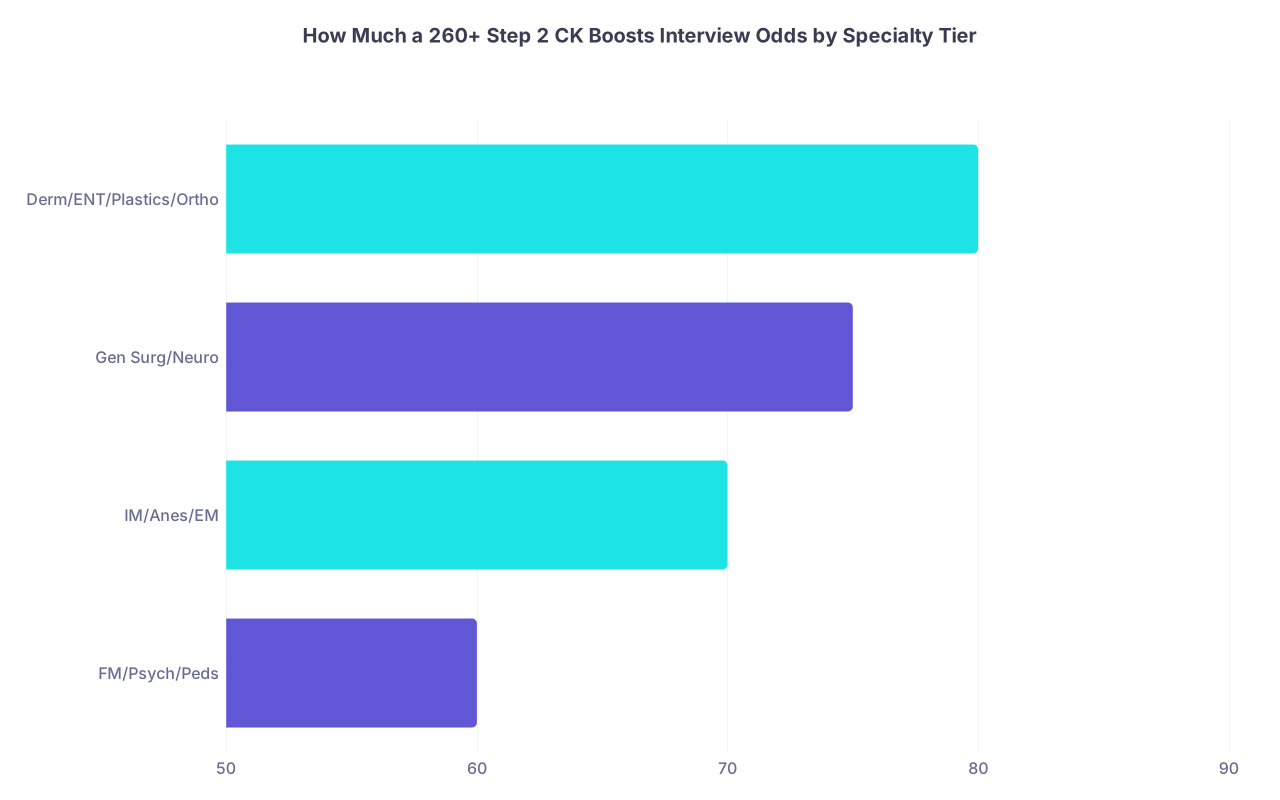
| Category | Value |
|---|---|
| FM/Psych/Peds | 60 |
| IM/Anes/EM | 70 |
| Gen Surg/Neuro | 75 |
| Derm/ENT/Plastics/Ortho | 80 |
Interpret this roughly as “relative boost value” (0–100 scale):
- Family med, psychiatry, peds: 260+ is overkill. You’ll likely get interviews from almost every place that isn’t explicitly targeting “mission fit only.” If you struggle with interviews at this score, the problem is almost never the number.
- Mid-competitive (IM, Anesthesia, EM): 260+ is a big deal, but still only one part. Top academic IM (UCSF, BWH, MGH) is flooded with 250–260+ applicants. They still cut aggressively based on letters, school, and research.
- Surgical fields (Gen Surg, Neuro): Very helpful, but program culture, letters from trusted surgeons, and performance on sub-Is carry equal or greater weight.
- Ultra-competitive (Derm, ENT, Plastics, Ortho, Urology, IR): 260+ is table stakes at many top programs, not a differentiator. You need research, home support, known faculty, and clean clinical narratives.
If you’re aiming for something like Harvard Derm, your 260+ is more “welcome to the pool” than “please pick your interview date.”
The Harsh Truth: Where 260+ Won’t Save You
Let’s go through the most common scenarios where a 260+ does not translate into the interviews people think they deserve.
1. Red Flags in the MSPE or Transcript
Clerkship comments matter. A lot.
I’ve seen MSPEs with phrases like:
- “Sometimes dismissive with nursing staff”
- “Slow to accept feedback”
- “Concerns were raised about timeliness”
Those are death for some programs. No one cares that you got a 263 if the PD reads “professionalism concern” three times in different words.
2. Weak or Generic Letters
For competitive specialties especially, a letter that says:
- “Hardworking, team player, strong fund of knowledge”
…without a single specific story, strong comparative language, or memorable detail—gets you buried.
A 245 applicant with a letter saying “Top 5% of all students I’ve worked with in 20 years, I’d recruit them to my own department immediately” will absolutely outperform a 260 with “solid resident material.”
3. Zero Evidence of Commitment to the Field
Ortho with no away rotations. Derm with no derm research. ENT with no ENT clinic exposure. You get the idea.
Programs hate being someone’s “backup” when they can tell you only started caring about the specialty 6 months ago. Your 260 says you’re smart. It does not say you give a damn about their field.
4. Massive Program-Applicant Mismatch
A community program that serves an underserved rural population sees:
- Your 260+
- 15 publications in basic science
- Personal statement about being a future R01-funded PI at an NIH-sponsored center
They will (correctly) assume you’ll bolt the second you get a university prelim or a research year somewhere. Score or not, they don’t want to be used as your safety net.
5. Being the “Wrong” Applicant Type for the Program
This is the ugly, less discussed part.
Harsh reality:
- Some university programs strongly prefer US MDs
- IMGs with 260+ still routinely get bypassed for US MDs with 240–250 when there’s limited interview slots
- Some programs are not comfortable with DOs in certain subspecialties, regardless of score
You can call it unfair. You’d be right. But pretending that a 260 magically erases those biases is fantasy.
What History Actually Suggests You Should Do With a 260+
So if a 260+ doesn’t guarantee interviews, what does it do? And how do you use it intelligently instead of as a security blanket?
Three practical realities from past cycles:
You can safely broaden your aim, not abandon all strategy.
You can credibly apply to more competitive programs than someone with a 230. That doesn’t mean only to top 10 brand names with zero safety net.You must still build the rest of the application to match the score.
If your test score says “top 10–15% nationally,” but your letters say “middle of the pack,” programs notice that mismatch instantly. They assume the letters are the truth, and the score is the outlier.You absolutely, positively should not under-apply.
I’ve watched 260+ applicants apply to 20–25 programs in competitive fields because “I should be fine.” They weren’t. They scrambled. The score did not bail them out of bad strategy.
If you want a rule of thumb:
260+ in moderately competitive fields (IM, Anes, EM, Peds):
You can probably shave off some ultra-safety programs, but you still need a mix of reach/target/safety and attention to geographic ties.260+ in hyper-competitive fields (Derm, Ortho, ENT, Plastics, IR):
Great. Now act like it doesn’t exist and prepare everything else—research, aways, letters, statement—as if you had a 245 and need every other angle maxed.
So, Does 260+ Guarantee Interviews?
No. History is brutally clear on this.
A 260+ Step 2 CK:
- Makes it much easier to clear hard score screens
- Puts you in a strong position if your letters, clinical performance, and story match
- Does not erase red flags, weak narratives, or mismatched applications
- Does not overcome systemic biases in school type or visa status
- Does not guarantee interviews at top programs in any competitive specialty
People love to worship one number because it’s simple and comforting. Real residency selection is messy, political, and annoyingly holistic.
You should absolutely be proud of a 260+. You earned it. But if you treat it like a golden ticket, you’re setting yourself up for a very rude wake-up call when ERAS opens and the silence from “dream programs” is louder than you expected.
Years from now, you will not remember the exact number on your Step 2 CK score report as the defining moment; you’ll remember whether you built a whole application worthy of being there—or whether you trusted a single metric to do a job it was never designed to do.