
It is early September. ERAS just opened. You are staring at your Step 2 CK score: 243.
Your friends are posting 250s and 260s in the group chat. Someone says, “Bro, just retake, you can crush a 255 easy.” Another: “Programs only care about the highest score anyway.”
You start thinking: Maybe if I retake Step 2, I can “fix” this.
Stop right there. This is where people quietly set their applications on fire.
You are not just deciding whether to take another test. You are deciding whether to permanently change your USMLE record in a way that you can never erase and that program directors will absolutely see and judge.
Let me walk you through the mistakes I see over and over—because by the time people realize they miscalculated, their second score is already in the system and ERAS is already submitted.
The Ugly Truth About Retakes: Programs See Everything
First misconception that needs to die: “Programs only care about my highest Step 2 score.”
Wrong.
ERAS shows:
- Every attempt
- Every score
- Every fail
- The sequence and the trend
You are not replacing your score. You are adding a second data point that can:
- Lower your average
- Raise questions
- Suggest poor judgment
Even if your second score is slightly higher, the story can still be bad.
Example I have actually seen more than once:
- First Step 2: 244
- Second Step 2 (retake): 247
Objectively, both are strong scores. But now the PD is thinking:
- Why did this person feel the need to retake a solid pass?
- Did they underestimate the time, judgment, or resilience required in residency?
- Are they perfectionistic to a fault?
In a competitive specialty, where they have 40 spots and hundreds of qualified applicants, many will prefer a clean, single 244 to a 244 ➝ 247 retake story. Less risk. Less drama.
Retakes do not automatically signal “grit.” More often they signal “could not accept reality and tried to game it.”
When Retaking Step 2 CK Is Clearly Dangerous
There are scenarios where retaking Step 2 almost always hurts more than it helps. If you are in one of these, I want you to hold the pen before you sign up again.
1. You Already Passed With a Respectable Score
If you passed on the first attempt with a score that is:
- At or near your specialty’s average, or
- Strong for your home institution’s match patterns
…retaking is usually a vanity project, not a strategy.
Let me be blunt: A 235+ in most core specialties (IM, peds, family, psych, neurology, OB/GYN) with no red flags is already “good enough” for a wide range of solid programs—especially in your region and at your home-type institution.
Is 235 competitive for Harvard MGH internal medicine? Probably not. But if your overall application is not top-tier, magically scoring a 255 on a retake will still not transform you into a Harvard-bound applicant. Programs will rank the whole file, not just that one line.
The mistake: believing a 10–15 point bump will suddenly move you into a totally different tier of programs when the rest of your application does not match that level.
What you risk instead:
- A lower or similar score that makes you look worse
- Lost weeks of time that should have gone to your personal statement, letters, and rotation performance
- Added anxiety and distraction right when interviews and ERAS prep should dominate your attention
2. You Are Retaking Purely From Anxiety or Peer Comparison
If the real reason you are considering a retake is:
- “Everyone else scored higher”
- “My friend told me programs want 250+ now”
- “I am worried this will not be ‘impressive’ enough”
…that is not a strategic reason. That is fear.
People forget something important: Program directors do not need you to be perfect. They need you to be safe, reliable, and sane to work with at 3 AM. A student who makes reckless decisions and cannot accept a good result will worry them more than someone with a slightly lower but stable score.
If anxiety is the driver, get perspective before you schedule an exam:
- Talk to your dean or an advisor who actually sees match data.
- Ask specialty-specific faculty, not random classmates or Reddit.
- Look at actual program requirements, not rumors.
Retaking from fear is one of the fastest ways to create the exact red flag you are scared of.
3. You Do Not Have the Time to Prepare Properly
This one is brutal but common.
Timeline mistake: Student takes Step 2 in July, gets a score “okay but not great” in August, panics, and decides to retake in late September so that the new score might show up during application review.
Reality: You now have maybe 4–6 weeks, while on a clinical rotation, while writing your personal statement, while chasing letters, while filling ERAS. And you think you are going to dramatically outperform your prior score?
This is where scores drop. Not by a little. By a lot.
I have seen:
- 239 ➝ 226
- 232 ➝ 220
- 245 ➝ 236
At that point, there is no clever spin. PDs see a downward trend, a failed gamble, and questionable insight. You cannot explain that away in an interview without sounding defensive.
If you do not have a solid 8–10 weeks of high-quality, focused study time, on a lighter rotation or dedicated time, betting your application on a retake is reckless.
The Myth of the “Score Upgrade”: Why Gains Are Less Likely Than You Think
Students routinely overestimate their ability to raise Step 2 scores on a retake. The idea is: “I got 238 with little studying; imagine what I can do if I really try.” That is fantasy math.
Real-world obstacles:
Diminishing returns
You have already mined the low-hanging fruit. Your basics are fine. The next 10–15 points require clinically nuanced reasoning, better test-taking, and robust stamina. That does not appear in four anxious weeks.Bias in self-assessment
People remember the questions they “almost got right.” They forget the huge number they got right purely from partial knowledge and luck. The exam already gave you some “free” points you do not control.Real life interference
On retake: more clinical duties, more fatigue, less novelty, more burnout. Cranking out 2,000 UWorld questions again while on wards is much uglier than it looks on a spreadsheet.
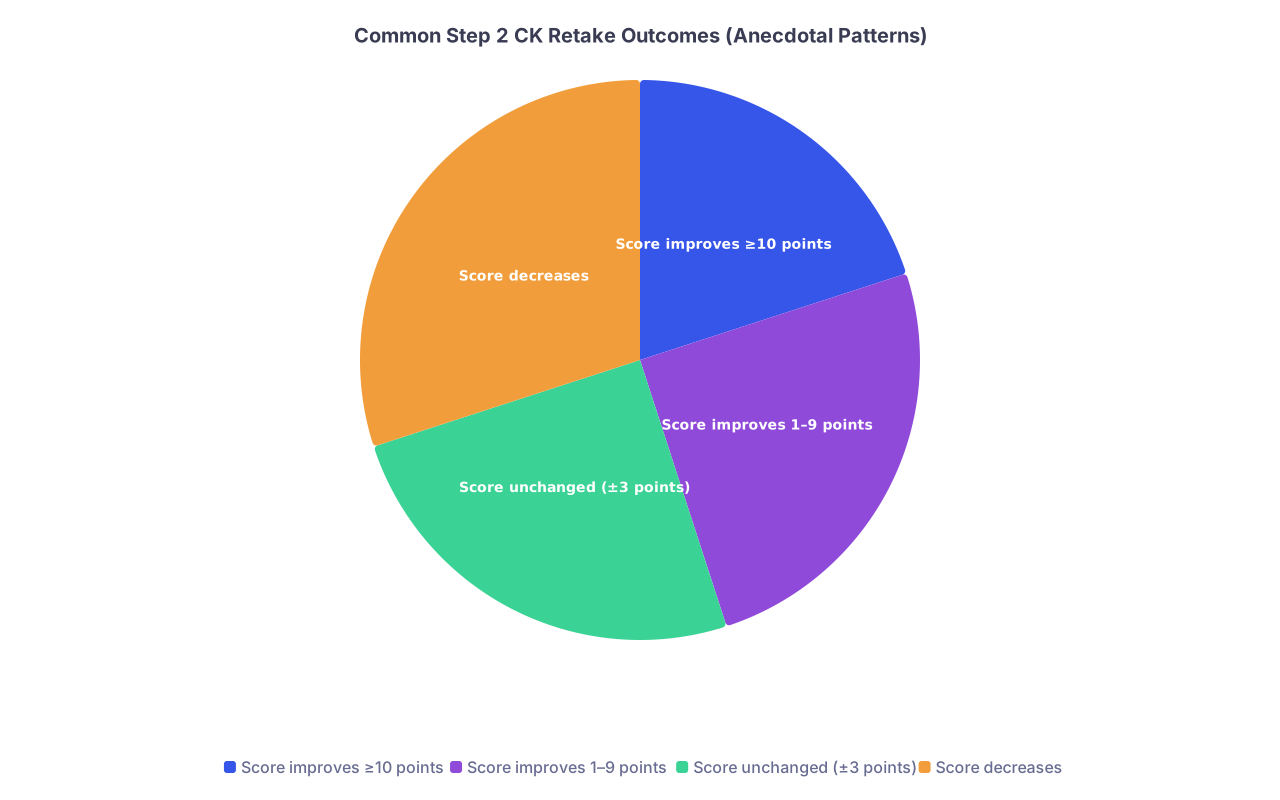
| Category | Value |
|---|---|
| Score improves ≥10 points | 20 |
| Score improves 1–9 points | 25 |
| Score unchanged (±3 points) | 25 |
| Score decreases | 30 |
Those numbers are not from a published paper, but they are very close to what I have seen across multiple classes: a large chunk of students either gain almost nothing or actually go backwards.
The key point: retaking is a risk, not a guaranteed upgrade. You need a very compelling reason to expose your entire residency application to that risk.
When a Retake Might Help — And How People Still Mess It Up
There are narrow situations where a Step 2 CK retake can be reasonable. Students still manage to sabotage these by executing them badly.
Situation 1: A True Outlier Low Score for Your Overall Profile
If your Step 2 is dramatically lower than:
- Your Step 1 (if reported)
- Your shelf exam performance
- Your NBME practice tests
…and you have a plausible explanation beyond “I got nervous,” a retake might sometimes be defensible.
Some programs do consider “trajectory” and “redemption.” A jump from, say, 215 to 238 with strong narrative around illness, documented disruption, or objectively atypical performance can reduce the sting of that original score.
Where students screw this up:
- They do not secure sufficient dedicated time before retaking.
- They retake just before ERAS with rushed prep.
- They treat the retake like “normal studying” instead of a targeted surgical strike on weaknesses.
- They cannot articulate clearly in interviews why the first attempt underperformed and what changed.
If you cannot show a clear process change—study planning, practice performance, health or logistics—then a big jump looks more like random variance than reliable improvement. PDs want reliability.
Situation 2: A Prior Fail on Step 2 CK
If you failed Step 2 CK, you have no choice. You must retake.
The mistake here is different: students underestimate how harshly some programs view multiple attempts. A fail + pass is survivable, especially in less competitive fields or at community programs. But a fail + marginal pass is dangerous. And a fail + second weak score + talk of a third attempt? That is almost game over for many specialties.
Your retake must be decisive. Conservative, not heroic. That means:
- Do not rush to test again “just to get a pass on file.”
- Do not schedule while you are still scoring borderline on NBMEs.
- Use multiple independent indicators: UWorld %, NBME scores, practice exams.
And absolutely do not plan a third attempt while hoping “some programs will understand.” Many will not.
Situation 3: Highly Competitive Specialty + Clear Cutoff Issue
There are a few ultra-competitive specialties (derm, plastics, ortho, ENT, neurosurgery) where some programs use specific score cutoffs, and your score may place you just below those.
In rare cases, for a very strong candidate with research, home support, and a realistic shot at top programs, a carefully planned retake might shift them from “auto-screen out” to “screen in” at select places.
Mistakes here:
- Believing that a retake alone can overcome a weak CV. It cannot.
- Not confirming with mentors who actually match into these fields that a retake makes sense.
- Retaking without clear data that you can outperform substantially (e.g., NBME scores consistently 15–20 points above your prior score).
Program Director Reality: How They Actually Read Your Scores
You need to stop imagining a PD lovingly analyzing your score micro-trajectory. They are drowning in applications. They glance.
Roughly what they care about:
| Score Pattern | Typical Interpretation |
|---|---|
| Single solid pass | Reliable, acceptable |
| Single very strong score | Academic strength, low concern |
| Fail then strong pass | Concern but possible redemption |
| Two attempts, small gain | Questionable judgment, noise |
| Two attempts, lower score | Red flag, poor planning/risk |
That “two attempts, small gain” line is where many anxious students land. They add a second data point that did not move them into a different category but did add doubt about their decision-making.
A PD is not asking, “Did this student maximize their personal potential?” They are asking:
- Is this applicant safe to rank?
- Do they look stable, realistic, and self-aware?
- Are they likely to pass in-training exams and boards?
- Are they going to drain our faculty with drama?
A retake that does not clearly solve a real problem can make you look like a risk, not an asset.
The Hidden Costs of Chasing a Higher Step 2 Score
Even if your retake somehow ends with a slightly higher number, you pay in other currency. Students routinely ignore these.
Opportunity cost: What you are not doing
While you are re-studying for Step 2, you are not:
- Building relationships with letter writers
- Honing your personal statement
- Improving MSPE comments on sub-I’s by being fully present
- Fixing weak spots in your application (gaps, lack of leadership, poor narrative coherence)
I have watched students grind for a retake, bump their score 8 points, and then submit a generic, bland personal statement and weak letters—because they ran out of time and emotional energy.
Guess which one actually moved the needle more for most programs? Not the 8 points.
Psychological toll: How you show up in interviews
Retakers often underestimate how much the process bleeds into the rest of the season:
- More self-doubt in interviews
- Preoccupation with explaining the retake story
- Subtle defensiveness when asked about “challenges” or “setbacks”
Some students become obsessed with explaining their scores rather than selling their strengths. That is a losing strategy.
Narrative damage: Your application story gets messy
Programs like clean narratives:
- “Solid student, steady performance, good team comments.”
- “Improving trajectory, clear growth, specific interests.”
A retake injects complexity:
- “Why did this student retake a pass?”
- “What exactly went wrong the first time?”
- “Are they prone to poor judgment under pressure?”
If your reason boils down to “I wanted a higher number,” it sounds shallow and impulsive. Even if that is the truth, you need a better story—and ideally, no retake at all.
How to Decide: A Ruthless Checklist
Use this as a filter. If you do not get a strong “yes” at multiple steps, you probably should not retake.

| Step | Description |
|---|---|
| Step 1 | Considering Step 2 retake |
| Step 2 | Retake required - plan carefully |
| Step 3 | Do NOT retake |
| Step 4 | Retake may be reasonable |
| Step 5 | Did you fail Step 2? |
| Step 6 | Is your score below most program cutoffs for your specialty? |
| Step 7 | Do trusted mentors strongly recommend retake? |
| Step 8 | Are practice scores clearly higher now? |
| Step 9 | Do you have 8-10 weeks to prep properly? |
If you reach that final “retake may be reasonable” box, you are in the minority. Most students stop earlier if they are honest.
Pay special attention to two checkpoints:
Mentor input
Not your classmates. Not random subreddit comments. A faculty member or dean who knows your file and sees match outcomes every year. If their answer is lukewarm—“you could consider it”—that is usually a “no.”Objective practice data
“I feel like I can do better” is useless. If your NBMEs and practice exams are not consistently much higher than your current Step 2 score, you are gambling, not strategizing.
Better Ways to “Improve” Your Application Than Retaking Step 2
If your Step 2 CK score is okay but not spectacular, and you feel pressure to “do something,” good. Channel that energy into things that actually move your chances instead of risking a retake.
Options that often pay off more than 10 extra CK points:
- Crush your sub-internships. MSPE and narrative comments carry real weight.
- Get strong, specific, recent letters of recommendation from people who know you well.
- Tighten your personal statement into a focused, coherent story instead of generic fluff.
- Apply smartly: a balanced list, including community and mid-tier programs, not just fantasy reaches.
- For some specialties, adding a focused research experience or a poster can help more than marginal score gains.
None of those require you to roll the dice on a second attempt that lives on your ERAS record forever.
The Bottom Line
Three things I want you to walk away with:
- A Step 2 CK retake is not a score edit; it is a permanent second data point that programs will judge, and often not in your favor.
- Unless you failed, have a true outlier low score with strong objective evidence you can do much better, and have solid mentor backing plus enough preparation time, retaking usually hurts more than it helps.
- Most students are far better off accepting a solid pass, strengthening the rest of the application, and avoiding the temptation to chase a “prettier” number that could end up sabotaging their match.