
The fastest way to turn a borderline Step 2 CK score into a giant red flag is to talk about it too much.
Let me be blunt: programs are usually willing to move past a low Step 2 CK. Applicants convince them not to.
You think you are “providing context.” In reality, you are raising doubts about judgment, insight, and resilience. I have watched it happen in real time: a resident walks out of an interview and says, “The score was not the problem. The way they would not stop talking about it was.”
If you have a disappointing Step 2 CK, you need a strategy. But that strategy is absolutely not giving a mini–grand rounds on why you scored what you scored.
This is where people wreck perfectly salvageable applications.
The Core Mistake: Treating Step 2 CK as the Main Character
The mistake is simple: you walk into the interview believing your entire job is to defend your Step 2 CK score.
So you:
- Bring it up before anyone asks.
- Over-answer the question when they do ask.
- Circle back to it unprompted “just to clarify.”
Every minute you spend litigating Step 2 CK is a minute you are not:
- Showing how you think clinically
- Demonstrating that you are teachable
- Connecting with the program’s culture
- Proving you can function as a reliable intern at 2 a.m.
Programs rank people they want to work with. Not people who can give the longest explanation for a standardized test.
Here is the part applicants underestimate: most programs already know how to interpret a low Step 2 CK. They have seen hundreds of these applications. They know score distributions. They know that good residents come from all over that curve.
Overexplaining says something else: “This score still controls me.”
That is the real problem.
What Overexplaining Actually Signals (And Why It Freaks PDs Out)
You think you are helping them understand. They hear something different.
1. Poor Prioritization Under Pressure
An interviewer asks: “I see your Step 2 CK is a bit lower than your Step 1. Can you tell me about that?”
Correct answer lives in 20–40 seconds.
The overexplainer does 4–6 minutes. They:
- Walk through every exam they have ever taken since high school
- Bring up drama with roommates, faculty, or the testing center
- Talk in circles about anxiety, “was not my best day,” “I usually test better”
- Shift blame to school, schedule, clerkship timing
Now imagine the PD sitting there thinking: “This is how this person handles a straightforward question? How will they handle an acute change in a patient’s status at 3 a.m.?”
If you cannot filter and prioritize in an interview, why should they trust your judgment on the wards?
2. Fragility Instead of Resilience
Residency is failure-rich. Notes get torn apart. Plans get overridden. Patients decompensate despite your best effort.
Programs want people who can:
- Take a hit
- Absorb it
- Adjust
- Move on
The applicant who keeps re-opening the Step 2 wound in every answer is broadcasting the opposite: “One bad test still owns my headspace months later.”
Overexplaining often sounds like:
- “I panicked when I saw the first few questions…”
- “I knew halfway through that I was failing…”
- “I still think about that exam all the time…”
Now the question becomes: What happens when this person gets a bad evaluation? Or fails their in-service exam? Or loses a patient?
Programs are not just assessing knowledge. They are assessing emotional stability under chronic stress.
3. Lack of Insight Into Real-World Priorities
I have heard versions of this line too many times:
“I just want you to know that this score does not represent who I am.”
The faculty silently think: “We know. We already know that. What we are trying to find out now is who you actually are.”
When you spend half your interview time on Step 2 CK, you are implicitly saying, “I think this test matters more than everything else I bring.” That is immature thinking. Programs want candidates who have perspective: exams are one part of a bigger professional identity.
Obsessing over the score signals that you are still operating in undergraduate, test-based mindset. Not as someone stepping into a physician role.
How Programs Actually Look at a Low Step 2 CK
You are imagining one narrative: “Low Step 2 CK = automatic rejection.”
They are usually thinking in buckets, not absolutes.
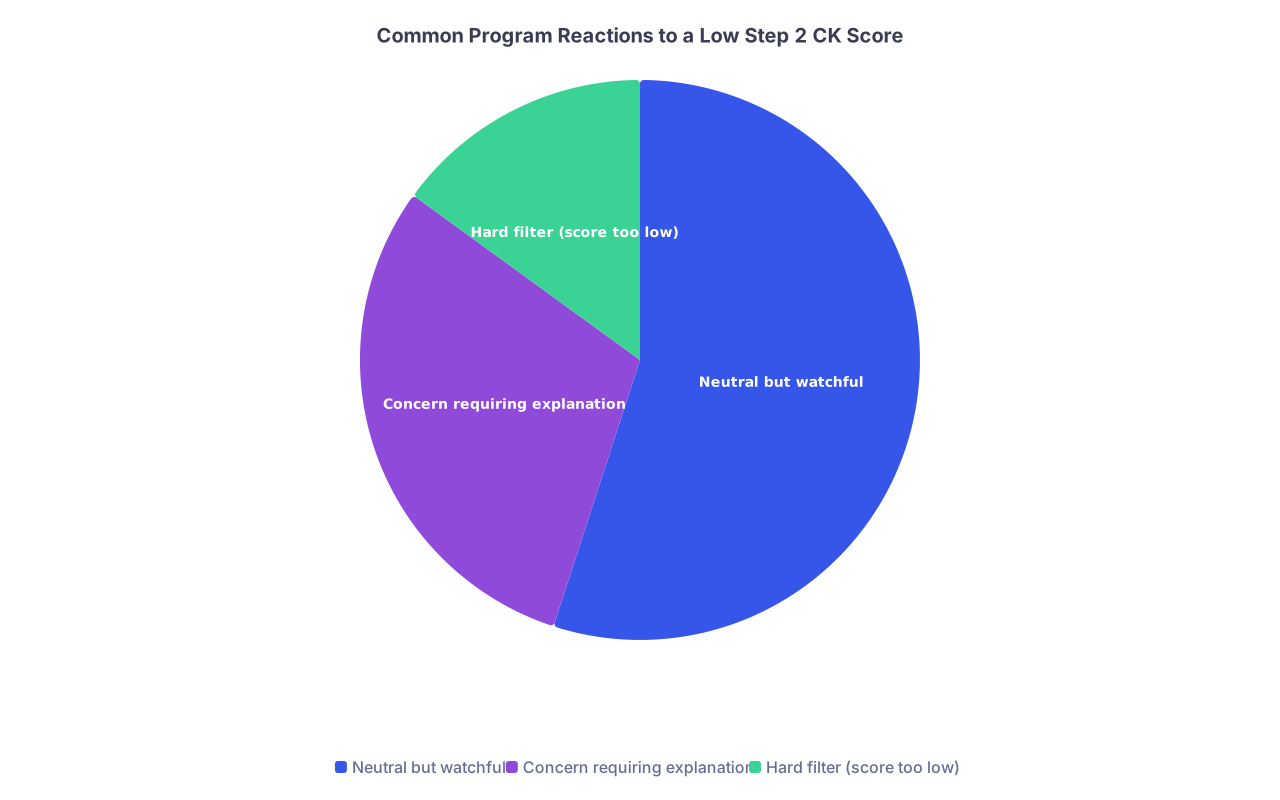
| Category | Value |
|---|---|
| Neutral but watchful | 55 |
| Concern requiring explanation | 30 |
| Hard filter (score too low) | 15 |
Most programs put you into one of three categories:
Score is low-ish but acceptable for this specialty/program.
They just want to confirm you are not unreliable, disorganized, or burned out.Score is a genuine concern (near failure, or much lower than Step 1).
They need a short, coherent explanation and clear evidence you can pass future boards.Below hard cutoffs / institutional thresholds.
You likely never receive an interview here anyway.
That middle group is where people destroy themselves. It is salvageable. Until you talk them out of giving you the benefit of the doubt.
Programs usually want three simple things:
- A plausible, concise explanation (if they ask at all)
- Evidence of upward or at least stable performance elsewhere (clerkship grades, sub-I, shelf exams)
- Clear plan and attitude toward future licensing exams
Notice what is not on that list: a 10-minute monologue about your exact percentile, the practice tests, or your Prometric experience.
The Most Common Overexplaining Patterns (And How They Backfire)
I will walk through the greatest hits I have seen tank interviews.
1. The “PowerPoint in Your Head” Explanation
You can tell the applicant rehearsed a full script:
- “So first, I want to give you some background about my preclinical years…”
- “Then I had a family situation I would like to elaborate on…”
- “Then on test day, what happened was…”
You can almost see the imaginary slides.
Problem: it feels canned, self-centered, and tone-deaf to the flow of conversation. You are answering the question you wanted them to ask, not what they actually asked.
Faculty reaction: “This person is using me as an audience for their defense speech. They are not listening. They are performing.”
2. The Overpersonal Disclosure
This one is especially damaging.
Examples:
- Going into graphic detail about mental health struggles beyond what is necessary
- Describing serious family trauma at length when a brief mention would have sufficed
- Discussing conflict with faculty or administration in a way that makes you sound volatile
You may think vulnerability builds connection. Up to a point. But interviews are still professional evaluations, not therapy sessions.
Over-disclosing around Step 2 often raises more questions:
- Is this issue stable now?
- Are they at risk of burnout or breakdown under residency hours?
- Will we constantly need to adjust schedules or coverage?
You are allowed to mention real obstacles. Just not in excruciating detail.

3. The Blame-Shift Narrative
This is the one that quietly kills an applicant even when the rest of their file looks good.
Red-flag phrases:
- “Our school’s scheduling really set me up poorly…”
- “The exam had so many vague questions; I do not think it really tested knowledge…”
- “There were huge issues at the testing center that threw me off…”
Sometimes these things are partially true. The problem is what they reveal: when things go badly, your first instinct is external blame, not internal reflection.
Program directors listen for ownership. They do not expect you to love the test. They do expect you to own your performance and your preparation.
4. The “Let Me Prove I Actually Know Stuff” Spiral
You feel ashamed of the number, so you start trying to “re-take” Step 2 in the interview:
- Overcomplicating clinical answers to show off knowledge
- Dropping random guideline details that are not relevant to the question
- Giving 7-step differential diagnoses to straightforward prompts
It sounds insecure. And worse, it often reveals gaps in clinical reasoning that were never the problem in the first place.
Your job in the interview is not to relive the exam. It is to show how you operate as a human in a clinical team.
When And How To Address a Low Step 2 CK Without Hurting Yourself
You cannot just pretend the score does not exist. But you must handle it with surgical precision.
Rule 1: Do Not Volunteer It Prematurely
If they do not ask about Step 2 CK, you usually do not bring it up.
The exceptions:
- The score is close to failing or failed and you have a clear, concise explanation and documented remediation or pass afterward.
- They explicitly asked in advance for you to be ready to discuss board performance (rare but possible).
Otherwise, let your entire application speak. Not just that number.
Rule 2: Answer the Question Actually Asked
If they say, “I noticed your Step 2 is lower than Step 1. Can you tell me about that?” they did not ask for your entire life story or an oral NBME.
Good structure:
- Brief context (1–2 sentences)
- Specific, responsible explanation (1–3 sentences)
- Concrete evidence you have improved / are stable now (2–3 sentences)
- One sentence pointing forward
Anything beyond that is usually self-sabotage.

| Step | Description |
|---|---|
| Step 1 | Interviewer asks about Step 2 CK |
| Step 2 | Give concise 4 part answer |
| Step 3 | Answer only what was asked |
| Step 4 | Stop talking |
| Step 5 | Is question broad or specific |
Rule 3: Own Your Role Without Self-Destruction
There is a difference between:
“I had a lot going on that month and the circumstances really hurt my performance.”
vs.
“I underestimated how much time I needed for dedicated prep, and I did not adjust early enough. I have since changed how I plan for major exams and my [shelf/in-service/COMLEX] reflects that.”
The second version shows:
- Awareness
- Responsibility
- Adaptation
That is exactly what programs want to see.
Concrete Examples: Good vs. Self-Destructive Responses
Let us look at specific scripts. Use the structure, not the exact wording.
Scenario 1: Step 2 Lower Than Step 1, But Both Passable
Bad (overexplaining, rambling):
“So, I just want you to know that test really does not reflect my actual knowledge. I had issues with my school scheduling, I was on a really tough rotation leading into dedicated, and my grandmother was sick, and I also had some personal mental health struggles that I am still kind of working through. I normally do much better on standardized tests—I scored really high on practice exams, like in the 240s—and I was really surprised and devastated when I saw the result…”
Good (concise, mature):
“I was disappointed that my Step 2 was lower than my Step 1. I misjudged how much time I needed to balance clinical duties and exam prep, and my dedicated period was more fragmented than it should have been. Since then, I have adjusted how I plan for major exams, and my medicine and surgery shelf scores, as well as my sub-I evaluations, are much more in line with my actual clinical performance. I feel confident in my ability to prepare effectively for future board exams.”
Notice: no drama, no excuses, clear ownership, clear correction.
Scenario 2: Very Low or Failed Step 2 CK With Retake
Here you must address it. But still not with a 10-minute saga.
Destructive:
“The first time I took Step 2, everything that could go wrong did. My roommate situation was a disaster, my school did not support me, I had test-center issues, and I felt completely abandoned. I do not even think the exam is a fair representation of clinical medicine, especially because a lot of the questions were really vague. After failing, I was in a really dark place for a while and thought about quitting medicine…”
Better:
“I failed Step 2 on my first attempt, which was a serious wake-up call. I was trying to manage too many personal and academic responsibilities at once and did not structure my preparation well. After that, I worked closely with our academic support office, created a detailed study plan, and sat for the exam again once my practice scores were consistently in the passing range. On my retake, I passed comfortably. Since then, I have continued to perform reliably on clinical rotations and exams, and I have a clear plan for staying on top of future board requirements.”
Short. Accountable. Forward-looking.

How To Prepare So You Do Not Overexplain In the Moment
Overexplaining is usually a panic response. You feel cornered, so you talk. And talk. And keep talking.
You can reduce that risk by preparing properly.
1. Write Your 30–60 Second Answer
Not a script to memorize word-for-word. But a skeleton:
- One line of acknowledgment
- One line of responsible cause
- Two to three lines of evidence of improvement
- One line about your plan / confidence going forward
Practice it aloud until you can say it calmly without racing or overloading details.
2. Practice Stopping
This sounds ridiculous, but it works.
Have a friend or mentor ask: “Can you tell me about your Step 2 CK performance?”
You give your 30–60 second answer. Then you shut up.
If you feel compelled to keep talking, that is your warning sign. Learn to tolerate that discomfort. If they want more, they will ask.
3. Watch Your Body Language
Overexplaining is not just verbal. It is:
- Nervous laughing
- Over-gesturing
- Hunching or shrinking when Step 2 comes up
- Shifting in your seat, looking down, speaking too fast
These all scream, “This topic destabilizes me.”
You want the opposite signal: “I understand this might be a question. I have thought about it, grown from it, and moved on.”
The Quiet Opportunity You Miss When You Overexplain
There is another cost to overexplaining that people forget: you crowd out your strengths.
A 15–20 minute interview gives you a handful of chances to land real impressions:
- That you work well with nurses and staff
- That you can talk to patients like a human
- That you are curious and coachable
- That you understand the reality of their program (hours, acuity, culture)
Every long Step 2 monologue steals time from something that could actually move you up their rank list.
Programs remember standout moments: a thoughtful answer about a difficult patient, a clear explanation of what you learned from a mistake on rotation, a specific reason you are interested in their trauma service or their community health initiatives.
Nobody ranks someone higher because they gave the most extensive postmortem on a 220.
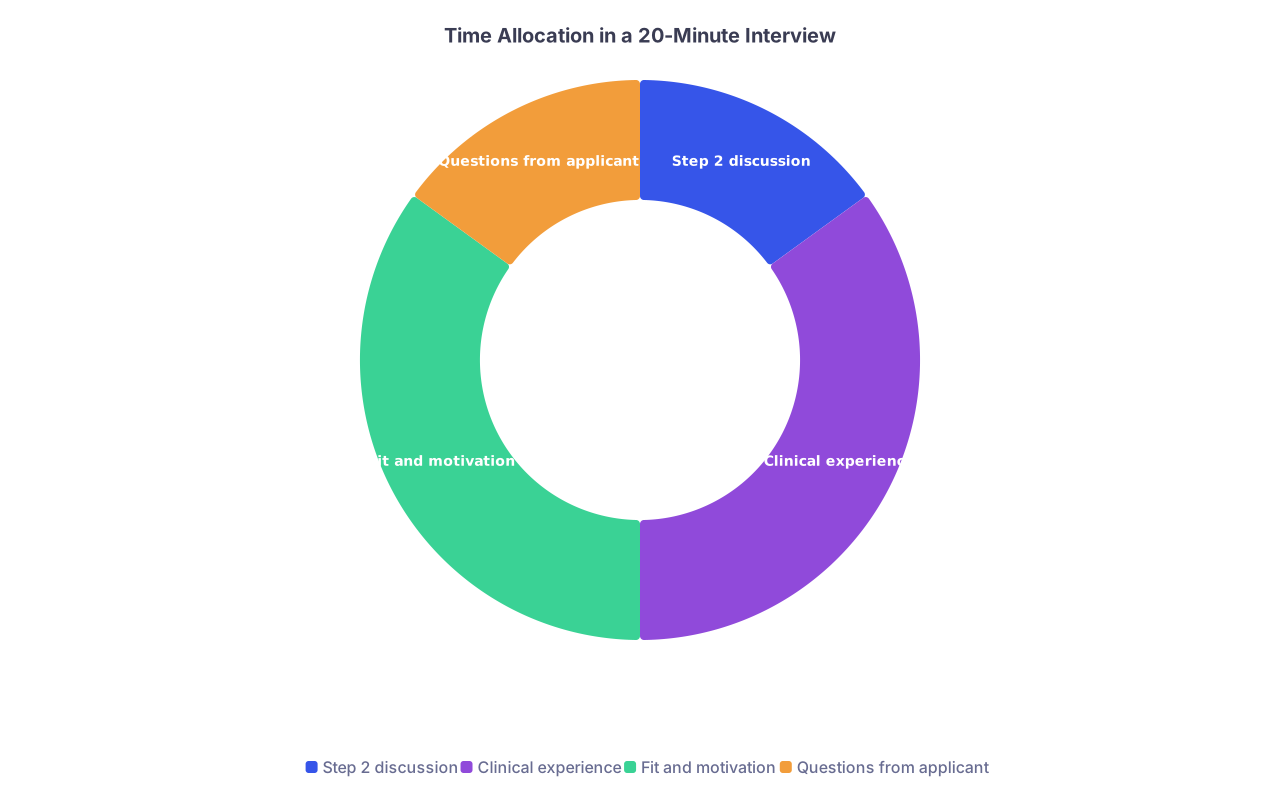
| Category | Value |
|---|---|
| Step 2 discussion | 3 |
| Clinical experience | 7 |
| Fit and motivation | 7 |
| Questions from applicant | 3 |
Your job is to keep Step 2 in that small slice. Not let it swallow the whole interview.
A Quick Reality Check: How Much Programs Truly Care
Let me be clear: Step 2 CK matters. Especially in competitive specialties and academic programs. You cannot wish that away.
But for most candidates sitting in an interview chair, the decision is no longer about the number alone. You got the interview. That means they already decided your application is at least plausible.
Now they are asking different questions:
- Will this person show up on time?
- Will they dump work on others or carry their weight?
- Will they crumble or adjust when things get hard?
- Will they represent the program well with patients and other departments?
How you talk about a low Step 2 CK is just one piece of that larger assessment. The goal is to handle it in a way that does not compete with everything else you could be showing them.

The Bottom Line: Do Not Let One Score Dominate Your Interview
Three things I want you to remember:
Overexplaining your Step 2 CK almost always looks worse than the score itself.
Long, defensive, or emotional explanations signal poor judgment, fragility, and lack of perspective.You need a short, honest, forward-looking answer—then you move on.
Own your role, mention growth, point to concrete evidence of improvement, and stop talking unless asked for more.Your interview value is everything that comes after that question.
Clinical maturity, interpersonal skills, program fit, and resilience are what get you ranked. Do not sacrifice those on the altar of one imperfect exam.
Handle the Step 2 question cleanly. Then spend the rest of your time showing them why they want you on their team at 3 a.m. That is how you stop a low score from defining you.