
The way competitive programs use Step 2 CK is not what you’ve been told. It’s not just a “board score.” It’s a stress test for your trainability.
Let me walk you through what really happens in those closed-room rank meetings, when your application is on the screen and someone says, “Let’s pull up the Step 2.”
What Step 2 CK Actually Signals Behind Closed Doors
On paper, Step 2 CK is a clinical knowledge exam. In reality, strong programs treat it as a proxy for three things:
- How you perform under pressure when the stakes are higher
- How fast you learn from feedback and failure
- How much risk they take by ranking you highly
I’ve heard this exact sentence from a program director at a top 10 IM program:
“Step 1 tells me what you did with four years of college and two preclinical years. Step 2 tells me what you did once you realized residency was coming.”
They’re not wrong.
Step 2 sits at a very specific inflection point: you’ve seen the wards, you’ve had at least some sense of real medicine, you’re busier, more tired, and your excuses are thinner. So if you rise here, they assume you’ll rise again under the even worse conditions of residency.
If you flatline or drop? The conversation becomes: “Can they handle real escalation in intensity?”
That’s trainability. Not raw intelligence. Not how well you memorize UWorld tables. How your trajectory changes when the heat turns up.
Why Competitive Programs Obsess Over Trajectory, Not Just the Number
Most students stare at the final Step 2 number. Program directors stare at the pattern.
They line things up mentally:
- Preclinical grades
- Step 1 (pass vs fail, and if known, the old numerical or school quartile)
- Clinical clerkship grades
- Step 2 CK
And they ask: “What direction is this person moving?”
Let me give you three archetypes I’ve watched being dissected in real meetings.
1. The “Late Bloomer” – Step 1 Mediocre, Step 2 Strong
Example:
- Step 1: Pass, school says “average” or bottom half
- Step 2: 252
- Clinical: Mostly Honors, strong medicine and surgery comments
Inside the committee room, the conversation changes from skepticism to interest very quickly:
“Okay, so they figured it out once they got clinical. That’s exactly what we want.”
Programs—especially in IM, EM, anesthesia, general surgery—love this pattern because it screams “trainable.” You didn’t peak early. You got better when the environment became more like residency.
2. The “Early Peak” – Step 1 Stellar, Step 2 Flat or Drop
Example:
- Step 1: 258
- Step 2: 241
- Clinical: Mix of High Pass and Honors, comments: “solid,” “reliable,” but nothing glowing
I’ve heard this phrased almost verbatim:
“Strong test taker, but I don’t see growth. Step 2 is a bit of a step down. Are they coasting?”
Programs do not automatically discard you—258 still buys a lot of leeway—but they’re less impressed than you think. In competitive specialties (derm, ortho, neurosurg, rad onc), a noticeable drop can spur a whispered: “Why the decline once they hit the wards?”
Not fatal. But it weakens the “trainability” narrative.
3. The “Consistently Struggling” – Step 1 Weak/Pass, Step 2 Still Mediocre
Example:
- Step 1: Bare pass on first try, or known to be low
- Step 2: 221–225
- Clinical: Mostly Pass, a few High Pass, no clear upward trajectory
This is where committees get nervous. The actual thoughts:
- “We’ll have to watch them closely.”
- “Can they pass our in-service? Our boards?”
- “Do we have the bandwidth to remediate if things go sideways?”
You’re not automatically out, especially at less hyper-competitive programs. But high-octane programs cannot afford multiple remediation projects. They’re not just ranking a student; they’re betting on whether you’ll pass ABIM/ABS/ABEM boards on the first try.
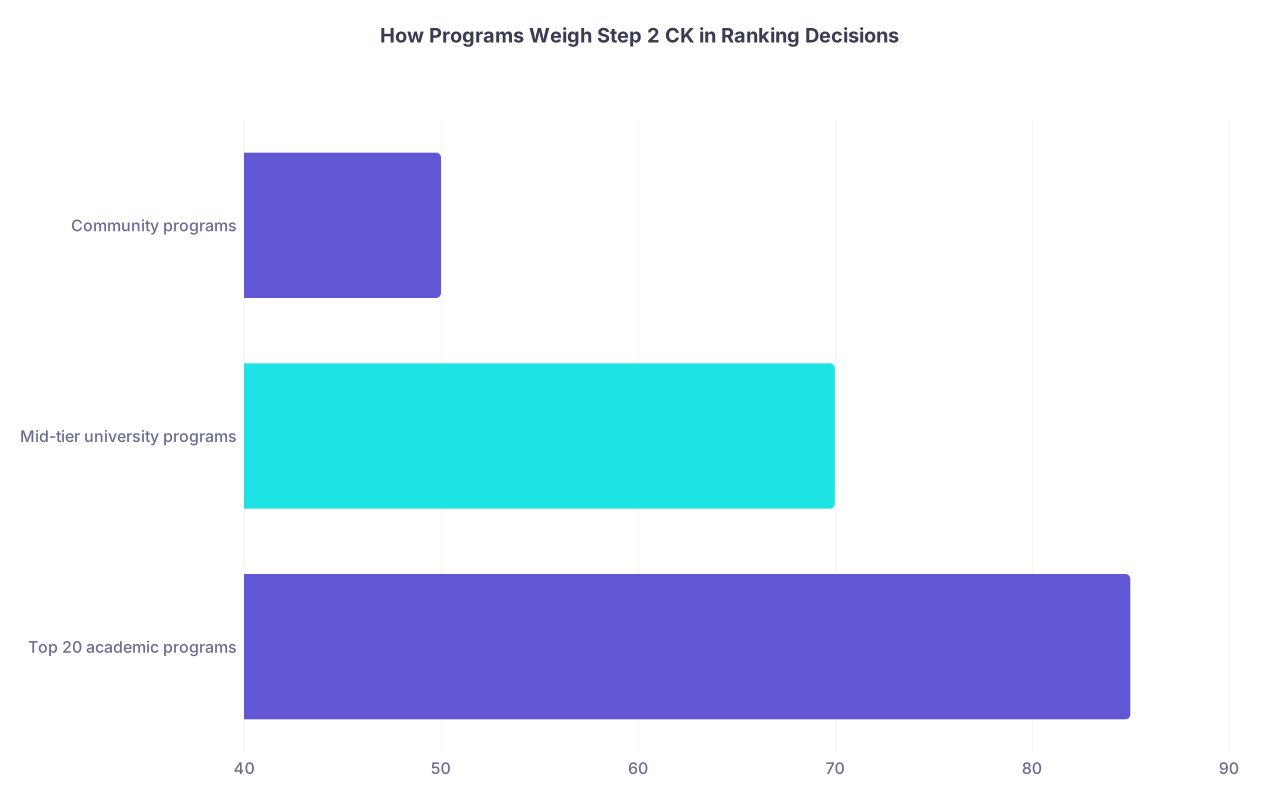
| Category | Value |
|---|---|
| Top 20 academic programs | 85 |
| Mid-tier university programs | 70 |
| Community programs | 50 |
Those percentages are roughly what I’ve heard informally when directors talk about how often Step 2 meaningfully affects rank order, not just whether you’re interviewable.
Step 2 CK as a Proxy for “Will This Person Survive Our Training Environment?”
Here’s the quiet truth: “trainability” is shorthand for “low-maintenance, will not drain faculty time, will make us look good on board pass stats.”
Harsh, but that’s how budget- and bandwidth-constrained programs think.
Directors can’t read your mind, so they look for signals:
- Did you improve between Step 1 and Step 2?
- Did your clinical performance match or exceed your Step scores?
- Did you handle more responsibility without falling apart?
Step 2 is a crude but convenient metric. They tie it to four risk calculations.
1. Risk of Board Failure
Every program lives in fear of a cluster of board failures. It hits their ACGME data, their reputation, their recruitment.
So when they see:
- Step 2 < 220 for a competitive field
- Multiple failed exams on your record
- Marginal clerkship comments (“needs frequent redirection,” “requires oversight for basic tasks”)
They don’t see “unlucky exam day.” They see a time bomb.
A PD at a busy surgery program said once:
“If I have two borderline applicants, I’ll always pick the one with a stronger Step 2. I can’t argue my way out of poor in-service scores with the department chair.”
Translation: Step 2 either reassures them or puts you in the “possible headache” bucket.
2. Response to Feedback
Programs interpret a Step 2 jump as proof that you responded to your own fear and the implicit feedback of the system.
You realized: “Step 1 was not what I wanted. I’ve got to wake up.”
Then you did. That arc is exactly what residency demands—constant course correction.
If Step 1 was weak and Step 2 stayed weak, they assume your default mode is inertia. That you might hear feedback, nod politely, and then return to baseline.
3. Stamina and Burnout Risk
Studying for Step 2 while on the wards is a different beast than Step 1 during preclinical.
Faculty use your Step 2 outcome as an indirect peek into your stress tolerance:
- Did you maintain or improve performance once your time and energy were fragmented?
- Or did your performance crumble when life looked a bit more like residency?
Nobody will say “burnout risk” out loud in the minutes we document, but after the formal meeting ends, that is absolutely how borderline cases are discussed.
4. Ceiling vs Floor
Strong Step 2 scores, especially with an upward trend, convince them your floor is safe. You might struggle here and there, but you’re unlikely to crash.
Average or weak Step 2 with no upward trajectory raises the fear that your floor is…unknown. And nobody wants unknown in a high-acuity ICU at 3 a.m. with a PGY-2 alone on nights.
Specialty-Specific Real Talk: Who Cares Most About Step 2?
Not all programs treat Step 2 the same way. Some lean hard on it as a sorting tool; others use it more as a tiebreaker.
| Specialty Group | Typical Step 2 Priority |
|---|---|
| Derm, Ortho, Plastics, Neurosurg | Extremely High |
| EM, Anesthesia, Rad Onc, ENT | Very High |
| IM, Gen Surg, OB/GYN | High |
| Peds, Psych, FM | Moderate |
Now let’s translate that into real committee behavior.
Derm / Ortho / Plastics / Neurosurg
At the top programs, Step 2 is basically your “prove it” exam now that Step 1 is pass/fail.
Comments I’ve heard in ortho meetings:
- “Anyone under 240 is already starting behind the pack.”
- “We have 70 apps over 255. Why would we stretch?”
High Step 2 reassures them that you’re not a liability for their very high boards bar. But what they really look for is: did you crush Step 2 and have an upward curve from Step 1 or from early performance?
If you had an old high Step 1 number and a weaker Step 2, they’ll still look at you, but your “trainability” story is weaker than your competition.
EM / Anesthesia / ENT / Rad Onc
These fields lean heavily on Step 2 because of acute decision making and the need for rapid pattern recognition in high-stakes situations.
Step 2 is seen as a surrogate for:
- Your ability to synthesize clinical data quickly
- Your readiness for in-service exams
- Your capacity to keep up with a rapidly changing knowledge base
I’ve watched EM PDs say: “Step 2 is the exam that matters for us. If they can’t handle that volume and complexity, they’re going to drown as a PGY-1 in our department.”
IM / Gen Surg / OB/GYN
These core specialties probably have the most nuanced use of Step 2.
Internal medicine, especially at academic powerhouses, loves Step 2 as a trajectory check. They’ll forgive a lower number if the rest of your file screams “growth.” They’ll worry about a great number if your evaluations are lukewarm or unflattering.
General surgery will use Step 2 to gauge who might survive ABSITE prep and board exams without hand-holding. A 220 with mixed clerkship comments will raise eyebrows. A 245+ with clear upward swing puts you in a safe zone.
OB/GYN tends to sit in the middle: not as score-obsessed as derm/ortho, but very aware of Step 2 because of mixed medical and surgical demands.
Peds / Psych / Family Med
Here’s the blunt truth: these fields—especially at community or mid-tier programs—are often more forgiving on Step 2 thresholds. But even they are not blind.
What they notice most:
- Failure patterns (repeat exams, USMLE/COMLEX flags)
- Massive disconnect between scores and evaluations (260 with “unprofessional” comments, or 220 with “top student I’ve worked with in 10 years”)
At good academic peds or psych programs, a strong Step 2 with narrative of growth can absolutely bump you ahead of someone with slightly stronger paper stats but flat trajectory and “fine, not remarkable” comments.
How Committees Actually Use Step 2 During Ranking
Let me take you into a real ranking meeting dynamic.
There’s a spreadsheet or shared screen. Columns:
- Name
- School
- Step 2 score
- Sometimes a color code or “tier” from 1–4
- Flags: research, red flags, etc.
Step 2 comes up at two points: screening and final sorting.
Phase 1: Screening for “Safe to Interview”
Most competitive programs have an informal “uh-oh” zone. For many academic programs, that’s roughly:
- Below ~225–230: they pause and ask, “What’s the story?”
- Below ~215: you’ll need real strengths elsewhere or an inside advocate
They won’t always hard screen by number, especially now with Step 1 pass/fail, but those ranges trigger discussion.
A PD might say:
“221. Any context? Any upward trend at school? Honors in medicine?”
If someone in the room can say, “Yes, late bloomer, strong medicine comments,” you may still get an interview. If your whole file matches the low score, you’re usually done.
Phase 2: Sorting the Middle and Top Tiers
This is where Step 2 becomes a tiebreaker and a risk adjuster.
A typical exchange:
- Faculty A: “I loved this applicant. Great interview, strong letters.”
- Faculty B: “Agreed, but their Step 2 is 229, and we’ve had trouble with board performance in that range.”
- PD: “Where do we have them compared to the 240+ folks with similar feedback?”
Nobody says “we refuse to rank them.” What they do is quietly slide you a few spots down, where you’re less likely to match there.
If your Step 2 is strong and others are borderline, your name will naturally float higher in the “safe” pile.
Turning Step 2 into a Story of Trainability (Even if the Number Isn’t Perfect)
You cannot change the score, but you can absolutely change what it means in context.
Here’s how sharper applicants frame it.
If You Improved from Step 1 to Step 2
You need to hammer this theme everywhere they give you a text box:
- Personal statement lines about discovering you learn best in clinical context
- MSPE and LORs that emphasize your growth on the wards
- Interview answers that highlight “I changed my approach after…” moments
You’re selling this narrative:
“I’m the resident who gets better every year. Give me responsibility and feedback—I climb.”
If You Plateaued
You lean on consistency and reliability:
- Show that your clerkship honors and comments match your Step 2 level or surpass it
- Emphasize that you’re calm under pressure, steady on nights, and not a boom-or-bust type
- Have letter writers explicitly describe your ability to internalize feedback and apply it
You’re saying:
“I might not be the flashiest Step score, but my performance on the wards and in call-heavy months is exactly what you want.”
If Your Step 2 Is Weak
You do not hand-wave it away. That’s what weak applicants do.
You do three things:
- Show authentic upward movement somewhere else: improving clerkship grades, sub-I excellence, strong narrative comments.
- Get at least one letter that directly addresses your work ethic, resilience, and ability to master complex material over time.
- If asked about it, own it briefly and pivot to evidence of how you’ve already done better under similar or higher pressure since then.
A good answer in an interview sounds like this:
“I wasn’t happy with my Step 2 score. I underestimated how different studying while on the wards would be. Since then, I changed how I prep for high-stakes evaluations—more consistent small-dose review rather than cramming—and on our in-house exams and my sub-I, I’ve seen much better results. My attendings in medicine and ICU have both commented on how quickly I pull in new information and apply it to patient care.”
That’s not excuse-making. That’s a trainability pitch.
What Program Directors Won’t Tell You Explicitly
Let me just put the subtext out in the open.
A strong Step 2 can forgive a lot. Middling school, average preclinical, limited research—if your Step 2 is strong and your clinical performance backs it up, you’ll be considered far more seriously than you think.
A weak Step 2 does not automatically kill you, but it forces your application into a “prove it elsewhere” category. You must have some combination of top-tier clinical performance, extraordinary letters, or niche strengths (e.g., critical research fit) to compensate.
Programs are scared of three things more than low scores:
- Residents who don’t improve
- Residents who crumble under increased load
- Residents who require constant remediation
Step 2 isn’t magic. But it’s one of the few nationwide standardized stress tests they have before you’re in their system. So they lean on it. Harder than they’ll admit to you publicly.
FAQs
1. If my Step 2 score is significantly higher than my Step 1, should I highlight that in my application?
Yes. Explicitly and repeatedly. You want every reader to see a clear upward trajectory. Have your personal statement, MSPE, and letters reinforce the theme that you developed more effective study habits, thrived in the clinical setting, and performed at a higher level once expectations increased. That’s exactly the “trainability” story programs want to see.
2. How bad is it if my Step 2 score is lower than my Step 1?
It depends how large the drop is and how strong the rest of your application looks. A small dip (5–10 points) with strong clinical grades and letters is rarely fatal. A larger drop raises questions about consistency under higher workload. You counter it by emphasizing strong clerkship performance, sub-I excellence, and any recent exam or in-service style successes that show the Step 2 score was not the start of a downward slide.
3. Do community or less competitive programs care about Step 2 “trainability” the same way top-tier academic programs do?
They care, but in a slightly different way. High-powered academic programs worry about board pass statistics and reputation; community programs worry about whether you’ll function safely and independently with fewer layers of backup. Both groups use Step 2 as a quick read on how you perform under increased demands. The difference is mostly in cutoff levels and how quickly a borderline score can be overridden by strong personal fit and clinical evaluations.