
It’s 7:59 AM.
Your phone has been buzzing with group chat messages since 7:00: “Got my Step 2 score!” “I passed!!” “Holy crap I broke 260.”
Your email is open. The NBME message is sitting there. Unread. Bold. You’ve clicked into the portal, you see “View Score Report,” and your mouse is just… hovering. You can’t make yourself click. Your heart’s racing, stomach is basically doing backflips, and your brain is already writing your SOAP personal statement because obviously you failed and your career is over.
This is where you are. Stuck between “it might be okay” and “my life is ruined” — without even knowing the number.
Let’s talk about what to actually do. Not in a vague “stay positive” way. In a “here is your game plan for both outcomes so you can finally open the damn thing” way.
Why You’re So Scared to Look (And No, You’re Not Being Dramatic)
Let me just say it: your fear is not irrational. Step 2 CK is now the big exam.
Step 1 went Pass/Fail. PDs love “objective” numbers. Programs filter. You’ve heard 1,000 versions of:
“Step 2 will be more important now.”
“They’ll use it to compensate for Step 1.”
“You basically get one shot.”
So your brain turns that into:
If this number is bad → I’m done.
You’re scared because:
- This feels like the last “big test” before your life path locks in.
- You’ve tied this one number to your self-worth, your chances in your specialty, your ability to look your advisor in the eye.
- You’ve heard horror stories: “I bombed Step 2 and didn’t match,” “My score tanked my whole application.”
Also, you’re tired. Core rotations, shelf exams, maybe some rough evals, some good ones, Step 1 limbo, now this. You don’t have “emotional reserve” left. So your brain does the easy thing: avoid.
Here’s the uncomfortable truth: the number is already decided. Whether you stare at that button or not, the score’s in there. The only thing you control now is:
- How fast you find out
- How quickly you move into a plan
Avoiding doesn’t protect you. It just prolongs the anxiety.
So I want to walk you through both scenarios — higher-than-feared and lower-than-hoped — and what concrete moves you’d make in each. Once your brain sees there’s a path either way, the terror drops just enough to click.
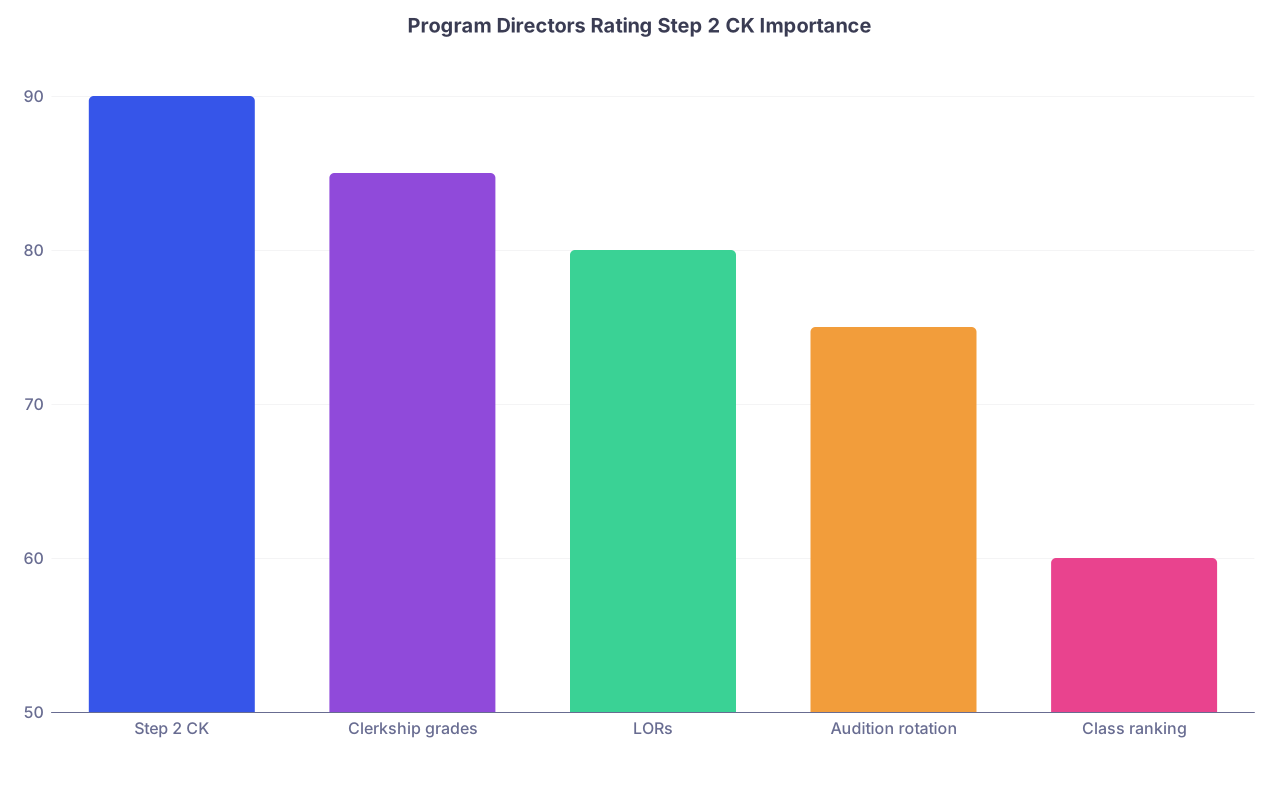
| Category | Value |
|---|---|
| Step 2 CK | 90 |
| Clerkship grades | 85 |
| LORs | 80 |
| Audition rotation | 75 |
| Class ranking | 60 |
Scenario 1: The Score Is… Okay or Even Good (But You’re Still Spinning)
Let’s say you finally click. You see the number. And it’s not a disaster.
Maybe you were fearing “I failed” and you got 229.
Maybe you were dreaming of 255 and you got 244.
Maybe you smashed it and got 262 — and your first reaction is still, “But will it be enough for derm/ortho/ENT?”
The anxious brain doesn’t really care where the number lands. It just moves the goalposts.
So here’s what to actually do if your score is solid, or at least workable.
1. Benchmark Your Score Against Reality, Not Rumors
You’ve probably heard people throw around numbers like “You need at least 250 for XYZ.” A lot of that is trash bravado or outdated pre-Step-1-pass/fail thinking.
Look at real data and not the loudest person in your class.
Use something like NRMP Charting Outcomes (latest available) and look at ranges, not just means.
Here’s a rough, very simplified idea of where many US MD applicants land and still match (not “guaranteed,” just common ranges), ignoring extremes:
| Specialty Type | Many Matched Applicants' Step 2 CK Range* |
|---|---|
| Very competitive (derm, ortho, ENT, PRS) | 245–260+ |
| Competitive (EM, gen surg, anesthesia) | 235–255 |
| Mid-competitive (IM, OB/GYN) | 225–245 |
| Less competitive (FM, peds, psych) | 215–235 |
*These are rough, overlapping ranges from recent cycles; people match above and below these all the time.
If your score sits in or near the range for your specialty, you are not out. You might not be the superstar “flex on Reddit” applicant, but programs are not filtering at insane numbers for most people.
2. Decide Your “Story” With This Score
PDs don’t just see the number. They see the pattern.
Some common patterns that are perfectly workable:
- Step 1 low or barely pass → Step 2 significantly higher
- Step 1 good → Step 2 slightly higher or about the same
- Step 1 missing (took late) → Step 2 solid, first real data point
If your Step 2 is:
- Higher than your practice tests → you outperformed. That’s a strength.
- Around your practice average → you’re consistent and reliable.
- Slightly below your dream number but not catastrophic → this is “fine, move on” territory.
You don’t need to spin an essay about it unless there’s a big discrepancy or a fail. Otherwise, your “story” is:
“I prepared steadily, took it once, passed with a solid score, then focused on being a good clinician.”
That’s enough.
3. Use the Score Strategically in Your Application
This is where the anxiety can actually be turned into control.
If your score is decent/good:
- Mention it if it helps offset a weaker Step 1 or lower preclinical performance.
- Let your advisors see it early so they can be honest: “Aim for these tiers of programs, apply broadly, add some reach and some safeties.”
- If it’s strong for your specialty, you lean harder into the rest of your app: research, leadership, narrative, LORs. You’re not scrambling; you’re optimizing.
If your score is very strong (like 250+ in most fields):
- You probably don’t need to panic-expand your list to 80 programs. You still apply broadly, but your anxiety shouldn’t be running your spreadsheet.
- Use it as leverage to ask mentors for strong letters, high-yield aways, or advocacy emails. People are more willing to go to bat for you when they can say, “This student has excellent board performance.”
Bottom line: a “fine” or “good” score does not need hours of spiraling. It just needs a 20–30 minute sit-down with data and an advisor to lock in an application strategy. Then you move on.

| Step | Description |
|---|---|
| Step 1 | Open Score Report |
| Step 2 | Contact Dean and Advisor |
| Step 3 | Plan Retake Timeline |
| Step 4 | Proceed With Original Specialty |
| Step 5 | Adjust Program List |
| Step 6 | Reassess Specialty Choices |
| Step 7 | Focus On Rotations and LORs |
| Step 8 | Backup Plan or Alternate Specialty |
| Step 9 | Pass? |
| Step 10 | Score Near Goal? |
Scenario 2: The Score Is Lower Than You Wanted (Or Straight-Up Bad)
This is the nightmare version in your head, right?
You click.
The number hits you like a punch.
It’s lower than your NBMEs.
Or way below your classmates’ screenshots.
Or you failed.
Let’s walk that out without sugarcoating, but also without doing the dramatic “my career is over” thing.
Step 1: Feel Awful for a Bit — On Purpose
You’re going to feel like garbage. Of course you are. Don’t try to be a robot.
Give yourself a defined window where you let it hit you. 24 hours. Not a month. A day.
Cry. Vent to someone safe (ideally not the hyper-competitive classmate who matched derm at Penn). Go for an angry walk. Doom-scroll for a bit. Fine.
But put a time limit on it. Tell yourself: “I get today to fall apart. Tomorrow, I make moves.”
Step 2: Categorize the Damage
“Bad” can mean very different things depending on your goals.
There’s a big difference between:
- 248 when you wanted 255 for derm
- 232 when you wanted 245 for gen surg
- 214 when you really wanted 230 for IM
- A fail
Those are not the same problem at all.
Be brutal and specific:
- Does this score completely rule out your dream specialty? (Example: 214 and you were going for plastics with no research. Yeah, that door is almost certainly closed.)
- Does it narrow your options? (Example: 232 for gen surg might mean fewer academic powerhouses, more community or mid-tier.)
- Does it mean you need to pivot to a safer specialty? (Example: struggling Step 1 + low Step 2 and zero other strengths.)
You don’t have to decide your fate alone, but you do need a realistic sense of what this score likely means in context.
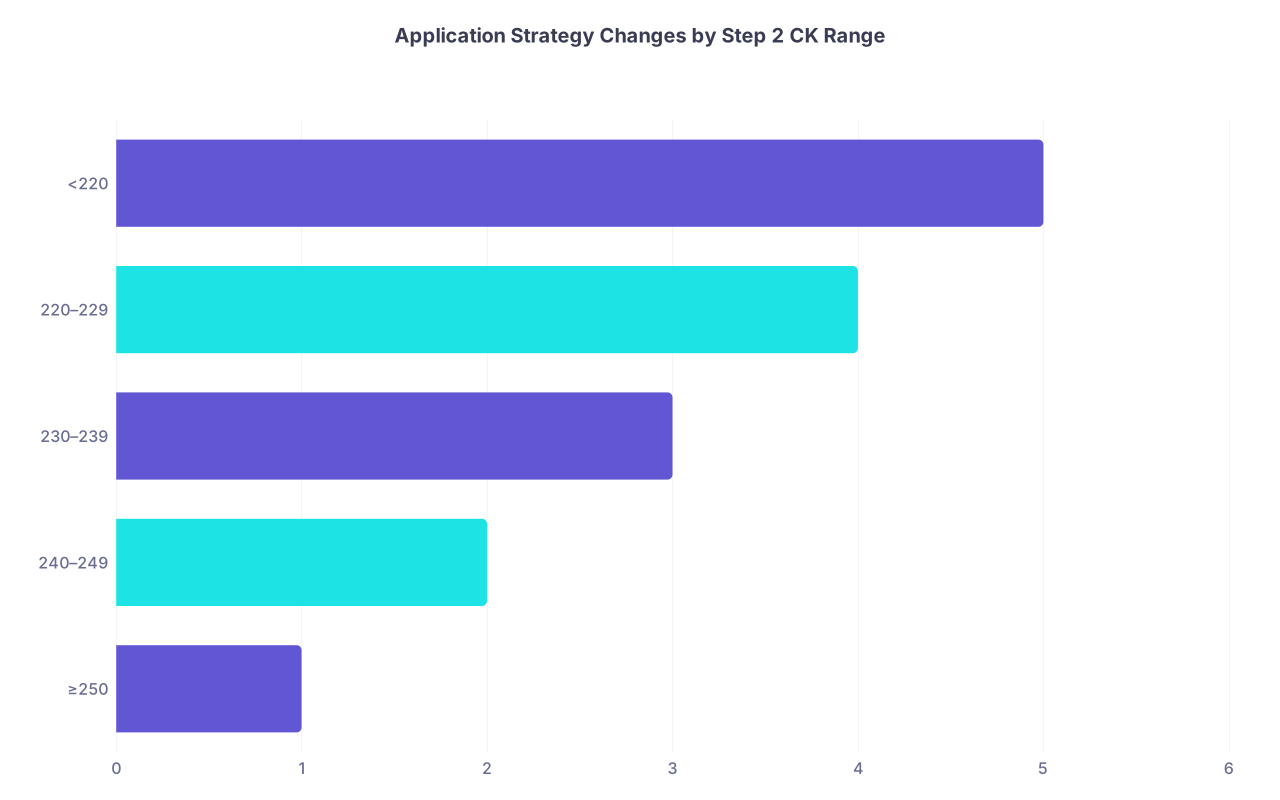
| Category | Value |
|---|---|
| ≥250 | 1 |
| 240–249 | 2 |
| 230–239 | 3 |
| 220–229 | 4 |
| <220 | 5 |
Step 3: Get Brutally Honest, Experienced Input
Your classmates are not your advisors. Reddit is not your dean’s office.
You need:
- A faculty advisor who actually knows the Match in your specialty
- Or your dean/Student Affairs office
- Or a PD you’ve worked with on rotation who is willing to be straight with you
You send an email that looks something like:
“I just received my Step 2 CK score (___). I’m interested in [specialty], with [brief summary: research, grades, aways]. I’d really appreciate 15–20 minutes of honest feedback about how this affects my chances and how to adjust my application strategy (program list, backup plans, etc.).”
Then you listen. And you push them a bit:
- “If I were your own student/child, what would you tell me to do with this score?”
- “Would you recommend a dual-apply? To which specialty?”
- “How many programs would you suggest I apply to, realistically?”
It might sting. But it gives you a path.
Step 4: Adjust Your Strategy, Not Just Your Feelings
This is the part people avoid. They feel bad, but they don’t fix the plan. Then they act surprised when March is brutal.
Depending on where you landed, you might need to:
- Apply to more programs than you originally planned
- Shift your list to include more community and mid-tier sites
- Add a backup specialty (IM, FM, peds, psych, anesthesia, etc.)
- Drop the ultra-competitive specialty if every advisor you trust says, “I would not risk a solo-apply with this score”
Is that fun? No.
Is it better than pretending nothing changed and gambling your Match on vibes? Yes.
You’re not being “weak” by adjusting. You’re being strategic in a system that’s harsh and numbers-driven.
Step 5: If You Failed Step 2 CK
This is its own special level of panic.
The internal narrative usually goes straight to: “No one fails this. I’m clearly not cut out for medicine. They’re going to kick me out.”
I’ve seen people fail Step 2 and still match. It’s not pretty. It takes work. But it happens.
Here’s the rough sequence:
- Tell your school quickly. Do not hide it. They find out anyway; you just look worse if you’re evasive.
- Meet with your dean/Student Affairs and figure out:
- When you can retake
- Whether you need to adjust rotations or take dedicated time
- What goes into your MSPE about this
- Do a post-mortem on why:
- Did you run out of time on sections?
- Were you barely passing NBMEs and took it anyway?
- Life crisis, health issue, burnout, or just underprepared?
- Build a retake with structure:
- Question goals per day
- Scheduled full-length practice exams
- Tutoring or group support if you truly don’t know what went wrong
When you pass on the retake (and the goal is usually pass + decent, not 260), your story becomes:
“I had a setback, addressed it head-on, and then passed with improvement while continuing to function clinically.”
You will have to explain it on interviews. But an honest, non-defensive explanation plus a passing retake and strong clinical evals can absolutely keep you in the game.

How Step 2 CK Fits Into the Whole Picture (Even Though It Feels Like Everything)
When you’re in this score-report limbo, it feels like nothing else matters. That’s not how PDs actually think.
If you look at PD surveys, Step 2 CK is very important. But it’s sitting in a cluster of other “very important” things:
- Clinical grades
- Letters of recommendation
- How you performed on audition/away rotations
- Class ranking / AOA (where relevant)
- Red flags / professionalism issues
Imagine two applicants:
- Applicant A: 260 Step 2, mediocre clinical evals, lukewarm letters, unremarkable on rotations.
- Applicant B: 234 Step 2, glowing evals, strong letters, crushed their sub-I, everyone loves working with them.
For many programs, especially non-hyper-elite ones, Applicant B is more attractive. PDs are terrified of residents who are miserable to work with or unsafe. A high score doesn’t fix that.
Your Step 2 score is:
- A filter in some places
- A signal of test-taking ability and maybe fund of knowledge
- A piece of the picture, not the whole portrait
A borderline score can be counterbalanced by strong everything else. A great score can’t rescue a bad reputation.
So if your score’s not what you wanted, the move is: overperform everywhere you still can. Rotations, aways, letters, interviews. Don’t sit in shame and assume you’re doomed. That just makes the rest of your app mediocre too.

What You Can Do Right Now Before You Even Click
Because I know — you might still not have opened it.
Here’s how you lower the stakes enough to actually face the number.
Write down your worst case and what you’d do:
- “If I failed → I email my dean today and schedule a meeting. I make a retake plan.”
- “If I scored <220 and want IM → I talk to an advisor about backup and program numbers.”
- “If I scored lower than my practice tests → I accept it, apply a bit more broadly, and move on.”
Write down your best case and what you’d do:
- “If I did better than expected → I use that confidence, ask for strong letters, and keep my original specialty.”
Decide who you’ll tell first, no matter what the score is.
A friend, partner, sibling, advisor. The rule is: you’re not carrying it alone.Block off 30 minutes today:
- 5 minutes to open and look
- 10–15 minutes to feel whatever you feel
- 10–15 minutes to send 1–2 emails (advisor, dean, mentor) based on what you saw

Your Next Step Today
Here’s what I want you to literally do when you finish reading this:
Open your email or NBME portal. Put your cursor over “View Score Report.” Before you click, say out loud (yes, actually):
“Whatever this number is, there is a plan for me. This is data, not a verdict.”
Then click.
Once you see the number, write it down. And send one email — to your advisor, your dean, or the person you trust most academically — that starts with:
“I just received my Step 2 CK score of ___. I’d really appreciate your help planning my next steps.”
That’s it. Just that one concrete action.
The score doesn’t decide if you move forward. You do.