

The belief that “a strong Step 2 CK score can save any application in SOAP” is wrong. The data shows that Step 2 CK helps, sometimes dramatically, but it does not function as a universal rescue line. Your actual probability of scrambling into a residency through SOAP is heavily constrained by Step 2 CK bands, specialty choice, and the raw supply–demand math of unfilled positions.
Let me walk through it the way a numbers person actually looks at this: inputs, constraints, probabilities, and where Step 2 CK meaningfully shifts the odds.
The hard math of SOAP: supply, demand, and score bands
Start with the structural problem, not the anecdotes.
Each year there are far fewer unfilled positions than unmatched applicants. That fundamental imbalance defines what “rescue chances” really mean.
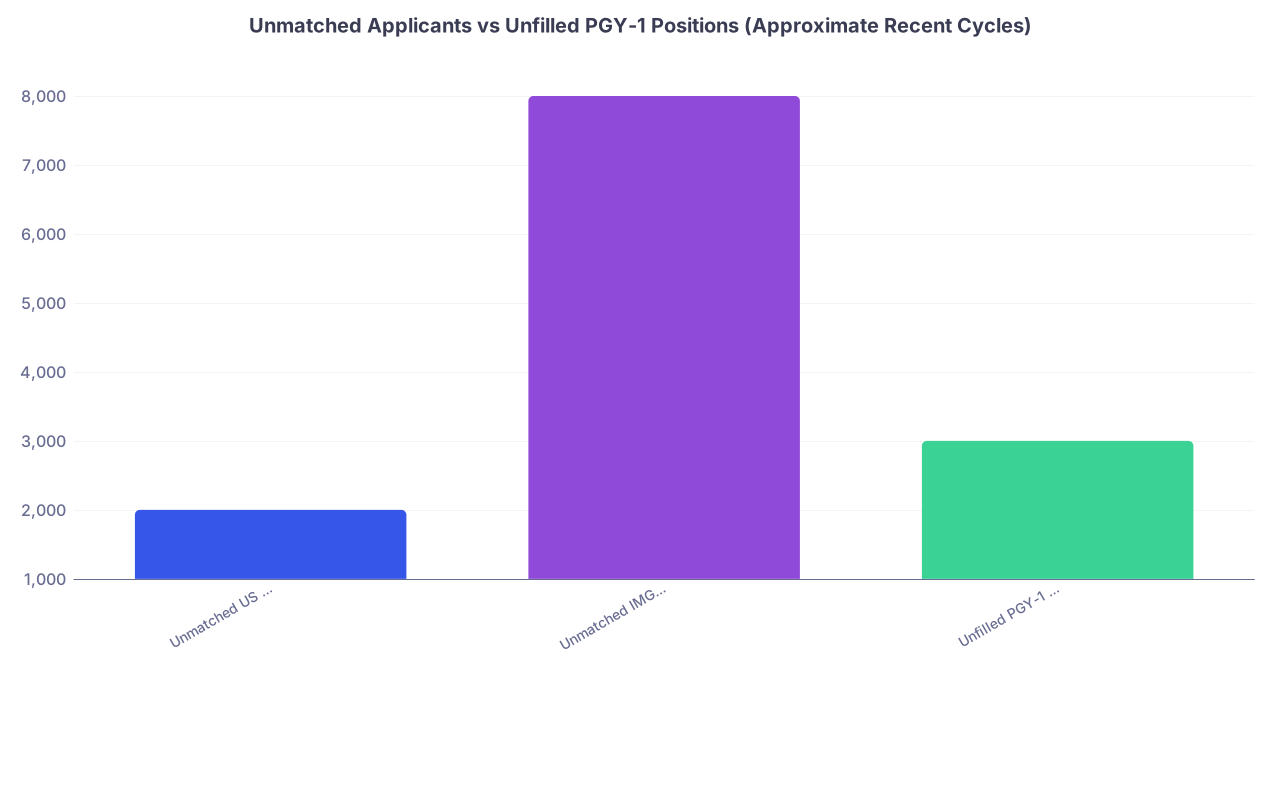
| Category | Value |
|---|---|
| Unmatched US Seniors | 2000 |
| Unmatched IMGs/DOs | 8000 |
| Unfilled PGY-1 Spots | 3000 |
Interpretation:
- Roughly 10,000+ total unmatched applicants (US MD, DO, and IMGs combined).
- Around 3,000 or so unfilled PGY-1 positions entering SOAP.
- That implies a global “fill probability” well under 50% even if everyone were identical. They are not.
Programs do not treat all unmatched applicants as equivalent. Step 2 CK is one of the few objective filters that remains visible in the chaos of SOAP week. When PDs and coordinators are processing hundreds of SOAP applications overnight, the data shows three dominant numerical screens:
- Step 2 CK score (or Step 1 for older cycles, but Step 2 has become primary).
- Attempt status (first-time pass vs fail or multiple attempts).
- Graduation year, especially for IMGs.
So the question is not “Can Step 2 CK rescue me?” The realistic questions are:
- Does my Step 2 CK move me into, or out of, the group that programs will even open?
- In SOAP, does my score give me leverage to aim for more desirable unfilled spots, or am I just trying to avoid being filtered out entirely?
How Step 2 CK segments your SOAP odds
Step 2 CK is no longer optional noise. With Step 1 now pass/fail, I see PDs putting more weight on Step 2 ranges. Think of bands, not exact scores.
Functional Step 2 CK bands for SOAP
These are rough operational categories many programs use in primary care–oriented SOAP review. Not official cutoffs, but the “mental bins” that repeatedly show up in committee conversations.
| Step 2 CK Band | Relative SOAP Positioning | Typical Impact |
|---|---|---|
| ≥ 255 | Top decile | Very strong, selective SOAP options |
| 245–254 | Above average | Competitive for most SOAP IM/FM spots |
| 235–244 | Solid | Viable for many community programs |
| 225–234 | Borderline for some | May be screened out of stricter programs |
| 215–224 | Risk zone | Many filters trigger here |
| < 215 or fail | High concern | Considerable restriction, needs favorable context |
Do not interpret these like normal Match ranges. In SOAP, many applicants with 220–230 will match into IM or FM if other factors are acceptable, because the pool is skewed: a lot of stronger applicants have already matched.
Here is the typical pattern:
- ≥ 245: You are numerically in the top group for SOAP in primary care and prelim medicine/surgery. Programs will not reject you because of Step 2 CK. The constraints will be visa, graduation year, and red flags.
- 230–244: Good enough for a wide set of internal medicine, family medicine, peds, and prelim spots. Some hospital-based or more competitive programs may draw a hard line closer to 240–245, but SOAP often softens those thresholds.
- 220–229: This is where Step 2 stops being a selling point and becomes merely “acceptable” or “borderline.” Strong US grads can still do well; IMGs with this range are often competing with a lot of peers.
- 210–219: Now you are developing a screening problem. Many programs that are already frantic will sort by ≥ 220 or ≥ 225 as a quick triage. You can still match in SOAP, especially FM and community IM, but the denominator of programs willing to consider you shrinks.
- < 210 or failed attempt: You are now asking programs to override a clear data red flag under time pressure. It happens, but it is not common, especially for hospital-based or academic programs.
The Step 2 CK score does not guarantee anything. It just moves your application between these buckets.
Score vs specialty: where Step 2 CK can actually “rescue” you
The key misunderstanding is thinking of SOAP as a backup in the same specialty. Most of the time, Step 2 CK rescues you only if you are flexible in specialty and geography.
Where Step 2 CK helps most
Look at where unfilled positions regularly cluster:
- Family Medicine
- Internal Medicine (community, non-university)
- Pediatrics (some cycles)
- Transitional Year and Prelim Medicine
- Some Preliminary Surgery, Psychiatry, and categorical spots at less popular locations
Now align that with score expectations.
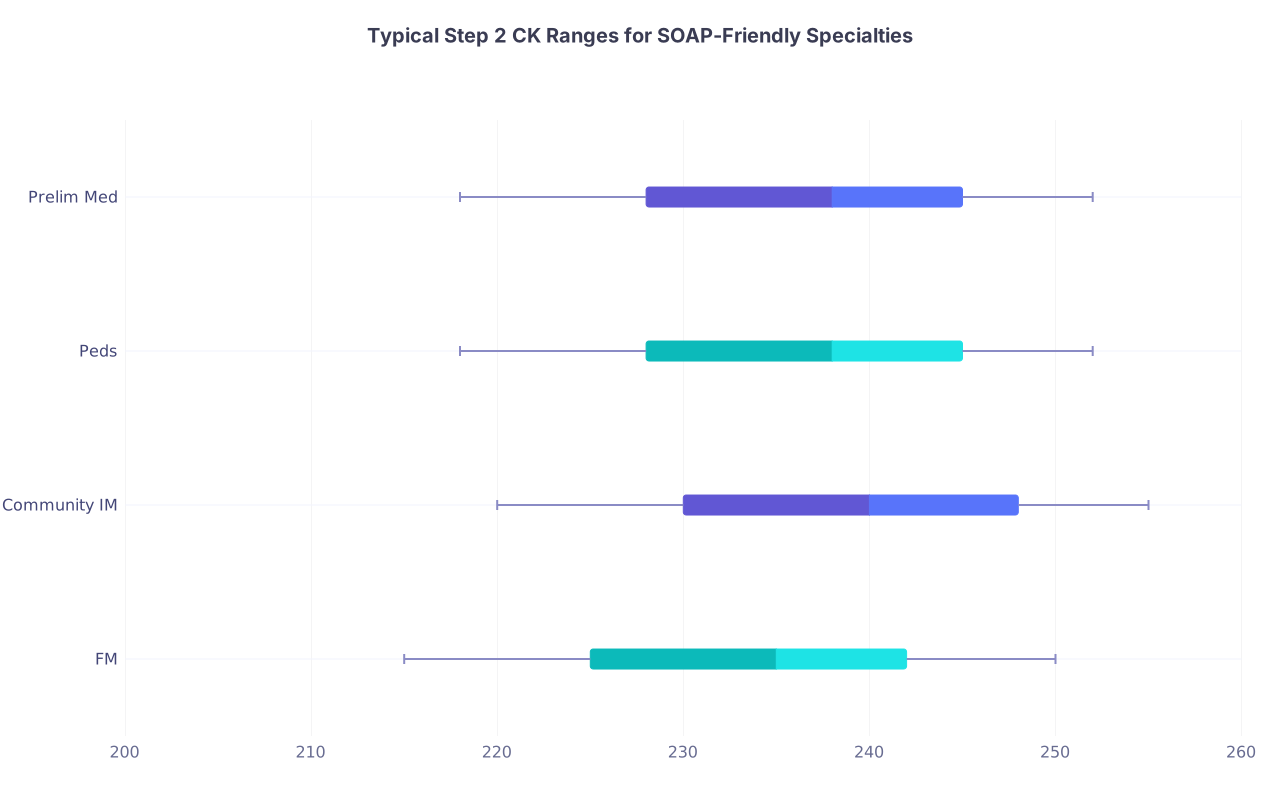
| Category | Min | Q1 | Median | Q3 | Max |
|---|---|---|---|---|---|
| FM | 215 | 225 | 235 | 242 | 250 |
| Community IM | 220 | 230 | 240 | 248 | 255 |
| Peds | 218 | 228 | 238 | 245 | 252 |
| Prelim Med | 218 | 228 | 238 | 245 | 252 |
Interpret this practically:
- A 245+ Step 2 makes you a strong SOAP candidate for most unfilled IM/FM/Peds/Prelim Med roles. Not “guaranteed,” but on the right side of most filters.
- A 230–240 Step 2 gives you a competent profile for those same spots, more so if you are a recent US grad.
- A 215–225 Step 2 may be enough, particularly in FM and some community IM, but often not enough to aim selectively in SOAP. You are in “take what you can get” territory.
Where Step 2 CK cannot reliably rescue you in SOAP:
- Dermatology
- Orthopedic Surgery
- ENT
- Integrated Plastics
- Neurosurgery
- Ophthalmology
- Radiation Oncology
Even general surgery and anesthesiology are poor bets for SOAP rescue unless you bring an unusually strong profile and there happens to be an unfilled spot at a program desperate enough to prioritize availability over traditional cutoffs.
This is what I tell people bluntly: a 255 Step 2 will not magically generate SOAP openings in derm. It will, however, make you extremely attractive to many IM or FM programs scrambling to fill.
Case patterns: how Step 2 CK interacts with SOAP outcomes
Let’s work through some realistic archetypes. These are composites of patterns I have seen across multiple cycles.
Case 1: US MD, no red flags, just missed in a competitive specialty
Profile:
- US MD, Step 1 pass on first attempt
- Step 2 CK: 250
- Applied to dermatology, minimal backup in IM
- Unmatched in main Match; enters SOAP
What does the data say about “rescue chances”?
- Competitive dermatology SOAP options: Essentially zero. The number of derm SOAP openings is usually near zero.
- Transition to medicine/FM during SOAP: Very plausible. A US MD with 250 Step 2 is well above the typical SOAP pool for FM and community IM.
- Risk: Limited program list because most derm-focused applicants did not build relationships with IM/FM programs, and SOAP prevents new contact with programs not on your list after submissions.
In actual numbers, a US MD with 250 Step 2, no failures, applying broadly in SOAP to FM and IM can easily be above the 50–60% probability range of securing some position. Not guaranteed, but substantially better than the global SOAP pool.
Case 2: US DO, borderline scores, applied widely but in a mildly competitive field
Profile:
- US DO, Step 2 CK: 225
- Target: Internal Medicine and Pediatrics, mix of university and community
- Few interview invites; unmatched
Step 2 CK here is not “rescuing” anything. It is the minimum bar. In SOAP:
- Many university-affiliated IM programs will auto-screen at 230–235 and above.
- Community programs and FM may accept 215–225, particularly for US grads.
- Geography flexibility is crucial.
A 225 Step 2 DO applicant in SOAP who applies aggressively to FM, community IM, and prelim medicine can still match. But the expected probability is lower than Case 1, and the applicant is at the mercy of how many positions remain in less desirable locations.
Case 3: IMG, old graduation year, strong Step 2 CK
Profile:
- IMG, graduation year 2016
- Step 2 CK: 250, Step 1 pass
- No US clinical experience beyond observerships
- Unmatched in IM
Here, the data shows Step 2 is necessary but not sufficient. Programs in SOAP are extremely sensitive to:
- Old graduation year
- Visa requirements
- Lack of recent clinical activity
Even with a 250, many IM programs will screen out based on YOG (year of graduation). I have seen high-scoring IMGs with strong Step 2 go 0/45 in SOAP simply because their YOG and visa status triggered filters.
For this profile, Step 2 helps keep you out of the automatic reject pile at some programs, but the rescue probability is still low, often below 20–30% even with full flexibility, unless you already have strong US letters and recent hands-on experience.
Step 2 CK timing: pre-SOAP vs in-the-middle score release
Another overlooked detail: when your Step 2 CK score becomes visible.
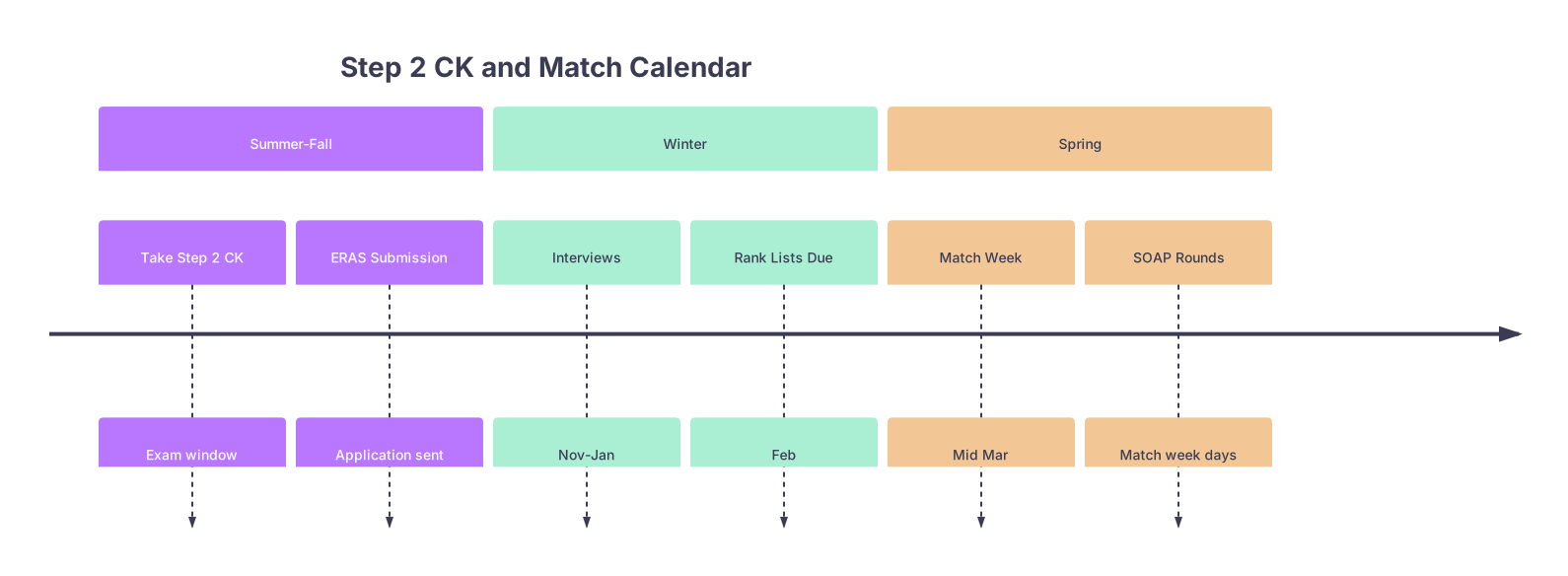
| Period | Event |
|---|---|
| Summer-Fall - Take Step 2 CK | Exam window |
| Summer-Fall - ERAS Submission | Application sent |
| Winter - Interviews | Nov-Jan |
| Winter - Rank Lists Due | Feb |
| Spring - Match Week | Mid Mar |
| Spring - SOAP Rounds | Match week days |
Three timing scenarios matter.
Scenario A: Step 2 CK available by ERAS opening
In this case, your Step 2 CK already influenced whether you matched on Monday. By the time you enter SOAP, programs have already used your Step 2 once. If you still went unmatched, Step 2 will not be a new positive surprise; it is already factored in.
Rescue role: Minimal new effect in SOAP, except in two situations:
- You originally applied mainly to competitive specialties (e.g., EM, surgery) and now pivot to FM/IM in SOAP. In that case, your same Step 2 becomes more valuable because you are now in a less competitive lane.
- You over-restricted your initial application list (few programs), and SOAP gives you a second chance to use that same score across a broader map of programs.
Scenario B: Step 2 CK taken late, score released just before Rank List deadline
In this pattern, programs may or may not have updated your file before ranking. Some will. Some will not. If you are unmatched, then in SOAP:
- Programs that look you up in ERAS during SOAP will now see a newer Step 2 CK.
- If the score is substantially higher than expected (e.g., you looked weak from preclinical metrics but hit 250+), it can indeed “rescue” perception.
Here Step 2 has moderate rescue value. I have seen people with weak preclinical performance but a late 240–250 Step 2 become very attractive SOAP candidates to IM/FM programs that never interviewed them earlier.
Scenario C: Step 2 CK result drops during or just before SOAP
Risky but common. You took Step 2 late, perhaps after applications went out, and the score posts very close to Match Week.
In SOAP:
- A strong newly released score (say 245–255) can absolutely boost your file, especially if your Step 1 was borderline or pass/fail with concerns.
- A weak score (< 220) can tank what little rescue probability you had, because now you have an active negative datapoint where previously there was uncertainty.
From a pure expected-value perspective, I advise most borderline applicants applying in competitive specialties: take Step 2 early enough that it is on your application and can be used both for main Match and SOAP. Surprises help fewer people than they hurt.
Step 2 CK vs failures and red flags: which matters more in SOAP?
Numeric score alone is not the full story. Programs often group applicants into risk categories:
- No failures, no professionalism issues
- Single exam failure, otherwise clean
- Multiple exam failures or professionalism concerns
The hard reality: a 250 Step 2 with a Step 1 fail is not “equivalent” to a 250 with no fails. That fail continues to suppress your SOAP chances substantially.
| Profile Type | Relative SOAP Attractiveness |
|---|---|
| No fails, Step 2 ≥ 245 | Very high |
| No fails, Step 2 230–244 | High |
| Step 1 fail, Step 2 ≥ 240 | Moderate |
| Step 1 fail, Step 2 225–239 | Low |
| Multiple fails or Step 2 fail | Very low |
From what I see in SOAP committees:
- Programs do occasionally “forgive” a single past failure if Step 2 shows clear recovery (e.g., 245+).
- Multiple failures or a recent Step 2 failure often move you into the “only in extreme need” group, regardless of other strengths.
So can a strong Step 2 “erase” a failure? No. It reduces the penalty. For SOAP, the difference between “no chance” and “some chance” can still be meaningful, but you are not graded on a clean slate.
Strategic use of Step 2 CK data in SOAP
If you are entering SOAP, you have at most a few hours to think like a data analyst and not like a hopeful gambler.
Here is how to translate your Step 2 into concrete decisions.
1. Calibrate expectations by specialty and score
Forget premed-era optimism. Use cold ranges.
- Step 2 ≥ 245, no fails: You are competitive for many SOAP IM/FM/prelim programs. Focus on program volume and geographic flexibility.
- Step 2 230–244: You are solid. You must be more flexible on prestige and location, and avoid chasing scarce competitive-land spots that rarely fill.
- Step 2 215–229: You need maximal breadth and realistic targets: FM, community IM, prelim medicine in less popular regions.
- Step 2 < 215 or exam failures: You are in low-probability rescue territory; focus on any program likely to interview at all, even prelim or transitional options.
2. Use score to prioritize list, not to chase prestige
I see this mistake every year: applicants with 220–230 Step 2 wasting SOAP preferences on a handful of borderline-competitive IM programs in big cities, instead of targeting 40–45 realistic community or regional programs.
Your Step 2 should answer: where am I a normal or above-average candidate in this reduced SOAP pool?
If your score is below the historic mean for a specialty, assume SOAP does not magically lower the bar for that specialty in big metros. It usually does not.
3. Understand your comparative advantage
In SOAP, your competitors are not just unmatched US MDs. They include:
- US MDs who aimed too high originally.
- DOs with solid Step 2s.
- IMGs with very high Step 2s but other constraints.
Strong Step 2 for a US MD is a massive comparative advantage over many IMGs and some DOs. That is simply how the data fall when programs talk openly. For IMGs, a strong Step 2 is necessary to even stay in the same conversation, but you still start numerically behind a recent US grad with a slightly lower score.
Be honest with your role in that ecosystem and build your SOAP list accordingly.
Data-driven reality check: what Step 2 CK can and cannot do
Strip away the mythology and anecdotes and you get a simpler picture.
Step 2 CK is one of the most powerful levers you control for SOAP, but it operates mainly by moving you into (or out of) filter bands. It does not create openings that do not exist.
High Step 2 CK scores (≥ 245) substantially improve your chances of rescue in SOAP if—and this is critical—you are willing to pivot to less competitive specialties and less popular locations. Scores below ~225 sharply constrain this flexibility.
Past failures, older graduation year, and visa issues can neutralize much of the advantage of a strong Step 2. In those groups, Step 2 transforms “no realistic chance” into “some chance,” not into parity with clean, recent graduates.
If you treat Step 2 CK as a precision tool for targeting the right SOAP lanes rather than a magic parachute, your strategy will match the data instead of the wishful thinking.


