
The myth that Step 2 CK is just a “cleanup exam” after Step 1 is dead. The data shows that Step 2 CK is now the primary numerical lever shifting your Match odds up or down across every competitiveness tier.
For better or worse, programs are using your Step 2 CK like a sortable column in Excel. And they are ruthless about it.
Below I will walk through what the numbers actually suggest: how much Step 2 CK moves your probability of interview and Match in low-, mid-, and high-competitiveness specialties; how different score bands function; and where a specific score meaningfully changes your strategy.
1. The New Role of Step 2 CK After Step 1 Went Pass/Fail
Before Step 1 became pass/fail, Step 2 CK was often a secondary metric. Now it is the main standardized number in your file. Programs needed a quantitative filter; they did not suddenly become holistic saints.
Several patterns have emerged from program surveys, NRMP Charting Outcomes, and anecdotal data from coordinators:
- Many programs have moved their old Step 1 numerical filters to Step 2 CK.
- Competitive specialties are using Step 2 CK as a quasi Step 1 replacement for ranking and interview offers.
- Mid- and low-competitiveness specialties are using Step 2 CK more flexibly, but still as an early screen.
Think about Step 2 CK as your “numeric signal” in an ocean of subjective data. For many programs, the decision tree is crude:
- Above an internal Step 2 CK cutoff → full review
- Borderline → soft review or secondary screen
- Below → auto-screen out unless strong home/connection factors

| Step | Description |
|---|---|
| Step 1 | Application Received |
| Step 2 | Flag for late review |
| Step 3 | Full file review |
| Step 4 | Secondary factors check |
| Step 5 | Screen out or hold |
| Step 6 | Step 2 CK Available |
| Step 7 | Score above cutoff |
This is not theoretical. I have seen internal spreadsheets where a coordinator sorted by Step 2 CK, drew a line at 245 for an academic IM program, and started reading from the top down.
The question is: how much does moving from, say, 235 to 250 actually change your odds in different competitiveness tiers?
2. Defining Competitiveness Tiers: Context Before Numbers
The effect size of Step 2 CK depends heavily on the “tier” of the specialty.
A pragmatic 3-tier framework:
- Low-competitiveness: Family Medicine, Psychiatry (most programs), Pediatrics (community), Internal Medicine (community-heavy), Pathology, PM&R at less selective sites.
- Mid-competitiveness: General Internal Medicine (mid/high academic), OB/GYN, Emergency Medicine, Anesthesia, Pediatrics (academic), some Neurology.
- High-competitiveness: Dermatology, Orthopedic Surgery, Plastic Surgery, ENT, Neurosurgery, Integrated Vascular, Integrated CT, and the top-tier programs in EM, Anesthesia, IM, etc.
Within each tier, Step 2 CK plays a different role.
3. Score Bands: How Programs Interpret Key Ranges
Programs do not read a Step 2 CK score as a continuous variable. They bucket.
Here is a realistic approximation of how many committees mentally categorize Step 2 CK:
| Score Band | Low-Comp Specialties | Mid-Comp Specialties | High-Comp Specialties |
|---|---|---|---|
| ≤ 219 | At risk / concern | Often screened out | Essentially non-viable |
| 220–229 | Acceptable | Weak / borderline | Rare exceptions only |
| 230–239 | Solid | Acceptable | Still below target |
| 240–249 | Strong | Strong | Low end of viable |
| 250–259 | Very strong | Very strong | Competitive |
| ≥ 260 | Outlier high | Signal of excellence | Strongly positive flag |
That mental framework drives behavior: which apps get opened, who gets the “take a closer look” comment, and who gets early invites vs. waitlist.
4. Low-Competitiveness Specialties: Step 2 CK as a Risk Filter, Not a Weapon
For low-competitiveness fields, Step 2 CK mostly functions as a floor, not a ranking weapon.
What the data trend shows
Looking at match rates for US MD seniors in family medicine, psychiatry, and pediatrics, overall match rates are very high (often >90%). But that masks stratification by exam performance.
Programs here reportedly use Step 2 CK roughly this way:
- Below ~220: “academic risk” flag. Concern about test-taking, readiness for boards, need for remediation.
- 220–240: safe territory. Step 2 CK becomes mostly a non-issue.
- 240–255: small positive bump. May help at more academic programs.
255: diminishing returns. It looks nice, but clinical evaluations, fit, geography, and language skills often matter more.
If we translate that into rough interview probability within this tier (assuming average letters and no red flags):
- Step 2 CK 215: you will likely match if you apply broadly and are realistic, but you will be shut out of some academic programs.
- Step 2 CK 230: you are in the “no one is worried” range. Step 2 CK will rarely hurt you.
- Step 2 CK 245: may open more academic doors but is not strictly necessary.
- Step 2 CK 255+: you are numerically overqualified in many community programs; they will still like you, but your application will be judged much more on “fit.”
The marginal benefit of moving from 235 to 250 in family medicine is modest compared with doing more strong outpatient letters or community work. The test is protective here, not decisive.
5. Mid-Competitiveness Specialties: Step 2 CK as a Major Sorting Tool
This is where the numbers start to matter a lot more. OB/GYN, anesthesiology, EM, academic IM, and academic peds are drowning in applications but with more variability in applicant profiles. Step 2 CK becomes a quick, brutal, and effective sorter.
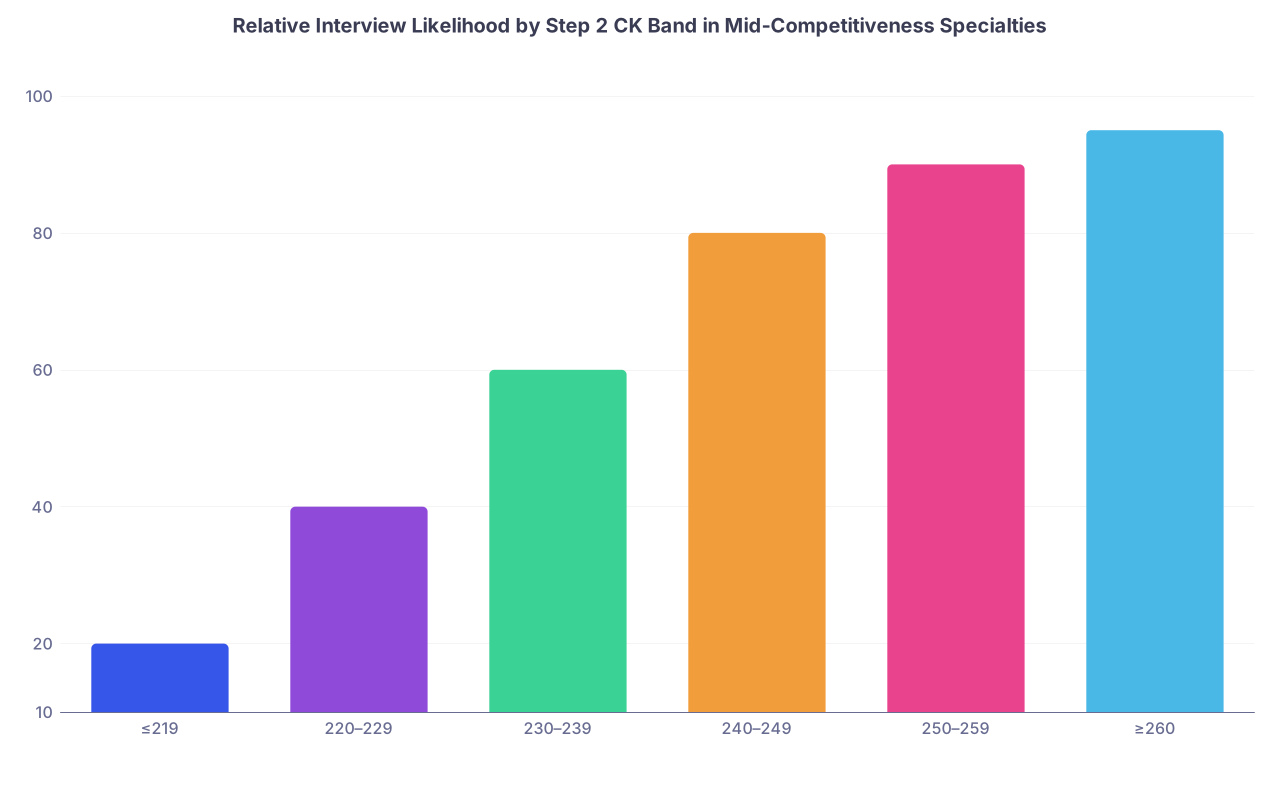
Interview odds by band (approximate trends)
Program directors in these specialties frequently cite internal cutoffs around the mid-230s to low 240s. Based on survey data and what I have seen on the ground, here is a realistic directional sense of how Step 2 CK shifts your interview odds at mid-tier academic programs:
≤ 219: significantly below most cutoffs.
You might get looks at community or less selective programs, especially with strong home advantages, but the default is “no review.”220–229: borderline.
Enough to get reviewed at many mid-tier or community programs, especially with high class rank or strong letters, but you are starting behind the pack.230–239: competitive but unremarkable.
You are in the big middle. You will get interviews if the rest of your application is coherent, and you apply broadly. But this score range is rarely a differentiator upward.240–249: clear positive signal.
Now you are hitting a sweet spot. This band tends to convert into a significantly higher interview rate, especially in IM, anesthesia, and EM.250–259: strong advantage.
Programs notice. Your name climbs higher on “to interview” lists, especially if combined with solid clinical grades and some research or leadership.≥ 260: standout.
In this tier, numbers like 262 or 265 often trigger comments like “top tier applicant” in committee. It does not guarantee a rank 1–3 spot, but you start in the “serious contender” pile.
Here is a simplified comparative view:
| Category | Value |
|---|---|
| ≤219 | 20 |
| 220–229 | 40 |
| 230–239 | 60 |
| 240–249 | 80 |
| 250–259 | 90 |
| ≥260 | 95 |
These are not literal probabilities; they capture relative direction. But the pattern is consistent: the jump from 230 → 245 or 235 → 250 often changes your actual interview landscape dramatically.
Academic IM example
In an academic internal medicine program receiving 2500+ applications for ~20 spots:
- They may auto-screen anyone <225 unless internal or special circumstance.
- Applicants 225–235 might be reviewed if they have strong research or AOA.
- Applicants 240–255 are the main interview pool.
- Applicants >255 become priority interview candidates, especially if they show interest in subspecialty or academic careers.
Here, Step 2 CK is not only a floor but a ranking lever.
6. High-Competitiveness Specialties: Step 2 CK as a Gate and Tie-Breaker
For the highly competitive specialties, you have two simultaneous forces:
- A large pool of high-achieving applicants with strong everything (research, letters, home advantage).
- Limited interview and Match spots, often concentrated in a small cluster of elite programs.
This environment amplifies the impact of Step 2 CK, especially because Step 1 is now pass/fail.
Typical Step 2 CK profiles in top-tier programs
Based on recent cycles and program director comments, it is realistic to assume:
- Median Step 2 CK at top derm/ortho/neurosurgery programs sits somewhere in the 250–260 range.
- The 25th percentile in these programs might still be around 245–250.
- Scores below 240 in these fields are relatively rare among matched US MD seniors, especially at academic centers.
Here is a stylized view of where Step 2 CK lands among matched US MD applicants in high-competitiveness specialties:
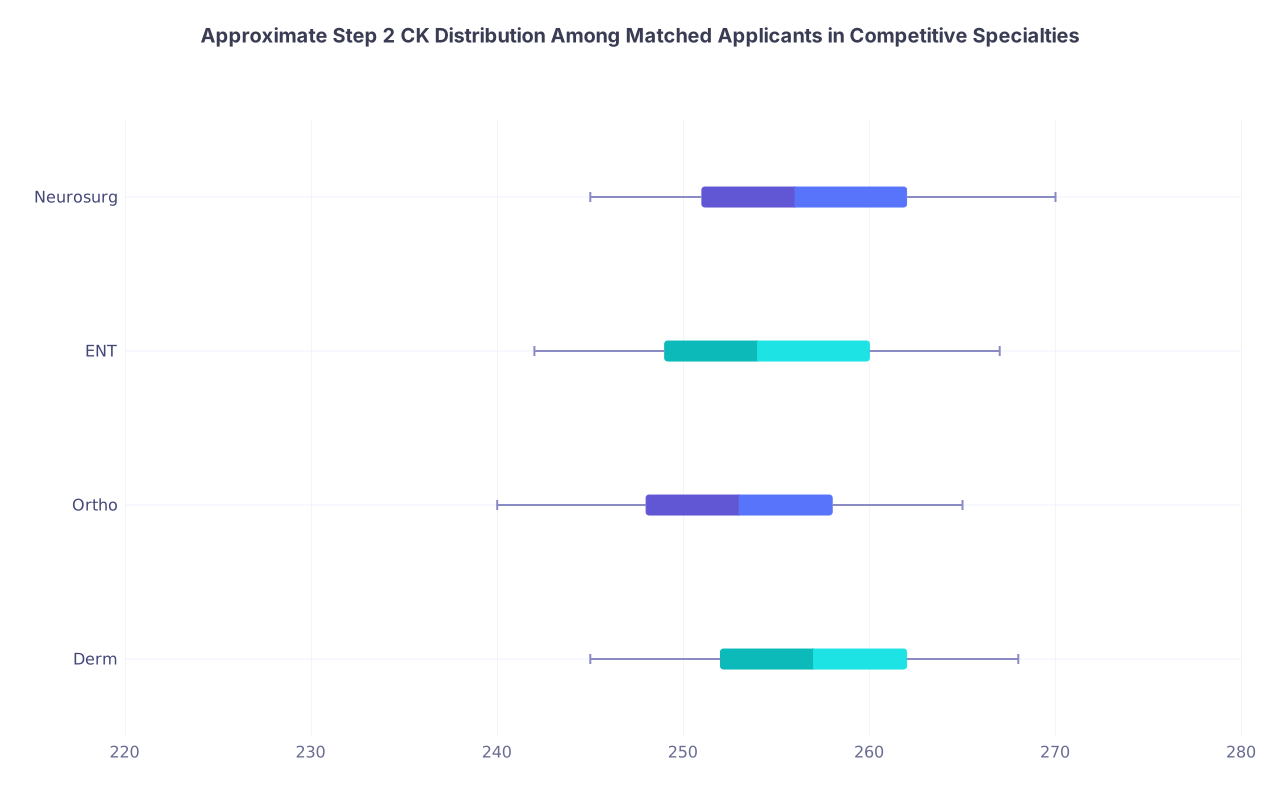
| Category | Min | Q1 | Median | Q3 | Max |
|---|---|---|---|---|---|
| Derm | 245 | 252 | 257 | 262 | 268 |
| Ortho | 240 | 248 | 253 | 258 | 265 |
| ENT | 242 | 249 | 254 | 260 | 267 |
| Neurosurg | 245 | 251 | 256 | 262 | 270 |
Again, these are illustrative, but they match what many programs quietly admit.
How different bands behave in these specialties
If you are a US MD aiming at derm, ortho, ENT, neurosurgery, or plastics:
≤ 229: you are almost completely blocked numerically.
Only extreme outliers (PhD, major first-author publications, unmatched reapplicants with powerful connections) get traction.230–239: possible but rare.
You need very strong compensatory strengths: AOA, multiple high-impact publications, elite home institution, massive advocacy from mentors.240–249: viable but uphill.
You must apply broadly and lean heavily on research output, audition rotations, and letters. Programs will see you as slightly below their numeric comfort zone but may still bite.250–259: in the mix.
This is where many matched applicants sit. Combined with solid research and letters, this range can fully support a successful Match.≥ 260: you have a strong numeric argument.
In combination with a coherent academic story, this score often gets called out explicitly (“260, multiple pubs, seems serious about our program”). It does not guarantee anything, but it removes a large barrier.
High-competitiveness programs do not care about Step 2 CK alone. But they absolutely use it to filter and to split hairs when candidates look similar otherwise.
7. How Step 2 CK Interacts With Other Application Components
Step 2 CK does not operate in isolation. The “Match odds” effect depends heavily on how your score combines with:
- School type (US MD vs DO vs IMG)
- Home vs away rotators
- Research quantity and quality
- Class rank and clerkship grades
- Red flags or professionalism issues
The multiplier effect for DOs and IMGs
For DOs and IMGs, a strong Step 2 CK often does more work than for US MDs because it functions as a credibility signal across institutions that might otherwise discount you.
A DO with a 255 Step 2 CK applying to anesthesia, for example, may interview broadly at academic centers that historically took very few DOs. Without that score, they likely would not.
Similarly, an IMG with 260+ plus strong US clinical experience gains entry to interview stages that a 235-240 IMG will never see, regardless of letters.
Compensating vs amplifying
- In mid-tier specialties, a high Step 2 CK (250+) can partially compensate for weaker research, provided you have strong clinical narratives and letters.
- In derm/ortho-tier specialties, a high Step 2 CK mostly amplifies an already strong profile. It rarely rescues a weak one.
In other words: in moderate specialties, high Step 2 CK is a compensatory asset. In elite specialties, it is a necessary but insufficient condition.
8. Strategic Thresholds: Where Scores Force Strategy Changes
Let me be blunt: certain Step 2 CK thresholds should trigger explicit strategic shifts.
Here is a simplified way to think about it:
| Step 2 CK Score | Strategic Interpretation |
|---|---|
| < 220 | Reassess specialty list; favor low-competitiveness |
| 220–229 | Avoid top-tier programs; apply broadly and realistically |
| 230–239 | Mid-tier specialties feasible; competitive fields limited |
| 240–249 | Most mid-tier and many academic programs realistic |
| 250–259 | Strong positioning; selective programs in reach |
| ≥ 260 | Highly competitive programs viable if rest is aligned |
Some concrete examples:
You score 218 and planned for OB/GYN or EM.
Data suggests your probability of matching in those fields drops substantially. You can still try if you have strong home support, but you should seriously consider adding lower-competitiveness back-up specialties and increasing your application volume.You score 235 and aimed for anesthesia at academic centers.
You are in range, but not a slam dunk. You likely need:- A broad application strategy (30–40+ programs).
- Strong letters and evidence of interest in the field.
- At least some research or scholarly activity.
You score 247 and aimed for academic IM or EM.
Your Step 2 CK score now supports a more assertive list including academic centers that might have been stretch targets at 232.You score 262 and are thinking derm vs IM.
That 262 materially changes your ability to pursue derm. Without it, derm would be extremely difficult unless you had exceptional research. With it, you still need serious derm research and mentorship, but your numerical barrier is largely cleared.
9. Timing: When a Late or Missing Step 2 CK Hurts Your Odds
Another underappreciated dimension: timing. A good score that arrives too late behaves like a mediocre score in the initial screening window.
Programs start downloading and sorting applications as soon as ERAS opens. Many large programs begin building interview lists within the first 2–4 weeks. If your Step 2 CK is missing, several things may happen:
- Some programs automatically hold your file until the score posts.
- Others review anyway but mark you as “pending” and move on to candidates with completed profiles.
- Some have strict policies: “No Step 2 CK score = no interview offer.”
So the presence and timing of Step 2 CK affects your odds almost as much as the raw number.
If you delay Step 2 CK to late fall and are applying to competitive or mid-tier specialties, you are effectively handicapping your file in the most important screening window.
10. Practical Takeaways: Where the Data Leaves You
To condense the analytics into concrete moves:
Step 2 CK is now the primary numeric driver of Match odds across most specialties.
In low-competitiveness fields, it mostly acts as a floor. In mid-competitiveness fields, it is a major sorting tool. In high-competitiveness fields, it is a gate and tie-breaker.Score bands matter more than single points.
Moving from 238 to 242 is negligible. Moving from 238 to 248 meaningfully shifts your interview landscape in mid-tier specialties, and from 248 to 258 does the same in high-tier ones.There are real strategy inflection points.
Below 220, you need to rethink specialty plans.
230–240 opens mid-tier doors; 240–250 opens academic doors; 250–260 and above make serious runs at competitive specialties plausible—but only with aligned research and mentorship.