
Last October, a fourth-year sat in a quiet conference room with her dean. 14 rejections. 2 interviews. Step 1 was pass. Step 2 CK? A 227. She’d been told, “Step 2 is just a formality now, as long as you pass.” The programs she applied to did not agree.
Let me tell you what actually happens behind those closed doors when committees look at Step 2 CK. They absolutely have cutoffs. They absolutely talk about them. And they absolutely do not publish them.
Why Step 2 CK Quietly Became the Gatekeeper
When Step 1 went pass/fail, a lot of students thought, “Good, less pressure.” Program directors had a different reaction.
I sat through a PD meeting in 2022 where an associate program director from a big-name IM program literally said: “We just moved our Step 1 filter to Step 2. Same numbers, new column.”
Not every program is that blunt, but the pattern is the same:
- Step 1 is now a noise signal.
- Step 2 CK is the only standardized, numerical, comparable metric across every school and country.
- Committees are drowning in applications and need fast filters.
So Step 2 became the quiet bouncer at the door.
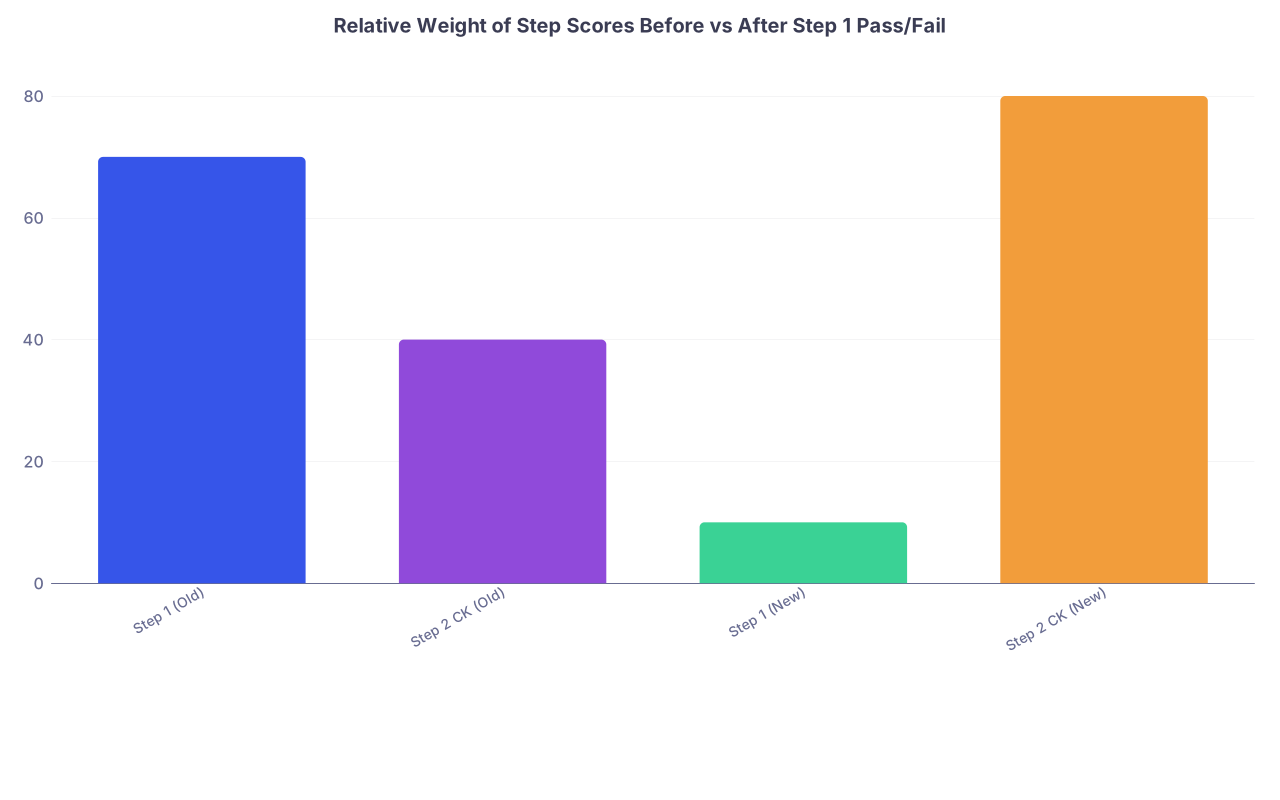
| Category | Value |
|---|---|
| Step 1 (Old) | 70 |
| Step 2 CK (Old) | 40 |
| Step 1 (New) | 10 |
| Step 2 CK (New) | 80 |
Those numbers aren’t official, but they’re accurate in spirit. Before pass/fail, Step 1 drove the bus. Now, Step 2 CK does. Especially for competitive specialties, big academic programs, and any institution drowning in 3,000+ applications.
The Reality: Yes, There Are Unspoken Cutoffs
Let’s stop pretending otherwise. Programs don’t advertise hard cutoffs because they don’t want to be boxed in legally or politically. But internally? They use them relentlessly.
Here’s how it looks from the inside.
You’ve got a spreadsheet of 3,000–4,000 applicants. Columns: school, Step 1 (P/F), Step 2 CK, research, AOA, home/away rotation, URM flag, visa needs, red flags, etc.
First move is never “holistic review.” First move is: filters.
I’ve seen this process more times than I can count. Typical sequence:
- Remove people with failed attempts (Step 1 or Step 2) unless they have some insane compensating factor.
- Set a Step 2 CK floor. Something like:
- “Below 220, auto-screen out unless flagged by faculty.”
- Or in surgery: “Below 240, we’re not looking unless they’re from X school or known to us.”
- Now you’re down to a manageable pile that actually gets “holistic” review.
Do they make exceptions? Yes. But exceptions prove the rule. If there wasn’t an implicit cutoff, you wouldn’t need exceptions.
Typical Hidden Thresholds by Specialty
No one will give you real numbers officially. Off the record, they talk in ranges. I’ll do the same.
These are approximate internal mental cutoffs where you go from:
- “Probably screened out”
to - “At least gets a look.”
I’m talking about U.S. MD/DO grads. For IMGs, the bar is almost always 10–15 points higher.
| Specialty Tier | Likely Screen-Out Below | Competitive Zone Starts Around |
|---|---|---|
| Top-tier Derm / PRS / Ortho / ENT | 240–245 | 255+ |
| Mid-high Surgical (Gen Surg, Urology, Neurosurg) | 235–240 | 250+ |
| Competitive IM / EM / Anesth / OB-GYN | 225–230 | 240+ |
| Mid-tier IM / Peds / FM (academic) | 215–220 | 230+ |
| Community IM / Peds / FM | 205–210 | 220+ |
Again, these are not “published cutoffs.” But they line up almost eerily well with what PDs complain about over drinks:
- “We just can’t interview people under 230 unless they’re internal.”
- “We had too many applicants, so we set the Step 2 filter at 245 this year.”
You think I’m exaggerating. I’m not.
How the Filters Are Actually Implemented
This is what the selection process really looks like in many places.
Step 1: IT builds the wall
Programs work with GME/IT to set ERAS filters:
- Only show applicants with Step 2 CK ≥ X
- Or only show applicants with USMLE taken (some will not even look at you if Step 2 CK is pending past a certain date)
If the number is 235, no one below 235 even appears in the main review queue. You’re not being “holistically reviewed and then rejected.” You’re not seen. At all.
Step 2: The unofficial “gray zone”
Many programs run two passes:
- First pass: “Green” applicants above a comfortable threshold (say 240+ for a mid-high tier program).
- Second pass: “Gray zone” applicants in the 220–239 range, maybe looked at only if they have:
- Strong home institution tie
- Honors/HP in all core rotations
- AOA or top-decile narrative
- Strong departmental letter or phone call
Below the internal floor (e.g., 220)? You’re functionally invisible unless some faculty member demands your file be pulled.

| Step | Description |
|---|---|
| Step 1 | All Applicants |
| Step 2 | Hold / Auto-reject later |
| Step 3 | Auto-screen out |
| Step 4 | Priority review |
| Step 5 | Secondary review if strong extras |
| Step 6 | Step 2 CK Available |
| Step 7 | Score above cutoff? |
| Step 8 | Score in green zone? |
That’s the part students never see: you are filtered long before anyone reads your essay about resilience.
What Different Programs Secretly Expect
Here’s the part everyone wants to know: “What number is enough?” There’s no single answer. But I’ll give you the mental categories committees actually use.
260+
You’re in the “signal of excellence” category. Programs notice.
For top-tier, hyper-competitive specialties, 260+ doesn’t guarantee anything—but it keeps you out of the auto-trash and gets you taken seriously even at places that don’t know you. It buys you forgiveness for weak parts of the app.
For core specialties (IM, Peds, FM, EM), a 260+ becomes an asset. People bring your name up in committee: “The 262 from [mid-tier school] with strong clinical comments? We should grab them.”
250–259
This is the quiet sweet spot. Above nearly all internal cutoffs, below the “unicorn” zone, but comfortably strong.
At many academic IM, anesthesia, OB‑GYN, EM programs, being in this band means you’re never removed for score alone. They might not be wowed, but no one is nervous. You’re safe.
For ortho, plastics, derm, ENT, neurosurg: 250s are expected or at least very common at top programs. Below that, you’d better have something special.
240–249
This range is nuanced.
- In IM/Peds/FM: You are absolutely fine at the vast majority of programs, including many academic ones.
- In EM, anesthesia, OB‑GYN: You’re competitive at a lot of places, especially with solid clinical evals.
- In the hyper-competitive fields: Now you’re dependent on the rest of the application (school name, AOA, research, away rotations). You’re no longer “standout by score.”
Committee talk sounds like:
“Score’s solid, anything else impressive?” or “240, good enough, what do their rotations say?”
230–239
Now you’re in the vulnerable middle.
A lot depends on:
- Your specialty
- Your school reputation
- Whether you’re MD/DO/IMG
- And whether the program is academic vs community
At many solid academic IM and Peds programs, 230s are fine. But for the competitive specialties, 230s are quietly filtered if you’re not strongly connected.
I’ve heard this exact line: “We set the Step 2 filter at 235 this year. We just had too many apps.”
220–229
This is where the trouble starts in competitive environments.
For academic IM/Peds, you’re now in a gray zone. You’ll get looks at mid-tier or community programs, especially if everything else is clean. But the national-brand residencies? You’re mostly out—unless:
- You did a home rotation and wowed them
- You’re from their own med school and strongly backed
- You bring something rare (meaningful research, unique skillset, or diversity they highly value)
For EM, anesthesia, OB‑GYN, and certainly any surgical subspecialty: this range is usually a big problem.
Below 220
I’ve been in these meetings.
- “We just can’t go below 220. The residents won’t tolerate it.”
- “Any sub-220s that we must look at because of strong internal advocacy?”
That’s the level of conversation you’re up against.
For less competitive primary care programs, below 220 is not a death sentence, but it’s still a red flag. Something else must be clearly stellar.
Ugly Truth: Scores Are Used to Protect the Program, Not Just to Judge You
Students always view Step 2 as a personal metric. PDs don’t.
They look at Step 2 CK and think:
- “Will this resident pass their boards?”
- “Will they be able to manage the cognitive load?”
- “Will this number come back to haunt us in board pass reports?”
Programs are terrified of low board pass rates. Those go straight into accreditation reports. So even decent human beings, who genuinely like helping people, will quietly filter out “risky” Step 2 scores because they think they’re protecting their program.
I heard a PD in a mid-size IM program say: “Our last probation came from a string of board failures. I am not going through that again. Anything under 220 is just not happening for us this year.”
That’s what you’re competing with: not just other students, but past scars of the program.
How Step 2 Interacts With the Rest of Your Application
PDs don’t read Step 2 in a vacuum. They make tradeoffs.
Here’s how those trades really look in committee discussions:
High score, weak evals:
“Sharp on test day, but can they function on the wards?” If your clinical comments say “average, reserved, needs direction,” a 255 does not fully rescue you, especially in high-volume or procedure-heavy fields.Moderate score, stellar evals:
“236 but the resident and attending said ‘top 5 student in 10 years’—we should rank them.” This happens a lot more than you’d think.
Strong narrative comments can salvage borderline scores, especially in IM, Peds, FM, and EM.Good score, zero advocacy:
No away rotations. No strong departmental push. No one knows you. You become just another 243 in a sea of 243s. The number helps you pass filters, but doesn’t pull you to the top.Borderline score, strong advocacy:
“This is the 224 that Dr. X called me about. Let’s interview.”
Faculty champion + known performance can absolutely override quiet internal cutoffs, but notice the verb: override. That means the cutoff is real.
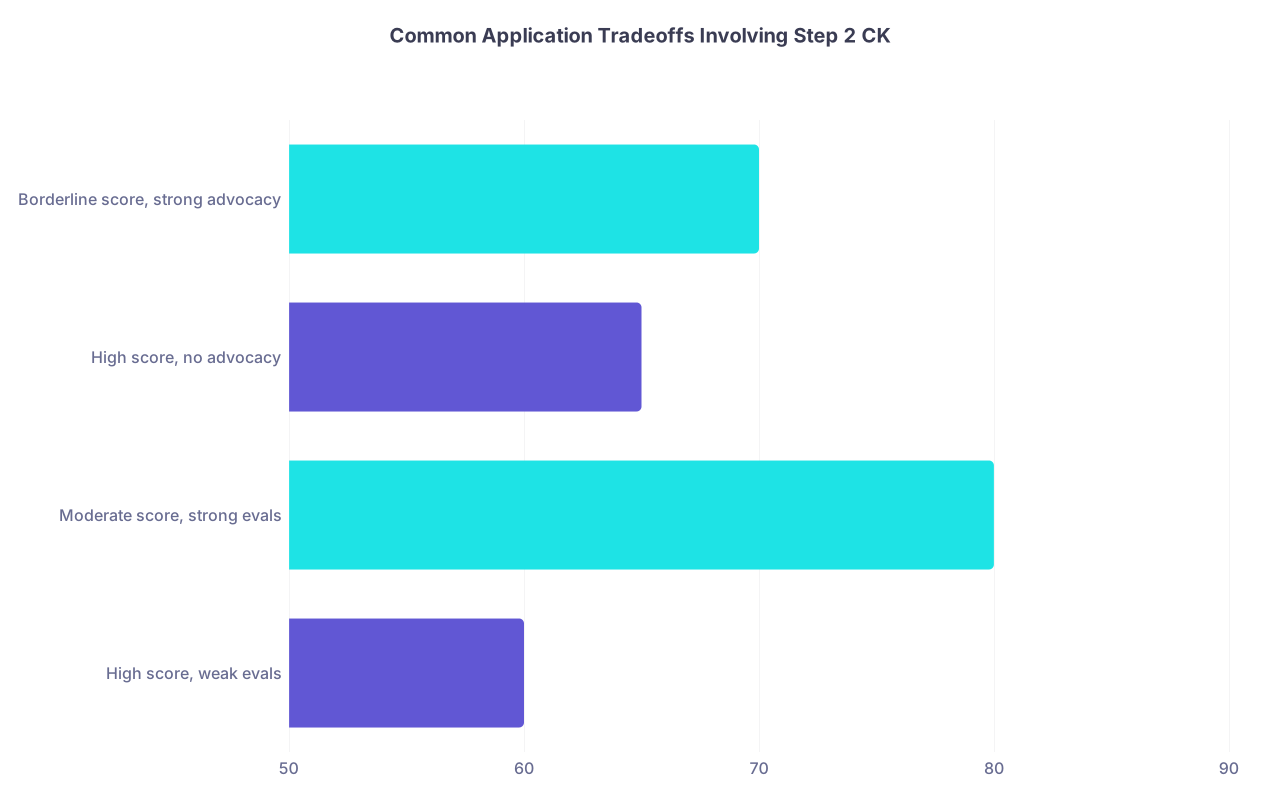
| Category | Value |
|---|---|
| High score, weak evals | 60 |
| Moderate score, strong evals | 80 |
| High score, no advocacy | 65 |
| Borderline score, strong advocacy | 70 |
Think of Step 2 as your ticket into the room. The rest of the application decides whether anyone sits down and talks to you.
When Taking Step 2 CK Late Quietly Kills Your Application
Another unspoken rule: programs don’t like uncertainty.
If it’s October and your Step 2 CK field in ERAS still says “pending,” a lot of programs will:
- Auto-hold your file
- Or soft-reject you without ever calling it that
Why? Because they cannot risk interviewing someone who then drops a 212 in December.
I’ve literally heard: “We’ll wait for their Step 2. If it’s good, there won’t be any interview spots left anyway.”
So pushing Step 2 too late without a very clear, communicated strategy is dangerous. Especially for students whose Step 1 was weak or just pass.
For borderline profiles, many PDs quietly expect Step 2 CK to be visible and solid by the time they’re seriously reviewing apps (late September–early October for many programs).
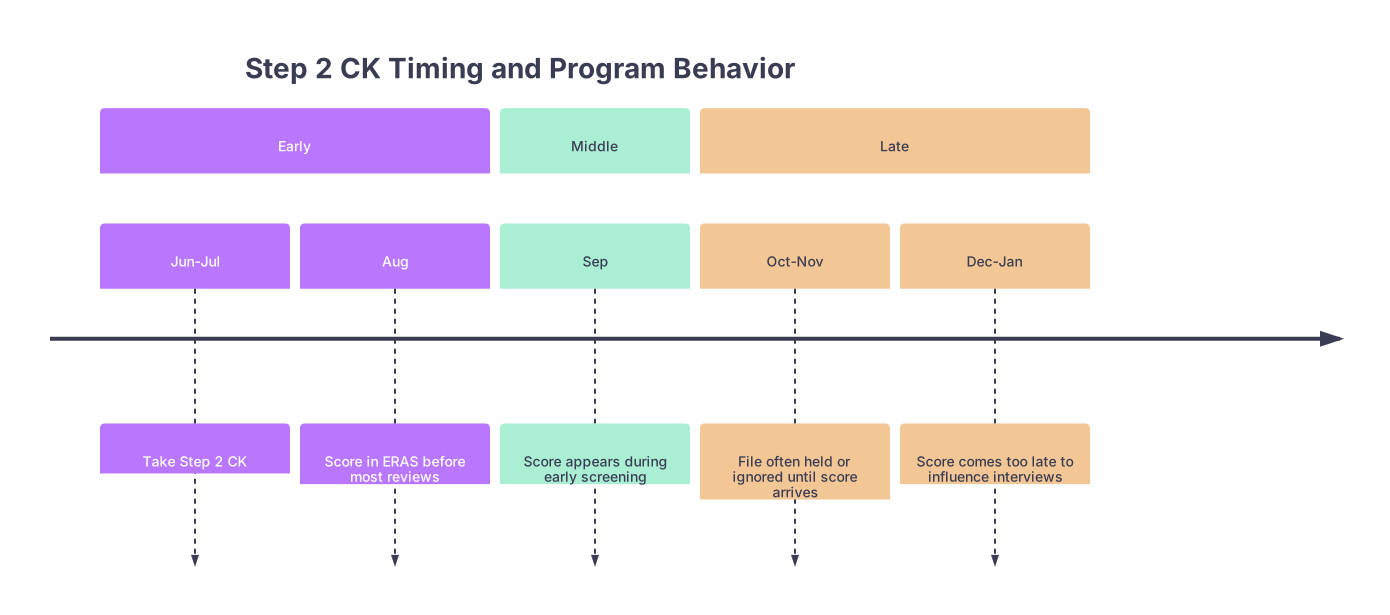
| Period | Event |
|---|---|
| Early - Jun-Jul | Take Step 2 CK |
| Early - Aug | Score in ERAS before most reviews |
| Middle - Sep | Score appears during early screening |
| Late - Oct-Nov | File often held or ignored until score arrives |
| Late - Dec-Jan | Score comes too late to influence interviews |
For IMGs: The Unspoken “Plus 10–15 Rule”
If you’re an IMG, here’s the rule nobody prints but everyone uses:
Whatever internal cutoff they use for U.S. grads, add 10–15 points for IMGs.
An internal medicine program might think like this:
- U.S. MD/DO: We’ll look closely at 225+
- IMG: Realistically, 240+ to be considered at all
And for competitive specialties, many PDs just don’t go there unless you’re absurdly strong (250s+) or already known to them.
I’ve sat in those rooms when they scroll through lists and say, “Any IMGs we have to look at because of faculty connections?” That’s the bar.
How To Read Your Step 2 Score The Way Committees Do
Take your score. Put the ego aside. Now ask:
- What specialty am I aiming for?
- What tier of programs am I realistically targeting—top academic, mid-academic, community?
- Am I U.S. MD, DO, or IMG?
- Do I have strong, documented clinical excellence to offset any weaknesses?
Then map it roughly like this:
If you’re ≥10–15 points above the typical internal floor for your target specialty/tier:
You’re relatively safe from auto-screen. Your battle is now about everything else.If you’re within ~5 points of that floor:
You’re in the danger zone. You need strong advocacy, strategic program selection, and probably more emphasis on mid-tier/community programs.If you’re >10 points below:
You’ve got to change something: specialty target, program tier expectations, or develop a very compelling narrative with real mentors backing you—and still apply widely.

Strategic Moves If Your Step 2 CK Is Lower Than You Wanted
This is where most advice online becomes uselessly vague. Let’s be concrete.
If your score is:
250s and above
Your job is not damage control. It’s alignment.
- Don’t waste this. Target strong programs, but don’t build an insane all-reach list.
- Make sure the rest of your app isn’t lazy just because your score is high. PDs resent “score only” applications that look phoned in.
240–249
You’re fine at most places. Focus on:
- Making your clinical evaluations and letters sing.
- Being realistic about hyper-competitive specialties: here, 240s are “normal,” not exceptional.
230–239
Now you need to be smart.
- Be honest about your competitiveness for your chosen specialty.
- If you’re chasing a surgical subspecialty or derm/PRS/ENT with a 233 and without an insane research CV, you’re running uphill in sand.
- Consider mixing in a parallel plan: a more attainable specialty where your score is less of a barrier.
220–229
You must fight on every other front.
- Very deliberate program list: heavier on mid-tier and community, fewer top-10 brand names.
- Maximize away rotations or sub-internships where you can build real advocates.
- Have your mentors be brutally honest about your competitiveness and where to apply.
Below 220
You need realism and a plan.
- You can match. People do.
- But you cannot apply like someone with a 245 and then act surprised when the interviews do not come.
- You’ll likely need:
- Broad applications
- Strong narrative about growth and improvement
- Mentors willing to personally reach out
- A backup plan if your target specialty is even moderately competitive

The Real “Importance” of Step 2 CK in the Match
Step 2 CK doesn’t make you a good doctor. It doesn’t measure empathy, work ethic, or judgment on a 3 a.m. call night.
But for the residency match, its importance is brutally simple:
- It opens doors or quietly closes them before you ever see the handle.
- It protects programs from risk (board pass rates, accreditation scrutiny).
- It gives committees something “objective” to hide behind when they’re overwhelmed.
If your Step 2 is strong, use it as a foundation, not a crutch. If it’s weaker, stop living in denial. Internal cutoffs are real, but so are exceptions—if you give people a reason to bend the rules for you.
You can’t control what cutoffs they whisper about in those conference rooms. You can control how realistic, strategic, and proactive you are once you know those whispers exist.
Years from now, you won’t remember your exact Step 2 CK score as clearly as you remember how you responded to it—whether you pretended the system was something it’s not, or adjusted to the way it actually works.