
High Step 2 CK scores are overrated as a rescue plan.
Program directors say this out loud in meetings, then go on Zoom town halls and tell students the opposite.
Let me tell you what really happens.
A monster Step 2 CK (250–270+) will get people talking. It may get your file pulled off the “auto-screened” pile. It might get you one more glance if someone in the room wants to advocate for you.
But it will not fix a chronically weak transcript, ugly professionalism comments, mediocre letters, or a pattern of poor judgment. And once AI filters and spreadsheet triage start, you’re more of a row in a table than a “redemption arc” character.
You’re thinking: “But PDs say ‘we look at the whole application.’”
They do.
They just don’t look at your whole application for very long.
How Step 2 CK Really Gets Used
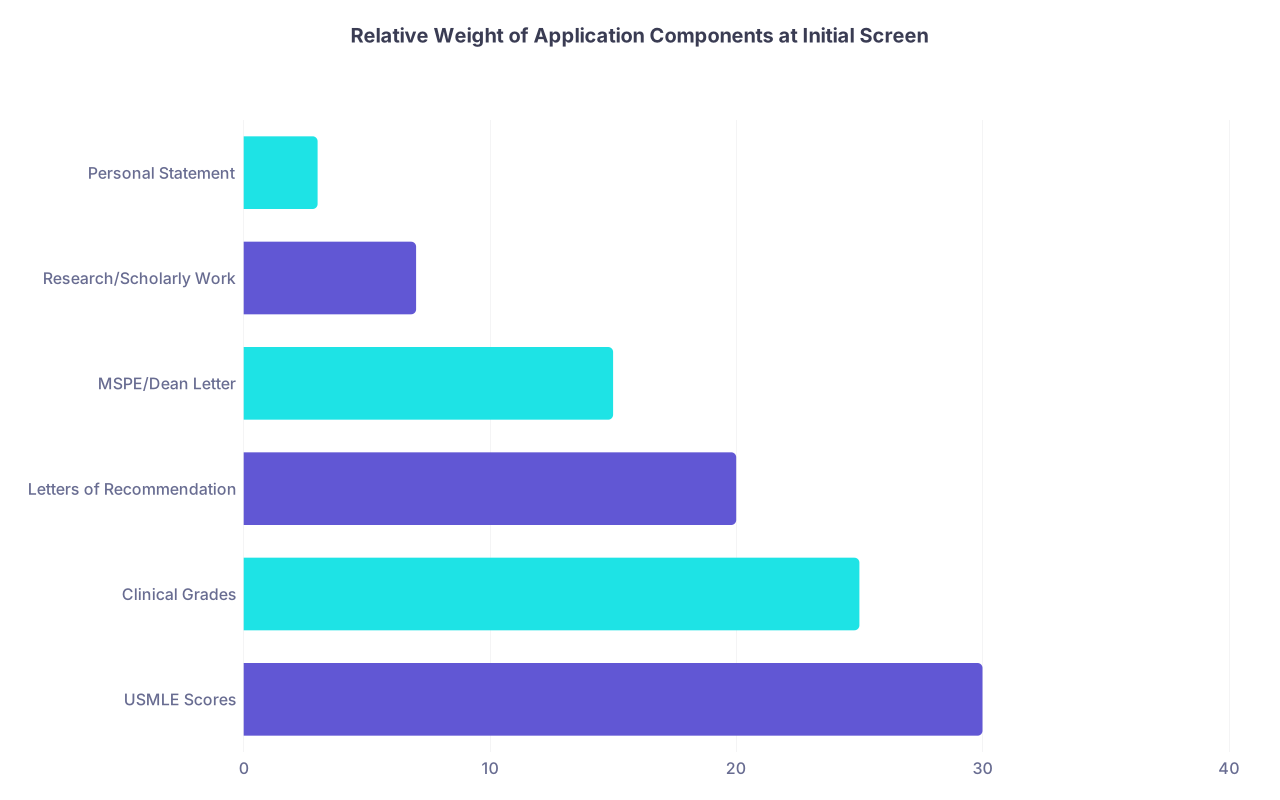
| Category | Value |
|---|---|
| USMLE Scores | 30 |
| Clinical Grades | 25 |
| Letters of Recommendation | 20 |
| MSPE/Dean Letter | 15 |
| Research/Scholarly Work | 7 |
| Personal Statement | 3 |
Let’s start with the unspoken algorithm.
Behind closed doors, most mid-to-large programs use Step 2 CK three ways:
- As an automatic filter (“cut score”)
- As a tie-breaker between otherwise similar applicants
- As a red flag detector when it’s low or inconsistent with the rest of the file
Notice what’s missing: “as a magic eraser for everything else.”
I’ve sat in rank meetings where someone says:
“He’s got a 263 Step 2, that’s insane,”
and the PD responds:
“Yeah, but look at the MSPE paragraph about professionalism. Hard no.”
That’s it. Done. High score, zero power.
Most programs use something like this rough flow, even if they pretend it’s more holistic:

| Step | Description |
|---|---|
| Step 1 | ERAS apps received |
| Step 2 | Score filter run |
| Step 3 | Auto-screened out or deprioritized |
| Step 4 | Secondary screen |
| Step 5 | Reject or low interest |
| Step 6 | Letters, experiences, fit |
| Step 7 | Rank later |
| Step 8 | Reject |
| Step 9 | Step 2 CK above cutoff? |
| Step 10 | Transcript and MSPE acceptable? |
| Step 11 | Interview? |
The high score mostly affects step C. It gets you through the gate. After that, it stops being the star and becomes just another data point.
If the rest of the file is weak, that shiny number is background noise.
The “Profile” Problem: Why One Score Can’t Carry You
Programs are not trying to build a leaderboard of test-takers. They’re trying to build a residency class. A group that can survive 3–7 years together without imploding.
That means they’re scanning for profiles, not isolated stats.
Here are the profiles that scare people in the room, even if the Step 2 CK is glowing:

1. The “Board Beast, Mediocre Clinician”
You know this one. 260+ Step 2 CK, but:
- Multiple “Pass” clinical grades in core rotations
- No honors in medicine or surgery
- Comments like “requires frequent prompting,” “needs to work on clinical reasoning,” “improving but still below level”
Internally, faculty phrase it like this:
“Great test-taker. Do I want them on call with me at 2 a.m. on July 2? Not really.”
The quiet truth: many PDs would rather have a 240 with consistent honors and glowing narrative comments than a 260 with lukewarm clerkship remarks. The clerkship comments are day-to-day reality. The Step 2 CK is a one-day stress test.
2. The Inconsistent Story
This is the file that just doesn’t make sense.
- Pre-clinical: multiple fails or remediation
- Step 1: barely passed (when it was scored), or needed multiple attempts on COMLEX
- Step 2 CK: 255
On paper, that sounds like a comeback story. That’s how you see it.
Here’s how the room often sees it: “What changed? Is this a real turnaround or a fluke?” If the MSPE and advisor letter don’t explicitly frame it as a documented trajectory (with concrete behavior changes, improved evaluations, upward arc), some PDs default to suspicion rather than admiration.
And if there’s any whisper of test accommodations or irregular behavior? Fairly or unfairly, people start second-guessing the number.
3. The Behavioral Landmine
I’ve seen this scenario multiple times:
- Step 2 CK: 250+
- Solid or decent clinical grades
- But the MSPE contains one painful sentence:
“There were concerns related to professionalism, addressed through a formal remediation plan.”
That single line obliterates whatever warm glow your Step 2 CK creates.
In closed meetings, it sounds like this:
“We can teach someone how to manage DKA. We cannot teach them not to scream at nurses. Pass.”
Programs are deathly afraid of problem personalities. A high test score doesn’t mean you’re not going to blow up a team dynamic.
4. The “Invisible” Applicant
Big score, but:
- Generic letters (“pleasant to work with,” “will make a fine resident” → code for “average”)
- No real depth: recycled activities, no clear commitment to anything
- Personal statement that could be copy-pasted to any specialty
- No one in the room actually knows you or feels invested in you
In that case, the Step 2 CK just wins you a brief shrug: “Smart kid, but we have 80 smart kids with better letters and actual fit.”
Concrete Cases: When Step 2 CK Fails to Rescue
Let’s be blunt and specific.
| Profile | Step 2 CK | Outcome |
|---|---|---|
| Strong score, poor clerkship comments | 258 | Few interviews, mid-tier match at backup specialty |
| Huge improvement after weak Step 1 and remediation | 255 | Mixed; some interviews, several silent rejections |
| Great score with professionalism flag in MSPE | 262 | Rejected or unranked at many mid/high-tier programs |
| Strong Step 2, average letters, bland application | 253 | Interviews mostly at lower-mid tier, regional programs |
These are real patterns I’ve seen behind the scenes:
Case 1: The Medicine Applicant With a 258 and “Needs Frequent Redirection”
Internal medicine, mid-tier academic program.
Applicant: 258 Step 2, 240 Step 1. IM rotation: Pass, narrative includes “needs frequent redirection” and “sometimes struggles to prioritize tasks.”
One faculty on the committee wanted to push them up the interview list because of the board potential. The PD shut it down with one sentence:
“We’re already sweating July. I don’t want someone I can’t trust to run the list.”
They ranked stronger clinical performers with 235–245 over this person without hesitation. The score got mentioned. It did not matter.
Case 2: The 255 “Redemption Arc” That Didn’t Fully Convert
Applicant from a lower-tier US MD school. Early failures in pre-clinical anatomy and pharmacology, repeated. Step 1: 205. Step 2 CK: 255.
To their credit, the student had an upward trend in clerkships and a well-written personal statement owning the early struggles.
What happened?
Some programs bought the story. They got interviews at a couple of solid academic places and matched decently.
But many others never saw the nuance. The auto-filter plus a quick read of “multiple remediations” was enough to bury them. At several places, committee members admitted, “If I had more time with each file, I’d look deeper, but we don’t.”
The Step 2 CK softened the blow but didn’t erase that early record.
Case 3: The 262 With a Professionalism Paragraph
This one was DOA at almost every competitive program.
The MSPE noted an unprofessional outburst on surgery, formal remediation, and “successful completion of professionalism curriculum.” The Step 2 CK? 262. Letters? Two strong, one lukewarm.
I watched three programs independently have almost the same discussion:
- “Score is amazing.”
- “I don’t want to deal with that professionalism risk.”
- “Exactly. We can fill our class with people who don’t come with that history.”
Where did they match? Community program in a less competitive region, after many top places ghosted completely.
How Programs Rank You When Everyone Has Good Scores
Here’s another dirty truth: in many specialties now, Step 2 CK is not the differentiator you think it is.
Look at this type of distribution:
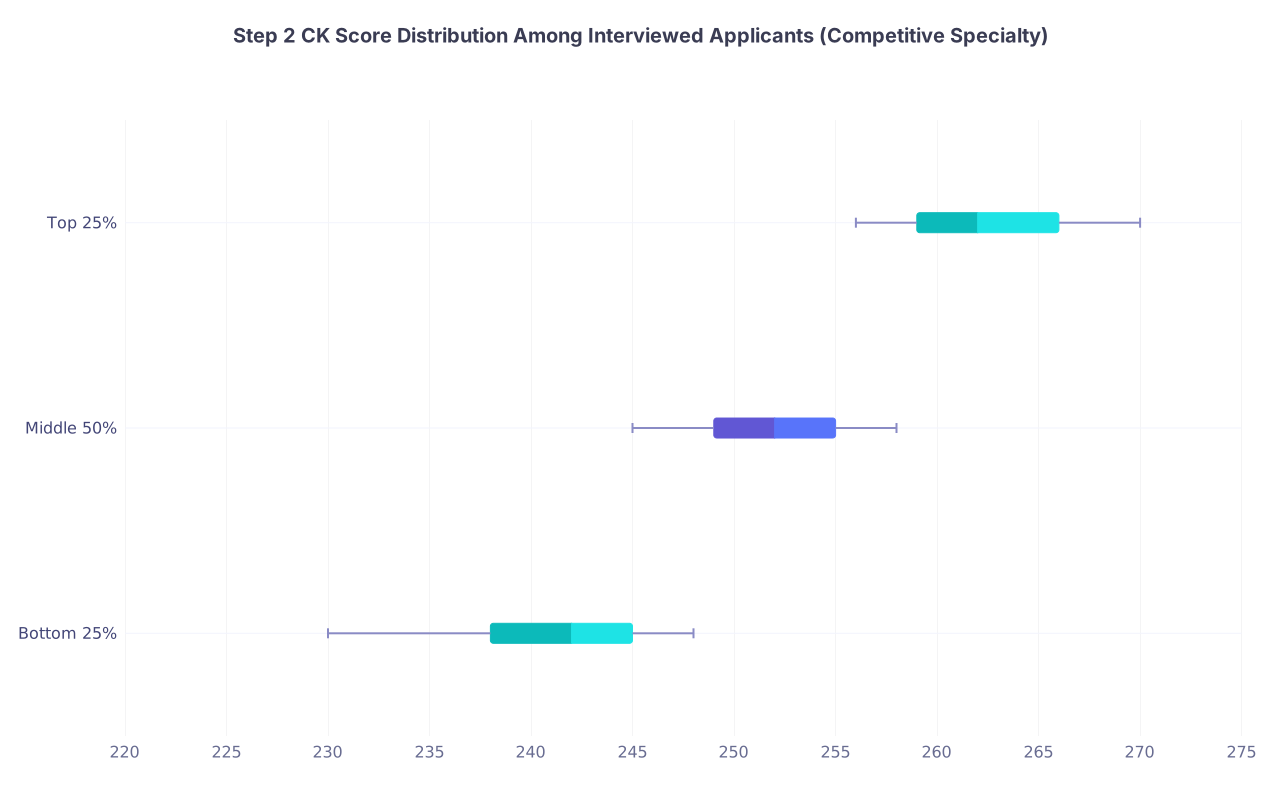
| Category | Min | Q1 | Median | Q3 | Max |
|---|---|---|---|---|---|
| Bottom 25% | 230 | 238 | 242 | 245 | 248 |
| Middle 50% | 245 | 249 | 252 | 255 | 258 |
| Top 25% | 256 | 259 | 262 | 266 | 270 |
At a solid academic program in EM, IM, or anesthesia, most interviewees are clustered in the 240–260 range. They’re all “good enough.”
Scoring 260+ puts you in the sparkle zone, fine. But the committee conversation at ranking goes like this:
“Okay, between these three with similar scores, who do we actually want to work with? Who has the better letters? Who’s more reliable? Who fits our culture? Who seemed coachable and self-aware in the interview?”
Nobody is saying:
“This person has a 261, the other has a 248, so 261 must go higher.”
I’ve watched them rank a 238 above a 260 because the 238 had “best medical student I’ve worked with” letters and the 260 came off as arrogant on interview day.
The top of the score curve is nice. It just stops mattering once you clear a competence threshold and they move to people and patterns.
Where High Step 2 CK Does Actually Help
Let’s not pretend the score is meaningless. It’s not. It just has a specific role.
Here’s where a strong Step 2 (say 245+ relative to your specialty) legitimately changes the game:
- You barely passed Step 1 or had a modest score, and your Step 2 is a clear, believable jump with improved clerkship evaluations. That combination can reassure programs you’ve matured and that your early missteps aren’t your ceiling.
- You’re from a lower-ranked MD or a DO school applying to moderately competitive specialties. A standout Step 2 may get your file actually read at programs that might otherwise ignore your school.
- You’re applying to fields where Step 2 is now the main objective bar (EM, anesthesia, IM for certain fellowships). There, it can get you over rigid cut lines.
But even in those cases, it functions mostly as a ticket to the table. It gets you read. It doesn’t guarantee they’ll like what they see once they open the folder.
Why Weak Applications Stay Weak, Even With a Great Score
Let’s break down what “weak application” really means, because people misuse that phrase constantly. It’s not just “low score.” It’s usually one or more of these:
- Sparse or generic narrative in MSPE and letters. No one is vouching for you as “top 10%” or “would recruit to our program.”
- Pattern of “bare minimum” behavior: no initiative, no meaningful scholarship, no leadership where you actually did something.
- Red or yellow flags: professionalism issues, big unexplained gaps, repeated course failures or exam attempts.
- Mediocre clinical comments: “did what was asked,” “pleasant,” “eager learner” with no specific praise or standout examples.
- An application that does not tell a coherent story about who you are and why this specialty.
A high Step 2 CK doesn’t fix any of that. It just adds one strong data point to an otherwise forgettable or concerning file.
Think of it this way: the test tells them how you perform alone at a computer. The rest of the application tells them how you perform in their hospital, with their residents, their nurses, their patients, and their name on your badge.
Guess which one worries them more if it goes wrong.
If You’re Banking on Step 2 CK to Save You, Do This Instead
If right now your internal monologue is, “I’ll just crush Step 2 CK and everything will be fine,” you’re already off track.
Here’s how people who actually dig out of a weak profile do it behind the scenes.
1. Build a Documented Upward Trajectory
You want your advisors and MSPE writer to be able to say this sentence:
“Over the last 18 months, this student has shown a clear, consistent upward trajectory in performance and professionalism.”
That means:
- Deliberately choosing rotations where you know you can shine and get strong letters.
- Asking mid-rotation: “What can I do better to perform at the level of an intern?” and then actually doing it.
- Fixing the behavior that led to earlier issues: late notes, disorganization, defensiveness, poor communication.
Then yes, pair that with a strong Step 2 CK. Now the number matches the story: “this person got their act together.”
2. Secure At Least Two Letters That Really Mean It
Letters are where a lot of “weak” applications quietly die.
If you have a high Step 2 but your letters say, “fine, nice, did what was asked,” programs will assume you’re average, not a gem.
You need letters where the writer:
- Knows you well enough to give real examples.
- Is willing to use comparative language (“top 10% of students I’ve worked with in 10 years,” “performed at the level of an intern on our service”).
- Mentions growth if you had early issues: “Initially struggled with X, but by the end of the rotation was independently managing Y.”
A big score plus that type of letter? That actually moves your file.
3. Fix the Narrative, Not Just the Number
If you’ve got baggage—failed courses, leaves, poor early performance—you can’t just hide behind a Step 2 score report.
You need a coherent, honest, non-dramatic explanation that:
- Owns the problem without self-pity
- Shows what you changed concretely
- Connects to the current pattern of improved performance and professionalism
Then your Step 2 becomes evidence supporting that narrative, not a disconnected outlier.
4. Control What PDs See First
PDs and associate PDs are skimming a sea of files. The order of impression matters.
Many read in roughly this order:
Score sheet → MSPE overview paragraph → clerkship grades and comments → letters → personal statement (maybe).
You can’t change the past grades. But you can influence:
- Who writes your letters and what they emphasize
- How your MSPE addendum or advisor commentary frames your trajectory
- How your personal statement aligns with the story others are telling about you
If all of those echo the same key points—growth, reliability, strong team member—your Step 2 CK becomes one more reinforcing data point. Not the sole pillar.
The Harsh Reality: Some Applications Can’t Be “Saved” in One Cycle
I’ve watched students cling to Step 2 CK hope when the deeper truth was this: they needed more time.
If you’ve got:
- Multiple significant professionalism events
- Chronic poor clinical evaluations across several rotations
- Very weak institutional support (your school is basically not backing you)
Then you may need more than a high test score and a few emails.
You may need:
- A research year with strong mentorship and new letters
- A prelim or transitional year where you can prove yourself clinically
- A different specialty choice that is more realistic for your profile
Faculty actually discuss this. I’ve heard PDs say: “If they do well in a strong prelim year and come back with great letters, we’d look again. But right now? Too risky.”
There’s a quieter, honest conversation happening that you don’t hear on webinars. That conversation rarely ends with “But if they just get a 260, we’re in.”
It ends with: “We need evidence of reliability in the hospital.”
FAQs
1. I bombed Step 1 but did great on Step 2 CK. Is that enough to overcome it?
Sometimes, but only if the rest of your application matches the improvement. If your clerkship performance, letters, and MSPE all show a clear upward trend, a strong Step 2 can absolutely reframe you as a late bloomer rather than chronically underperforming. If everything else is flat or weak, the high Step 2 looks more like an anomaly than a true turnaround.
2. How high does Step 2 CK need to be to “stand out” in competitive specialties?
For very competitive fields (derm, ortho, ENT, plastics), you’re usually looking at mid‑250s and up just to be in the conversation at many academic programs. But the brutal truth: in those specialties, great scores are the baseline. Your research, letters from known faculty, and away rotation performance often matter more than the extra 5–10 points on the exam.
3. Can a very high Step 2 CK compensate for being from a lower‑ranked or DO school?
It can help you clear auto-filters and get your file looked at at places that might otherwise pass over your school. That’s real. But once they open the file, they’re still judging you on the same things as everyone else: clinical performance, letters, narrative, and fit. A big score can get you to the door. It doesn’t walk you through it.
4. If I know my application is weak, should I delay applying until after I take Step 2 CK and have the score?
If your Step 2 CK is likely to be significantly stronger than your existing metrics, yes, having it in hand before applying usually helps more than submitting early with only a weak Step 1 or shaky record. But do not fool yourself: if the underlying weaknesses (poor evaluations, professionalism flags, generic letters) aren’t addressed, timing alone won’t fix it. A later, stronger application beats an early, weak one most of the time.
Remember these truths:
- Step 2 CK opens doors; it rarely repairs everything behind them.
- Programs select patterns and people, not isolated numbers.
- The smartest move is not “score as savior,” but “score as part of a believable, upward story you’ve already started writing.”