
Step 2 CK is the tiebreaker weapon programs pretend is “holistic data.” It is not. It is the lever they pull when they have two (or twenty) similar applicants and need a clean way to separate you.
Let me walk you into the room you never see: the actual rank meeting.
I’ve sat in those rooms. I’ve watched strong personalities fight for “their” students, and I’ve watched the conversation die the second someone pulls up the Step 2 CK column and says: “Look, 271 versus 246. Come on.” That ends more debates than any personal statement ever will.
You’re told Step 2 CK matters “somewhat.” For tiebreakers, it matters a lot.
What Really Happens in Rank Meetings
Programs like to advertise “holistic review.” On the website, that’s true. On the first pass of ERAS, that’s somewhat true. On rank night with a crowded list and a tired committee? Holistic goes out the window fast.
Here’s the usual flow, stripped of marketing gloss.

| Step | Description |
|---|---|
| Step 1 | Initial application review |
| Step 2 | Interview invites |
| Step 3 | Post interview scoring |
| Step 4 | Preliminary rank list |
| Step 5 | Use tiebreakers - Step 2 CK, letters, fit |
| Step 6 | Approve list |
| Step 7 | Adjusted rank list |
| Step 8 | Contentious or crowded tiers |
The first passes are about obvious yes/no decisions. Known quantities. Home students. Away rotators that impressed everyone. Red flags that get quietly buried.
The tension happens in the middle tiers—where you live if you’re a good, solid applicant. That’s where Step 2 CK starts quietly running the show.
Picture this: Internal Medicine program, mid-tier academic center. They’ve interviewed ~300 people. They’ll rank around 220. They’re arguing about who sits in the 40–120 band that actually has a good shot at matching there.
The spreadsheet is up on the projector. Columns for:
- Name
- School
- Home vs away
- Interview score
- Letters (often as “strong / average / vague red flag”)
- Step 1 (now P/F but still shown if historically numeric)
- Step 2 CK
- “Fit” or “gut” score (yes, people literally label it like this)
The PD scrolls. Attending A: “I really liked Patel, great clinical sense.” Attending B: “Yeah but her Step 2 is a 235. Kim is a 254 and same interview tier. I don’t think we can justify putting Patel ahead.”
You know what happens next. Patel drops 20–30 spots. Nobody writes that on an official policy document, but it happens, program after program.
Why Step 2 CK Became the Default Tiebreaker
Once Step 1 went pass/fail, a quiet panic ran through program offices. They lost their lazy, blunt sorting algorithm. They needed a new one. Step 2 CK was sitting right there.
Here’s what program directors like about Step 2 CK when making rank list decisions:
It’s current.
It tells them who can still perform now, after clinical rotations, not who peaked as a second-year memorizing minutiae.It’s clinical.
They believe (rightly or wrongly) that Step 2 CK approximates how you’ll function on wards and in exams like the ITE and boards.It’s convenient.
Numbers make arguments easy to win. “But they’re a 262, we can’t let them slide to 90th.” That sentence ends a lot of debates.It’s politically safe.
If someone questions why an applicant was ranked lower, saying “we prioritized stronger clinical performance metrics” sounds neutral and defensible.
Let’s be blunt: many programs have quietly shifted from “Step 1 cutoff” to “Step 2 CK cutoff” or “Step 2 CK expectation,” even if they refuse to put that in writing.
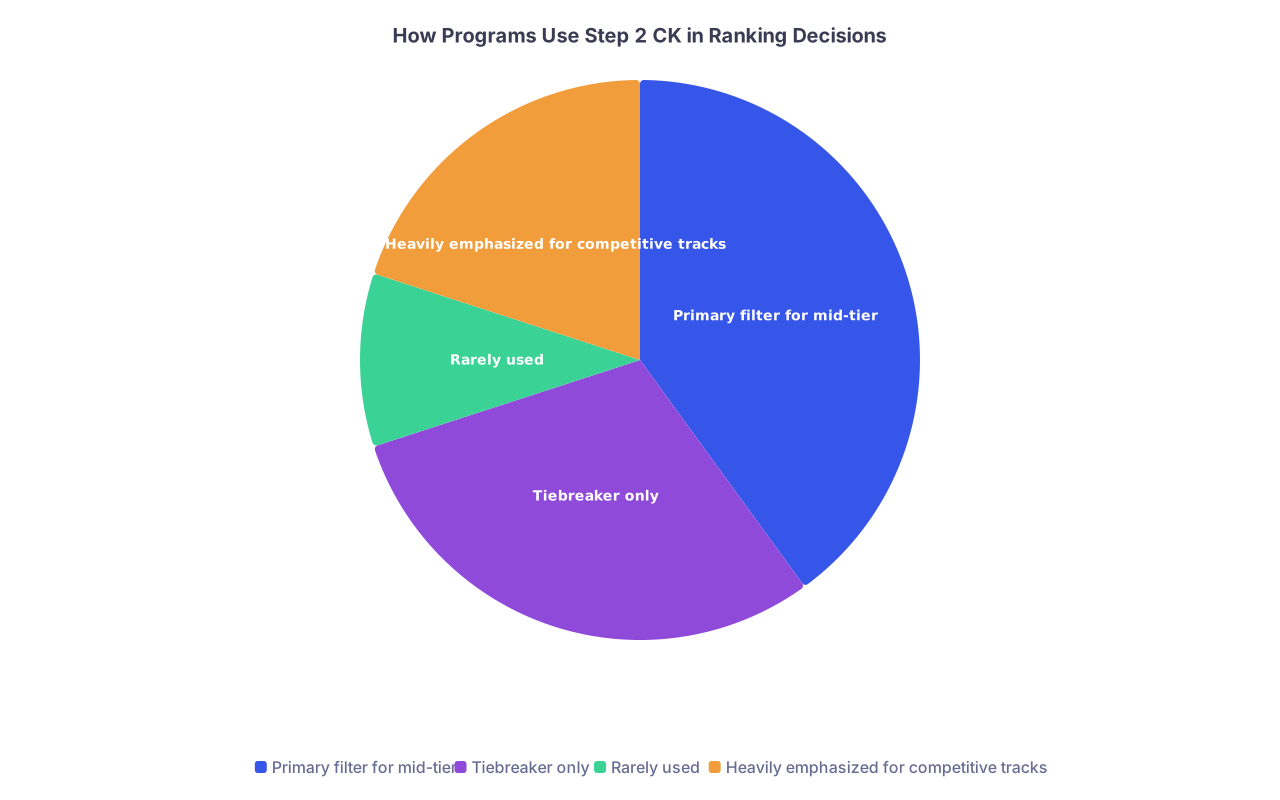
| Category | Value |
|---|---|
| Primary filter for mid-tier | 40 |
| Tiebreaker only | 30 |
| Rarely used | 10 |
| Heavily emphasized for competitive tracks | 20 |
Those numbers are not from a single paper. They’re the rough reality you hear when PDs talk off the record at national meetings and faculty dinners.
They’ll tell you:
“We do holistic review.”
Then they’ll say, over coffee:
“But between us, anyone under 230 on Step 2 makes us nervous unless there’s a strong reason.”
Where Step 2 CK Really Tips the Scale
There are patterns. I’ll show you where I’ve seen Step 2 CK swing things, program after program.
1. The Same-Tier Slugfest
This is the classic scenario. Two people sit in the same “tier” on the rank sheet.
- Similar interview scores
- No red flags
- Comparable schools
- Both with okay letters
And then:
- Applicant A: Step 2 CK 244
- Applicant B: Step 2 CK 262
If they’re both in the “we like them” band, B usually rises. Unless A has a PD’s personal story attached (“I worked with her on wards; she’s phenomenal”), the number wins.
This happens constantly in:
- Internal Medicine
- General Surgery
- EM
- Anesthesia
In highly competitive fields (Derm, Ortho, ENT, Plastics, Rad Onc), this isn’t even “tiebreaker.” It’s often entry ticket.
2. The “Redemption Arc” vs “Consistency” Debate
You’ve got two candidates:
- Candidate 1: Step 1 low pass or historically 210–220, Step 2 CK 255
- Candidate 2: Step 1 strong or historically 245, Step 2 CK 243
The committee argument sounds like this:
“Candidate 1 really turned it around, great improvement, clearly grew during clerkships.”
Versus:
“Candidate 2 is consistent, solid, less risk of slipping.”
Different programs lean different ways. But in the last few years, more academic programs started valuing that Step 2 jump—a kind of resilience and upward trajectory. Community-heavy or risk-averse programs sometimes still favor the “steady” profile.
Where this matters a lot: applicants trying to break into a more competitive tier than their Step 1 (or early performance) would support. Step 2 CK becomes the proof-point that you’re not the same student you were in M2.
3. When Someone Has To Drop
Rank meetings aren’t just about who climbs. They’re also about who falls.
Imagine a surgery program with a big cluster in the 50–120 range. Someone will say:
“We’ve got too many ‘projects’ here. We need people who will pass the ABSITE, not give us heartburn every January.”
Translation: look at Step 2 CK.
- Anyone under a certain soft threshold (say <230–235 for some surgery programs) gets nudged down unless they have exceptional offsetting strengths.
- Anyone with a very high Step 2 CK, even if they’re “quiet” on interview, often gets protected from a big drop.
I’ve watched PDs literally say: “His interview was fine, not dazzling, but he’s a 263 and from a decent school. He’ll be fine. Keep him in the top 70.”
That’s the protective power of a strong Step 2 CK.
4. The “We Need Our Board Pass Rates” Reality
This part you almost never hear bluntly, but every PD thinks about it.
Programs live and die by board passage rates. A string of residents failing boards can trigger internal reviews, ACGME visits, even serious consequences. PDs know this.
So they look for surrogates. Step 2 CK is their best surrogate.
Especially in:
- Family Medicine
- Pediatrics
- OB/GYN
- IM and subspecialties
They’re not just asking “Is this applicant smart?” They’re asking “Will this person make my life miserable when the board results come out?”
If your Step 2 CK is borderline, you’ll feel that in your rank position at programs that have recently struggled with board pass rates. They may never say it, but you’ll see it in how far you fall on their list compared to where you expected to land.
Specialty Differences: Who Cares Most, And How
Not every specialty uses Step 2 CK the same way. But there’s a pattern.
| Specialty Group | Typical Step 2 CK Role |
|---|---|
| Derm, Ortho, Plastics, ENT, NSG | Front-line filter + tiebreaker |
| Rad Onc, Urology, Ophtho | Strong signal + tiebreaker |
| IM, EM, Anesthesia, Gen Surg | Major factor in middle tiers |
| Peds, FM, Psych, PM&R | Board-risk screen + tiebreaker |
| Path, Neuro, Neurology | Variable by program |
Derm / Ortho / ENT / Plastics / Neurosurgery
Here, Step 2 CK is rarely just “a tiebreaker.” It often decides who even gets ranked above the “courtesy” line. Programs may officially claim they do not have cutoffs. Internally they absolutely have expectations. You show up with a low 230s Step 2 in these fields? You’ll need stellar connections, home program advocacy, or unique research to survive rank discussions.
IM / EM / Anesthesia / General Surgery
These are the battlegrounds for Step 2 as tiebreaker. These fields often have large interview pools and big ranked lists. That’s where Step 2 CK is constantly being used to sort the mushy middle.
Peds / FM / Psych
Less “score worship,” more “board anxiety.” If your Step 2 is very low, or your school’s reputation for exam performance is shaky, you’ll feel it. But a 260 doesn’t buy you nearly as much extra love here as it does in surgery or anesthesia. Above a certain threshold, these programs care more about fit and communication.
Timing Games: When Your Score Arrives Matters
Another thing almost nobody tells you directly: the timing of your Step 2 CK score controls how it can be used as a tiebreaker.
Scenario 1: Score Is Ready Before Interviews
If your Step 2 CK is in your ERAS file early, programs can use it in three phases:
- Deciding whom to interview
- Structuring interview expectations (they already have a mental category for you)
- Tiebreakers during rank meetings
This is ideal if you have a strong score. It becomes your calling card from day one.
Scenario 2: Score Hits During Interview Season
Some programs refresh their files religiously and bring new Step 2 scores into post-interview discussions. Others are lazy and never update. Depends heavily on the coordinator and PD.
Insider truth: I’ve seen applicants send “updated score” emails that never actually get opened before rank meetings. If your score posts in late December or January and you do not clearly flag it and get it into the PD’s line of sight, it may sit unseen in ERAS.
Scenario 3: Score Posts Very Late (Close to Rank Deadline)
This is the messiest. Programs vary:
- Some will not adjust ranks based on late score additions; they consider the list “done.”
- Some will bump people up or down if the score is extremely high or low.
- Some are paranoid about last-minute data and ignore it unless a faculty member advocates for you personally.
If you are counting on Step 2 CK to redeem a weak Step 1 or strengthen your application, you do not want to be Scenario 3.
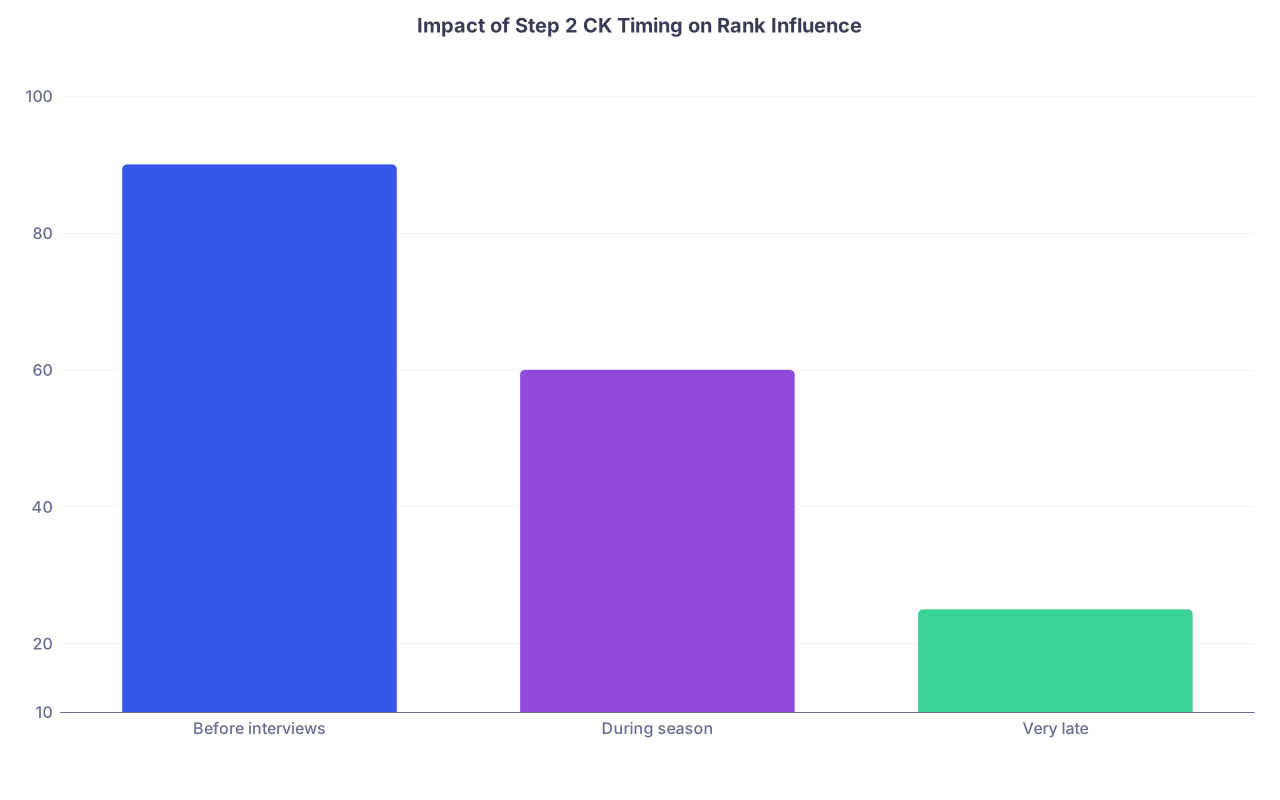
| Category | Value |
|---|---|
| Before interviews | 90 |
| During season | 60 |
| Very late | 25 |
Those numbers represent the relative chance that your Step 2 CK will meaningfully influence your rank position. Early equals power. Late equals “maybe someone glances at it.”
How Programs Actually Argue About You
I’ll give you some real composite conversations I’ve heard behind closed doors, scrubbed for identifying details but very typical.
Example 1: The High-Score, Boring Interview
Program: Mid-tier anesthesia.
Applicant: Midwest MD, Step 2 CK 266, interview scored “fine, a bit stiff,” generic letters.
Faculty A: “Honestly I don’t remember him well.”
Faculty B: “Yeah, same, but I did not get any weird vibes.”
PD: “He’s a 266. He’s going to crush the ITE. Put him in the top 40. Safe pick.”
Nobody loves him. Nobody objects either. The number blunts all ambivalence.
Example 2: The Great Fit, Mediocre Step 2 CK
Program: University IM.
Applicant: DO from a regional school, strong away rotation there, loved by residents, Step 2 CK 229.
Chief: “She was fantastic on service. I’d be happy to work with her.”
Faculty: “I agree, but 229 worries me for our boards.”
PD: “We can rank her, but not high. Mid-100s range? If she matches here, we’ll plan to support her hard on exams.”
This is the compromise: they don’t cut her; they just push her down where the risk feels more “acceptable.”
Example 3: The Late Score Surprise
Program: Community EM.
Applicant: US MD, Step 1 pass with rumors of barely passing, Step 2 CK delayed. Interviewed well.
Two weeks before rank list is due, Step 2 CK 259 appears in ERAS.
Coordinator: “Do we update everyone who had late scores?”
APD: “Anything huge?”
Coordinator: “This guy. 259.”
APD (scrolling): “Oh, I liked him. Let’s move him up 30 spots.”
That’s how crude it is sometimes. Not a re-review of the whole file. Just “Great number, bump him.”
What This Means For You Strategically
You cannot control every variable. But you can control how Step 2 CK appears in your story when the rank list meeting happens.
Here’s what’s actually useful:
If your Step 2 CK is strong, make sure it’s seen.
Don’t assume ERAS auto-visibility is enough. A short, professional update email to PD/coordinator after it posts can be the difference between “forgotten column” and “Oh, 257, nice.”If your Step 2 CK is weaker than you’d like, own the narrative early.
On interviews, talk clearly about how you learn, how you prepare for big exams, and how you’ve built better systems. PDs hear “I’ve reflected and changed my approach” a lot, but they rarely hear specifics. Give specifics.Do not play chicken with the exam date.
If you’re planning on using Step 2 CK to rescue a weak Step 1, taking it too late is like bringing your best weapon after the battle is mostly over. Some programs will never see it in time to care.Understand your specialty’s “soft thresholds.”
Do your homework. Talk to residents. If every resident in Ortho at a program quietly says “Most of us were 250+,” and you’re at 228, you’re not using Step 2 CK as a weapon there. You’re playing a different game: personality, connections, story.Protect yourself from being silently dropped 30–50 spots.
The worst thing is thinking “they loved me” and finding out you matched much lower than expected or not at all. Step 2 CK is a major hidden reason for that kind of drop in many programs. Be realistic: your feeling about the interview does not erase a number that makes PDs anxious.
FAQ (Exactly 5 Questions)
1. If my Step 2 CK is below average for my specialty, should I still send it to programs?
Yes. Not sending it looks worse. Programs assume you’re hiding a disaster. A borderline score can still work if the rest of your application is strong and you present a credible plan for future exam success. Hiding it just breeds suspicion.
2. Can an excellent Step 2 CK compensate for a mediocre interview?
Up to a point. A very strong score can keep you high enough on the list that you still match there, especially in large programs that value exam performance. But a genuinely bad interview (unprofessional, arrogant, red-flag vibes) cannot be rescued by any number. “Fine but unmemorable” can be rescued. “Concerning” cannot.
3. How late is too late to take Step 2 CK if I want it to affect my rank?
If you’re aiming for it to influence both interview offers and rank meetings, you want your score in by early fall. To influence at least rank meetings reliably, you want it in by late December. January scores sometimes move the needle; February scores often arrive after many lists are already mentally set.
4. Do programs ever re-rank people after seeing unexpectedly low Step 2 CK scores post-interview?
Yes, absolutely. If someone interviewed well but then posts a surprisingly low score that suggests board-risk, some programs will quietly slide that applicant down a tier or two. They usually do not un-rank them entirely unless the score is disastrous or confirms a broader pattern of academic struggle.
5. If Step 1 is now pass/fail, will programs eventually care less about Step 2 CK?
Not in the near term. If anything, the pendulum has swung toward Step 2 CK being more important than before as a single standardized metric. Until programs build usable, reliable alternatives—and that takes years—Step 2 CK will stay the default tiebreaker, the “safety” metric PDs fall back on when arguing over your place on the list.
Key truths to remember:
- Step 2 CK is the rank-meeting tiebreaker more often than anyone publicly admits.
- Timing, specialty, and score band determine whether it’s your shield, your sword, or your anchor.
- If you want to win the hidden debates about your name in that conference room, you cannot afford to treat Step 2 CK like an afterthought.