
It’s early August. ERAS opens in a few weeks.
Your friends are trading personal statement drafts and debating how many programs to apply to. You? You’re telling yourself:
“I’ll just submit ERAS now and take Step 2 CK later. Programs will understand. Everyone’s doing that.”
No. They won’t. And no, they aren’t.
If you’re banking your entire application on the myth that Step 2 CK “can wait until after ERAS,” you’re playing chicken with the Match. I’ve watched too many students—good students—get burned by this exact belief.
Let me walk you through how this goes wrong, where people lie to themselves, and how to avoid becoming that cautionary story your dean whispers about at advising meetings.
The Core Lie: “Programs Don’t Really Need Step 2 CK Yet”
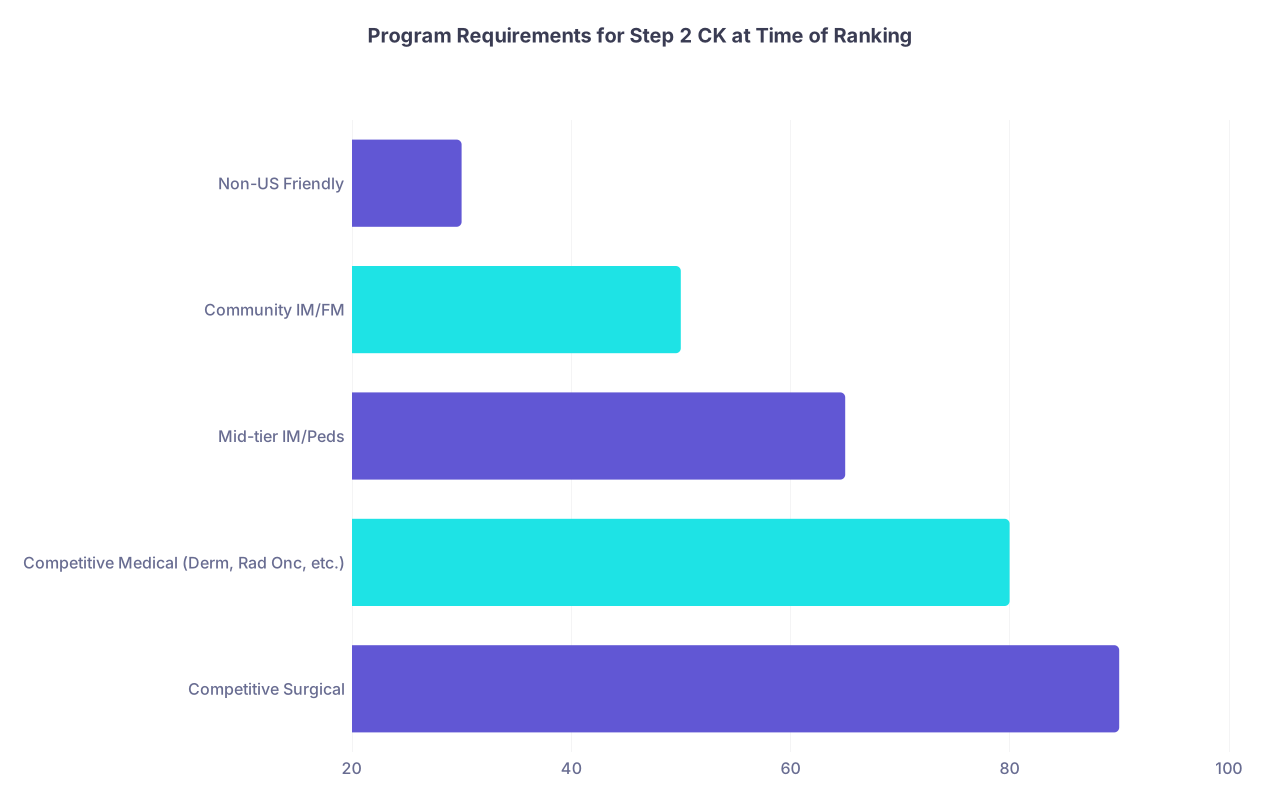
| Category | Value |
|---|---|
| Competitive Surgical | 90 |
| Competitive Medical (Derm, Rad Onc, etc.) | 80 |
| Mid-tier IM/Peds | 65 |
| Community IM/FM | 50 |
| Non-US Friendly | 30 |
Here’s the quiet truth you will not see on glossy program websites:
Many programs say they don’t require Step 2 CK at application.
But internally? They treat missing Step 2 CK like a giant yellow flag.
How this lie forms
You hear:
- “Step 1 is pass/fail now, Step 2 is more flexible.”
- “My friend last year took CK in October and still matched.”
- “The dean said ‘you don’t absolutely need it’ for ERAS submission.”
So you translate:
- “Programs don’t care that much about Step 2 CK timing.”
- “I can push it off. I’ll do it when I have more time after ERAS.”
Here’s what actually happens on the program side, especially in moderately competitive and above specialties:
Initial screen
- Apps with completed Step 2 CK and decent scores → easy to sort, easy to compare.
- Apps with no Step 2 CK → need extra effort to interpret. Programs are busy; they avoid extra effort.
Risk calculation
Missing Step 2 CK = risk. Programs think:- “What if this person fails?”
- “What if they take it late and bomb it?”
- “We cannot rank them high without a score.”
Shortcut behavior
In a pile of 2,000+ apps, coordinators and PDs absolutely use:- “Step 2 available? Y/N” as a quick filter—even if not stated as an official requirement.
If you’re a perfect applicant—honors, AOA, strong home department support—you can sometimes get away with late Step 2. If you’re not in that very small group, planning to take Step 2 CK after ERAS submission is a bad bet.
The Five Big Failure Modes of “I’ll Take CK Later”

Let’s be specific. Here’s how this myth actually kills applications.
1. You disappear from early interview waves
Programs often send early interview invites to:
- Students with:
- Step 2 CK already in
- Strong or at least clear metrics
If your app is missing Step 2 CK, you’re much more likely to fall into the “hold until more data” pile. You don’t see that on your end. You just see:
- “Application received”
- Then: silence
By the time your score finally drops in November, a lot of interview spots at competitive and even mid-tier programs are already taken or “soft reserved” for applicants they’ve already identified.
You miss those early waves. You get:
- Fewer interviews
- Worse spread of programs
- More reliance on “safety” options
All because your application wasn’t complete when it actually mattered.
2. Step 2 CK becomes a high-stakes, high-anxiety nightmare
Students who push CK after ERAS always say the same thing in May/June:
“I’ll have more time to study later. I’ll just focus on rotations now.”
Reality version:
- You’re doing a demanding sub-I or audition rotation
- You’re scrambling on LORs
- You’re building your ERAS application
- You’re revising your personal statement
- You’re fielding early emails from programs or your department
Now add:
- “Oh, and also cram for a 9-hour exam that basically replaced Step 1 as your main numeric metric.”
That’s not “more time.” That’s chaos.
I’ve watched people with 250+ Step 1-equivalent practice scores underperform on CK because they tried to study in 20-minute chunks after 14-hour days on surgery. They always say the same thing:
“I underestimated how fried I’d be.”
You’re not special. You will also be fried.
3. You lose your only chance to repair a weak Step 1 story
For anyone with:
- Barely passed Step 1
- Remediated clerkship
- Average or below-average preclinical performance
Step 2 CK is not optional timing-wise. It’s your:
- Redemption
- Reassurance
- Evidence you’re on an upward trajectory
If you delay Step 2 CK until after ERAS opens, you:
- Submit an application where the only hard datapoint is a weak or borderline Step 1
- Expect programs to gamble on you
They won’t. Not when there are hundreds of other applicants who already proved themselves on CK.
If Step 1 is pass/fail for you, it’s even more brutal. Programs are starving for a number to hang their hat on. If you don’t give them a Step 2 CK score early, they treat your file like a black box.
Black boxes don’t get interviews.
4. You accidentally drift into “too late to matter” territory

| Step | Description |
|---|---|
| Step 1 | Take CK by June |
| Step 2 | Score in by July |
| Step 3 | Fully visible for ERAS screening |
| Step 4 | Take CK in Aug |
| Step 5 | Score in by Sept |
| Step 6 | Visible for early invites |
| Step 7 | Take CK in Oct |
| Step 8 | Score in Nov |
| Step 9 | Late impact - many invites gone |
| Step 10 | Take CK in Nov or later |
| Step 11 | Score after main invite season |
| Step 12 | Minimal impact this cycle |
Here’s the part students consistently misunderstand:
It’s not just when you take Step 2 CK.
It’s when the score posts relative to:
- Program screening windows
- Interview invitation waves
- Rank list decisions
If:
- You take CK in late October
- Score posts late November
Then for many programs:
- Screening is mostly done
- Interview slots are mostly allocated
- You show up as “now complete” way too late
Your shiny Step 2 CK score becomes a nice footnote, not a real driver of interview invites. Great for your ego. Useless for this cycle.
5. You accidentally lock yourself out of ranking at some programs
Here’s the part nobody bothers to warn you about until it’s too late:
Plenty of programs have these internal policies:
- “We will not rank applicants without a Step 2 CK score in our system.”
- “We must have Step 2 CK before rank list certification.”
- “We remove applicants from ranking lists if CK is missing by X date.”
These policies are often:
- Not obvious on the website
- Only mentioned at pre-interview or interview day
- Buried in an FAQ or shared verbally
So what happens?
Scenario I’ve seen too many times:
- You get the interview early (because of a strong Step 1/pass or great letters)
- You still haven’t taken CK
- Program says on interview day:
“We require CK by January 15 to be eligible to rank.” - You scheduled CK for late January because “after interviews will be easier.”
Now you’re staring at a calendar realizing:
- You cannot move the date earlier without compromising prep
- If you don’t have a score in their system by their deadline, you’re automatically not rankable
You did the “hard” part (got the interview) and still get cut at the finish line. From your side it looks random.
It’s not. It’s timing.
Who Can Actually Afford to Take CK After ERAS?
Let me be fair. There are people who can take CK later and be fine. But it’s a very small, very specific group.
| Applicant Type | Safely Delay? |
|---|---|
| Top 10% at strong home program + strong home support | Maybe |
| Applying to less competitive specialty with strong Step 1 | Sometimes |
| Applying only to home or regional community programs | Sometimes |
| IMG/FM applicant without strong US letters | No |
| Anyone relying on CK to overcome weak Step 1 or unknown school | No |
If all of the following are true, you might be okay delaying CK a bit (not into November/December, but not July-early either):
- You’re in a less competitive specialty (think FM, Peds, Psych in some regions)
- Your school has a strong track record of placing people in that specialty
- Your home department is actively advocating for you
- You already have:
- Strong clerkship grades
- Strong letters
- No academic red flags
Even then, I still usually advise:
- Take CK by late July / early August
- Have score in or pending with known test date at ERAS opening
You don’t plan by asking, “What’s the latest I can get away with?”
You plan by asking, “What timing gives me the least risk?”
The Hidden Trap: Interview Season + CK Studying

Everyone who pushes CK later tells themselves a fantasy:
“I’ll do my interviews and then really focus on CK.”
No you won’t.
Here’s what late fall actually looks like:
- Back-to-back interviews (sometimes 3–5 per week)
- Travel fatigue if in-person, or Zoom fatigue if virtual
- Thank-you emails
- Follow-up communication
- Program research for each interview
- Rotations continuing in the background
You try to squeeze in UWorld blocks between interviews. Some days you succeed. Most days you don’t. Your studying becomes:
- Inconsistent
- Fragmented
- Guilt-driven
And now CK isn’t just a test—it’s a cloud over your entire interview season. You’re distracted, second-guessing yourself, and negotiating with your own exhaustion.
If you think you’re going to be the one person who:
- Crushes interviews
- Maintains full CK study intensity
- And does not burn out
You’re lying to yourself.
Safer Timing: What Actually Works
You want to avoid being the disaster story? Fine. Here’s the boring, safe plan that reliably works for most people.
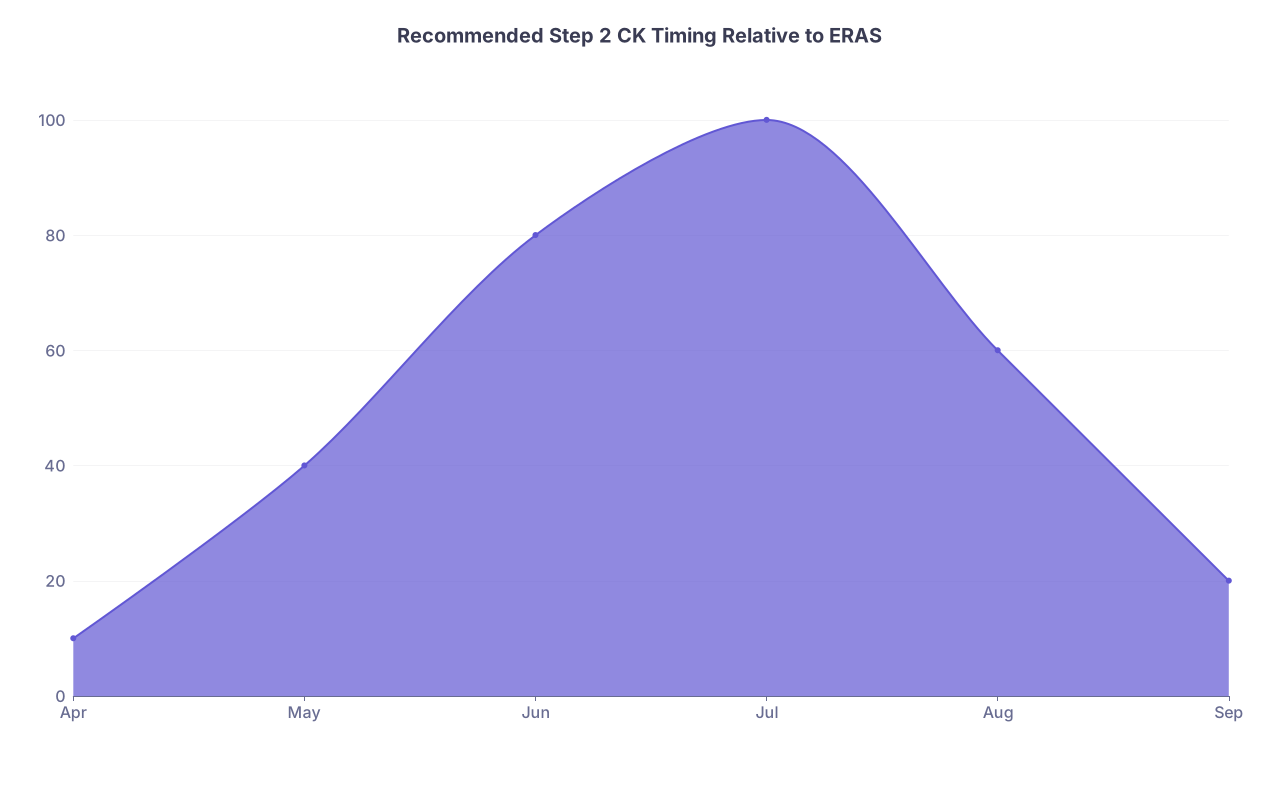
| Category | Value |
|---|---|
| Apr | 10 |
| May | 40 |
| Jun | 80 |
| Jul | 100 |
| Aug | 60 |
| Sep | 20 |
The “sweet spot” for Step 2 CK timing for most US MD/DO students:
- Test between late May and late July
- Score available by late August / early September
Why this works:
- You’re far enough into clinical rotations that your clinical reasoning is real
- You’re early enough that:
- You can retest if disaster strikes
- Your score is 100% visible for screening
- You’re not trying to study during:
- Peak away/audition rotations
- ERAS crunch time
- Interview season
For IMGs and anyone with a weaker application story, I push this even earlier when possible:
- Test by May–June
- Have score in hand before you even start building ERAS
Because you, especially, can’t afford to ask programs for trust without data.
Red Flags You’re Falling Into the “I’ll Just Take It Later” Trap

Start worrying if you catch yourself saying any of these:
- “I’ll see how my sub-I goes first before scheduling CK.”
- “I just want to focus on rotations now; I’ll find time for CK after ERAS.”
- “My advisor said it’s not required to have CK by application.”
- “I’m waiting for my UWorld average to go up before I pick an exam date.”
Translation for each:
- You’re letting rotations completely cannibalize study time
- You’re planning around your comfort, not match risk
- You’re misinterpreting ‘not required’ as ‘not important’
- You’re delaying commitment, not improving preparedness
Instead, you need to ask harder questions:
- “If my CK score comes out in late November, what is realistically still affected that cycle?”
- “If I underperform CK, do I have any time buffer to retake? Or am I dead in this specialty?”
- “If a program demands CK before ranking, can I meet that requirement without panicking?”
If you don’t like the answer to those, your timing is wrong.
How to Fix Your Plan Right Now
If you’re reading this and already scheduled CK for late October/November “because ERAS,” you’re not doomed. But you do need to stop pretending that’s fine.
Here’s what I’d do if you were sitting in my office:
Pull out the calendar. No vibes, just dates.
- ERAS submission date
- When most of your target programs historically send invites
- Rank list certification deadline
- Your current CK date and likely score release
Ask one hard question:
“Does my current CK timing maximize my chances of being seen, invited, and ranked?”If the answer is no, move the test earlier if at all possible.
- Even if it means a slightly tighter study period
- A slightly lower but on-time score beats a slightly higher but too-late score
If moving earlier is impossible:
- Aim for:
- Strong signals in other areas (letters, audition rotations, home support)
- Honest conversations with advisors about specialty competitiveness
- Consider:
- Slightly widening your specialty or geographic range to offset timing
- Aim for:
What I would not do is sit there and say, “Well, my friend took CK in November and matched derm, so I’ll be fine.” Your friend is not the baseline. Your friend is the exception.
FAQ: Four Questions You Should Be Asking (But Probably Aren’t)
1. Is it ever better to delay Step 2 CK to avoid a potentially low score before ERAS?
Sometimes—but far less often than students think.
If your practice scores are:
- Dangerously low (borderline pass/fail)
- Inconsistent and unstable even after serious dedicated prep
- Reflecting something clearly off (major burnout, personal crisis)
Then yes, you might strategically delay to avoid a score that basically ends your chances this year.
But here’s the catch:
If you’re in this situation in July or August, the problem is not timing. The problem is readiness. You likely need to strongly reconsider:
- Specialty competitiveness
- Taking a research year
- Or, painfully, your timeline for application
Using “I’ll just take it after ERAS” as your fix is not strategy. It’s denial.
2. Do programs really penalize late CK scores if everything else looks good?
Many do. Some won’t admit it.
Remember:
- Programs are flooded with applicants
- Time is limited
- Risk tolerance is low
If they have two similar files:
- Applicant A: CK done, solid score
- Applicant B: CK missing, “planning to take it later”
Applicant A is almost always getting the interview slot. Not because B is bad, but because A is clearer and lower risk.
So yes, late scores often function as a soft penalty. You just won’t see the “we passed because of missing CK” note on your end.
3. If I have a strong Step 1 (pre-P/F), do I still need early Step 2 CK?
Need? Not always. Smart? Usually yes.
Strong Step 1 buys you some flexibility. But in many specialties now, Step 2 CK is carrying more weight for:
- Demonstrating clinical knowledge
- Confirming you haven’t declined
- Comparing candidates from different schools and grading systems
If you’re:
- Going for a competitive specialty
- At a less well-known school
- Lacking big-name letters
Early CK can still significantly strengthen your file. I’ve seen 250+ Step 1 students helped—not hurt—by early CK, especially when their score was consistent or higher.
4. What’s the single worst Step 2 CK timing mistake you see?
Easy:
Scheduling CK after ERAS submission with a score release date:
- Past major interview invitation waves
- And uncomfortably close to rank list deadlines
…while simultaneously applying to a competitive specialty and telling yourself, “It’ll be fine, I’ll just crush interviews.”
That combo—late CK, competitive field, optimistic self-talk—is the Match equivalent of driving at night with your headlights off and saying, “I know this road.”
Bottom Line: Don’t Gamble With Timing
If you remember nothing else, keep these three points:
- “I’ll just take Step 2 CK after ERAS” is not a plan. It’s a risk you’re underestimating because you don’t see how programs actually operate.
- A slightly earlier, solid Step 2 CK score that programs can see and use beats a later, slightly higher score that arrives after decisions are mostly made.
- If your application needs Step 2 CK to clarify or rescue your story, delaying it past ERAS is not strategy—it’s self-sabotage.
Protect yourself. Schedule CK with the Match calendar in mind, not just your comfort.