
It’s September 15th. ERAS just opened.
You hit submit on your application, heart racing… and there it is. Step 2 CK: “Not Available.”
You tell yourself, “It’s okay, programs will see my strong clinical grades. They’ll know my score is coming. Everyone says it’s fine.”
Let me tell you what actually happens on the other side of that screen.
I’ve sat in those screening meetings. I’ve watched PDs and coordinators go down spreadsheets with color‑coded columns. I’ve heard the exact phrases they use when your Step 2 CK is missing. And no, it is not as gentle or nuanced as the official advice you get from your dean’s office.
You want the real version? Here it is.
How Programs Really Screen Your File Without Step 2 CK
Most applicants imagine some holistic, slow, thoughtful process. That’s not how this starts.
For the first pass, it’s speed. Volume. Survival.
On a busy IM or surgery program, that first pass might mean 1,500–4,000 applications being screened in a week. They are not reading your heartfelt personal statement line by line. They’re running filters and manually scanning columns.
Here’s roughly what the first filter screen looks like on their side:
- Column for school name
- Columns for Step 1 (if pre‑pass/fail era) and Step 2 CK
- Columns for visa status, YOG (year of graduation), home students, AOA, red flags
Now imagine that Step 2 CK column.
On day 1–10 of review, a missing Step 2 CK typically triggers one of four reactions:
“Auto‑hold”
This is the most common. Your file goes into a “maybe later” pile. That pile is usually code for: we will only open this if we run out of strong fully-complete applicants. In many big‑name programs, that “later” never comes.“Require score before invite”
Some programs quietly have a rule: no Step 2 CK = no invite, unless you’re from their home school or someone on faculty is actively advocating for you. They don’t advertise this on their website, but it’s written in their internal selection criteria. I’ve literally seen policies like: “FMG/IMG must have Step 2 CK at time of review.”“Read only if something special”
A PD might say: “If they’re from our school, have strong letters, or a known research mentor vouching, I’ll look. Otherwise skip.” Translation: unless you’re already on their radar, you’re invisible.“Immediate no”
Less common but real. Especially in certain competitive surgical subspecialties and some high‑volume community programs. Reason: they’re terrified you will fail Step 2 late, prevent them from filling a spot, or make them look bad on board pass rates.
That’s the cold reality at the first pass. Your missing Step 2 isn’t “neutral.” It is a liability that forces someone to work harder to justify reading you.
And in this game, anything that asks a busy PD to “do more work” is bad for you.
The Truth by Specialty: Who Cares, Who Pretends Not To
Not all specialties treat Step 2 CK the same way. The public talk is “we look at the whole application.” Behind closed doors, it sounds more like:
| Specialty | Missing Step 2 CK Impact |
|---|---|
| Internal Medicine | Hurts, but sometimes tolerated early |
| General Surgery | Big red flag, often hold or reject |
| Pediatrics | Manageable if strong otherwise |
| Emergency Medicine | Increasingly harmful, many want it |
| Family Medicine | Often flexible, but not always |
Let’s be more blunt.
Internal Medicine
Academic IM (think: MGH, UCSF, Duke, Michigan) quietly uses Step 2 CK as a differentiation tool now that Step 1 is pass/fail. If Step 2 is missing:
- If you’re from their own school or a top med school: they may park you in a hold pile and see if your score drops in before rank meetings.
- If you’re from a lower‑known US school or an IMG: your chances of being looked at drop dramatically unless you have some hook (big‑name research, strong personal connection, unique background they’re specifically targeting).
Community IM programs are more varied. Some absolutely require Step 2 early because they’ve been burned before by late failures or by weak applicants who never take it.
General Surgery
Surgery does not like unknowns.
In several programs I’ve worked with, the phrase I kept hearing was: “No Step 2 by the time we’re seriously reviewing? Skip.” Not every surgery program is this rigid, but many are.
If you’re going for general surgery without a Step 2 score:
- With a strong Step 1 (if you still have one), AOA, great letters, home rotation: they might hold your file.
- Without those: your app often doesn’t survive the first 15 seconds.
Pediatrics & Family Medicine
These fields are more forgiving on paper. But forgiving doesn’t mean blind.
PDs will still ask:
- Is this applicant going to pass boards?
- Will they be safe on call as an intern?
- Do they need a ton of remediation?
If your Step 2 is missing and:
- Your Step 1 was borderline (or just a pass with weak pre‑clinical performance)
- Your clerkship grades are unimpressive
- You’re from a school they don’t know well
They’ll be cautious. Some will wait. Others quietly move you down the list in favor of someone who’s already proven they can clear the Step 2 bar.
EM, Anesthesia, OB/GYN
These are increasingly score‑sensitive. Especially EM with the squeeze on positions and turmoil with SLOEs and program closures.
I’ve heard versions of this more than once in EM and anesthesia rooms: “If they can’t get Step 2 done on time, I worry about their time management.” Harsh? Maybe. But that’s how it’s read.
Bottom line: the more competitive or stressed the specialty, the less patience there is for incomplete files.
How PDs Interpret “Missing” Step 2 CK (This Part Stings)
Forget the official language. Here’s what “Step 2 CK: Not Available” actually signals to a lot of faculty when they’re tired, buried in files, and making snap judgments.
They don’t say all of this out loud. But I’ve heard enough comments in closed meetings to know what’s in the air.
“They’re hiding a bad score.”
Even if your test is scheduled for next week. The default suspicion is you either took it late because you weren’t ready, or you’re delaying reporting because it’s mediocre. Especially if there’s any other hint of academic weakness.“Risk of failing Step 2.”
If your transcript shows basic science struggles, repeating a course, or low shelf scores, a missing Step 2 amplifies the risk in their mind. PDs care about board pass rates more than you think; it affects accreditation and their reputation.“Poor planning.”
Right or wrong, many faculty equate late Step 2 with “they did not plan their fourth year strategically.” It reads as: disorganized, passive, reactive. Not the traits they want in a new intern at 3 a.m.“We’ll be stuck waiting and guessing.”
Programs need to finalize rank lists by late February. If your score is coming in late January or February, they remember that stress. They’ve had situations like:
“We ranked them high, then their Step 2 CK came back and they barely passed.”
Most PDs do not like that feeling and try not to repeat it.
You may have very valid reasons: illness, personal crisis, family responsibilities. A few PDs will genuinely care enough to read that context. Many will not get far enough into your application to ever see your explanation.
Harsh? Yes. But you wanted the truth.
Timing: The Silent Killer
You cannot talk about missing Step 2 without talking about timing. The date you sit for Step 2 and when your score posts matters more than people admit.
Let me break down how PDs feel about this in their heads:
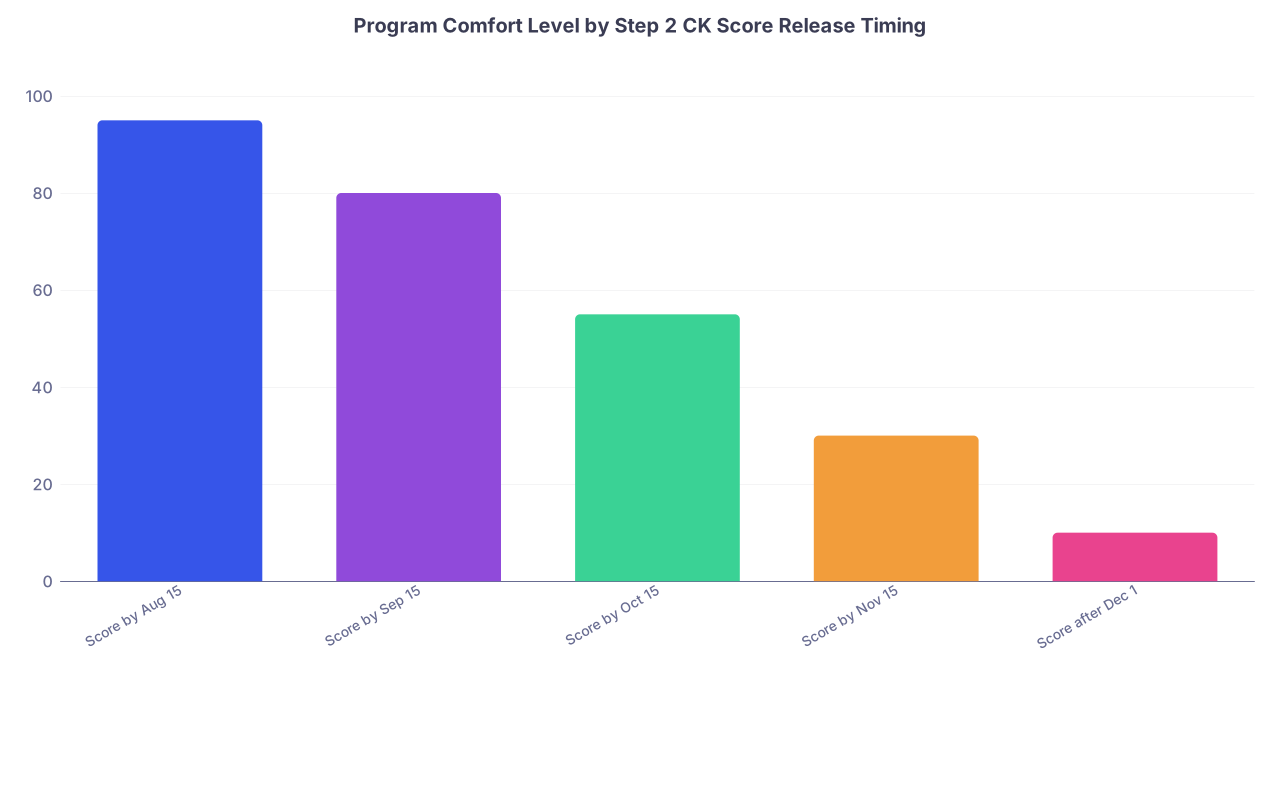
| Category | Value |
|---|---|
| Score by Aug 15 | 95 |
| Score by Sep 15 | 80 |
| Score by Oct 15 | 55 |
| Score by Nov 15 | 30 |
| Score after Dec 1 | 10 |
These numbers aren’t from a paper. They’re from shared sentiment in actual selection meetings.
Score in by August 15
This is ideal. Your file is complete at the start of review. You’re treated like a “known quantity.”Score in by September 15
Still very acceptable. Some programs start reviewing seriously in late September/early October.Score in by October 15
Risky. Many early invites are already out or being decided. Your file might get looked at in the “second wave” if they still need to fill interview slots.Score in by November 15
You’re now at the mercy of how full they are. Some programs have almost all invites sent by then. You’re hoping someone cancels, or they remember to re‑scan the “now complete” pile.Score after December 1
For many programs, you are effectively invisible. Interviews are largely booked, and attention shifts from “who to invite” to “who to rank.”
The number of applicants who think, “It’s fine, my Step 2 will be in by December” is much higher than the number of programs that will actually care about a new score that late.
US vs IMG vs DO: The Double Standard
What PDs will tolerate from a Harvard US MD they know and what they’ll tolerate from an IMG they’ve never met are not the same.
Here’s how the missing Step 2 game really plays out across groups:
| Applicant Type | Typical PD Reaction to Missing Step 2 CK |
|---|---|
| US MD, Top Tier School | Often given benefit of the doubt, temporary hold |
| US MD, Mid/Lower Tier | Mixed; some will hold, many move on |
| DO Student | Increasingly expect Step 2, especially for ACGME-heavy programs |
| IMG / FMG | Often automatic hold or reject without Step 2 |
US MD (especially from known schools)
You get the most slack.
If a PD knows your school, trusts its clinical training, and sees good clerkship comments, they will sometimes wait. Especially if your letters are from people they know personally. That’s the old boys’ network in action.
But even for you, if you’re aiming at big‑name academic programs or competitive specialties, missing Step 2 still hurts.
DO applicants
The bar has moved. With the single accreditation system, more ACGME programs expect DO candidates to “prove” themselves on Step 2 CK, not just COMLEX.
Some programs won’t say this out loud, but inside they’re thinking: “If they really wanted us to take them seriously, they would have taken CK early and done well.”
No Step 2 as a DO is often interpreted as uncertainty about competing directly on that metric.
IMGs / FMGs
This group gets hit the hardest by missing Step 2.
Many PDs rely heavily on Step 2 CK to standardize IMGs against US grads. If you’re an IMG without a Step 2 score at application time:
- Some programs won’t even open your file.
- Others will mark you as “revisit later” and never actually revisit once they fill their IMG slots with candidates who already have strong scores.
I’ve heard this sentence more than once: “We have 300 IMGs with complete files and solid Step 2. Why are we chasing someone who doesn’t even have a score yet?”
That’s the mindset you’re up against.
Behind Closed Doors: How Decisions Get Made About You
Let me walk you through what a real meeting sounds like when your file is missing Step 2.
Picture: conference room, late afternoon, 6 people around a table with laptops. PD, APD, chief resident, maybe a clerkship director. They’re reviewing a list of borderline or “hold” applicants to decide who gets the last 10 interview spots.
They open your file.
- School: mid‑tier US MD
- Step 1: Pass
- Step 2 CK: Not Available
- Clinical evals: mostly high passes, a few honors
- Letters: decent but not glowing
- Personal statement: fine, not memorable
Here’s the kind of dialogue I’ve actually heard in that context:
“Do we have their Step 2 yet?”
“No.”
“When are they taking it?”
“Scheduled for November.”
Pause.
“We’re already full by then. Any reason to prioritize them?”
“…Not really.”
“Okay, move on.”
That’s it. That’s your whole fate in under 20 seconds.
Or, another scenario:
“This one’s from our home school, no Step 2 yet.”
“They’re solid on the wards. I’d be comfortable with them here.”
“Okay, we can invite. Step 2 will probably be fine.”
Notice the difference? Same missing score. Different relationship and trust level.
The uncomfortable truth is this: without Step 2 CK, you’re asking programs to take a risk. They will sometimes do that—for known quantities, protected students, or those with advocates. They rarely do it for strangers.
If You’re Applying Without Step 2: Damage Control Strategy
Sometimes you’re already in too deep. The test is scheduled. ERAS is open. You don’t have the luxury of rewinding time.
So what can you actually do if Step 2 CK will be missing or late?
1. Be brutally realistic about your competitiveness
If your application is already soft—average school, no big research, mediocre letters—then missing Step 2 is not “one more small issue.” It might be the thing that quietly kills your cycle at mid‑to‑high tier programs.
You compensate by:
- Applying more broadly and more heavily to safer tiers.
- Prioritizing programs known to be more holistic or community‑based.
- Not wasting your list on 40 programs that will filter you out instantly.
2. Communicate strategically (not desperately)
If your test date is reasonable (August/early September), you can:
- Email a very short, professional note to your top programs only:
“My Step 2 CK is scheduled for [DATE], and I expect my score to be available by [ESTIMATED DATE]. I wanted to let you know my exam is in progress and my application will be complete shortly.”
Will this magically get you invites? No. But it pre‑emptively counters the “they’re hiding something” narrative just a bit. Some APDs actually do make a note.
Do not send long explanations unless you have a legitimate serious circumstance (major illness, family crisis, etc.). Even then, keep it tight.
3. Lock down every other signal of competence
If you’re missing Step 2, every other part of your application has to scream: “Trust me, I can handle this job.”
That means:
- Strong narrative in your MSPE and clerkship comments about work ethic and reliability
- Concrete evidence of clinical performance (honors, strong narratives, consistent comments from multiple rotations)
- Letters from people who actually know you and can write: “I have no concerns about their ability to pass Step 2 and Step 3.”
If PDs see that kind of language, they’ll occasionally override their discomfort about a missing score.
4. The second wave: use your posted score aggressively
Once Step 2 finally posts—especially if it’s strong—you do not just silently hope they notice.
You:
- Update ERAS with the score immediately.
- Send targeted (not mass) emails to programs that you’re genuinely interested in and still haven’t heard from:
“My Step 2 CK just became available with a score of [XXX]. I remain very interested in your program and would be grateful if you would consider my now‑complete application.”
Do some programs roll their eyes at these emails? Sure.
But I’ve also seen last‑minute invites go out after a strong Step 2 made someone jump off the fence.
Should You Delay Applying If Step 2 CK Will Be Late?
This is the question people dance around in advising meetings.
Here’s the unsanitized answer from what I’ve seen.
If both of these are true:
- Your Step 2 CK is likely to be significantly higher than what your file currently suggests (i.e., you’ve improved, your practice tests are much stronger than your Step 1), and
- You are targeting competitive specialties or competitive academic programs
Then yes, sometimes it’s better to delay a year and apply with a complete, strong application than roll the dice with a half‑baked one and tank your chances.
I’ve met too many residents who basically wasted an entire cycle with incomplete scores, then had to SOAP or reapply. They could have protected themselves by waiting, taking Step 2 early in a gap year, and applying once fully armed.
The problem is: no one wants to tell a fourth‑year, “You might be better off not applying at all this year.” It’s emotionally brutal. But from a pure probability standpoint, it’s sometimes the only rational move.
Visualizing the Application Risk Curve
Just so you have a mental picture of how your “risk” looks to programs as Step 2 timing slips later:
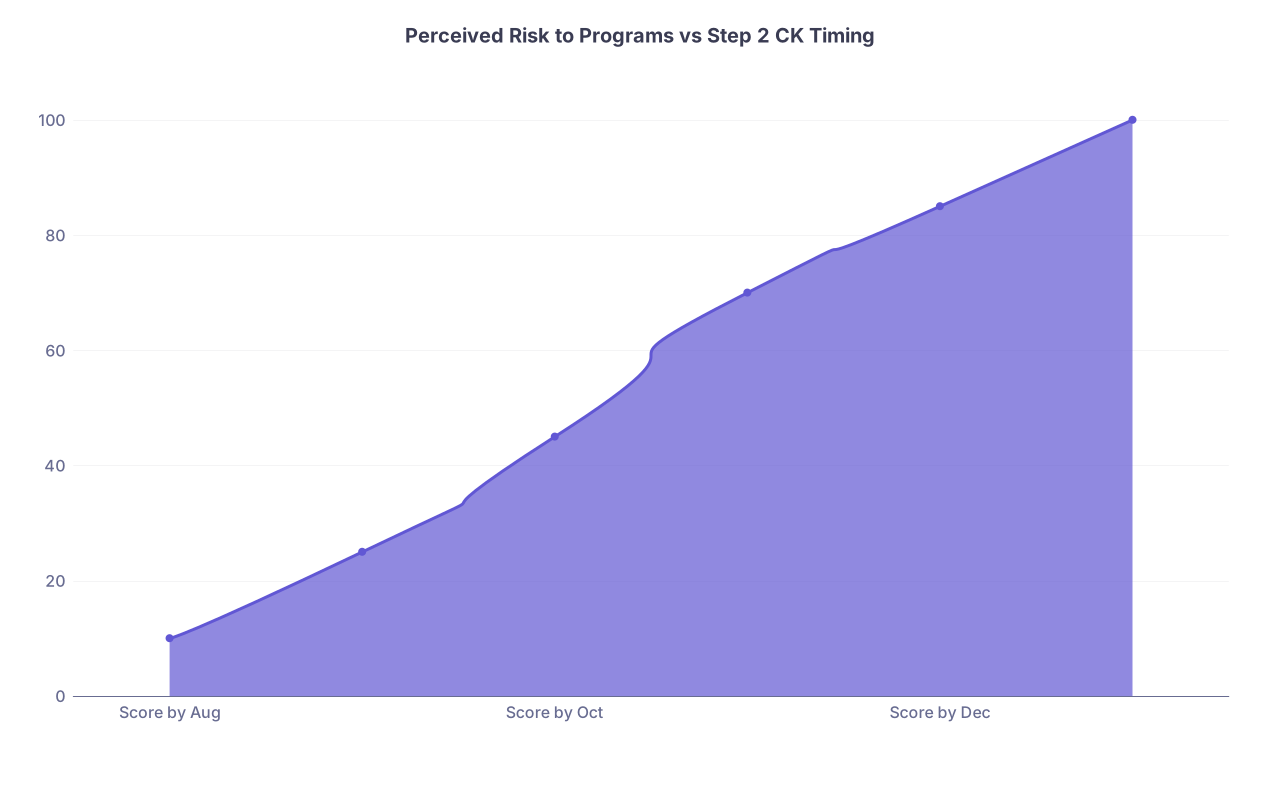
| Category | Value |
|---|---|
| Score by Aug | 10 |
| Score by Sep | 25 |
| Score by Oct | 45 |
| Score by Nov | 70 |
| Score by Dec | 85 |
| No Score by Rank List | 100 |
That spike after October is real in terms of PD discomfort and reluctance to gamble on you.
FAQs: What Applicants Always Ask About Missing Step 2 CK
1. Will programs actually reject me automatically for not having Step 2 CK?
Some will. Especially for IMGs, DOs without a CK score, and in competitive specialties. Others will “hold” your file, which often functions as a silent rejection if your score comes in late. There’s no master list of which programs do this; it’s written in internal policies and evolved from previous bad experiences with incomplete files.
2. If my Step 1 was strong (pre–pass/fail), can I safely delay Step 2?
Safer, yes. Safe, no. Many programs have shifted emphasis to Step 2 regardless of Step 1 status. A strong Step 1 buys you more benefit of the doubt, but it doesn’t eliminate the unease of an unknown Step 2, especially if your school or letters aren’t top tier. Top programs in particular still want to see Step 2 by early in the season.
3. What if I have a legitimate reason (illness, family emergency) for delaying Step 2?
Include a brief, factual note in your ERAS experiences or a short addendum, and if appropriate, your dean’s letter may reference it. A few PDs will genuinely factor that in. But understand this: empathy does not fully neutralize risk in their minds. Some will still choose the candidate with a completed file and known score, especially if the field is competitive.
4. Can a great Step 2 score later in the season rescue my application?
Sometimes. If your score posts in October and it’s clearly strong relative to your field’s norms, some programs will take a second look, especially mid‑tier and community programs that still have unfilled interview spots. If your score posts after November, the probability of it materially changing your interview count drops sharply. It can still help for ranking if you already have interviews.
5. I already applied without Step 2. Should I cancel the exam and push to a later date to “improve” my score?
Usually no. That just digs you deeper. Delaying even further amplifies the exact concerns PDs already have: risk of failure, poor planning, and lack of readiness. Barring a real crisis, it’s almost always better to take the exam on the earliest realistic date you can score solidly, get the number on the board, and then use it to strengthen your position within the same cycle or to inform a smarter reapplication plan if needed.
Two things to walk away with:
Missing Step 2 CK is not neutral. On the PD side, it reads as risk, uncertainty, and more work. You have to give them a compelling reason to look past that—or accept that many simply will not.
Timing is strategy. When you take Step 2 isn’t just a logistics question; it’s a signal about your readiness and judgment. Get that wrong, and you spend a whole cycle fighting a silent handicap no one explains to you honestly.
Now you know what really happens to your file. Use that information like someone who understands the game, not like someone hoping it will all “work out.”