
It is late. Your ERAS personal statement is open. Your Step 2 CK score report is sitting on the desk, that three-digit number burned into your brain. You keep thinking: “Should I put this in the essay? Do I need to explain it? Can I brag about it?”
You start typing: “I scored a 2XX on Step 2 CK, which demonstrates my strong clinical knowledge…”
Stop. Backspace. You are about to make a mistake I see every application season.
Step 2 CK absolutely matters for residency. But your personal statement is one of the worst places to mishandle it. Programs already have your score. What they are trying to understand from the personal statement is something completely different: judgment, maturity, insight, fit.
Let me walk you through the most common ways applicants misuse their Step 2 CK scores in personal statements—and how to avoid quietly sabotaging yourself.
Mistake #1: Turning Your Personal Statement into a Score Justification
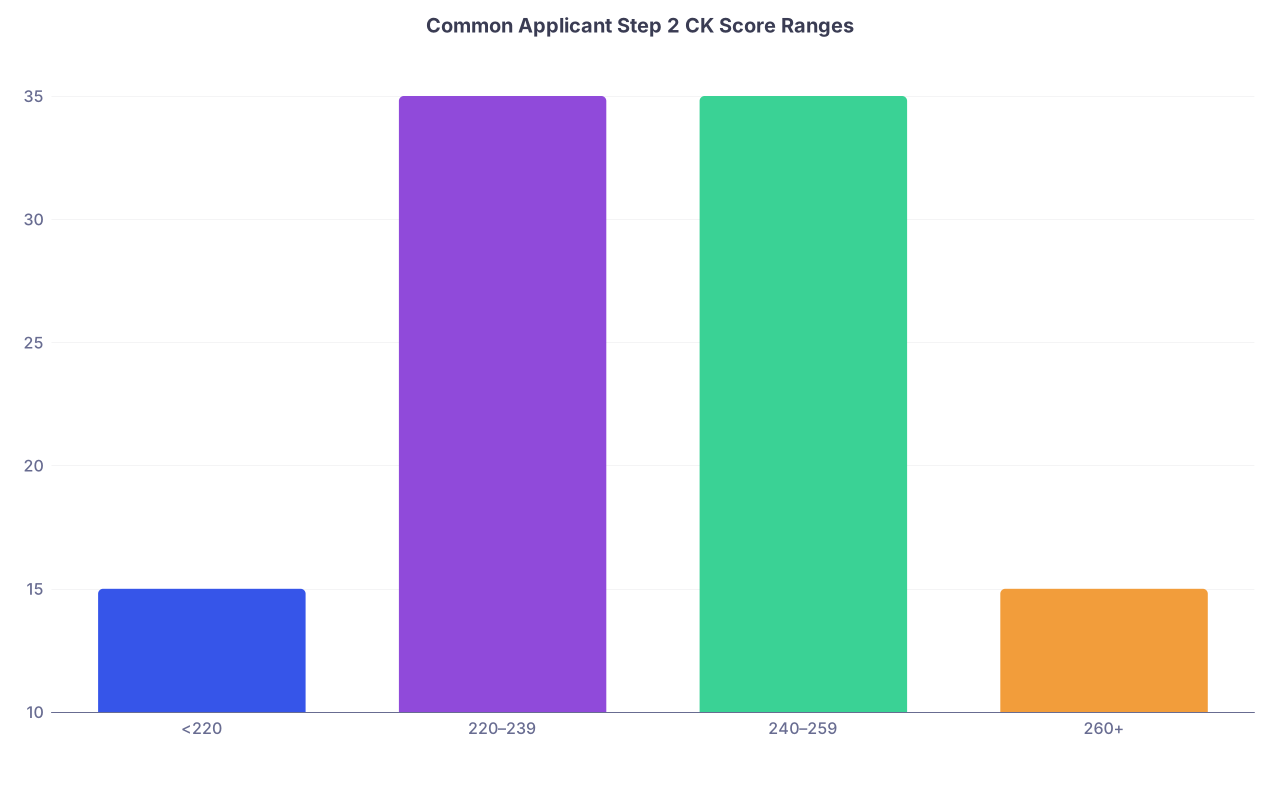
| Category | Value |
|---|---|
| <220 | 15 |
| 220–239 | 35 |
| 240–259 | 35 |
| 260+ | 15 |
You got a score you are not thrilled with. Maybe Step 1 was pass/fail and Step 2 CK felt like your one numerical shot. Now you are tempted to spend half the personal statement “explaining” it.
You write about being sick during the exam. A family emergency the week before. Bad test anxiety. An unfair exam form. You think you are offering context. Program directors read it as one thing: excuse-making.
I have watched faculty read these paragraphs. They lean back, eyebrows up, and you can almost hear the thought: If you will blame the exam, will you also blame the nurse, the patient, the system when something goes wrong?
Here is the core problem: the personal statement is not the right vehicle for damage control on a single metric. ERAS already shows your Step 2 CK. If you spend a full paragraph trying to “reframe” it, you are broadcasting insecurity and poor prioritization. You had 650–850 words to tell them who you are. You used it to re-argue a test.
When you might need an explanation:
- Severe, clearly documented personal or health crisis overlapping with the exam
- Dramatic outlier relative to your transcript (e.g., strong clinical grades and then a very low Step 2 CK)
- Licensing or remediation consequences connected to the score
Even then, tuck that context into:
- The “Additional Information” section
- A concise advisor comment in your MSPE (if your school allows)
- A brief, factual line in the personal statement, not a full emotional narrative
What not to do:
- Do not morally litigate your score.
- Do not describe how you “deserved” a higher number.
- Do not go month-by-month through your misfortunes.
A safe, mature version, if explanation is truly needed:
During the period of my Step 2 CK preparation, I experienced a significant family health crisis that affected my performance. While the score does not reflect my usual academic trajectory or clinical evaluations, it reinforced the importance of asking for help early and protecting time for focused, undistracted patient care and learning.
Two sentences. Context without drama. Then move on.
Mistake #2: Bragging About a High Score in a Tone-Deaf Way
Flip side. You crushed Step 2 CK. 260+. You feel like not mentioning it is leaving money on the table. So you try something like:
“My Step 2 CK score of 263 places me in the top percentile among applicants, confirming my strong clinical acumen…”
Programs already know your number. When you restate it in the personal statement, it feels like someone reading their own CV aloud at dinner.
Worse, it signals something you do not intend: that you think your score is your main asset. For some competitive specialties, you can get away with a quick, humble nod to strong exam performance when it is relevant to a story. But even then, it should never be the focal point.
Red flags that you are mishandling a good score:
- Explicitly stating the exact number in the essay
- Comparing yourself to “other applicants”
- Using the score as proof of being “more prepared” or “more dedicated” than peers
- Building your whole narrative around “I work hard and it shows in my test scores”
Better approach: let others infer from your application as a whole. The personal statement should complement the numbers, not echo them.
If you must allude to it (for example, to support an academic medicine or education interest), phrase it like this:
Strong performance in coursework and licensing exams has given me a solid foundation in clinical reasoning, which I aim to deepen through rigorous residency training and future involvement in medical education.
No number. No chest-thumping. Just integration.
If you are itching to put the raw number in prose, that is your sign to delete it.
Mistake #3: Making Step 2 CK the “Character Arc” of Your Story

Some applicants build their entire personal statement around the Step 2 CK journey.
“I struggled on Step 1, then completely restructured my life, studied for months, and redeemed myself on Step 2 CK—and this transformation shows who I am.”
That sounds profound to you, because you lived it. To a reader who has seen 500 versions of the same narrative, it sounds like this: “My main growth experience in medical school involved… a test.”
The danger:
- It shrinks your whole identity to your exam trajectory
- It makes your most important story about you, not about patients
- It suggests a narrow definition of resilience—test-based, self-focused, performance-obsessed
Here is what programs actually want to see in a “growth arc”:
- Taking ownership of mistakes in patient care or communication
- Learning to work in teams under pressure
- Developing empathy with difficult or complex patients
- Sustained service or research, not just sprinting for one exam
Can an exam ever be part of a meaningful growth story? Yes. But it should not be the only character development you can offer. If your biggest “transformation” is going from 225 to 250, that is not the compelling story you think it is.
If you choose to mention it, the test should be background, not the protagonist. For example:
My early challenges with standardized exams forced me to confront unhelpful perfectionism and to seek feedback more openly. The same deliberate approach I learned then now shapes how I prepare for patient encounters, follow up on results, and reflect after difficult shifts.
Notice: the focus is on who you became as a clinician, not how much your score improved.
If an honest outline of your current draft looks like:
- I was devastated by Step 1
- I studied extremely hard
- I conquered Step 2
- Therefore I am ready for residency
Throw it out and start over. That structure is a trap.
Mistake #4: Using Step 2 CK to Argue Against Objective Weaknesses
Here is a subtle but deadly move: trying to use Step 2 CK as “proof” that other weaknesses in your application do not matter.
I see this logic often:
- “My clerkship grades are mediocre, but my Step 2 is high, so I am actually strong clinically.”
- “I have limited research, but my Step 2 shows my academic ability.”
- “I honored only one rotation, but my Step 2 demonstrates my potential.”
Programs are not that simplistic. They know Step 2 CK is a multiple-choice exam taken in a controlled environment with no real patients present. It correlates with some performance metrics, sure, but it does not erase a pattern of in-person evaluations.
What this misstep looks like in writing:
“Although my clinical evaluations in third year were mixed, my Step 2 CK score of 255 shows that I have strong clinical reasoning skills and am well-prepared for residency.”
That sentence tells the reader: “Believe my test, not the people who actually worked with me.” Bad look.
A healthier approach if you have weaker evaluations:
- Own the pattern briefly and specifically
- Show insight into the behaviors that contributed
- Demonstrate concrete, longitudinal improvement with non-test evidence
For instance:
Early in third year, my evaluations reflected challenges with time management and prioritization. With feedback from residents and support from my clerkship director, I began preparing more intentionally before rounds and structuring my patient presentations. By my later rotations in medicine and surgery, my evaluations highlighted more organized thinking and reliable follow-through.
If you then want to mention Step 2 CK briefly, it should be in parallel with other improvements, not as a trump card:
This same deliberate approach helped me consolidate my clinical knowledge by the time of Step 2 CK, but more importantly, it has changed how I prepare for and learn from daily patient care.
Rule of thumb: if you are pitting Step 2 CK against other parts of your application, you are misusing it.
Mistake #5: Over-Explaining a Perfectly Normal Score
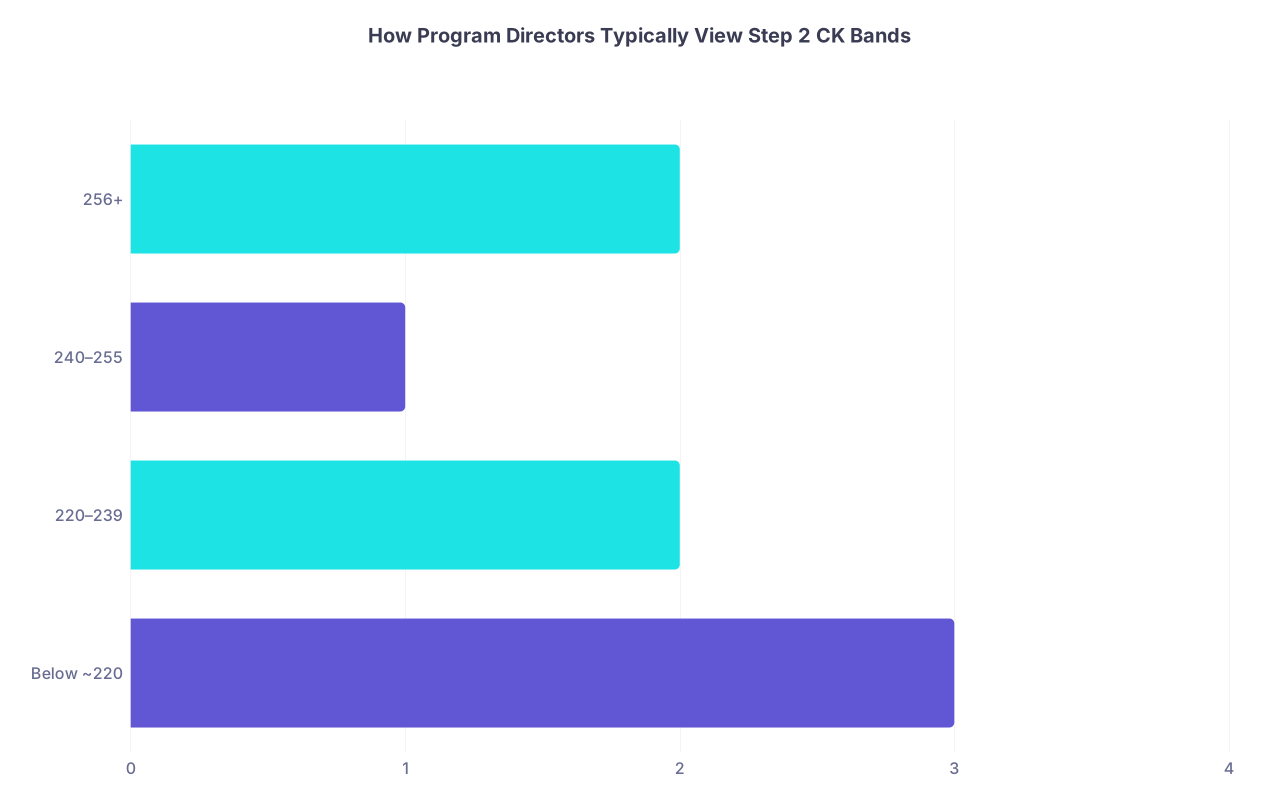
| Category | Value |
|---|---|
| Below ~220 | 3 |
| 220–239 | 2 |
| 240–255 | 1 |
| 256+ | 2 |
(Scale: 1 = usually fine with context, 3 = often concerning / needs context.)
I see this all the time: a student with a very average, perfectly acceptable Step 2 CK—say 235—who has convinced themselves this is a “problem” that must be explained.
So they add tortured lines like:
“While my Step 2 CK score may not fully reflect my dedication to medicine…”
To a program director, that 235 might have been invisible noise. After this sentence, it is suddenly a “thing.”
Do not create red flags that did not exist.
Unless your score is:
- Clearly below your specialty’s typical range
- Wildly inconsistent with the rest of your record
- Associated with a concrete consequence (like delayed graduation)
…you do not need to say a single word about it. Not one.
Programs are not looking for perfect robots. They are looking for residents who know what actually matters.
If your Step 2 CK is:
- Reasonable for your specialty
- Not disastrously low
- Not central to your application narrative
Then your best move is strategic silence. Let your personal statement highlight things numbers cannot: your thinking, your values, how you handle patients, what kind of colleague you will be.
Mistake #6: Turning the Essay into a Study Skills Lecture
Some applicants respond to Step 2 CK (good or bad) by writing paragraphs about “how I learned to study.”
They go into:
- Spaced repetition schedules
- Question bank strategies
- Anki decks
- Pomodoro timers
This might impress a premed friend. It does not impress an attending who has handled codes at 3 AM. It makes you look like your main identity is “test-taker” rather than clinician.
A little bit of meta-learning is fine if it connects to clinical behavior:
Learning to plan my study time carefully for Step 2 CK taught me to break large goals into manageable tasks. I now apply the same structure to patient care—prioritizing the sickest first, breaking down complex problems into steps, and double-checking key data before presenting.
That is enough. Two sentences. Then get back to actual medicine.
If your draft spends more than 3–4 sentences on your study methods, you are off track. Nobody is reading your personal statement thinking, “I hope this person can outline how they used UWorld.”
They want to know:
- How you think about uncertainty
- How you handle pressure from real people, not question banks
- Whether you take feedback well
- Whether patients will like you and trust you
Test prep stories rarely answer those.
Mistake #7: Using Step 2 CK as a Thinly Veiled Specialty Justification

Another pattern: applicants trying to justify their choice of specialty with Step 2 CK.
Variations:
- “My high Step 2 CK demonstrates my readiness for a cognitively demanding field like neurology.”
- “My strong performance on Step 2 CK confirmed my interest in internal medicine.”
- “Scoring well on pulmonary questions fueled my passion for critical care.”
It sounds flimsy because it is flimsy. Your choice of specialty should not rest on a test.
Programs want to see:
- Real patient encounters that shaped your interest
- Long-term exposure (electives, sub-Is, research)
- Specific aspects of the specialty you find meaningful
You can mention that you enjoyed the clinical reasoning reflected in shelf exams or Step 2 CK only if it is a tiny supporting detail, not the core argument. Otherwise you look like someone choosing a career based on what came easily on a multiple-choice test.
If your draft includes a sentence where Step 2 CK is the reason, or primary confirmation, for your specialty choice—cut it.
Mistake #8: Letting Step 2 CK Anxiety Hijack Your Tone
Some misuses are not about explicit content at all. They are about tone.
You can tell when an applicant is haunted by their Step 2 CK. The entire essay carries an undercurrent of apology or defensiveness, even if they never mention the score directly.
Patterns I see:
- Overcompensating with grandiose language: “I will work harder than anyone,” “My commitment is unmatched,” “No one will outwork me”
- Excessive, almost pleading humility: “Despite my limitations…”, “Even though my record is imperfect…”
- Repeatedly returning to the idea of “proving myself”
That tone is often driven by one thought: “They are going to judge me for that number.” So you unconsciously write the entire statement as an argument against it.
The problem: programs do not want an insecure chip-on-the-shoulder intern. They want someone grounded. Someone realistic. Not someone whose identity hinges on one exam.
Your task in the personal statement is not to neutralize every possible criticism. It is to show who will actually walk into their hospital on July 1st.
If you find yourself revising sentences to “make up” for your Step 2 CK, pause and ask:
- If my score were completely erased from ERAS, would this still be the statement I want to send?
If the answer is no, you are letting the exam drive the narrative more than it deserves.
How to Use Step 2 CK Well (When You Actually Should)
Let me be clear: mentioning Step 2 CK is not automatically wrong. It is just usually unnecessary, and often mismanaged.
Here are narrow situations where it can be used appropriately:
| Scenario | Better Location Than PS | If In PS, Keep It To… |
|---|---|---|
| Significant score drop or failure | MSPE / Additional Info | 1–2 factual sentences of context |
| Severe life event overlapping exam | MSPE / Advisor letter | Brief note linking to insight, not self-pity |
| Dramatic upward trend tied to deeper growth | Additional Info | One sentence, embedded in broader growth story |
| Academic medicine / education focus | CV, letters | General reference to “strong exam performance,” no numbers |
Key rules if you mention Step 2 CK at all:
- No raw number in the essay unless explicitly instructed by a mentor who knows your file and your specialty well.
- No score flexing as character evidence.
- No score apologizing for normal or mildly suboptimal results.
- Keep it proportional—if Step 2 CK is one line in your application, it should not be four paragraphs in your statement.
A Quick Sanity Checklist Before You Submit
Before you upload that personal statement to ERAS, do this:
- Search your document for “Step”.
- Count how many times Step 2 CK, Step 1, or “exam” appears. More than 2–3? That is a warning.
- For every sentence that mentions Step 2 CK, ask:
- Would this sentence still be necessary if the reader could not see my score?
- Hand it to one honest person (advisor, resident, chief) and ask:
- “Does this sound anxious about my score? Does the test feel too central to my story?”
- Make sure at least 80–90% of your essay is about:
- Patients, clinical experiences, your values, your fit with the specialty, and how you work with other people. Not about your performance on tests.
If in doubt, you are almost always safer saying less about Step 2 CK, not more.
FAQs
1. My Step 2 CK is significantly below my specialty’s average. Should I address it in my personal statement?
Only briefly, and only if you can do it without excuses. One or two factual sentences that provide context, paired with a clear description of what you changed or learned, is the upper limit. Put any more detailed explanation in the Additional Information section or have your dean’s office address it in the MSPE. Do not turn your personal statement into an appeal letter.
2. My Step 2 CK is very high for my specialty. Is it a mistake not to mention the exact score?
It is not a mistake to leave the number out. Programs already have it. Repeating it in the essay usually feels like self-congratulation and does not add value. At most, you can allude generally to strong exam performance in the context of academic interests, but avoid putting the three-digit score in prose.
3. Can I talk about changing my study habits for Step 2 CK as an example of growth?
Yes, but sparingly. One short paragraph is plenty, and the focus should be on how that growth now shows up in your clinical work, professionalism, or reliability—not on the study techniques themselves. If your “growth story” never leaves the realm of test prep, you are underusing your most valuable real-world experiences.
4. Where is the best place to explain a very unusual or problematic Step 2 CK situation (like a failure or big delay)?
Use the channels designed for that: the Additional Information section in ERAS, your MSPE (if your school supports that), and a conversation with your dean or advisor about whether to alert programs directly. In your personal statement, keep it to a brief acknowledgment at most, and spend the bulk of your words demonstrating maturity, insight, and what kind of resident you will be—not re-arguing the exam.
Open your personal statement right now and do a “Step sweep”: delete every mention of Step 2 CK that is not absolutely necessary, then reread the essay and ask yourself if a stranger would walk away knowing who you are as a future resident—without ever needing to think about a score.