
What happens when a program director sees your low Step 2 CK score… and then finds absolutely nothing in your application that explains it?
They assume the worst. Every time.
Not because they are cruel. Because they are busy, they have options, and silence is easy to interpret as “this is just who you are as a test taker… and probably under pressure in general.”
If you have a low Step 2 CK and you do not give context, you’re making one of the most common—and fixable—errors in residency applications.
Let me walk you through the mistakes I keep seeing and how to avoid quietly tanking your file.
The Biggest Mistake: Letting Your Score “Speak for Itself”
It does speak for itself. Just not the way you want.
You know your story:
- Maybe you got COVID the week before.
- Maybe a family member was in the ICU.
- Maybe you were working 80-hour weeks on a malignant rotation while trying to study.
- Maybe you simply messed up your timing and bombed one block, totally out of character with your NBMEs.
But if none of that appears anywhere in ERAS, here’s what your low Step 2 CK actually says to most selection committees:
- “This applicant struggles with standardized exams.”
- “They may not be safe for boards.”
- “They might drag down our program’s pass rates.”
- “They either lack insight, or they don’t know how to respond to adversity.”
That last one hurts you more than you think. Programs don’t just care about the number. They care about your judgment in how you respond to it.
The worst move? Pretending it didn’t happen and hoping they “focus on the whole application.”
They won’t. Not if they have hundreds of files and you give them zero reason to doubt their first impression of your score.
Why Context Matters So Much Now (More Than You Think)
Step 1 going pass/fail didn’t make Step 2 CK less important. It did the opposite.
For a lot of programs, Step 2 CK is now their primary quantitative filter. That means a low score, unexplained, isn’t just a ding. It can be an auto-screen out.
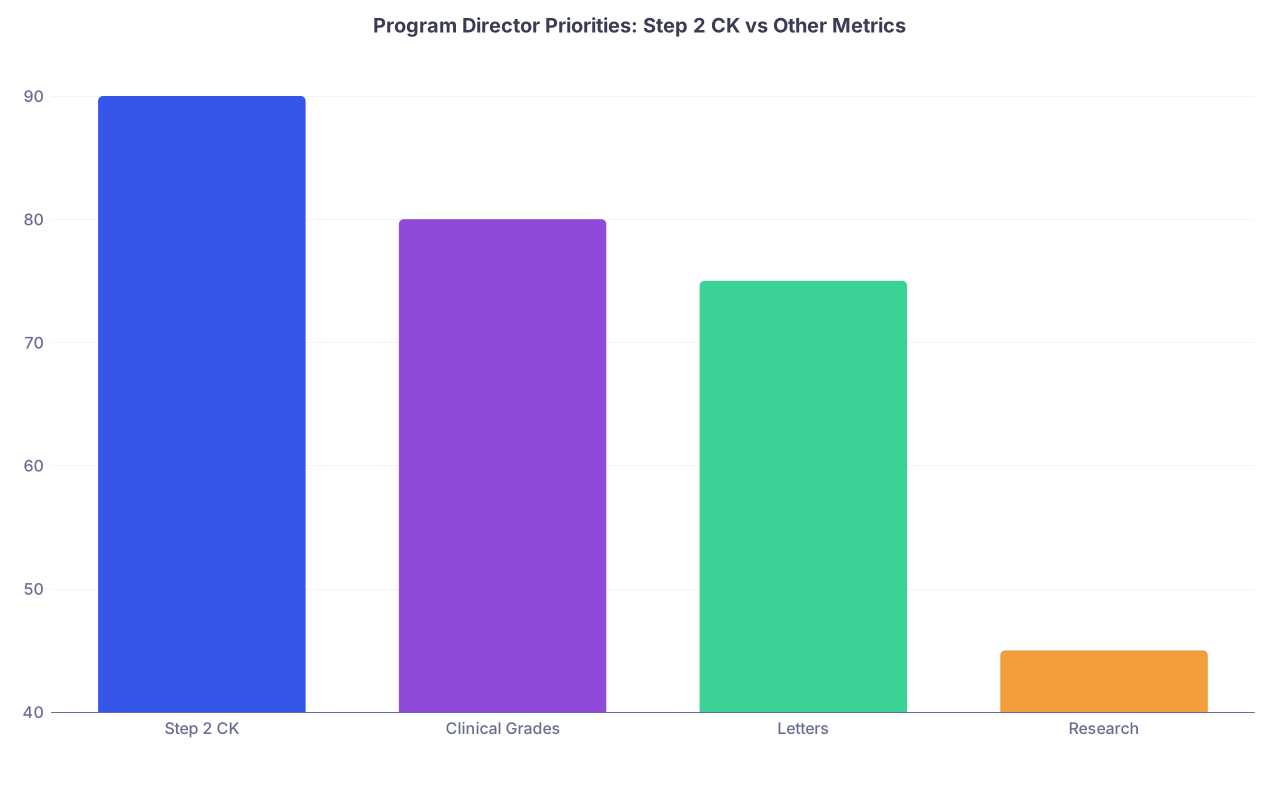
| Category | Value |
|---|---|
| Step 2 CK | 90 |
| Clinical Grades | 80 |
| Letters | 75 |
| Research | 45 |
Rough numbers from recent NRMP Program Director surveys (varies by specialty, but the pattern is consistent): Step 2 CK is near the top of the list of “important” components.
Now connect the dots.
A low Step 2 CK with:
- No explanation in your personal statement
- No note in your MSPE
- No mention in your advisor letter
- No reflection in your ERAS experiences
…looks like one thing: a red flag you don’t even realize is a red flag.
That is what kills you.
Programs are not allergic to low scores. What they hate is unexplained risk. Someone who scores low but shows reflection, remediation, and improvement feels safer than someone who pretends nothing is wrong.
Common Bad Reactions That Make Things Worse
Let me be blunt. These are the patterns that keep showing up in the applications that get quietly passed over.
1. The Ostrich Strategy: Total Silence
You get your score. It’s below your target. You panic. Then you decide: “If I don’t mention it, maybe they won’t notice.”
They notice.
Your USMLE transcript is literally front and center. Committees scroll to it very early. You are not hiding anything by staying silent. You are just forcing them to make up their own story.
This is the single most damaging mistake: no context, no plan, no reflection.
2. The Excuse Dump
On the other extreme:
You write three rambling paragraphs in your personal statement about:
- Illnesses
- Family emergencies
- Relationship drama
- Study resource drama
- “The exam did not reflect my true knowledge”
Now you’ve traded one problem (low score, no context) for two problems (low score + lack of professionalism).
Programs don’t mind hearing about real adversity. But if your explanation sounds like finger-pointing, excuse-making, or emotional oversharing, you just moved yourself into the “high maintenance” bucket.
Bad signs:
- Blaming NBME or “exam style”
- Long descriptions of how unfair the curve was
- Overly dramatic tone for what sounds like poor planning
3. The Wrong Place, Wrong Tone Explanation
You stick a defensive paragraph in the first half of your personal statement:
“I know my Step 2 score is lower than ideal, but I believe numbers do not define me…”
Now your score is the first serious thing they learn about you. You paid money to lead with your weakest point.
Or you bury it in an ERAS experience description in a weird way that feels out of place.
Or you try to be too cute about it. Joking about a low board score almost never lands well.
4. The “I’ll Just Retake” Fantasy
You think: “I’ll schedule a retake, then they’ll know I’m serious.”
Except:
- You probably can’t retake Step 2 CK unless you failed.
- Even if you could, your old score doesn’t disappear.
- Programs are not impressed by “I will do better later” promises without evidence now.
Hoping a future action will fix a current red flag is magical thinking. Not a strategy.
How Programs Actually Read a Low Step 2 CK
Let’s be clear on the risk profile from the program’s side.
They are asking themselves:
- Is this applicant likely to pass specialty boards on first attempt?
- Is this score an outlier or part of a pattern?
- Did something specific happen, or is this baseline performance?
- Is the applicant self-aware and proactive about weaknesses?
If your Step 2 CK is low and:
- Your clerkship grades are mediocre
- You have no shelf scores listed (or they’re bad)
- No one in your letters mentions strong medical knowledge
- You give no context
They draw a straight line: this isn’t a fluke. It’s who you are as a test taker.
If your Step 2 CK is low but:
- Preclinical and clinical grades are strong
- Shelf exams (where listed) are good
- Letters mention strong knowledge, critical thinking, and reliability
- You briefly and clearly explain the circumstances and what you learned
Then the narrative changes: one bad day, explained and mitigated.
You can’t erase the number. But you can control the story around it.
Smart Ways To Provide Context Without Sounding Desperate
Here’s where most applicants screw it up. They either overshare or under-explain. You want a middle path: concise, factual, reflective.
Think in three parts:
- What happened (brief)
- What you did about it
- How your later performance supports your ability
Use the Right Locations
You do NOT need to talk about your Step 2 CK everywhere. That looks obsessive.
Better options:
- A short paragraph in your personal statement (later in the essay, not the lead)
- A brief note discussed with your dean and possibly referenced in the MSPE
- A targeted comment in a letter from someone who actually witnessed those circumstances (if appropriate and natural)
Bad options:
- A rant in your personal statement
- Mention in every interview answer unprompted
- A weird ERAS experience entry titled “My Step 2 CK” (yes, I’ve seen it)
A Reasonable Example Paragraph
Something like this:
“My Step 2 CK score is lower than the standard range for applicants in this specialty. During the time I was preparing and testing, I was also managing an acute family health crisis that affected my focus more than I anticipated. I made the mistake of not postponing the exam. Afterward, I met with faculty mentors, adjusted my study approach, and demonstrated stronger performance on subsequent clinical evaluations and subject exams. This experience pushed me to improve how I plan under pressure and to seek help sooner, skills I bring to residency.”
Notice what this does:
- Acknowledges the number directly
- States the context briefly, without melodrama
- Admits an error (not postponing)
- Shows corrective action and later performance
- Ends on growth, not self-pity
That’s the balance you want.

Do Not Hide Patterns That Make Your Story Collapse
Another mistake: giving one explanation that doesn’t match the rest of your record.
For example:
- You blame acute illness for your Step 2 CK performance
- But your shelves were consistently mediocre
- Your Step 1 (back when scored) was also low
- No one comments on strong medical knowledge
Programs are not stupid. They see patterns. If your “explanation” contradicts the larger picture, it looks like spin rather than honesty.
You should:
- Be honest about patterns if they exist: “I’m not a naturally fast standardized test taker; I’ve had to build that skill deliberately.”
- Then back it up with evidence of improvement, structure, and reliability in other domains: clinical evaluations, procedures, call performance.
You should not:
- Pretend a chronic issue is just one unlucky day.
- Over-attribute everything to one event that clearly cannot account for years of performance.
If the pattern is: “I’ve always struggled with speed and long exams,” own it briefly and focus on how you’ve learned to compensate: question banks, timing drills, structured review, faculty guidance.
Honest + proactive beats denial every time.
Specialty Reality Check: How Bad Is “Low” in Your Field?
One more trap: not calibrating what “low” actually means for your specialty. A 228 means something very different in FM vs Derm.
| Specialty Tier | Safer Zone | Yellow Flag Zone | Red Flag Zone* |
|---|---|---|---|
| Highly Competitive (Derm, Ortho) | ≥ 255 | 240–254 | < 240 |
| Moderately Competitive (EM, Anes) | ≥ 245 | 230–244 | < 230 |
| Less Competitive (FM, Psych, IM) | ≥ 235 | 220–234 | < 220 |
*Red flag doesn’t mean “no chance”; it means “you must manage this actively and realistically.”
If you’re 229 and applying Family Medicine, your score is not a catastrophe. Silence is less dangerous there, though context can still help if the rest of your file is strong.
If you’re 229 and applying Dermatology with no research, no AOA, and no story? That’s not just “low Step 2 CK.” That’s misalignment with reality.
Here’s the mistake:
You obsess about contextualizing the score itself but ignore whether your overall application matches the competitiveness of the specialty. That’s how you burn a whole cycle on a fantasy.
You don’t have to give up on your dream, but you do need:
- A parallel plan with more realistic programs or specialties
- A frank conversation with a faculty advisor who isn’t afraid to tell you “this is a reach”
Turning a Weak Score into a Signal of Maturity
Programs don’t actually expect perfection. They expect:
- Awareness of weaknesses
- Evidence of remediation
- Stability under pressure
A low Step 2 CK score is an opportunity (yes, I know that word is overused, but here it fits) to demonstrate those traits if you handle it well.
You can do that by:
- Owning it directly, once, somewhere they will see.
- Connecting it to specific, not vague, circumstances.
- Showing concrete actions you took afterward (study changes, mentorship, improved shelves, better organization).
- Making sure your letters and MSPE organically support your story.
What you avoid:
- Self-pity
- Blame
- Shrugging it off like it doesn’t matter
- Never mentioning it and hoping no one cares
Handled correctly, your low Step 2 CK becomes a data point in a bigger narrative of resilience and growth, not the headline.
Tactical Moves You Should Not Skip
Don’t guess. Have a plan.
Here’s the sequence I’d actually follow if you’re sitting on a low score right now.

| Step | Description |
|---|---|
| Step 1 | Receive Low Step 2 CK Score |
| Step 2 | Assess Specialty Competitiveness |
| Step 3 | Adjust specialty list and programs |
| Step 4 | Meet with faculty advisor |
| Step 5 | Review full academic pattern |
| Step 6 | Decide if context explanation is needed |
| Step 7 | Draft brief context paragraph |
| Step 8 | Focus on strengthening other parts |
| Step 9 | Align MSPE and letters with story |
| Step 10 | Finalize ERAS with realistic list |
| Step 11 | Score viable for target field |
Key steps people skip (and regret later):
- Meeting with a realistic advisor (not just a friend).
- Checking actual program-specific Step 2 CK data where available.
- Editing their personal statement with someone who will cut out self-pity and drama.
- Coordinating with their dean’s office about MSPE wording.
This isn’t busywork. It’s the difference between an application that reads “random low score, who knows why” and one that reads “low score, understood and addressed.”

The Interview Trap: Don’t Blow It When They Ask
If you put any context in your written materials, expect to be asked about it. A lot of applicants handle that badly.
Two common interview mistakes:
- Giving a totally different story than what’s in your application.
- Sounding defensive, bitter, or still emotionally raw.
Your answer should be:
- Consistent with what you wrote.
- Short.
- Focused on what you learned, not how unfair it was.
Something like:
“My Step 2 score is lower than I would have liked. At the time, I was dealing with a family health issue and didn’t postpone when I probably should have. Since then, I’ve adjusted how I plan around major exams, and my clinical performance and subject exams have been stronger. The experience pushed me to be more proactive with my limits and time management.”
Then stop talking. Don’t keep apologizing. Don’t over-explain. Don’t spiral.
You acknowledge. You show reflection. You move on.
Bottom Line: Silence Is a Choice, and It’s the Wrong One
A low Step 2 CK score doesn’t automatically kill your match chances. I’ve seen people match with:
- 22x into IM and FM
- 23x into Psych
- 23x–24x into EM with great SLOEs and performance
But those who matched with a weak score almost never did one thing: they didn’t pretend it never happened. They took ownership, they provided context, and they backed it up with performance elsewhere.
The ones who got buried?
Same scores, zero explanation, unrealistic specialty lists, and an application that left programs guessing.
Don’t make that mistake.
FAQ (Exactly 4 Questions)
1. How low is “too low” for Step 2 CK to need an explanation?
If your score is below the national mean for your target specialty, or clearly below the average of programs you’re applying to, you should at least consider a brief explanation. As a rough rule: if you’d feel anxious sitting in a program director’s chair looking at that number, you probably need to address it. For truly non-competitive specialties with strong supporting metrics, you can sometimes let a borderline score stand without explanation, but that’s a calculated decision you should make with an advisor, not alone at 2 a.m.
2. Should I always explain my low Step 2 CK in my personal statement?
Not always. If Step 2 CK is modestly below average but consistent with your academic pattern, you might let your overall record speak and focus your personal statement on your story, clinical interests, and strengths. If the score is significantly lower than expected based on the rest of your file—or is below a common cutoff—then a short, late-paragraph explanation is smart. The key is brevity and tone: a few tight sentences, not a sob story.
3. Can a strong Step 2 CK compensate for a low Step 1 or vice versa?
A high Step 2 CK can partially redeem a low Step 1 by showing upward trajectory and better mastery of clinical material. Programs like that pattern. The reverse—high Step 1, low Step 2 CK—is more concerning, because Step 2 is closer to day-to-day clinical reasoning and board readiness. That pattern definitely needs context if the gap is large. Either way, the theme matters more than the single number: improving, stable, or declining.
4. What if there truly was no major life event—I just misjudged and underprepared?
Then you say that, in a professional way, or you say nothing and accept the risk. You don’t need a dramatic tragedy to justify a low score. You can own a planning mistake: you underestimated the exam, overcommitted on rotations, or didn’t start question banks early enough. Briefly acknowledge poor strategy, then emphasize what you learned and how your later performance changed. Honest, specific self-critique is more credible than a vague “test anxiety” line with no supporting detail.
Open your ERAS personal statement draft right now and search for “Step 2” or “score.” If there’s no mention and your Step 2 CK is below your specialty’s average, decide today where—and how—you’ll write three clear sentences of context before you send a single application.