
Last week I watched a friend literally refresh his inbox every 30 seconds. ERAS was open, programs were already sending out interview invites, and his Step 2 CK score? Still “pending.” He kept saying the same thing over and over: “They’re screening right now. What if they just toss my app without my Step 2?”
If you’re here, I’m guessing your brain is running the exact same loop: “My Step 2 CK posts after programs start screening… am I screwed? Do they think I’m hiding something? Is this going to silently kill my interview chances while I just sit here?”
Let’s walk through this like two people who both catastrophize everything but still want the real picture.
First: Are You Actually Screwed If Step 2 Posts After Screening Starts?
Short answer: no. But you can lose opportunities if you don’t play this right.
Here’s the uncomfortable truth I’ve seen over and over:
- Some programs barely care when your Step 2 posts, as long as it’s in before rank list time.
- Some programs strongly prefer to see it before offering interviews.
- A smaller subset will hard-filter (no Step 2 score visible = auto-hold or auto-reject).
So your situation isn’t “game over,” it’s more like:
- “My file might sit on a shelf for a bit,” or
- “I might get overlooked in the first wave.”
What determines how bad this is:
- How strong your Step 1 is (especially now that it’s Pass/Fail).
- How your application looks overall (clerkships, letters, school reputation).
- How long the lag is between screening starting and your Step 2 posting.
- How proactive you are once the score drops.
If your score is coming a week or two after programs start screening, that’s very different from it coming in November when most interview offers have already gone out. Timing matters, but even “late” doesn’t mean “mission failed.”
What Programs Actually Do With Step 2 Timing
Let me be blunt: programs aren’t sitting there cackling, thinking, “Ha, no Step 2 yet, deny.”
They’re usually doing something more boring:
- They pull ERAS filters (e.g., “Only show applicants with Step 2 score uploaded”).
- Or they sort by “complete vs incomplete” files.
- Or they scan quickly and give priority to applicants who are “easier” to evaluate.
So if you’re missing Step 2 when they start screening, you might get:
- Put in an “incomplete / review later” pile.
- Reviewed based on everything else (Step 1 P/F, clerkship grades, letters, school, etc.).
- Auto-skipped if they turned on a hard filter for “has Step 2 score.”
And that last one is the nightmare scenario everyone obsesses over.
But here’s the twist: many programs know the NBME releases are batchy and messy. They expect a good chunk of apps to be missing Step 2 initially. They don’t want to lose good candidates just because NBME was slow by a week.
So lots of programs will:
- Re-review people after major score release days.
- Or get an email from you later, look you up, and take a second pass at your app.
Does that guarantee anything? Absolutely not. But it means you are not dead in the water just because screening started before your score posted.
The Ugly “What If” Scenarios You’re Probably Spinning Through
Let me just name them and answer them.
1. “What if programs assume my Step 2 is low because it’s late?”
If your test date was reasonably on time (July/Aug/early Sept), they know it’s just the release schedule. Everyone’s in the same NBME queue.
They start getting suspicious if:
- You still don’t have a score when others from your class do, and
- You haven’t mentioned a date at all, and
- Your Step 1 or preclinical record looks shaky.
If your exam date is documented (MSPE, a CV update, or in an email) and the timing matches NBME’s usual 3–4 week release window, nobody assumes you’re hiding a disaster score. They might assume you’re average. They might assume they just need to wait.
2. “What if they reject me before my score posts and never look again?”
Some will. Honest answer.
Lots of programs send out a big wave of rejections early just to manage volume. If you get auto-rejected in that pass, there’s usually no “reconsideration” mechanism just because a new score came in.
But:
- Many programs don’t mass-reject that aggressively.
- Some specifically say “We will continue to offer interviews on a rolling basis throughout the season.”
- I’ve seen people get early rejections from super-reach places and still land multiple mid-tier interviews later after their Step 2 hit.
This is why having a broad list matters when your Step 2 is posting close to or after screening start.
3. “What if my Step 2 is meh and it posts after they thought I might be stronger?”
That’s the reverse fear: they liked you better when they didn’t know.
Reality: if your app looked impressive enough to get pulled without Step 2, a slightly lower-than-expected Step 2 doesn’t automatically tank you. Honestly, the real damage of a “meh” Step 2 is to borderline files where they’re looking for some objective number to justify the yes/no.
Programs are heavily used to seeing a wide range of Step 2 scores. They’re not shocked by 230s, 240s, even lower, depending on specialty and overall file.
4. “What if my Step 2 is great but misses the first wave of interview invites?”
This one hurts, because you earned the strong score and timing robbed you.
Good programs review applications multiple times. They know late LORs and late Step 2 scores are common. People do get November/December interview invites largely triggered by new scores.
But yes, you might miss the sugar-high of those first September/early October blasts, especially at super competitive programs that largely fill early.
How Much Does Step 2 Timing Matter by Specialty?
Some specialties care about Step 2 timing a lot. Others, not nearly as much.
| Specialty | Step 2 Timing Impact | Notes |
|---|---|---|
| Internal Med | Moderate | More flexible with timing |
| Family Med | Low | Often holistic, broad review |
| Pediatrics | Moderate | Prefer score but not rigid |
| General Surgery | High | Often want scores early |
| Dermatology | Very High | Hyper-competitive, early eval |
Rough pattern I’ve seen:
- Primary care fields (FM, IM, peds): much more forgiving about timing. They have tons of spots, lots of rolling review, and are used to score delays.
- Moderately competitive fields (EM, OB/GYN, anesthesia, psych): they like having Step 2 early, but they still routinely interview people whose scores posted after screening started.
- Hyper-competitive (derm, ortho, plastics, ENT, some surgical subs): having Step 2 in and strong early is a huge advantage. Late or missing scores here are much riskier.
But even in those high-stress fields, there are people every year who match with Step 2 that posted “late” as long as the number is solid and the rest of the app is strong.
Concrete Timeline: How Bad Is Your Situation?
Here’s where your brain is probably melting: “Is my timing just mildly annoying or totally catastrophic?”
Let’s anchor it.
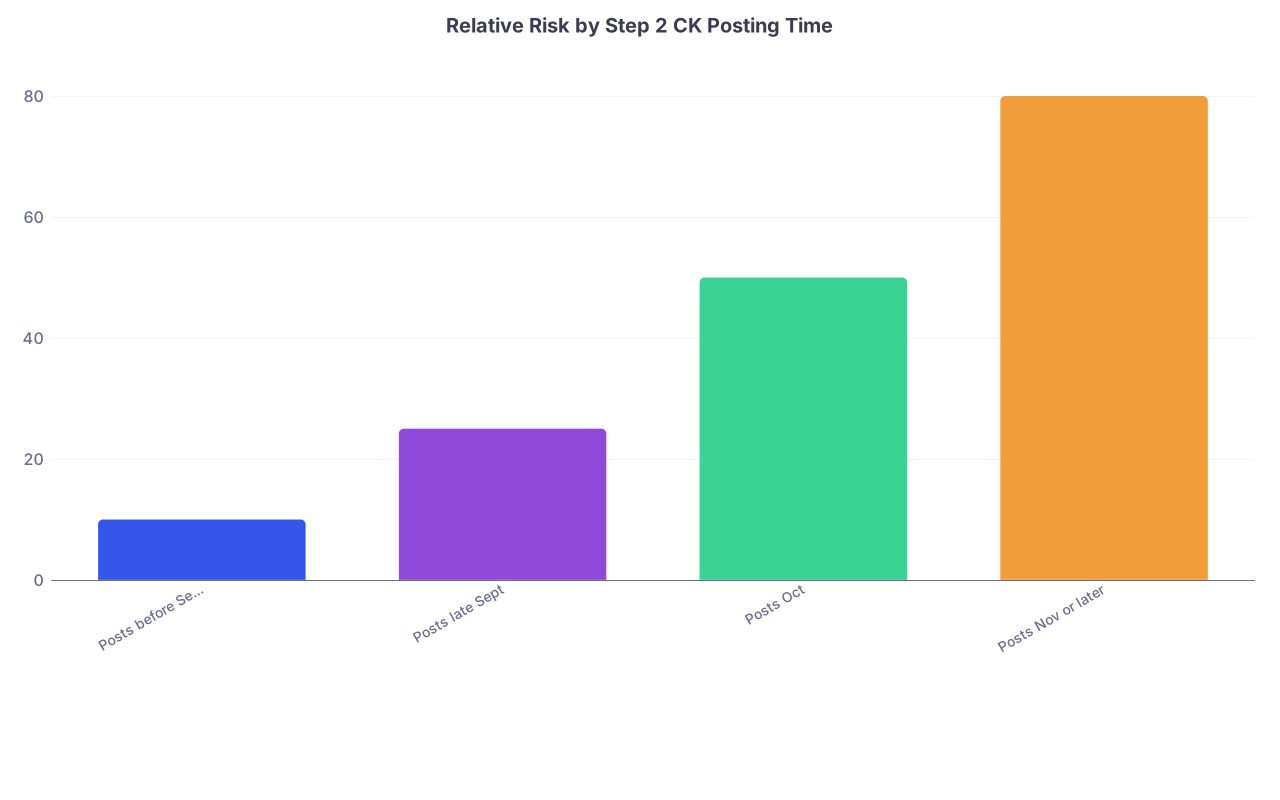
| Category | Value |
|---|---|
| Posts before Sept 15 | 10 |
| Posts late Sept | 25 |
| Posts Oct | 50 |
| Posts Nov or later | 80 |
Interpretation (numbers are just to illustrate relative stress, not real percentages):
- Posts before Sept 15 (ERAS opens): Ideal. Programs see it from the first glance.
- Posts late Sept: Very common. Programs have started screening but are still early in their invites. Risk rises but manageable.
- Posts in October: Now you’re late for some programs, still okay for many, especially mid/low competitiveness.
- Posts in November or later: Rough. Many programs have already given most invites. You are absolutely not doomed, but you’re relying on later-wave invites and less competitive programs.
If you’re in the late-Sept-to-Oct zone, this is annoying but not fatal. If you’re past that, you and I both know it feels like a pit in your stomach—but there’s still strategy to salvage this.
What You Should Actually Do While You’re Waiting
This is where people freeze and just catastrophize for three weeks. Don’t do that.
Here’s the playbook.
1. Make Sure Your ERAS Is Otherwise Complete and Strong
Before your score even posts:
- Personal statement: done, not cringe, specialty-specific.
- LORs: at least 3 in (including at least one in your specialty if possible).
- Experiences: clear, no giant gaps, leadership/volunteering filled out thoughtfully.
- MSPE: your school will upload it on Oct 1 anyway, but you can’t control that.
You want programs to look at your file without Step 2 and think, “This is worth holding until the score comes in,” not “This is obviously weak even before we get the number.”
2. Know Your Exact Score Release Date
NBME gives an estimated Wednesday release. You should know:
- Test date
- Expected score release date
- When that lands relative to big ERAS milestones (Sept 15, Oct 1, etc.)
Why? So when you later email a program, you can say something like:
“I sat for Step 2 CK on August 20 and my score is scheduled to be released on September 18.”
That sounds planned and responsible. Not chaotic.
3. Decide When You’ll Email Programs (and When You Won’t)
You do not need to blast every program on day one yelling “MY SCORE ISN’T HERE YET BUT I PROMISE IT WILL COME.”
Most PDs won’t care, and you’ll just look panicked.
Better approach:
- If your test date was normal and your score will post by late Sept: don’t email in advance. Let it come in, then update.
- If your score won’t post until October or later: consider a short, calm note to your top programs only, acknowledging the timing and giving them your date.
Then, once your score hits:
- Upload to ERAS (it auto-updates).
- For top choice programs, send a brief email saying your Step 2 posted and you remain very interested.
4. Prepare a 2–3 Sentence Email Template
You want something ready so you’re not word-vomiting in your panic. Something like:
Subject: Step 2 CK Update – [Your Name], [AAMC ID]
Dear Dr. [PD Name] / Residency Selection Committee,
I hope you’re doing well. I wanted to share that my Step 2 CK score has now been released and is available in ERAS (Step 2 CK: 245). I remain very interested in [Program Name] and would be honored to be considered for an interview.
Best regards,
[Name], [Med School], [AAMC ID]
Short. Direct. Not needy. You’re giving them a reason to re-open your file.
How Programs Re-Screen Once Scores Drop
This is the part applicants underestimate.
A lot of programs do secondary screening rounds. They’ll:
- Pull a list of applicants who now meet some criteria (e.g., Step 2 above X).
- Or re-run a filter after a big Wednesday of score releases.
- Or look again when they’re filling late interview slots in November/December.
The Step 2 score—especially if it’s solid or better than your Step 1 story—can bump you from “borderline” to “interview.”
I’ve watched:
- A student with a Step 1 pass and okay grades get no bites early, then land multiple IM interviews after a 250+ Step 2 posted in late Sept.
- A borderline EM applicant with an okay Step 2 getting October invites because the department re-ran filters once everyone’s scores came in.
Is that guaranteed? No. But it absolutely happens.
How to Keep Your Sanity While You Wait (Or At Least Fake It)
Let’s be honest: you’re not going to be zen. But you can at least stop making it worse.
- Limit ERAS portal checking. Set a rule: twice a day. That’s it. Morning and evening.
- Batch your anxiety. Give yourself 15 minutes a day where you’re allowed to spiral, vent to a friend, journal, whatever. Outside that window, you gently tell your brain, “We’ll panic at 8 PM.”
- Work on other parts of your life. Rotations, research manuscript, side project, literally anything. The more you sit and stare, the worse this feels.
- Stop comparing to classmates who already have invites. Their timing, specialty, and Step situation are different. Social media screenshots of interview invites are not data; they’re triggers.
Quick Reality Check: When Is It Actually a Huge Problem?
I won’t sugarcoat this part.
Your Step 2 posting after screening is a significant problem when:
- It doesn’t post until late October or November, and
- You’re applying to a competitive specialty, and
- You don’t have some other standout factor (elite school, insane research, heavy connections).
In that case, you should:
- Apply broadly and include a solid number of less-competitive programs and maybe even a safety specialty if your school supports that.
- Be realistic about possibly needing a SOAP backup or a reapplication strategy if the season stays quiet.
But “posts one or two weeks after screening starts” is not that. That’s just… aggravating.

| Step | Description |
|---|---|
| Step 1 | Take Step 2 CK |
| Step 2 | Score Pending |
| Step 3 | Normal Review |
| Step 4 | Initial Review Without Score |
| Step 5 | Hold or Auto Reject |
| Step 6 | Review Based On Other Data |
| Step 7 | Interview Consideration |
| Step 8 | Score Released Later |
| Step 9 | ERAS Auto Update |
| Step 10 | Possible Re Screen |
| Step 11 | Programs Start Screening |
| Step 12 | Program Uses Step 2 Filter |
This is basically what you’re up against. Annoying, not hopeless.
FAQs
1. Should I delay submitting ERAS until my Step 2 CK posts so it looks “complete”?
No. Submit ERAS on time. A “late” app with a Step 2 score is often worse than an “early” app without it. Programs value early submission; you can always let Step 2 populate later and update them. Don’t wait to submit just to look tidy.
2. If my Step 2 score is low and posts after screening starts, should I email programs or stay quiet?
If it’s truly low relative to your specialty (e.g., applying ortho with a 215), a blast email won’t save you and might just highlight it. Let ERAS update, focus on mid/low-tier programs, and talk honestly with your dean or mentor about backup options. For moderate scores (not great, not awful), I’d still email top choice programs because the holistic file might still get you a look.
3. Do programs see the exact date my Step 2 CK was released?
They see the score and they can infer timing based on when it appears in ERAS, but there isn’t a big red flag that says “this person delayed their exam out of fear.” They’re too busy to interpret microscopic timing differences unless you were outrageously late compared to your class.
4. Is it ever smart to delay taking Step 2 so it posts later, closer to interviews?
No. That’s over-optimizing and usually backfires. Programs want enough time to review scores and offer interviews. The only “delay” that sometimes makes sense is taking Step 2 after you’ve fixed serious knowledge gaps or poor practice test trends—but that’s about performance, not gaming screening timing. If you’re ready, earlier is almost always better.
Key things to hold onto:
- A Step 2 CK score that posts after screening starts is a headache, not a death sentence.
- Most programs re-review once scores hit—especially if the number helps clarify your story.
- Your job is to keep your app strong, update smartly (not desperately), and remember that timing is one variable, not the whole game.