
The CK questions that really matter are not the ones you get right. They’re the ones that feel exactly like a 2 a.m. cross-cover page.
Let me break this down specifically.
Step 2 CK is not a trivia contest. It is a pressure test: can you think like a safe, efficient, unsupervised-but-closely-watched intern? Certain question types map almost one‑to‑one onto what you will actually face in July. When those stop feeling exotic and start feeling “routine,” you are much closer to being ready—both for the exam and for intern year.
Below I am going to walk through the CK question archetypes that signal real readiness, why they matter for residency programs, and how to use them as a self‑diagnostic tool instead of just another question block.
1. “I Have 30 Seconds on the Phone” Management Questions
These are the backbone of both CK and intern life.
You know the pattern: 4–6 lines of history, a couple of vital signs, maybe one lab that is off the rails. Then one high‑stakes question:
- “Best next step in management”
- “Most appropriate next step”
- “Most appropriate initial treatment”
The signal that you are getting closer to intern‑ready is not just your percentage correct. It is how automatic your internal algorithm feels.
You should be able to scan the stem and immediately sort it into one of a few mental buckets:
- Unstable → resuscitate / ICU / call for help
- Stable with red‑flag condition → urgent but non‑ICU intervention
- Stable, outpatient-type problem → guideline‑driven, staged plan
On the exam, this shows up as:
- Septic shock vs simple sepsis (pressors vs just fluids + abx)
- NSTEMI vs unstable angina (heparin + DAPT vs stress test later)
- Hyperkalemia with vs without EKG changes
If you are still debating between two options that differ in aggressiveness and time frame (e.g., “urgent cath now” vs “stress test later”) and you do not have a clear mental rule, you are not ready yet. Programs want interns who do not waffle when the nurse says, “BP is 78/40, what do you want to do?”
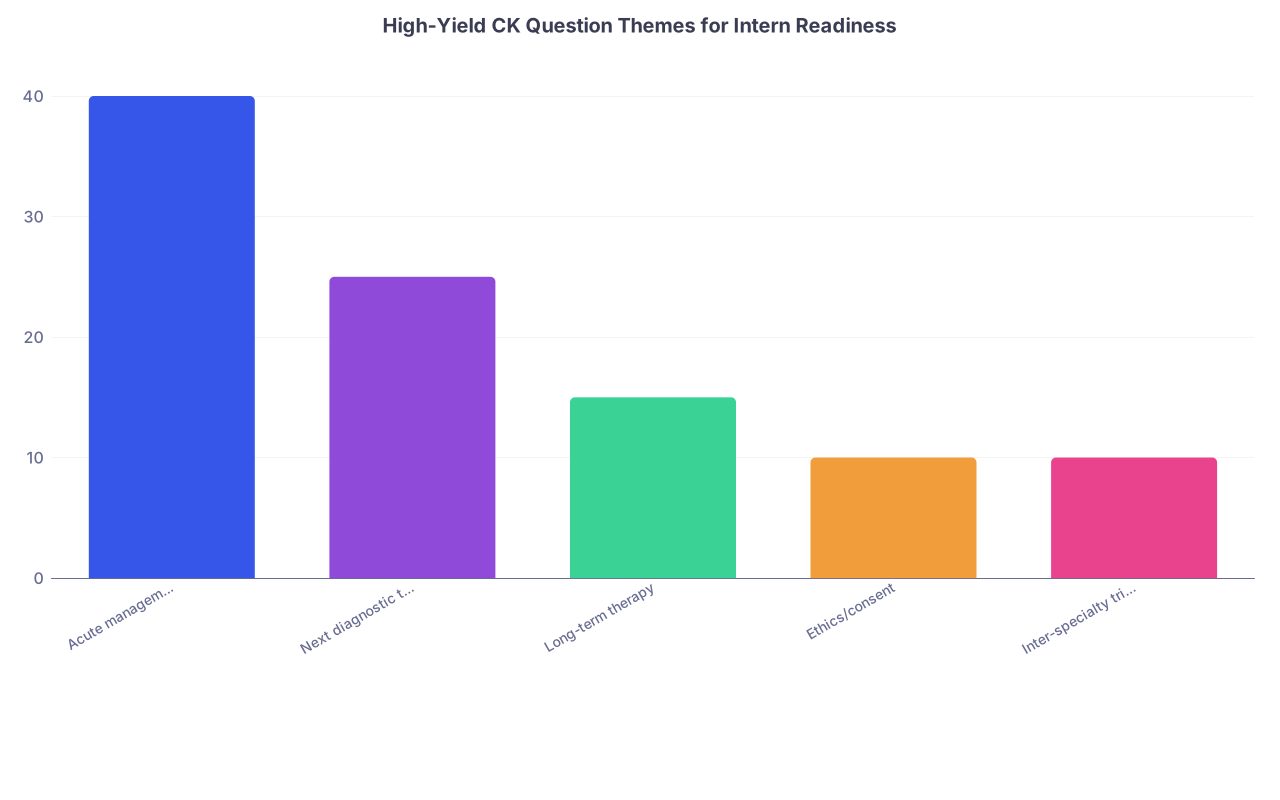
| Category | Value |
|---|---|
| Acute management | 40 |
| Next diagnostic test | 25 |
| Long-term therapy | 15 |
| Ethics/consent | 10 |
| Inter-specialty triage | 10 |
Notice that the exam disproportionately rewards acute decision‑making. That distribution mirrors what PDs care about: are you safe on cross‑cover?
What “ready” looks like for this type:
- You can answer most “next step” questions without re‑reading the stem twice.
- You instinctively classify the situation as “ICU-level” vs “ward-level” vs “clinic-level.”
- You rarely mix up “most appropriate initial test” vs “most accurate test” vs “best next step in management.”
If every management question feels like starting from zero, your clinical reasoning scaffolding is still too thin.
2. Multistep Hospital Course Questions (The “Day 3 Complication” Pattern)
Intern year is not one vignette. It is a sequence: admit → manage → complication → disposition. CK reflects that with questions where the time dimension matters.
Typical structure:
- Patient admitted for X
- Treated with Y
- Now, 2–5 days later, something new appears
- Question: “Most likely cause / complication / next step.”
Examples:
- Post‑op day 3 hypoxemia → atelectasis vs PE vs pneumonia
- Day 5 central line → now septic shock → line‑associated infection vs UTI vs pneumonia
- Hospitalized for pancreatitis → 1 week later persistent fever → pancreatic abscess vs pseudocyst
These questions test whether you can track a narrative and identify what is “expected” vs “this should not be happening.” That is literally the daily work of intern sign‑out: “This is day 3 post‑op, pain is controlled, but if the fever persists beyond tomorrow we worry about…”
If you find yourself missing these questions, the usual reasons are:
- You ignore the timeline. You treat every complication as if it could occur at any time.
- You anchor on the original admitting diagnosis instead of accepting that something new happened.
- You do not have “post‑op day” and “hospital day” mental buckets for likely problems.
You want to reach the point where:
- Post‑op day 1–2 → atelectasis, pain, inadequate mobilization
- Post‑op day 3–5 → pneumonia, UTI, DVT/PE
- Week 1+ → wound infection, abscess, dehiscence
and you can deploy that on instinct. Because the consults you will call as an intern depend on this exact time‑course thinking.
3. Cross‑Coverage Style “Pager Questions”
If you want to know whether someone is ready for intern year, page them five times in an hour with completely unrelated issues. CK does a milder version of that: jump between specialties rapidly, always in the “something is going wrong on the floor” zone.
Question patterns that mimic real pages:
- “The nurse reports that the patient is now more confused…”
- “Overnight, the patient develops new onset shortness of breath…”
- “Four hours after receiving medication X, the patient has…”
These questions often hide several layers:
- You must distinguish a benign expected effect from a true deterioration.
- You must know which problems can be handled with an order vs which require seeing the patient now vs which need a rapid response.
Common scenarios:
- New confusion in a previously oriented patient → delirium workup, medication changes (opiates, anticholinergics), infection
- New hypotension on the ward → bleeding, sepsis, medication‑induced (antihypertensives, epidural), cardiogenic causes
- New tachycardia post‑op → volume status, pain, PE, sepsis
The CK question often asks:
- “Most appropriate immediate step”
- “Most appropriate initial evaluation”
If you are still repeatedly choosing “order a CT scan” or “send them for MRI” before checking vital signs, blood glucose, or doing a focused bedside exam in your mental model, you are missing the intern‑level prioritization. On the floor, you do not start with imaging. You start with “go see the patient” or “stat vitals / EKG / glucose.”
What readiness looks like:
- You instinctively think: airway, breathing, circulation, mental status, bedside assessments.
- You can separate “call rapid response now” from “I’ll see them at the end of this note.”
- You do not waste interventions on low‑yield, time‑consuming studies when simple fixes exist (e.g., giving fluids, adjusting meds, treating pain).
4. “Most Appropriate Next Test” – With Real‑World Resource Logic
Another signal CK uses: can you choose diagnostic tests the way a real intern must—balancing yield, invasiveness, and sequence?
You know the question design:
- Stable patient, non‑emergent situation.
- Several plausible tests listed: CT, MRI, US, biopsy, invasive studies, serologies.
- The exam wants the cheapest, safest, reasonably sensitive test that actually changes management right now.
Examples:
- Suspected DVT: venous duplex ultrasound vs D‑dimer vs CT angiography.
- Suspected PE in pregnancy: V/Q scan vs CT angiography vs D‑dimer.
- Painless jaundice: ultrasound vs CT abdomen vs ERCP vs MRCP.
These map onto intern responsibilities when you are writing orders or prepping for morning rounds. Residents and attendings will expect you to propose a plan that does not carpet‑bomb the patient with three imaging modalities and a biopsy “just to be safe.”
Where students go wrong:
- Choosing the “most accurate” test when the question is clearly “most appropriate initial test.”
- Jumping straight to invasive or high‑risk procedures without exhausting noninvasive options.
- Ordering tests that do not change immediate management (e.g., ordering ANA in a crashing patient).
The “you’re getting there” sign:
- You automatically scan answer choices for the least invasive modality that could reasonably answer the clinical question.
- You can articulate, even to yourself, “If this test is positive, I will do X; if negative, I will do Y.” If you cannot state that, the test is probably not the best next step.
- You recognize CT/MRI/ERCP as tools with risk, cost, and indications, not as default reflexes.
5. High‑Yield “What Do You Do Before the Consultant Arrives?” Questions
This one separates the Step‑2‑ready from the intern‑ready.
On the exam and in life:
- You suspect a surgical abdomen. The real question is not “call surgery?” That is obvious. The real question is: what do you do for the patient while you are waiting?
- You identify possible acute stroke. Of course you call neurology. What do you do before they see the patient?
CK tests this by:
- Presenting an urgent situation where the consult is implied.
- Asking for the immediate stabilization step instead of the specialty call.
Typical examples:
- Upper GI bleed with hypotension → IVF, blood, stabilize, PPI before endoscopy.
- Suspected esophageal variceal bleed → 2 large‑bore IVs, octreotide, antibiotics, PPI, then GI.
- Epidural abscess → MRI with contrast before calling spine surgery.
Intern‑ready thinking looks like this:
- “Who do I need to call?” and “What do I need to do myself right now?” are separate mental questions.
- You prioritize resuscitation, pain control, NPO orders, and basic monitoring before specialized interventions.
- You do not abdicate responsibility upward (“I’ll just call the attending”) as your only action plan.
Programs want interns who can buy their critically ill patient 15–30 minutes of stability while help mobilizes. CK questions that force you to choose between “call X” and “start Y medication/IV/oxygen” are stress‑testing that exact instinct.
6. Ethically Messy, Consent, and Capacity Questions
These are not just “ethics filler.” They are internship reality.
Classic CK patterns:
- Confused or intoxicated patient refusing a life‑saving intervention.
- Minor patient wanting contraception, abortion, or STI care without parents.
- Non‑English speaker with family insisting on “no interpreter.”
- Competent patient refusing treatment that the team strongly recommends.
On the floor, this becomes:
- “Can we operate on this patient without consent?”
- “Do we have to tell the parents?”
- “Can we honor this DNR tattoo?” (yes, I have seen that one argued in real life).
The exam is assessing:
- Do you understand decision‑making capacity (task specific, time specific)?
- Do you know when implied consent applies?
- Do you know when minors can consent on their own?
- Do you prioritize patient autonomy correctly, even when it bothers the team?
If you still repeatedly err on the side of “do what the family wants” instead of “do what the capacitated patient wants,” you are not aligned with modern practice or CK.
Signs of readiness:
- You can, in your head, run through capacity: understands information, appreciates consequences, can reason about options, can communicate a choice.
- You do not default to psychiatry consult every time a patient disagrees with the team.
- You recognize that language barriers require professional interpreters, not family members, for consent and serious discussions.
These questions may not feel like physiology, but they are exactly the scenarios that generate real‑world complaints, lawsuits, and ethics committee referrals. Programs want interns who do not create avoidable disasters at 3 p.m. family meetings.
7. Medication Reconciliation and “Do Not Kill the Patient with Your Orders” Questions
This is where CK gets very internship‑specific: polypharmacy, interactions, renal dosing, and side‑effect recognition.
Question structures you must own:
- New symptom after starting a drug → recognize classic toxicity.
- Chronic patient with long med list → identify which med to stop or adjust.
- Patient with new renal failure → identify which medications are contraindicated or require dose change.
Examples:
- Elderly patient with confusion after adding oxybutynin → anticholinergic delirium, stop the med.
- Patient on lithium started on thiazide or ACE inhibitor → lithium toxicity risk.
- Patient with worsening creatinine on ACEI with bilateral renal artery stenosis → stop ACEI.
On the wards, this turns into:
- “The home med list says they are on 16 medications. Which do we restart? Which do we hold?”
- “Creatinine climbed from 1.0 to 2.3. What do we stop?”
You should reach the point where:
- You automatically think “kidney, liver, QT interval, bleeding” when adding medications.
- You recognize a handful of lethal classic combinations (e.g., MAOI + SSRI, linezolid + SSRI without taper, spironolactone + ACEI in hyperkalemic patients, etc.).
- You have a mental alarm when a new side effect exactly matches a medication added in the stem.
| Pattern | Example Pair |
|---|---|
| Renal function worsening | ACEI/ARB + bilateral RAS |
| Electrolyte derangements | ACEI/ARB + spironolactone |
| Serotonin toxicity | SSRI + linezolid/triptan |
| Bleeding risk | DOAC + NSAID |
| Delirium in elderly | Anticholinergics, benzos |
When these question types stop feeling like obscure pharmacology and start feeling like “Oh yeah, I would never order that together on the wards,” that is a major readiness flag.
8. Multi‑System “Sick but Not in One Textbook Chapter” Questions
CK intentionally blends systems the way real patients do. Intern‑year patients do not present with “pure cardiology” or “pure nephrology.” They come with diabetes, CKD, CAD, COPD, and a new infection.
Question pattern:
- 45‑line monster stem.
- Multiple comorbidities.
- Labs from three different organ systems.
- Medications list that itself is a puzzle.
- Then a focused question: “Best next step,” “most likely diagnosis,” or “best long‑term management.”
The trap is focusing on the wrong detail. Ready interns can:
- Immediately decide which data are noise vs signal.
- Summarize the case in one sentence in their own head.
- Anchor on the acuity: “Is this an acute decompensation of chronic disease or something entirely new?”
Example:
- 67‑year‑old man with CAD, CHF, CKD, diabetes presents with SOB and leg swelling. On CK, the question is not “List all of his comorbidities.” It is: is this CHF exacerbation, COPD exacerbation, PE, or nephrotic syndrome? You have enough data in the stem to decide, but only if you can sift.
On the floor, this is exactly morning pre‑rounding. You scan labs, vitals, overnight events, then decide what actually changed.
Signs you are not there yet:
- You re‑read long stems multiple times.
- You miss obvious red flags because you are lost in minutiae.
- You cannot, in one short sentence, summarize the main problem.
Signs you are close:
- You spontaneously reformulate the stem in a problem‑based sentence: “Elderly man with known CHF and CKD now has acute SOB and orthopnea after dietary indiscretion, BNP up, CXR with pulmonary edema → CHF exacerbation.”
- You use vitals trend and exam findings first, labs second.
This type of question is the exam’s way of asking: Will you drown in information the first week of wards?
9. “Intern Workflow” Style Questions: Orders, Timing, and Disposition
CK also quietly tests whether you understand how inpatient workflow actually runs.
Examples:
- When is it safe to discharge? (e.g., pneumonia patient stable on oral antibiotics, vitals normalized, reliable follow‑up).
- When do you stop DVT prophylaxis or antibiotics?
- When do you need telemetry vs step‑down vs ICU?
- Who can you safely send home from the ED vs who needs admission?
Question stems often look like:
- “Which of the following is the most appropriate disposition?”
- “Which medication should be discontinued at this time?”
- “The patient has remained stable for X days; what is the most appropriate next step?”
On the wards, this appears as:
- Your attending on rounds: “Can they go home today? What are the barriers?”
- Medicine‑surgery turf battles over who admits the patient.
- The nurse asking whether a telemetry order can be discontinued.
Ready answers do not come from pure pathophysiology. They come from:
- Understanding criteria for stability (afebrile duration, hemodynamics, oxygen needs).
- Knowing time frames: how long to continue pharmacologic DVT prophylaxis, when to step down.
- Recognizing that risk‑stratification tools (e.g., CURB‑65, Wells, TIMI) exist and roughly how they guide disposition even if hardcore memorization is not required.
When these questions feel intuitive, you are thinking like the person actually clicking “discharge” in the EMR, not like a student shadowing.
10. Using These CK Question Types as a Self‑Assessment Tool
Do not just track your overall UWorld percentage and hope it maps to readiness. Break your performance down by the question archetypes above.
One practical approach:
Over a week of question blocks, tag or mark questions that fit:
- Acute management / next step.
- Hospital course complication.
- Cross‑cover deterioration.
- Diagnostic test selection.
- Ethics/consent.
- Med reconciliation / drug toxicity.
- Disposition / level of care.
At the end of the week, review wrong and “guessed” questions by category, not by specialty.
Specifically ask:
- Am I consistently over‑ or under‑aggressive in acute management?
- Do I miss time‑course clues in hospital course questions?
- Do I prioritize fancy imaging over bedside basics?
- Do I default to “call someone else” instead of stabilizing the patient first?
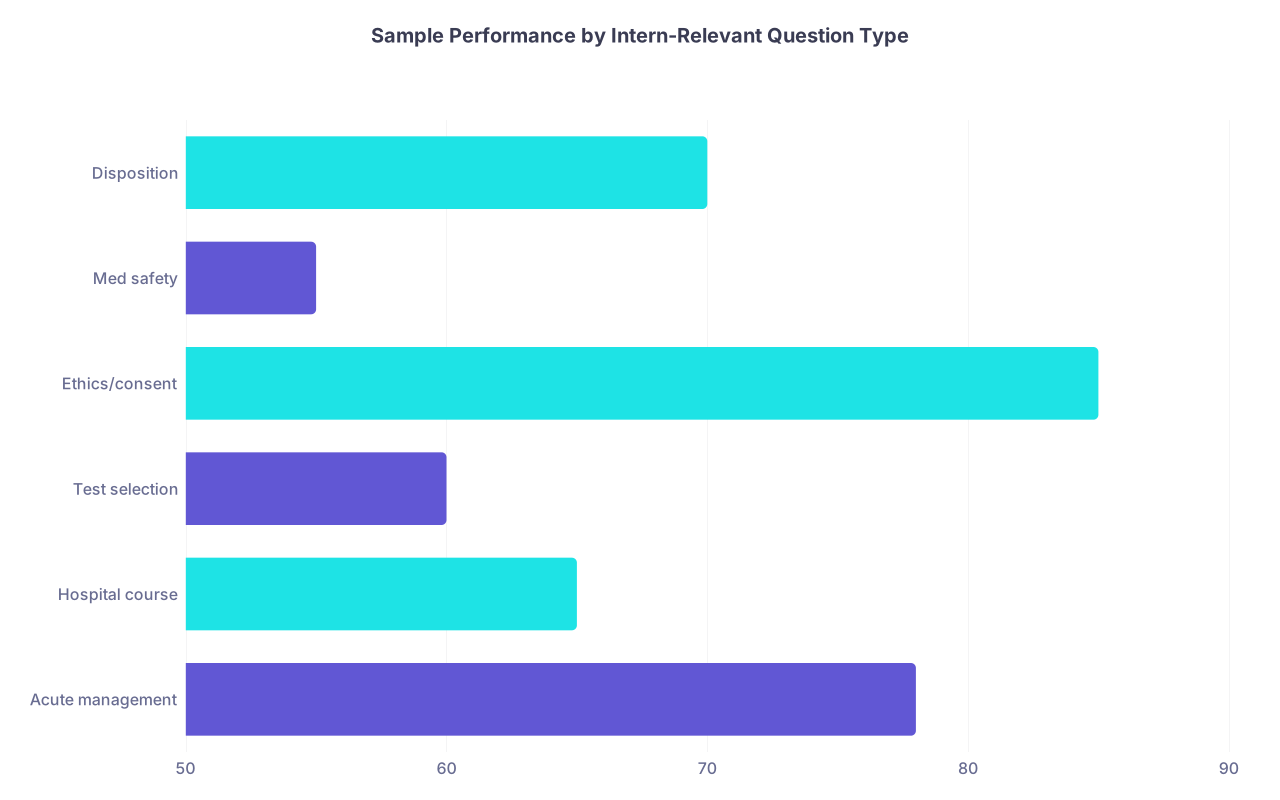
| Category | Value |
|---|---|
| Acute management | 78 |
| Hospital course | 65 |
| Test selection | 60 |
| Ethics/consent | 85 |
| Med safety | 55 |
| Disposition | 70 |
This kind of breakdown shows you where your “intern brain” is underdeveloped:
- 78% on acute management is solid.
- 55–60% on med safety and test selection is a liability, both on CK and in July.
Then you target:
- For acute management: watch review videos that explicitly walk “unstable vs stable” algorithms.
- For hospital course: review post‑op complications by post‑op day, nosocomial infections, and expected vs unexpected trends.
- For med safety: build a one‑page list of “never‑combine” meds and “always‑adjust” meds in CKD/elderly.
11. Why Residency Programs Care Specifically About Step 2 CK for This
Program directors are not stupid. Step 1 went pass/fail. They shifted their attention to Step 2 CK because it is the only standardized snapshot they have of your clinical reasoning under pressure.
And, critically, the question styles I have outlined line up with what they fear most:
- The intern who does not recognize a crashing patient.
- The intern who calls consults but does not stabilize first.
- The intern who orders unsafe meds or endless, pointless tests.
- The intern who creates ethical or consent disasters.
Step 2 CK, especially in the higher score ranges, signals not just knowledge but “pattern maturity” in exactly those domains.

| Step | Description |
|---|---|
| Step 1 | Step 2 CK Question Types |
| Step 2 | Acute management |
| Step 3 | Hospital course and complications |
| Step 4 | Diagnostics and test selection |
| Step 5 | Ethics and consent |
| Step 6 | Medication safety |
| Step 7 | Disposition decisions |
| Step 8 | Cross cover calls |
| Step 9 | Daily orders |
| Step 10 | Family meetings |
| Step 11 | Admissions and discharges |
When your CK prep has hardened you in these areas, you walk into interview season with something much more meaningful than a number. You carry an actual clinical thought style that residents and attendings recognize within minutes during case‑based questions.
12. How You Know You’re Genuinely “Intern‑Ready” From Your CK Prep
Strip away the score for a second. Ask yourself:
- Acute scenarios:
- When UWorld throws you a shock/sepsis/ACS/PE case, do you quickly know “what would I do in the first 5 minutes”? Or do you freeze and reread?
- Hospital narratives:
- Can you track the evolution of a case across days and anticipate the next complication?
- Orders and tests:
- When faced with multiple imaging and lab options, do you naturally gravitate to the least invasive, highest‑yield first step?
- Med safety:
- Do you routinely catch dangerous medication combinations in question stems before reading the answer choices?
- Ethics:
- Do the ethics questions feel like puzzles, or do they feel like applying a framework you already own?
If the majority of those feel intuitive, your CK prep has done more than prepare you for an exam. It has bootstrapped your intern brain. That is exactly what residency programs hope to infer from a strong CK.
Two or three key points to walk away with:
- The CK questions that matter most for residency are the ones that mimic cross‑cover pages, hospital course complications, and real‑world orders—treat those as your primary readiness markers.
- Use question archetypes, not just percentages, to audit yourself; fix weak patterns in acute management, test selection, med safety, and ethics now, before July exposes them on a real patient.