
The biggest mistake applicants make about Step 2 CK is thinking it is “just another exam score.” It is not. The clinical skills domains on Step 2 CK line up almost one‑to‑one with how program directors judge you as an intern.
Let me break this down specifically.
Step 1 going pass/fail shifted the center of gravity. Step 2 CK is now the de facto standardized measure of whether you can function as a junior resident. The exam’s content outline is essentially a blueprint of the ACGME core competencies and the milestones programs are required to evaluate. If you understand that mapping, you can study smarter, argue your case better on the interview trail, and avoid some wildly naive mistakes I see every cycle.
We will walk domain by domain, show you exactly which residency competencies they hit, and what that means for your application strategy.
The Two Translation Layers: USMLE → ACGME → Program Director
USMLE does not use “ACGME competencies” language in the exam blueprint, but the alignment is painfully obvious if you have ever sat through a Clinical Competency Committee meeting.
Think of it as three layers:
USMLE Step 2 CK clinical skills domains
Things like:
– History and physical examination
– Diagnostic reasoning
– Patient management
– Communication and ethics
– Systems‑based practice topics (quality, safety, high‑value care)ACGME Core Competencies and Milestones
The six core competencies:
– Patient Care (PC)
– Medical Knowledge (MK)
– Practice‑Based Learning and Improvement (PBLI)
– Interpersonal and Communication Skills (ICS)
– Professionalism (PROF)
– Systems‑Based Practice (SBP)How program directors actually think
“Can this person take call?”
“Will they drown on nights?”
“Can I trust them not to hurt patients?”
“Will they function on our multidisciplinary teams or create drama?”
Step 2 CK feeds directly into those questions.
To make the mapping concrete, here is the 30,000‑foot view:
| Step 2 CK Clinical Domain | Primary ACGME Competencies |
|---|---|
| History & Physical Exam | PC, MK, ICS |
| Diagnostic Reasoning | MK, PC, PBLI |
| Patient Management | PC, MK, SBP |
| Communication / Ethics / Law | ICS, PROF, SBP |
| Safety, Quality, High-Value | SBP, PBLI, PROF |
You will notice something: Step 2 CK is not “just medical knowledge.” The exam deliberately pushes into patient care, systems understanding, and professionalism territory. That is exactly where residency lives.
History and Physical Exam: The Foundation of Patient Care
If you ignore any domain on Step 2 CK, do not ignore this one. History and physical (H&P) skills are the backbone of Patient Care and Interpersonal and Communication Skills. Every specialty cares about this, just in different flavors.
What USMLE is testing
On Step 2 CK, H&P shows up in stems that implicitly ask:
- Did you ask the right questions?
- Did you pick up the right exam findings?
- Did you recognize what matters and what is noise?
You see it in questions where:
- The correct diagnosis hinges on one subtle history element (e.g., painless vs painful jaundice, acute vs chronic back pain, sexual history details in urethritis vs prostatitis).
- The physical exam clue is buried in the middle of a paragraph (e.g., decreased breath sounds and hyperresonance vs inspiratory crackles; reduced anal sphincter tone vs midline tenderness).
This is not trivia. This is how you actually avoid missing epidural abscess, cauda equina, or ruptured ectopic at 3 a.m.
Mapping to residency competencies
Patient Care (PC)
In milestones language, this is: “Gathers essential and accurate information,” “Performs accurate and appropriate physical examination.”
Translation: The intern who takes a scattered history and writes “neuro exam grossly intact” for everyone is dangerous. Step 2 CK items force you to be specific.Medical Knowledge (MK)
H&P questions are really “Do you understand how disease presents in the real world, not just in the board review book?” Recognizing atypical MI, subtle meningitis, early cord compression—this is MK applied.Interpersonal & Communication Skills (ICS)
Embedded communication challenges: sexual history, intimate partner violence, substance use, end‑of‑life discussions. If you consistently miss these on Step 2 CK, you will be the resident who never uncovers domestic violence or never clarifies code status.
Program directors care because H&P skills determine how much supervision you require. A good H&P means fewer near misses, fewer frantic pages to the attending, and fewer 5 a.m. “we admitted the wrong thing” conversations.
Diagnostic Reasoning: Medical Knowledge Plus Clinical Judgment
This is where Step 2 CK starts to separate memorization from actual clinical reasoning. Most applicants underestimate how tightly this domain maps to multiple competencies.
What USMLE is really probing
Diagnostic reasoning questions on Step 2 CK are not just “name that disease.” They test:
- Hypothesis generation and refinement
- Use of pretest probability and Bayesian thinking (even if you never use the word “Bayesian”)
- Avoiding cognitive errors—anchoring, premature closure, availability bias
Some archetypal questions:
- Choosing between “do nothing and observe,” “order more testing,” or “start treatment now” when each option seems superficially plausible.
- Distinguishing similar presentations:
– IBS vs celiac vs IBD vs lactose intolerance
– Bipolar vs borderline vs substance‑induced mood disorder
– Viral URI vs early pneumonia vs CHF exacerbation
There are also questions where the wrong answer is an overuse of imaging or labs that do not change management, hammering you on test stewardship.
How this maps to ACGME
Medical Knowledge (MK)
This is obvious. Step 2 CK is your main MK signal now that Step 1 is pass/fail. Programs in competitive fields (derm, ortho, ENT, rad onc) obsess over this.Patient Care (PC)
Reasoning is part of care. Correctly triaging chest pain, deciding when to LP, when to CT head before LP—this is direct patient safety.Practice‑Based Learning and Improvement (PBLI)
The exam quietly tests whether you think like someone who reads guidelines and adjusts practice. Questions on D‑dimer, Wells scores, Ottawa ankle rules, HEART scores—that is PBLI philosophy baked into MCQs.
I have heard program directors say in rank meetings: “Their Step 2 CK is 220 but they did well on rotations—are they a weak test taker or is their reasoning shaky?” The score forces that discussion. If your reasoning domain is soft, people assume you will struggle with ICU and ED rotations, where decisions are fast and incomplete.
Patient Management: Where Residency Lives
This domain might as well be titled “Can this person function as an intern without blowing up the service?” It is the most directly residency‑relevant slice of the exam.
What patient management questions look like
You know these by feel:
- “What is the next best step?”
- “Most appropriate initial management?”
- “Best long‑term management?”
- “Most appropriate step to prevent complication X?”
They test:
- Acute stabilization (airway, breathing, circulation)
- Sequencing of interventions (give thiamine before glucose, bronchodilator before steroids, fluids before vasopressors)
- Level of care (ICU vs ward vs outpatient)
- Time‑sensitive decisions (tPA windows, PCI, antibiotics before CT in suspected meningitis)
- Chronic disease titration (DM, HTN, CHF, anticoagulation)
USMLE is essentially simulating the pager: “Patient with X, vitals Y. What do you do now?”
ACGME mapping here is brutally direct
Patient Care (PC)
This is the core of PC: make the right call, at the right time, with the right intensity. Milestones literally have “Manages patients with common clinical conditions with assistance” → “independently.”Medical Knowledge (MK)
It is MK applied, but program directors interpret strong management performance as “this person will not freeze or panic on nights.”Systems‑Based Practice (SBP)
Some management questions test whether you use the system correctly:
– When to involve consultants
– When to use outpatient vs inpatient resources
– Appropriate discharge planning management (home health, SNF, follow‑up timing)
This is also where specialty differences in expectations show up. A 260 in someone going into neurosurgery is interpreted differently than the same score in a peds applicant—not because the questions change, but because the expected baseline management sophistication in that field is different.
Communication, Ethics, and Professionalism: The Hidden Score Signal
Here is where many applicants are blind: they think Step 2 CK is “all path and pharm.” They do not appreciate how many questions are quietly testing Interpersonal Skills, Professionalism, and Systems‑Based Practice.
What these questions actually test
These are the items that feel like ethics OSCEs converted to multiple choice:
- Breaking bad news
- Handling requests for unnecessary opioids, antibiotics, or imaging
- Dealing with non‑adherence
- Informed consent and capacity
- Confidentiality issues (adolescents, HIV status, reproductive decisions)
- Reporting obligations (child abuse, STIs, threats to others)
- Boundary issues, conflicts of interest, gifts, industry relationships
- Team communication failures, handoff problems
They also probe cultural humility and bias awareness implicitly: how you respond to a patient from a different background refusing care, or a family insisting on non‑beneficial treatment.
Competencies in play
Interpersonal and Communication Skills (ICS)
How you talk to patients, families, and other professionals. This shows up in scenarios: do you confront, accommodate, avoid, or educate? The wrong tone (paternalistic, dismissive, overly legalistic) is often a distractor.Professionalism (PROF)
Respect for autonomy, honesty, boundaries, appropriate advocacy. Questions about altering the record, hiding errors, lying to insurance—these directly test your professionalism.Systems‑Based Practice (SBP)
Knowing reporting laws, how to escalate safety issues, how to use ethics consults or case management—that is SBP, not trivia.
On paper, no one says “We use Step 2 CK to measure professionalism.” In real life, if your score is strong, programs are comfortable that at least you are not completely tone‑deaf in these domains. They still rely heavily on narratives (deans’ letters, LORs) for ICS/PROF, but the exam is a baseline filter.
Safety, Quality, and High‑Value Care: Systems‑Based Practice in Multiple Choice
The newer Step 2 CK content pushes hard into what attendings complain interns are terrible at: understanding systems, safety, and value.
You see this in:
- Adverse event and error questions
- Root cause analysis setups (“several patients received wrong medication… what is the best next step?”)
- Questions on hand hygiene, central line bundles, VTE prophylaxis
- Avoiding unnecessary repeat labs, imaging, and over‑treatment
- Cost‑conscious care (generic vs brand, do not order daily CTs “just to check”)
This is where USMLE is forcing you to think like someone in M&M conference, not just someone flipping through a pharm flashcard deck.
Competency mapping
Systems‑Based Practice (SBP)
This is almost pure SBP: use of resources, coordination of care, integration with safety systems, understanding how errors happen in real hospitals.Practice‑Based Learning and Improvement (PBLI)
Recognizing errors, reflecting, implementing process changes, quality improvement thinking. Many items are basically mini‑QI scenarios.Professionalism (PROF)
Owning errors, disclosing them properly, prioritizing safety over self‑protection.
Residents are evaluated on these constantly now because ACGME and hospitals care about readmissions, CLABSIs, CAUTIs, and malpractice risk. Step 2 CK is simply aligning the test with what the system is screaming for: interns who understand that “just order everything” is not safe or sustainable.
How Programs Actually Use Step 2 CK in the Match Era
You care about mapping because you are not doing theory. You are trying to get a job.
Here is how Step 2 CK feeds into residency decisions right now:
1. As the primary standardized academic metric
With Step 1 pass/fail:
- Step 2 CK often becomes the only hard, comparable number across schools.
- Many competitive programs now have quiet cutoffs (often 240–250 range for high‑end specialties, lower but still real for others).
- A weak Step 2 CK with a pass Step 1 is much harder to “explain away” than the reverse.
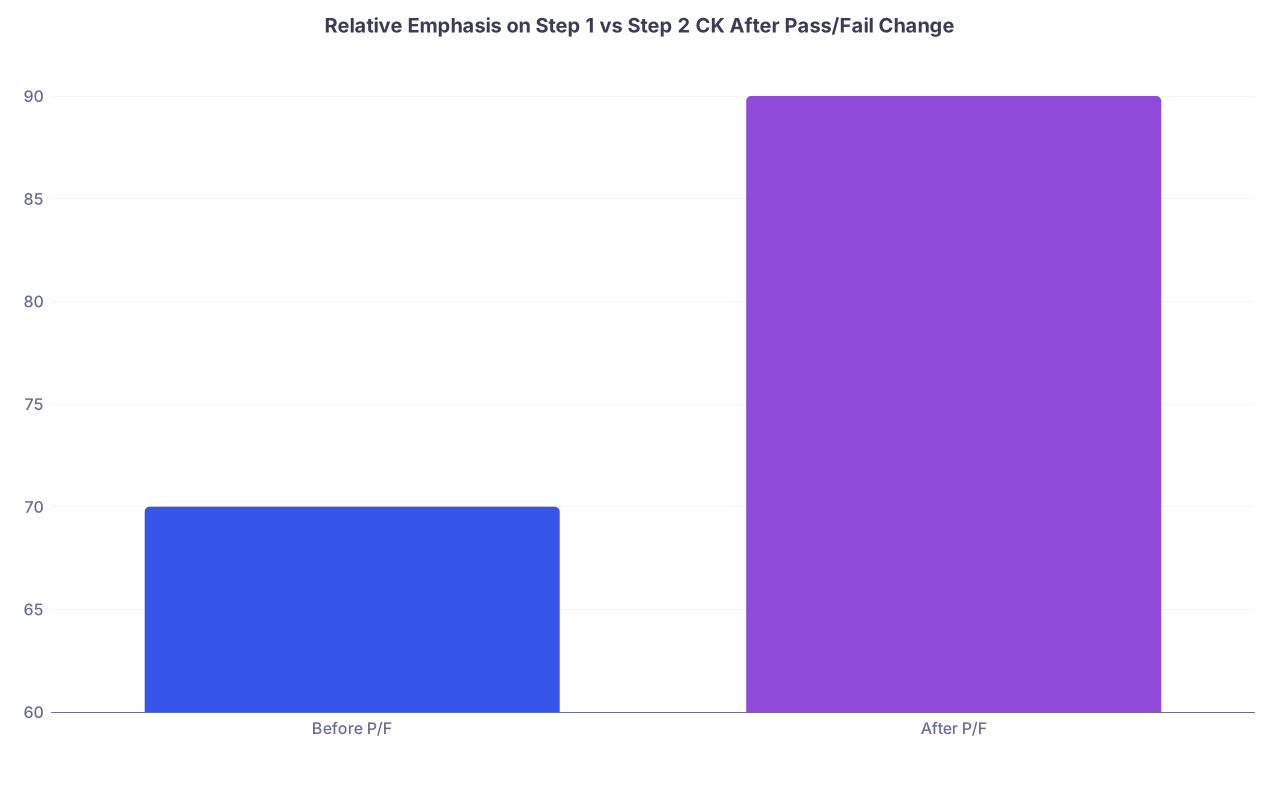
| Category | Value |
|---|---|
| Before P/F | 70 |
| After P/F | 90 |
Interpretation: not exact percentages, but the direction is real. Program directors have openly said in NRMP and specialty surveys that Step 2 CK importance has increased.
2. As a proxy for “day 1 intern readiness”
Programs are required to attest that their incoming interns can:
- Gather accurate histories and exams
- Synthesize problems
- Form reasonable initial plans
- Communicate and behave professionally
- Work in hospital systems without constant rescue
You know what that sounds like? The Step 2 CK blueprint.
A high score gives programs confidence: “We can put this person on nights by September and they probably will not implode.”
3. As a tie‑breaker and risk filter
When two applicants look similar in:
- School tier
- Letters
- Research
- Clerkship grades
Step 2 CK often breaks the tie. High score → less perceived risk. Low or late score → more scrutiny.
Programs also use it to:
- Decide who to invite when applications are overwhelming
- Flag potential remediation needs early (“We need to watch this person closely on ICU”)
- Justify rank decisions in committees when contested (“Yes, but look at their Step 2 CK…”)
Concrete Examples: Domain → Competency → Resident Behavior
Let’s make this more real. I will give you specific question archetypes and show how they translate to residency‑level evaluation.
Example 1: Acute shortness of breath in the ED
Step 2 CK stem:
- 68‑year‑old with COPD, worsening dyspnea, wheezing, mild fever. ABG shows CO2 retention. Options: IV steroids, antibiotics, intubation, noninvasive ventilation, CT‑PA, etc.
- Ask: “Next best step in management.”
What you are being tested on:
- Recognize acute COPD exacerbation, not PE or pneumonia alone.
- Decide to use noninvasive ventilation first, not intubate immediately, not rush to CT.
- Always address oxygenation and ventilation before imaging.
Residency mapping:
- Patient Care: Stabilizes ABCs appropriately.
- Medical Knowledge: Understands pathophysiology and guideline‑driven management.
- Systems‑Based Practice: Uses ICU vs step‑down beds correctly, avoids unnecessary CTs.
How this shows up in milestones wording: “Recognizes and manages emergent and urgent conditions in adult patients.”
Example 2: Adolescent contraception and confidentiality
Step 2 CK stem:
- 16‑year‑old girl asks for birth control, does not want parents told. Parents later call asking about her visit.
- Ask: “Most appropriate response.”
What you are being tested on:
- Understanding minor consent laws and confidentiality around reproductive health.
- Balancing parent involvement with adolescent autonomy.
- Communicating without being evasive or betraying trust.
Residency mapping:
- Professionalism: Maintains patient confidentiality appropriately.
- ICS: Communicates clearly, sets boundaries respectfully.
- SBP: Understands legal and institutional frameworks for adolescent care.
On rotations, this is the med student who does not promise impossible secrecy, does not blurt out details to parents in the hallway, and knows when to bring in social work.
Example 3: Post‑operative fever on POD#3
Step 2 CK stem:
- 54‑year‑old POD#3 from colectomy, fever 38.9°C, mild tachycardia, abdomen tender. WBC elevated. Options: broad‑spectrum antibiotics immediately, CT abdomen with contrast, remove Foley, incentive spirometry only, blood cultures and observe, etc.
- Ask: “Next best step.”
What you are being tested on:
- Classic 5 Ws (wind, water, wound, walking, wonder drugs) is the memory hook, but real test is: is this surgical site infection, anastomotic leak, atelectasis, UTI, etc.?
- Recognize timing and severity that push you toward CT abdomen and possible re‑operation vs “just walk and IS.”
Residency mapping:
- PC/MK: Differentiates benign from dangerous post‑op fever.
- SBP: Knows when to urgently involve surgery vs manage conservatively.
This is exactly the conversation an intern has at 2 a.m. with their senior: “Hey, this is what I am seeing, this is what I am worried about, here is what I think we should do.” Step 2 CK is the paper version of that.
Specialty‑Specific Nuances in How Step 2 CK Domains Matter
Not every specialty weights every domain equally in practice, though all are formally important.
Internal Medicine, EM, and Critical Care Bound Specialties
- Obsess over diagnostic reasoning and management.
- Higher thresholds for “acceptable” Step 2 CK scores.
- Systems and safety questions (sepsis bundles, VTE prophylaxis, antibiotic stewardship) map directly to their daily practice.
Surgery and Surgical Subspecialties
- Care a lot about acute management, perioperative care, and systems (OR scheduling, post‑op complications, pre‑op risk).
- Communication and professionalism domains are critical—you will be on teams with strong hierarchies and high‑stress interactions.
Pediatrics, Family Medicine, Psychiatry
- Place extra emphasis on communication/ethics and longitudinal management.
- Adherence, family dynamics, developmental considerations—these all live in Step 2 CK stems.
Radiology, Pathology, Anesthesiology
- Still care about Step 2 CK score as a proof of strong MK and reasoning.
- They know you will not be on the front line of adolescent contraception counseling, but they do expect solid acute management understanding (for anesthesia) and systems/safety awareness across the board.
Using This Mapping to Study Smarter and Sell Yourself Better
Knowing how domains map to competencies changes how you approach both prep and your application narrative.
Studying with competencies in mind
Do not just “do questions.” Ask yourself after each block:
- Which competency did this question really test?
– Was it pure MK (e.g., enzyme deficiency) or PC (next step in sepsis)?
– Was this ICS/PROF (handling a racist patient, dealing with error disclosure)?
– Was this SBP/PBLI (QI scenario, cost‑effective test choice)?
Patterns:
- If you are missing a lot of management questions → your PC and applied MK are soft. That is what terrifies program directors.
- If you are missing ethics/professionalism items → you are sending a subtle “I do not get medicine as a trust profession” signal. Fix it.
- If you are missing systems/safety questions → you will be a pain for your quality office and M&M conferences.
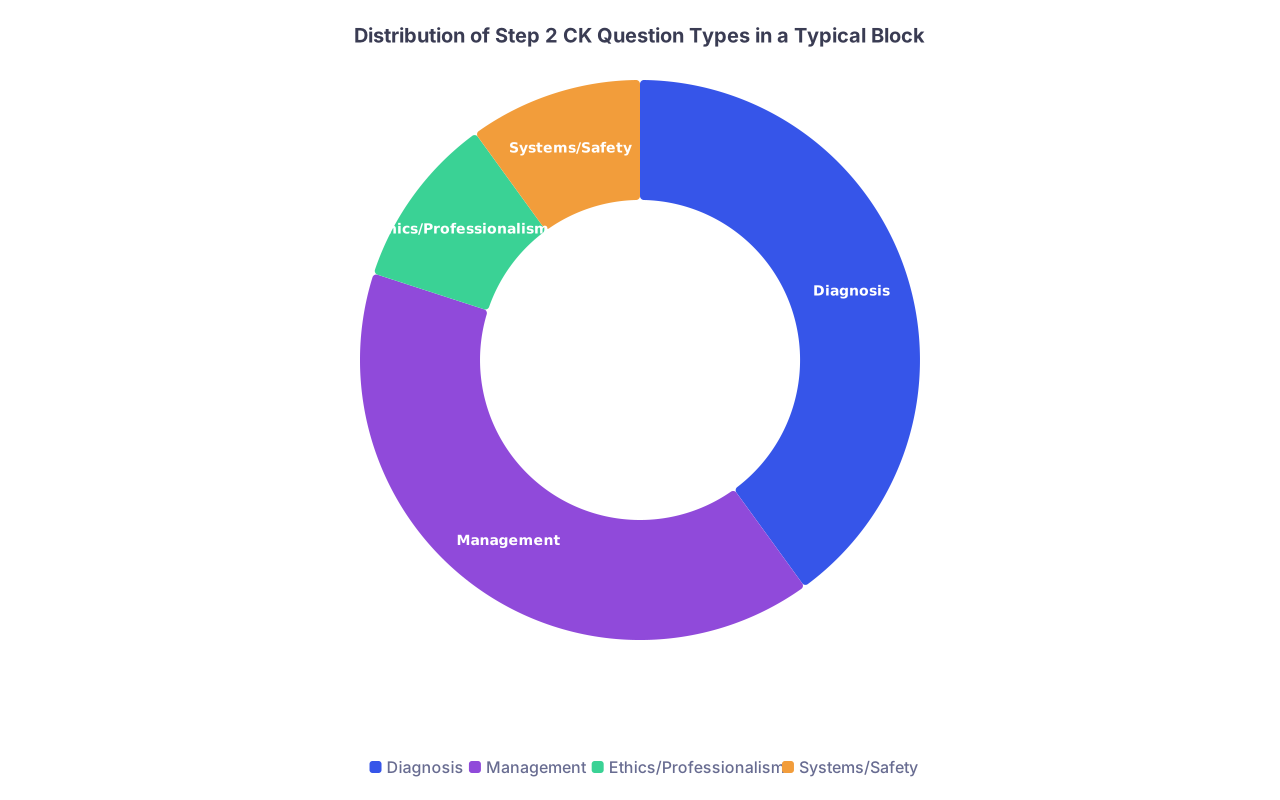
| Category | Value |
|---|---|
| Diagnosis | 40 |
| Management | 40 |
| Ethics/Professionalism | 10 |
| Systems/Safety | 10 |
Again, not exact values, but the proportions are roughly right: diagnosis and management dominate, but the others are large enough to move your score.
Talking about Step 2 CK on your application and interviews
You will not say, “My Step 2 CK demonstrates my ICS competency,” obviously. But you can connect dots intelligently.
Examples:
If you scored high and are going into a cognitive specialty:
“My Step 2 CK score reflects the same thing I enjoy on the wards—pulling subtle history and exam details together quickly and forming an actionable plan.”If you made a meaningful jump from Step 1 to Step 2 CK:
“Once I got into clinical rotations, my performance improved significantly. Step 2 CK captures that better than Step 1 did. I am much stronger in applied reasoning and management than in pure basic science recall.”If you were weaker in pre‑clinical but strong clinically:
“My clerkship evaluations and Step 2 CK both show that I think well in real patient scenarios, especially in acute management and team‑based care.”
You are framing Step 2 CK as a competency‑aligned data point, not just a number.
A Simple Visual: From Question Types to Competencies
To tie it together, here is a simplified mapping from common Step 2 CK question “feel” to residency competencies.
| Question Archetype | Dominant Competencies |
|---|---|
| Identify diagnosis from H&P | MK, PC |
| Choose next diagnostic test | MK, PC, SBP |
| Choose next management step | PC, MK |
| Handle conflict/communication issue | ICS, PROF |
| Reportable disease / legal duty | SBP, PROF |
| Safety / quality improvement case | SBP, PBLI, PROF |
And the reality on the ground: your intern year is these same archetypes, just with real people and a pager.
What This Means For You, Practically
Let’s boil this down without fluff.

| Step | Description |
|---|---|
| Step 1 | Step 2 CK Domains |
| Step 2 | ACGME Competencies |
| Step 3 | Program Director Risk Assessment |
| Step 4 | Interview Invitations |
| Step 5 | Rank List Position |
| Step 6 | Residency Performance |
You are not just passing an exam. You are giving programs their first standardized look at your day‑1 resident profile.

Common Misinterpretations You Should Ignore
A few recurring myths I hear from students that do not survive contact with actual program leadership.
“Step 2 CK just measures test‑taking, not clinical ability.”
Wrong. Of course it is a written test with all the limitations that implies, but the cases and decisions are exactly what interns handle. It is not perfect, but it is not divorced from reality.“Ethics and communication questions do not really matter for my score.”
Also wrong. Miss enough of those 10–15% and your scaled score suffers. And those domains map to professionalism concerns, which programs care about even more than raw knowledge.“Once I hit a certain number, programs stop caring about the details.”
They may not parse subscores (you do not even get them), but they absolutely look at context: Step 1 vs Step 2 trajectory, timing of score release, how your performance lines up with clerkship comments.

Final Takeaways
Three points, and then you can get back to UWorld.
Step 2 CK is a competency exam in disguise. Its clinical skills domains map directly onto ACGME core competencies—Patient Care, Medical Knowledge, ICS, Professionalism, SBP, PBLI. Programs use your score as a proxy for “intern ready or not.”
Management, reasoning, and systems questions are not side dishes. They are the main course. How you handle “next best step,” safety, ethics, and resource use items tells programs exactly how much supervision you will need and how safely you operate in a real hospital.
Use the mapping strategically. Study with competencies in mind, interpret your score as part of your clinical identity, and—if you are smart—frame your performance on Step 2 CK as evidence that your strengths align with how residency actually evaluates you.