
Most applicants are looking at Step 2 CK scores the wrong way.
They obsess over a three‑digit number and ignore the one metric that programs actually use to mentally “bucket” them: percentiles. If you are talking about Step 2 CK for residency without talking about percentiles and performance profiles, you are missing half the conversation.
Let me break this down precisely, the way PDs, selection committees, and data‑literate advisors actually think about Step 2 CK.
Why Percentiles Beat Raw Scores For Residency Decisions
A Step 2 CK score without context is just a number. A percentile tells you position and risk.
USMLE publishes national data by score, mean, SD, and percentile ranks. Programs use that data (explicitly or implicitly) to answer three questions:
- How does this applicant compare to the national pool?
- How consistent is this with their prior performance (Step 1, grades, etc.)?
- How likely is this person to succeed in our program and pass boards?
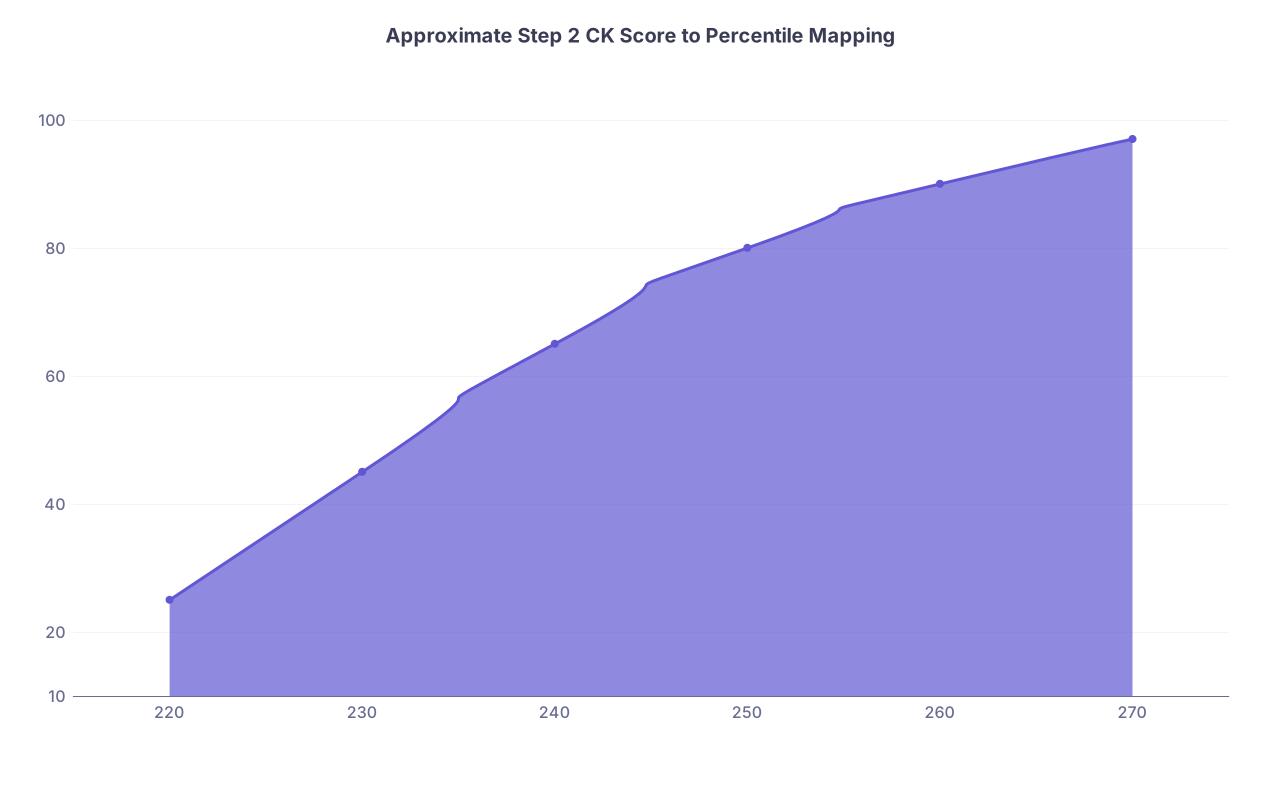
Here is how the math roughly shakes out in recent cohorts (these are ballpark, not exact; actual distributions shift slightly every year):
| Category | Value |
|---|---|
| 220 | 25 |
| 230 | 45 |
| 240 | 65 |
| 250 | 80 |
| 260 | 90 |
| 270 | 97 |
So:
- 220 is roughly 25th percentile
- 230 around mid‑40s
- 240 mid‑60s
- 250 around 80th
- 260 around 90th
- 270 high‑90s
Now, consider two applicants:
- Applicant A: 250 from a school with average board performance
- Applicant B: 245 from a school whose mean Step 2 CK is 235
Raw scores: 250 vs 245. You might think A “wins.”
Percentiles tell a different story. If Applicant A is ~80th percentile and Applicant B—relative to their school, plus a modest Step 1—is substantially outperforming expectations, B may actually be the more “impressive” candidate in context. Several PDs I know in IM and EM literally say in committee, “This is a high‑percentile score for their background; they clearly punched above their weight.”
Percentiles add three layers you do not get from just the three-digit score:
- National context – Where you sit in the distribution.
- Risk prediction – Lower percentiles correlate with higher board failure risk.
- Comparative strength – How exceptional you are in a crowded field.
Programs do not admit “scores.” They admit relative strengths within their target band.
Reading The Step 2 CK Performance Profile Like A Program Director
Too many students glance at the performance profile once, see some bars, and move on. That is a mistake.
Your resident application is quietly shaped by the details in that PDF.
The Anatomy Of The Performance Profile
The current Step 2 CK performance profile typically includes:
- Total score and pass/fail status
- A vertical bar showing your performance vs national mean ± SD
- Content area performance bars (foundations, systems, physician tasks)
- Often shaded bands representing the national average performance band
Each of those bars can be mentally translated into an approximate percentile. A PD does that in about three seconds.
Here is how:
Total score bar
The line shows your score position against the national mean and 1 SD bands. If you are >1 SD above the mean, you are likely >84th percentile. ~2 SD? You are in rare air.Content area bars
Each major domain (e.g., Internal Medicine, Surgery, Pediatrics, etc.) has a bar. The midpoint of the bar approximates your performance. Where it sits relative to the shaded “average” band tells people whether you are high, average, or low in that domain.Consistency across domains
Big swings—very high in some, very low in others—trigger questions: knowledge gaps? bad test day? mismatched interests? Very flat, high bars suggest broad, reliable knowledge.
I have sat in meetings where someone literally says:
“He is solidly above average overall, but his OB/GYN and Surgery bars are well below the mean; not ideal for a field heavy on acute care.”
You need to be reading your profile with that same eye.
Translating Your Score To Percentiles (And Using It Properly)
You do not need a perfect conversion table to get most of the value. You just need to be able to honestly say: I am roughly at X percentile nationally and understand how that lands in different specialties.
A rough mental map (recent era):
| Score Range | Approx Percentile | Interpretation |
|---|---|---|
| 215–224 | 15–30th | Below average / lower band |
| 225–234 | 30–50th | Around average |
| 235–244 | 50–70th | Solidly above average |
| 245–254 | 70–85th | Strong |
| 255–264 | 85–93rd | Very strong |
| ≥265 | 93rd+ | Exceptional |
For your purposes, this is how you should think and talk in applications and advising meetings:
- 30–50th percentile: “My performance is around national average.”
- 50–70th: “I scored above the national mean; I am in the top half/third of test takers.”
- 70–85th: “My score is in the top quartile.”
- 85–93rd: “Top decile or close.”
- 93rd+: “Top few percent nationally.”
You will not write “85th percentile” on ERAS. But you will decide your target programs, backup range, and signal strategy based on where you actually stand, not the fantasy that “245 is amazing everywhere.”
Because it isn’t. Not for derm or plastics at the most competitive places. It is very good. Not elite.
Percentiles By Specialty: Where Your Score Actually Sits
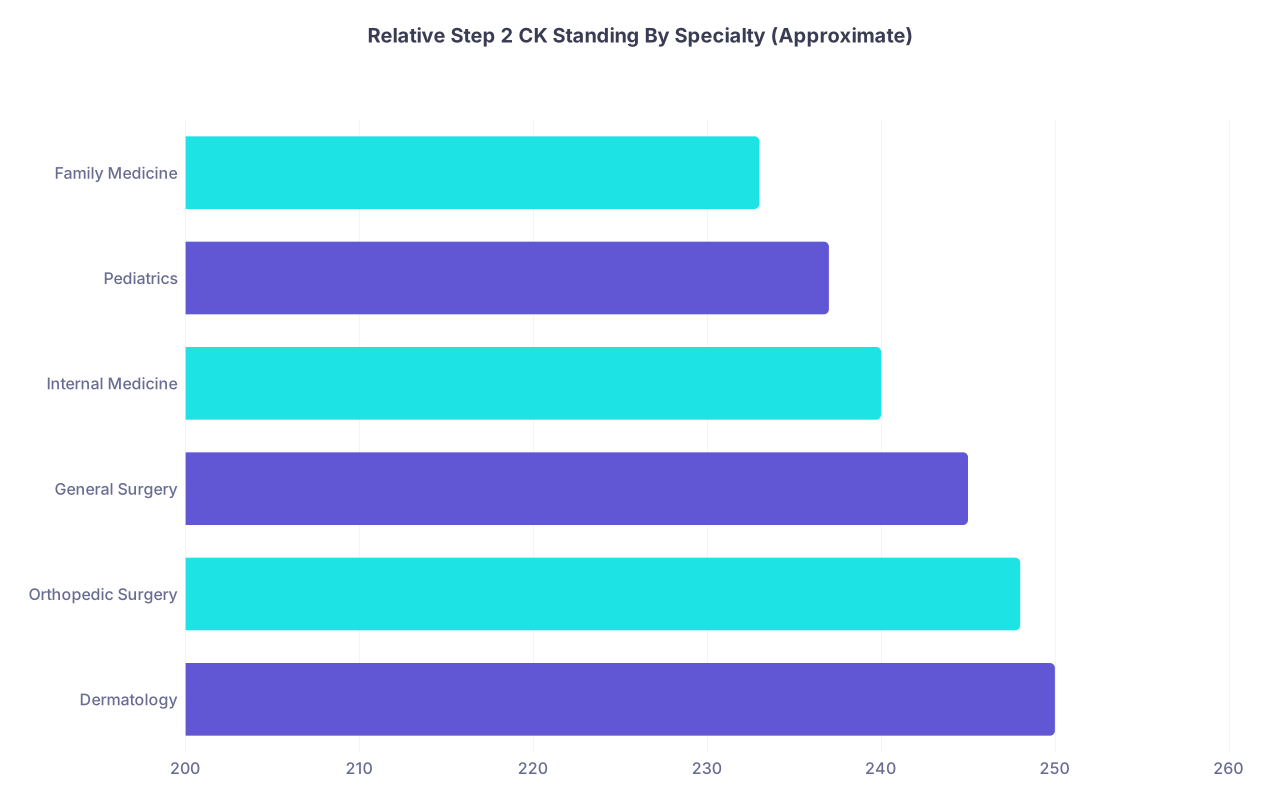
Step 2 CK percentiles are not read in a vacuum. They are read relative to what is typical for that specialty.
Let me show you why obsessing about an absolute score is misleading.
| Category | Value |
|---|---|
| Dermatology | 250 |
| Orthopedic Surgery | 248 |
| General Surgery | 245 |
| Internal Medicine | 240 |
| Pediatrics | 237 |
| Family Medicine | 233 |
Interpretation (approximate averages of matched applicants):
- Dermatology: Mean Step 2 CK around 250
- Ortho: Upper 240s
- General Surgery: Mid‑240s
- Internal Medicine: ~240 (higher at top academic places)
- Pediatrics: mid‑230s
- Family Medicine: low‑ to mid‑230s
So:
- A 245 (roughly 80th percentile) is “good” for IM, very strong for FM, average to slightly above for derm.
- A 230 (~40–50th percentile) is fine for FM, borderline for mid‑tier IM, weak for competitive surgery fields.
This is why percentiles must be interpreted specialty‑specifically. An 80th percentile score positions you differently in FM vs ENT.
If you want to be realistic and smart:
- Find your approximate percentile from your score.
- Look up recent NRMP Charting Outcomes means for Step 2 CK in your specialty.
- Ask: am I below, at, or above the mean of matched applicants?
That is a far better decision tool than arguing whether 242 “counts as strong.”
The Performance Profile And Risk: What PDs Worry About
Program directors are not just looking for stars. They are trying to avoid problems.
Boards failures. Struggling residents. Probation. A surprisingly large chunk of selection behavior is risk‑aversion, not star‑chasing.
Percentiles and subscore patterns help them estimate:
- Probability of passing the relevant specialty board on first attempt
- How much teaching bandwidth you will consume
- How comfortable they will feel putting you on busy services early
A few patterns that raise eyebrows:
Global low percentile (≤25th)
Even with a pass, a 210–220 range score in a moderately competitive field will push your application into “risk” territory unless offset by exceptional other strengths (home med school, known quantity, research giant, etc.).Very low percentiles in key content areas
Example: Step 2 CK 238 (fine), but performance profile shows clearly below average in Medicine and Clinical Reasoning. That is a red flag for IM, EM, and any cognitively heavy field.Big score drop vs Step 1 percentile
If you were ~80th percentile on Step 1 and drop to ~30th on Step 2 CK, committees will talk about it. They will ask why. They may consider it a warning sign for clinical performance or burnout.
How To Use Percentiles To Shape Your Application Strategy
Enough theory. Here is how you actually use Step 2 CK percentiles to make decisions.
1. Setting Target Tiers For Programs
You should be building a tiered list:
- “Reach” programs
- “Realistic” programs
- “Safety” programs
Percentiles let you define those tiers with some precision.
As a rough logic:
- If your Step 2 CK percentile is ≥80th for your specialty’s typical matched cohort, then:
- You are academically comfortable applying to most programs, including top‑tier, with enough other strengths.
- If you are 50–80th percentile:
- You are at or slightly above the mean for many core specialties; aim for a balanced mix of mid‑tier, your home region, plus a handful of aspirational programs.
- If you are <50th percentile:
- You must be more strategic. Heavy reliance on:
- Home program
- Away rotations where you performed strongly
- Programs historically friendly to your school
- Geographic ties
- You must be more strategic. Heavy reliance on:
Do not base this just on your personal sense that “I’m a good clinician.” Committees are not in your head. They see the percentile.
2. Deciding Whether To Take Step 2 CK Early For Competitive Fields
For competitive specialties (derm, ortho, plastics, neurosurgery, ENT, urology, some EM and anesthesia programs post‑Step 1 pass‑fail), there is a real question:
Do you take Step 2 CK early to have the score before applying, or risk a late score?
If your practice exams suggest a percentile range that would be clearly supportive (say, ≥75–80th percentile nationally), having that score early is usually a win. It gives PDs data when Step 1 is now uselessly pass/fail.
On the other hand, if practice NBMEs put you around 30–40th percentile, racing to get a mediocre score in before ERAS opens is not a good trade. Delaying slightly, studying more intensely, and submitting a later but stronger percentile can change your entire application tier.
This is why talking in “score goals” alone is simplistic. You want to know:
“What percentile will this likely place me into at test time?”
Using Subscore Percentiles To Back Up Your Specialty Interest
One underused move: using your performance profile to subtly support your story.
Say you are applying to pediatrics. On your Step 2 CK performance profile:
- Total score: 240 (roughly 65th percentile)
- Pediatrics content domain: above the national average, close to top band
- Chronic illness management / preventive care tasks: above average
Is that going to single‑handedly get you in? No. But when a PD sees your narrative about loving longitudinal care and your subscore bars actually show strengths in pediatrics and preventive care, it adds coherence.
Flip side: claiming you are “destined for OB/GYN” with a performance profile that shows you tanked OB/GYN content compared to everything else. People notice that mismatch, even if they do not say it out loud.
Some committees literally pull up the performance profile during rank meetings and say,
“Her OB/GYN bar is solidly above average, and her Surgery and acute care bars look fine; that fits with what faculty wrote.”
You cannot rewrite the profile, but you can:
- Be aware of how it looks to outsiders.
- Emphasize the pieces that align with your story.
- Minimize overclaiming in areas where your profile is clearly weaker.
Step 2 CK Percentiles: How To Talk About “Underperformance” Without Making It Worse
You will occasionally need to address a weaker Step 2 CK performance.
Notice I said weaker performance, not “low score.” We are talking percentiles and trends, not just numbers.
Scenario: You were ~70th percentile on Step 1 (passed, high) but dropped to ~35th percentile on Step 2 CK.
How do you play this?
Be honest with yourself first
Was it:- Timing (took the exam during an exhausting rotation)?
- Burnout?
- Poor prep strategy (never did full‑lengths)?
- Life events (illness, family crisis)?
Decide whether to address it proactively
If:- It is clearly inconsistent with the rest of your record, and
- You have a specific, plausible explanation that is not just “I choked”
then a brief program‑specific communication or personal statement sentence may help.
Example:
“My Step 2 CK score does not reflect my usual performance; I sat for the exam while undergoing treatment for X, which has since resolved. My clinical evaluations and shelf performance before and after that period have been consistent with my typical work.”Back it up with other evidence
If your Step 2 percentile is weaker, you cannot leave everything else average. You need:- Strong clinical evals
- Honors in key rotations
- SLOEs or letters that explicitly vouch for your clinical judgment and reliability
Do not write long apologetic paragraphs. Committees have limited patience. One to two clean sentences in the right place, then let your stronger parts speak.
Using Practice Percentiles To Time Your Exam (And Protect Your Application)
This is the move most students ignore. They look at NBME percentages or raw scores and guess. PDs do not care about your NBME raw. They care where your final product lands in the Step 2 percentile distribution.
Better approach:
- Use NBMEs and UWSAs that provide a predicted Step 2 CK score.
- Map that predicted score to an approximate percentile.
- Decide “go” vs “delay” based on that percentile, not your emotional reaction to the number.
Example:
- Two weeks before planned test date you score:
- NBME: 235 predicted Step 2 → roughly 55–60th percentile.
- Your target specialty: IM, with matched applicant mean around 240.
Reality: That predicted score puts you slightly below, but near, the mean of matched IM applicants. If:
- Your application is otherwise strong, and
- You are okay with a broad list of programs including community and mid‑tier academics,
then going ahead is reasonable.
If you are dead‑set on the MGH/Johns Hopkins tier and you have bandwidth to delay 4–6 weeks, aggressively study, and push that predicted score into the 245–250 range (~70–80th percentile), delaying may be the better institutional choice.
Again, not because 235 is “bad,” but because your percentile in the target cohort is merely average, and you are aiming for a non‑average outcome.
How Percentiles Interact With The Rest Of Your Application
Step 2 CK percentiles are not destiny. But they absolutely shift how committees interpret the rest of your file.
Think about three applicants to a mid‑tier IM program:
- Applicant 1
- Step 2 CK: 260 (~90th percentile)
- Mediocre third‑year comments, few honors, thin research
- Applicant 2
- Step 2 CK: 245 (~80th percentile)
- Strong evals, several honors, solid research, strong letters
- Applicant 3
- Step 2 CK: 230 (~45th percentile)
- Excellent clerkship performance, outstanding letters, clear commitment to IM
What happens?
- Applicant 1: High percentile buys attention, but mediocre clinical record creates real hesitation. Many PDs are tired of “gunner test takers who underperform on the wards.”
- Applicant 2: High percentile plus strong clinical data. This is the safest and most attractive package.
- Applicant 3: Lower percentile, but if the letters and clinical performance are exceptional and there are credible reasons for test performance, many programs will rank them over Applicant 1.
In other words, percentiles help:
- Lift strong overall applications into higher tiers.
- Rescue borderline applications if other components are outstanding.
- Sink otherwise unremarkable applications when there is no compensatory strength.
Visualizing Your Step 2 CK As Part Of Your Overall Profile
If I were building a mental diagram for an applicant assessing their readiness for a competitive specialty, it would look something like this:

| Step | Description |
|---|---|
| Step 1 | Step 2 CK Score |
| Step 2 | Estimate Percentile |
| Step 3 | Compare to matched mean |
| Step 4 | Compare to program range |
| Step 5 | Apply broadly including top tier |
| Step 6 | Strengthen other domains |
| Step 7 | Proceed with planned list |
| Step 8 | Increase number of programs |
| Step 9 | Specialty competitiveness |
| Step 10 | Percentile vs mean |
| Step 11 | Percentile |
This is how you should be thinking: percentiles feed into specialty context, which feeds into list construction and what else you need to overperform on.
FAQs
1. How do I find my exact Step 2 CK percentile?
USMLE does not print the exact percentile on your score report. You estimate it by using:
- The reported national mean and standard deviation for your test period
- Recent score‑to‑percentile charts (NBME sometimes publishes these; many advising offices maintain internal tables)
- Approximate mappings like the ones earlier
You do not need exact decimal points. Knowing that you are approximately 60th vs 85th percentile is enough to make sane decisions.
2. My Step 2 CK score is lower than my Step 1 percentile. How bad is that?
It depends on the magnitude and direction:
- Small drop (e.g., 75th → 60th percentile) is common and usually irrelevant.
- Large drop (e.g., 80th → 30th) gets noticed, especially in competitive specialties.
If the rest of your file is strong and you have a concrete explanation, it is manageable. If the rest of your file is also average, then the trend reinforces a “borderline” impression.
3. Does a very high Step 2 CK percentile compensate for a mediocre Step 1 pass?
Often yes, especially now that Step 1 is pass/fail. A high Step 2 CK percentile (80th+) tells PDs you have the clinical knowledge and test‑taking ability to pass boards, which is what they care about. I have seen applicants with weak Step 1 passes essentially “rebrand” themselves with a strong Step 2 CK result and a solid clinical record.
4. Do programs actually look at the content area bars on the performance profile?
Many do, especially in more academic programs and for borderline decisions. In rank meetings, I have seen faculty point to the bars for Medicine, Clinical Reasoning, and Systems topics when judging how “safe” an applicant is. It is not the first thing they look at, but it is there, and it is used to confirm or question impressions from the rest of the file.
5. Should I mention my Step 2 CK percentile explicitly in my personal statement?
No. There is no need to write “I scored at the 85th percentile nationally.” Programs can infer that from your score and internal tables. What you might mention, very briefly, is a relative improvement (e.g., “I improved my performance significantly between Step 1 and Step 2 CK, reflecting my growth in clinical reasoning”), if that narrative aligns with the rest of your record.
6. How much does Step 2 CK percentile matter for less competitive specialties like Family Medicine?
It still matters, but less as a differentiator and more as a safety check. Programs want reassurance that you will pass boards. A score in the ~40–50th percentile range is usually adequate if other parts of your application fit well. A very high percentile in FM can help you at top academic FM programs, but for most community programs, your clinical performance, fit, and commitment to primary care may matter more than whether you are 55th vs 80th percentile.
Key points: Stop fixating only on the raw Step 2 CK score. Think and plan in percentiles, not just numbers. Then plug that percentile into your specialty context and overall application profile to make adult decisions about timing, program lists, and how you present yourself.