
The way most students “use” NBME Step 2 CK forms is lazy and borderline useless for Match prep.
They treat them as a confidence check—“I’m around a 245, that feels okay”—instead of what they actually are: structured, highly predictive sampling of how you think under exam conditions, and how competitive your application will look to program directors in 3–6 months.
Let me break this down specifically.
1. What NBME Forms Really Tell You (Beyond Just a Number)
NBME forms are not generic “practice tests.” They are psychometrically tuned instruments built from the same item-writing DNA as the old live Step 2 CK forms. That is why they predict as well as they do—if you know how to read them.
Mistake I see constantly: students only look at the 3-digit predicted score and ignore pattern-level data. For Match prep, that is backward.
Here is what NBME Step 2 CK forms actually give you:
- A reasonably accurate score estimate under test-like fatigue and timing.
- A content blueprint of your weak domains relative to other examinees.
- A stress test of your decision-making when you are not sure.
- A trajectory signal: are you on an upward slope, flat, or slipping?
Used correctly, those four things tell you:
- How your Step 2 CK is likely to land (ballpark) for program director screening.
- Whether you can “rescue” a weak Step 1 with a strong Step 2 CK.
- What specialties are realistic, borderline, or fantasy.
- How aggressively you must apply, and to which tier of programs.
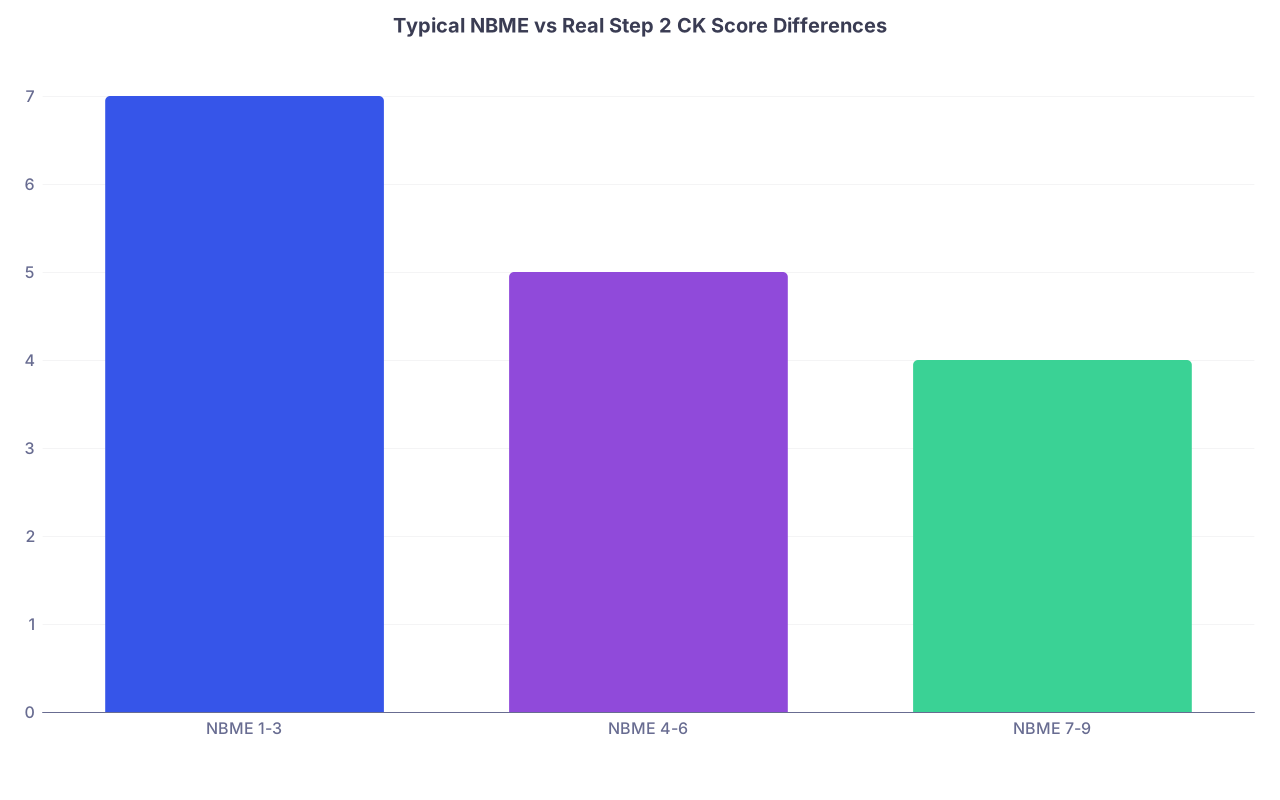
Let’s pin down the predictive accuracy piece first, because everyone asks this.
| Category | Value |
|---|---|
| NBME 1-3 | 7 |
| NBME 4-6 | 5 |
| NBME 7-9 | 4 |
Those numbers are average absolute differences (points) I have seen recurrently:
- Early forms (1–3): often 5–10 points under or over final
- Mid-late forms (4–6): usually within 3–7 points
- Very late forms (7–9, if you take them within 2 weeks): often within 0–5
And yes, outliers exist. But if your last two forms averaged 252, you are not magically scoring a 225 on test day unless something went catastrophically wrong (illness, sleep, meltdown).
The far more interesting—and Match-relevant—piece is whether you are consistently underperforming in domains that matter disproportionately for certain specialties.
For example:
- Repeated weak spots in OB/GYN and pediatrics? That will show up on a real exam, but it also hints at how you will perform on those rotations and shelf exams. Programs in those fields care about that.
- Chronic issues in ethics/professionalism items (inappropriate testing, unsafe discharge)? That is not just low-yield trivia. That is how attendings evaluate your judgment.
NBME forms, if you dissect them, tell you who you are clinically, not just what you know.
2. The NBME–Step 2 CK Score Relationship: How Predictive Is It Really?
People want a simple equation: “NBME × something = real Step 2.” Reality is messier, but there are reliable patterns.
Think of prediction at three time windows:
- Far (≥6 weeks out)
- Mid (3–5 weeks out)
- Near (≤2 weeks out)

Far: ≥6 weeks before Step 2 CK
NBME taken this early is more of a baseline capability than a hard prediction. Your real score ceiling is usually about 10–15 points above this if you work intelligently.
Example pattern I see regularly:
- 8 weeks out: NBME 6 – 232
- 5 weeks out: NBME 7 – 241
- 2 weeks out: NBME 8 – 247
- Real Step 2 CK: 249
You did not become a different person. You improved test-taking discipline, filled in recurrent gaps, and learned the style. So early NBME = starting point, not destiny.
Mid: 3–5 weeks before
Now you are in the zone where NBME forms start reflecting your “operating level” under exam conditions. The variance between NBME and real Step 2 CK shrinks.
Typical spread here:
- Real score ≈ last NBME ± 7 points
You still have room to move, especially if:
- You are doing large, targeted question volumes (e.g., UWorld second pass, Amboss) with real review.
- You correct repeated conceptual blind spots (electrolyte management, acid–base, ventilator settings, anticoagulation, developmental milestones).
But unless you overhaul your methodology, you are not jumping 20–25 points.
Near: ≤2 weeks before
At this point, your nervous system, not just your brain, is part of the equation. Sleep, anxiety, burnout. That all shows up.
If you take an NBME form within 10–12 days of your exam:
- Real Step 2 CK is usually within ±5 points of the average of your last 2 forms.
- Outliers (more than 10 points difference) often correlate with non-academic factors: being sick, catastrophic timing errors, or mismanaging anxiety.
So for Match planning, when you are talking to advisors or calculating realistic specialty targets, this is the number you should anchor to: last 2 NBME forms taken within 3 weeks of test day.
3. Pattern-Level Data: The Stuff Everyone Skips But Program Directors Care About
NBME score reports do something students barely glance at: they stratify performance by content domain and physician task.
Those categories are not random; they map onto how attendings and program directors think about you as a future resident.
Here is the structure you should be paying attention to:
- Content: internal medicine, surgery, peds, OB/GYN, psych, neuro, emergency.
- Tasks: diagnosis, management, prognosis/outcome, preventive care, professional responsibility.
When you line up multiple NBME forms, certain patterns scream at you if you bother to look.
Example: The “unsafe manager” pattern
Over 3 forms you see:
- Diagnosis: around average or slightly above.
- Management: consistently below borderline, especially acute cases.
- Professionalism/ethics: below borderline.
Translation: you recognize what is wrong, but your next step is shaky or unsafe, and your grasp of system-level consequences is weak.
On a score sheet, this might drag you down 10–15 points because of missed “gimme” management questions. In residency, this looks like:
- Ordering the wrong imaging.
- Sending home borderline-unstable patients.
- Fighting consultants or calling them at the wrong time.
That is exactly the sort of resident programs do not want. So if your NBME reports are showing this pattern, fixing it is high-yield not just for your score, but also for how attendings perceive you on rotations and in letters.
Example: The “knowledge-rich, time-poor” pattern
Across forms:
- Content performance fairly even, no glaring weak specialty.
- But your block-by-block timing analysis (if you actually track it) shows you always rush the last 8–10 questions.
This is the classic “good brain, poor system” problem. On test day, that chops 5–10 points. In residency, it looks like notes done late, orders lagging, and you being always slightly behind on rounds.
So yes, fix it now. Use your NBME attempts to enforce:
- 90 seconds per question as a default.
- Explicit skipping of time-sink vignettes on first pass.
- Hard cutoffs for review—never let the last 5 questions become random guesses.
These patterns influence both your final Step 2 CK score and how your clinical performance appears on rotation evaluations. Those evaluations end up in your MSPE and LORs, which programs read.
4. Converting NBME Trajectory into Realistic Match Strategy
Now we move from exam prep to application strategy. This is where most students are flying blind.
You should be asking one ruthless question: “Given my Step 1 and my likely Step 2 CK, what does my application realistically support?”
Not “what do I wish it supported.”
| Specialty Tier | Example Fields | Broad Step 2 CK Target Band* |
|---|---|---|
| Ultra-competitive | Derm, Plastics, Ortho, ENT | 250+ |
| High | Radiology, EM, Anesthesia, Gas, Road-type | 245+ |
| Mid | IM, OB/GYN, Gen Surg, Neuro | 235–245 |
| Less competitive | Psych, Peds, FM, Path | 225–235+ |
*These are rough national-level bands. Individual programs and DO vs MD context shift things.
Step 1 vs Step 2 CK: How NBME predictions fit in
Scenario 1: Low Step 1, solid NBME-based Step 2 prediction
Say Step 1: 213. Your last two NBMEs: 241 and 244.
Pattern I have seen repeatedly:
- Real Step 2 CK: 243–247.
- Programs read that as clear academic growth and proof you can handle clinical reasoning.
For many specialties (IM, peds, psych, FM, even some OB/GYN), that is more important than your Step 1 blemish, especially now that Step 1 is pass/fail. Your NBME trajectory is your argument: “I am on an upward curve.”
Scenario 2: Strong Step 1, disappointing NBME Step 2 trajectory
Step 1: 245. NBMEs: 236 → 238 → 239 close to exam. Real Step 2 CK: 238–242.
You did not crash, but you also did not reinforce your academic profile. For very competitive specialties, this can hurt, because Step 2 CK is often the tie-breaker now that Step 1 is less informative. In this setup, class rank, research, and letters matter more.
But more importantly: your NBME pattern told you 3–4 weeks out that a 260 fantasy was dead. If you persisted with “I’m aiming for derm at a top-10” without adjusting your program list, that is on you.
Using NBME data to tier your program list
Here is how I would operationalize NBME patterns into application strategy for someone 3–4 weeks before Step 2 CK:
- Take your last two NBMEs.
- Average them.
- Add +3 if you have not yet peaked in question volume and are tightening your process.
- That number is your realistic Step 2 CK “anchor band.”
Example:
- NBME 7: 236
- NBME 8: 242
- You are still ramping, and review is becoming more efficient.
- Anchor ≈ (236 + 242) / 2 + 3 = 240
Now map that to specialties. A 240:
- Reasonable for categorical IM, non-elite general surgery, OB/GYN, anesthesia at mid-tier programs, EM at community and mid-tier academic.
- Likely too low for ultra-competitive (derm, plastics, neurosurgery, ortho in big-name places) unless you have stellar research and connections.
So you:
- Adjust your program list to include more mid-tier and community programs.
- Increase breadth of geographic regions.
- Stop telling yourself stories about matching at programs that historically expect 250+.
That is not pessimism. That is aligning with actual outcomes I have seen year after year.
5. Timing Decisions: Postponing Based on NBME Patterns
Here is the ugly question almost everyone asks too late: “Should I delay my exam?”
NBME forms are the only semi-objective lens you have. Use them ruthlessly.

| Step | Description |
|---|---|
| Step 1 | Last 2 NBMEs average |
| Step 2 | Take as scheduled |
| Step 3 | Consider push 4-6 weeks |
| Step 4 | Push 2-4 weeks only if schedule allows |
| Step 5 | Usually take unless catastrophic |
| Step 6 | Within 5 points of goal? |
| Step 7 | Time before exam |
Let me be explicit.
You should strongly consider postponing if all of these are true:
- You are ≥4 weeks from the exam.
- Your last two NBME forms:
- Are below your minimum acceptable band for target specialty by ≥10 points.
- Are flat or dropping, not rising.
- You still have unexposed question volume (e.g., <60–70% of UWorld done properly).
Example:
- Target band for EM: ~240.
- Last two NBMEs: 223, 225.
- Exam in 5 weeks.
- You have done only 55% of UWorld, with half-hearted review.
Postponing 4–6 weeks to close that gap is rational—both for the score and for your Match competitiveness.
On the other hand, postponement becomes pointless (or harmful) when:
- You are already 70–80% of your realistic ceiling based on months of work.
- Your last two NBMEs are within 5–7 points of target.
- Fatigue and burnout are setting in.
I have watched many students postpone from “NBME 245, goal 250” to “NBME 249, real 246” after two extra months. Net gain: zero. Lost: time for sub-Is, research, and letters.
So be clear: what is your floor score you can live with for your specialty tier? If your NBME patterns say you are likely to hit that, you take the exam and move on with your application.
6. Interpreting NBME Miss Patterns Like a Program Director
NBME questions are not just random vignettes; they are proxies for how you think. Program directors, whether they articulate it or not, infer the same from your scores.
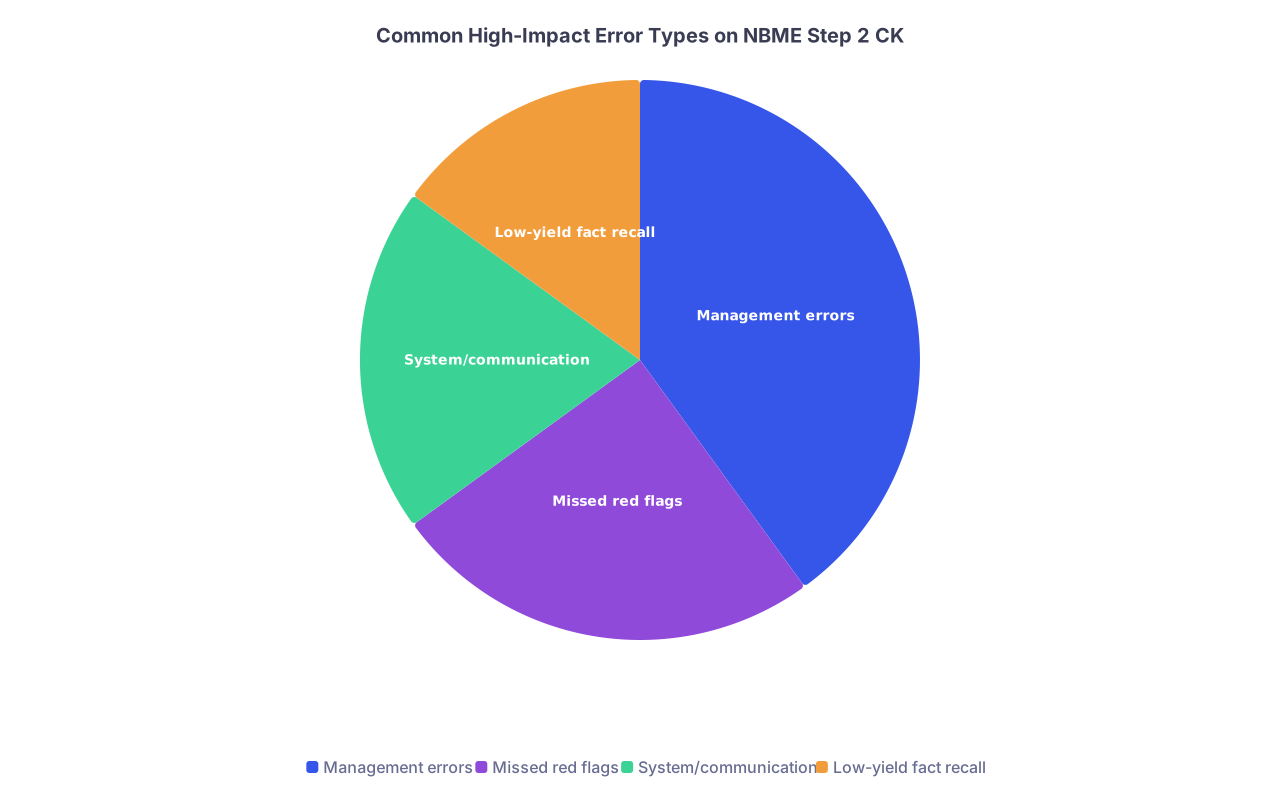
If you want to tie your NBME patterns directly into Match prep, focus on three domains of misses:
- Patient safety and red flags.
- Bread-and-butter management.
- System-level and communication issues.
| Category | Value |
|---|---|
| Management errors | 40 |
| Missed red flags | 25 |
| System/communication | 20 |
| Low-yield fact recall | 15 |
1. Patient safety / red flag misses
NBME repeatedly punishes you for:
- Sending home chest pain without ruling out ACS properly.
- Missing ectopic pregnancy red flags.
- Not admitting septic or borderline septic patients.
These are not just “wrong answers.” These are “we would not trust you on the wards” signals.
If, on review, you notice you are often under-calling severity or under-admitting, you need to correct that bias now. Build a rule set:
- “Anyone with X, Y, Z red flags gets admitted.”
- “Unstable vitals or altered mental status never goes home.”
- “First do the test that excludes the most dangerous thing.”
On the exam, that raises your score. On the wards, that makes attendings more comfortable with you—and your letters reflect that.
2. Bread-and-butter management errors
NBMEs are packed with high-yield, common scenarios: COPD exacerbation, DKA, GI bleed, acute stroke, heart failure, pneumonia.
If you are consistently missing these while getting rare syndromes correct, that is a massive red flag for programs. It screams “reads a lot, but cannot manage common problems.”
So track your misses:
- DKA: wrong fluid order or insulin sequence.
- COPD: misjudging steroid or antibiotic indications.
- Stroke: wrong window, wrong use of tPA, wrong antiplatelet strategy.
Then go to your resources (UWorld tables, UpToDate, EMCRIT) and build 1-page algorithms for each. Not five pages of notes. Single-page, decision-focused pathways.
You will see this show up in both rising NBME performance and more confident clinical reasoning on rotations.
3. System-level / communication misses
These are the ethics, consent, disclosure, and “next best conversation” questions.
Students often roll their eyes at them as “subjective,” but attendings absolutely judge you on this in real life. Fumbled handoffs. Poorly delivered bad news. Not calling a consultant when you should.
On NBME forms, if you are repeatedly missing:
- Best next step in handling angry family members.
- Correct approach to a medical error disclosure.
- Proper way to address an impaired colleague.
You are losing easy points. But more importantly, you are signaling poor professional judgment. Fixing this now—reviewing ethics guidelines, reading short professionalism chapters—pays off in both domains.
7. Turning NBME Analytics into an Actual Match-Prep Plan
Putting this together, here is what a serious NBME-informed Match plan looks like for a 6–8 week window before your exam.
You are not just “taking practice tests.” You are:
- Using NBMEs to ratify your likely score band.
- Identifying repeated error archetypes.
- Choosing specialties and program tiers aligned with that band.
- Tightening your clinical reasoning habits so your rotations match your score.

| Step | Description |
|---|---|
| Step 1 | Take NBME |
| Step 2 | Score and domain review |
| Step 3 | Refine timing and errors |
| Step 4 | Adjust study plan or postpone |
| Step 5 | Identify error patterns |
| Step 6 | Targeted practice and review |
| Step 7 | Estimate final Step 2 band |
| Step 8 | Align specialty and program tiers |
| Step 9 | Finalize application strategy |
| Step 10 | Gap from target band? |
By the time you are submitting ERAS and going on interviews, your Step 2 CK and its NBME shadow should tell a coherent story:
- Your initial baseline.
- Your upward (or plateaued) trajectory.
- Your final score aligning with the range of programs you actually applied to.
This is what I see in the applicants who match comfortably, not just “by luck.”
8. The Bottom Line: NBME Forms as Your Match Weather Report
Let me strip this down to what matters.
NBME Step 2 CK forms are not confidence toys; they are your best predictive tool for both your final score and your realistic Match competitiveness.
The single worst habit is obsessing over the 3-digit value and ignoring:
- Trajectory over time.
- Repeated domain weaknesses.
- Error archetypes (safety, management, professionalism).
Your last two NBMEs, taken within 3 weeks of your exam, usually bracket your Step 2 CK score within about 5 points. That should drive:
- Whether you postpone.
- Which specialties are realistic.
- How you tier and geographically spread your program list.
If you use NBME forms this way—like a serious clinician reading a trend in vitals, not a gambler checking a slot machine—you stop guessing about your Match odds and start planning like a professional.