
The idea that “Step 2 CK just replaces Step 1 now that it’s pass/fail” is dangerously incomplete. Step 2 CK is not just another number; it’s the tripwire that can quietly move your file into the “needs explanation” pile.
Let me tell you what really happens on the other side of ERAS when your Step 2 CK hits the screen.
What Program Directors Actually Do With Your Step 2 CK
In PD meetings, no one is saying, “Let’s take the holistic view first.” That’s brochure language.
What actually happens is this: someone pulls a spreadsheet, sorts by Step 2 CK, and the room starts above a line. There’s usually a quiet, unspoken cutoff. They may deny it publicly. They use it privately.
I’ve sat in selection meetings where the program director said, “Sort by Step 2. Let’s start at 250 and work down. Stop when we’ve got 60 names.” Everything below that? Either never discussed or only reviewed if there’s some compelling hook like a home student, a known mentor, or a unique niche.
Step 2 is doing three jobs for them now:
- Replacing Step 1 as the academic filter
- Acting as the reality check on your transcript and MSPE
- Triggering red-flag scrutiny when there’s any inconsistency or concerning pattern
The brutal truth: a mediocre Step 2 is not just “fine.” Combined with the wrong context, it becomes a magnifying glass.
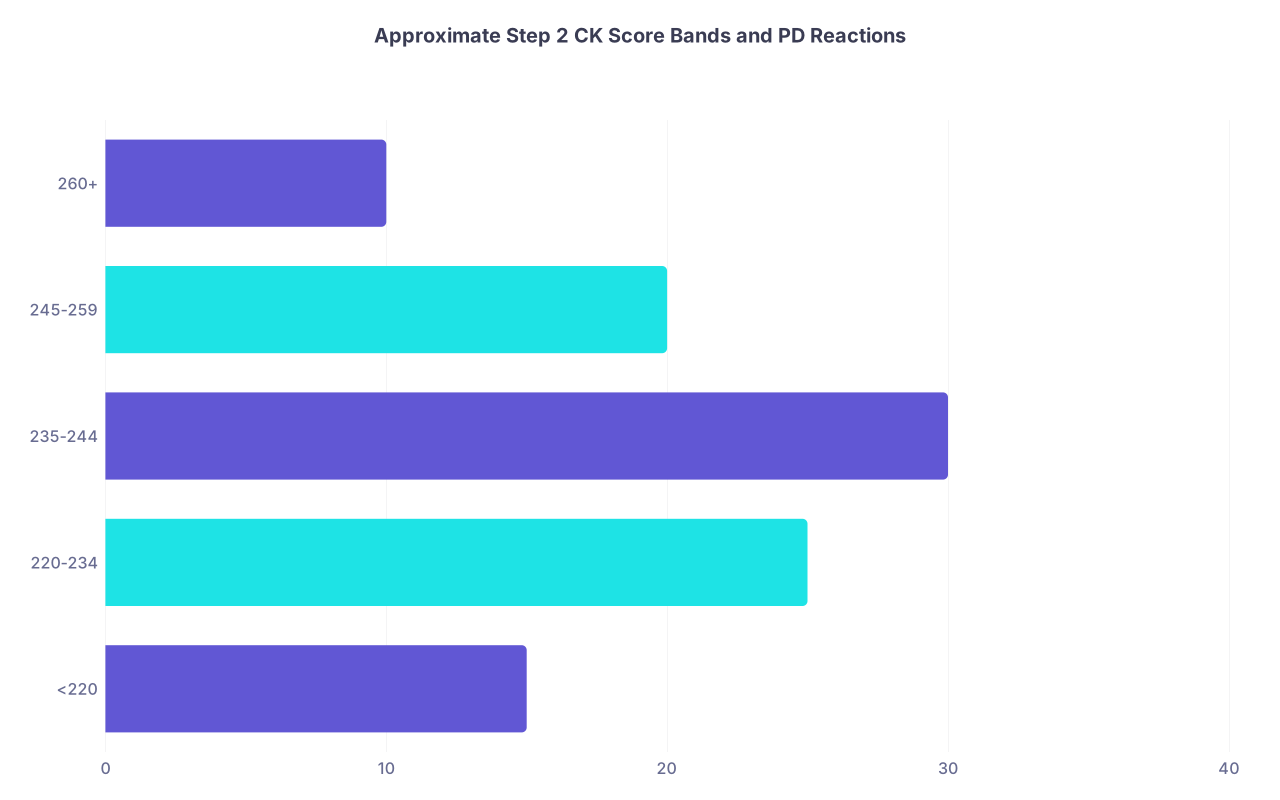
| Category | Value |
|---|---|
| <220 | 15 |
| 220-234 | 25 |
| 235-244 | 30 |
| 245-259 | 20 |
| 260+ | 10 |
Those bands aren’t “good vs bad.” They’re categories of how much extra explanation your file will demand behind closed doors.
How One Score Turns Into a Red Flag
A single Step 2 CK score doesn’t exist in a vacuum. Inside the conference room, people compare it to three things, almost automatically:
- Your Step 1 (if you took it numerically)
- Your clinical evaluations
- Your school’s reputation and grading system
The red flag is rarely just the number. It’s the mismatch.
I’ve heard the same phrases over and over from attendings and PDs scrolling through ERAS:
- “Why is this so low compared to Step 1?”
- “These clerkship comments don’t match this score.”
- “How did this person get all Honors with a 222?”
- “Big drop-off. What happened there?”
Each of those questions is code for: We need an explanation. And most applicants never realize their file has silently moved from “strong” to “suspect” over that one number.
The “Step 2 Red Flag” Scenarios We Actually Talk About
Let me walk you through the patterns that light up the radar.
1. Step 1 High, Step 2 CK Noticeably Lower
Example: Step 1 250 → Step 2 CK 228.
On Reddit, people call that “still a solid score.” In the selection room, I’ve watched PDs literally frown at that pattern.
The interpretation behind the scenes:
- “Peaked on Step 1 and coasted.”
- “Burned out?”
- “Bad test-day judgment? Poor prep? Overconfident?”
- “Are their clinical skills weaker than their basic science knowledge suggested?”
If your narrative in the MSPE, letters, and personal statement reads like you’re a star, but your Step 2 says “average,” people start doubting the narrative, not the score.
Is this fair? Not always. Is it what happens? Absolutely.
2. Steep drop relative to school norms
Programs know your school’s typical score distribution. They have internal spreadsheets. Faculty talk. PDs trade data at conferences.
If School X usually has Step 2 mid-240s and you show up with a 218, people notice. I’ve heard: “Something went wrong here. See if there’s a failure or LOA.” The search for a hidden red flag starts.
3. Step 2 CK barely passing for competitive specialties
Orthopedics, dermatology, plastics, ENT, urology. There’s almost no appetite for risk when scores are borderline.
A 220 in family medicine is one conversation. A 220 in ortho is a different conversation entirely. For some specialties, that score is not just “a concern”; it’s the end of the conversation before it begins unless you’ve got a home program desperate to keep you.
4. Step 2 CK out of sync with glowing comments
If your MSPE and evals read like:
- “Top 5% of students I’ve worked with in the last decade”
- “One of the strongest clinical problem-solvers in the class”
…but the Step 2 CK says 219, PDs get skeptical. They start wondering if your school inflates everyone’s comments or if you simply cannot perform under standardized conditions.
I’ve literally heard: “If they’re that good clinically, why is this score so low? Something’s off.”
5. Failing Step 2 CK or Big Score Discrepancies
A fail is the obvious red flag. But what you probably don’t hear enough:
A fail is survivable for some specialties at some programs if the story around it is clean, honest, and matches everything else in your app. What kills people is a fail plus a defensive or vague explanation in the MSPE or personal statement.
When PDs see a fail, they ask:
- “Did they own this?”
- “Did they improve significantly on the retake?”
- “Does this align with borderline clinical evals or is it an outlier?”
Second attempt with a big jump (e.g., 196 → 238) tells them something very different than 196 → 205.

How Different Specialties Weaponize Step 2 CK
Not all specialties use Step 2 the same way. But they all use it more than they advertise.
| Specialty | Typical Use of Step 2 CK | Risk Tolerance |
|---|---|---|
| Dermatology | Primary rank filter | Extremely low |
| Orthopedics | Hard screener + tiebreaker | Very low |
| Internal Medicine (academic) | Strong weight, esp. at top programs | Low |
| Family Medicine | Screen for fails/very low scores | Moderate |
| Psychiatry | Looks for major red flags | Moderate |
Here’s what actually happens in different rooms.
Competitive Fields: Step 2 as a Gatekeeper
In derm, ortho, plastics, ENT, neurosurg, radiation oncology, Step 2 is the enforcement tool. Faculty might say, “We review everyone holistically,” but then they filter the spreadsheet and start at 250+.
I sat in an ortho file review where someone pointed at a 244 and said, “He’s good, but we’ve got a ton of 250+ with research. Let’s stick to 250+ unless there’s something incredible.” That’s how cutoffs are born.
For you, that means:
- One slightly low Step 2 can erase a year of research, glowing letters, and a strong Step 1.
- Any red flag tied to the score (drop from Step 1, second attempt, or LOA around exam time) makes it almost impossible to compete above the “safety” tier.
Middle-Competitive Fields: Step 2 as the Tiebreaker and Validator
Internal medicine, EM, anesthesiology, OB/GYN, general surgery: Step 2 does a lot of subtle work here.
Program directors in these fields often:
- Use Step 2 to distinguish between two very similar applicants
- Look for consistency between Step 2 and in-service potential
- Check that a strong application isn’t “propped up” by Step 1 alone
If Step 1 was pass/fail for you, Step 2 becomes the only reliable exam signal they have. So all the pressure moves to that one number.
“Lifestyle” or Less Competitive Fields: Step 2 as a Risk Screen
Family, psych, peds, PM&R. People tell themselves these specialties “don’t care about scores.” That’s naive.
What they often do is:
- Ignore small differences at the top range
- Use Step 2 to weed out very low scorers or fail patterns
- React strongly to inconsistencies (glowing narrative + weak score)
They may not reject you for a 225. But pair a 225 with marginal evaluations or professionalism concerns, and Step 2 becomes Exhibit A in the argument against risking you.
What Triggers Extra Scrutiny: The Hidden Checklist
Most programs won’t admit this exists, but informally, they all have something like a mental checklist when they see a Step 2 that doesn’t fit.
I’ve literally seen PDs scan for:
- US vs. IMG status
- Step 1 performance
- Any remediation or LOA
- Shelf exam failures
- Comments about “needs more supervision than peers”
- Concern about time management or consistency
If something in that list is off, a mid or low Step 2 becomes proof of a pattern rather than a one-time blip.

| Step | Description |
|---|---|
| Step 1 | Step 2 CK Score Seen |
| Step 2 | Proceed with normal review |
| Step 3 | Check Step 1 or COMLEX |
| Step 4 | Academic risk flagged |
| Step 5 | Check MSPE and evaluations |
| Step 6 | Move to red flag pile |
| Step 7 | Consider with caution or lower on rank list |
| Step 8 | Score below program comfort zone |
| Step 9 | Pattern of low scores |
| Step 10 | Inconsistencies or concerns |
Notice something: Step 2 doesn’t doom you by itself. It doom-summons every other weakness in your file into focus.
If You Have a Step 2 Issue: Damage Control That Actually Works
Here’s where most students screw this up. They either ignore the problem (“maybe no one will notice”), or they write some long, vague paragraph about “test anxiety” that convinces no one.
Attendings and PDs are allergic to generic excuses. They’ve heard it all.
The approach that actually works is:
- Acknowledge.
- Contextualize.
- Demonstrate correction.
Not in dramatic, confessional style. In clean, tight language.
How PDs Want to See It Explained
This is the tone that goes over well behind closed doors:
- Direct, brief explanation if there’s a concrete factor (illness, family crisis, logistical catastrophe), without melodrama.
- Evidence of improvement: shelves, retake, in-service, local exams, or subsequent performance.
- Alignment: your advisors at your home school say the same thing in the MSPE that you say in your statement, and your letters don’t contradict it.
What they absolutely do not want:
- “I have test anxiety” with no documentation and no pattern of accommodations.
- Blaming the exam, the curve, “unexpected questions,” or “unfair content.”
- A 900-word essay about your personal hardship that never circles back to how you adapted and improved.

Where To Put The Explanation
Insider rule: do not scatter your explanation all over your application.
The best practice I’ve seen:
- One short, controlled explanation in your personal statement or secondary (if allowed).
- Consistent language in your dean’s letter/MSPE if they address it.
- If it’s a fail or drastic drop, a brief, mature acknowledgment during interviews if they bring it up.
You are not campaigning. You are answering the unspoken question: “If I rank this person, will this come back to haunt me?”
Preventing Step 2 from Becoming a Red Flag in the First Place
If you haven’t taken Step 2 yet, here’s the part no one tells you honestly: your Step 2 strategy has to match the story you’re trying to sell.
You want your file to say one coherent thing: “This person performs at or above the level their transcript and evaluations suggest.” That’s all.
So:
- If your clinical evals are average and your school is known to be mid-tier, you can’t afford a low 220 and expect IMGs with 250s not to edge you out.
- If your Step 1 was a monster 260, you cannot sleepwalk through Step 2 and put up a 230 without raising eyebrows. The expectation is that you at least stay in the same ballpark.
- If you’re going into a competitive field, aiming for “good enough” on Step 2 is a delusion. You are in an arms race, whether you like it or not.
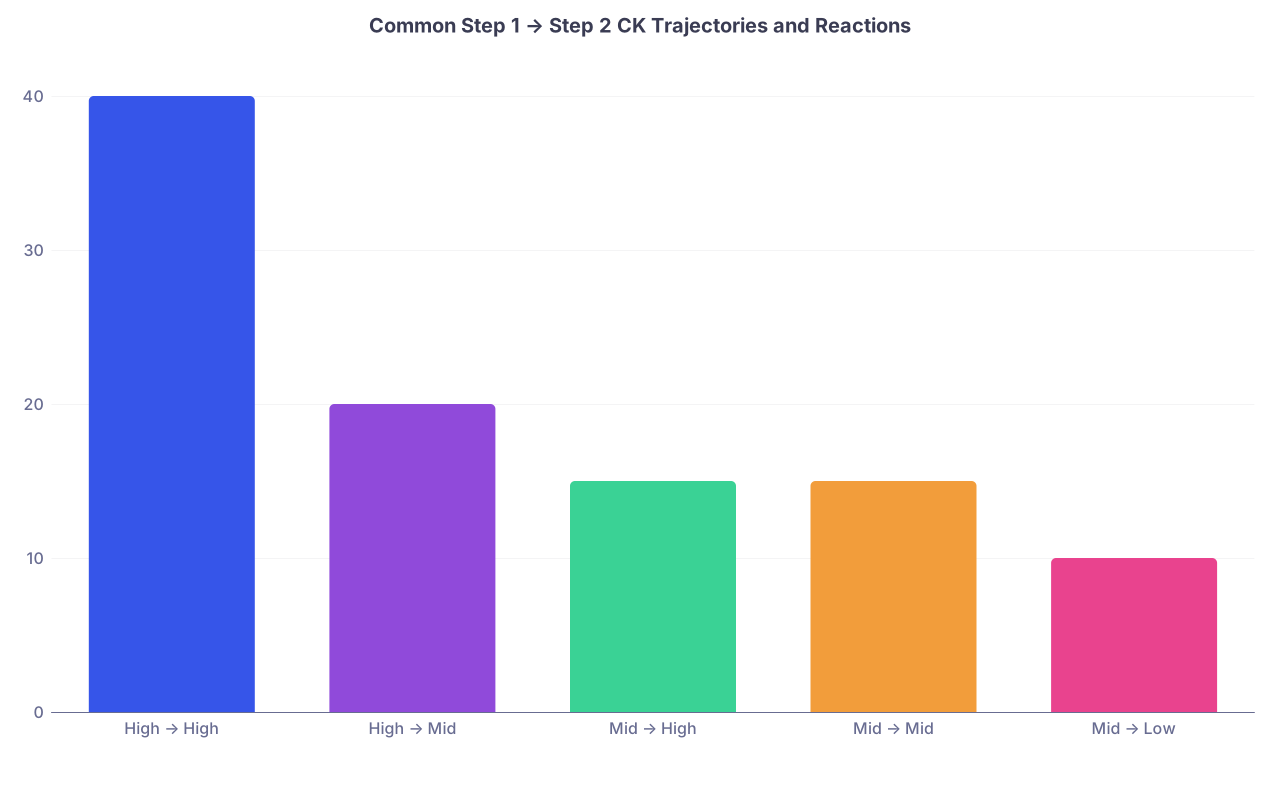
| Category | Value |
|---|---|
| High → High | 40 |
| High → Mid | 20 |
| Mid → High | 15 |
| Mid → Mid | 15 |
| Mid → Low | 10 |
Behind the closed doors, this is the subtext:
- High → High: “Consistent, reliable, no concerns.”
- High → Mid: “Why the slide? Any burnout or issues?”
- Mid → High: “Nice growth. Let’s look closer.”
- Mid → Mid: “Average. Check for other strengths or weaknesses.”
- Mid → Low: “Potential problem. See if there are other red flags.”
Your job: stay out of that last category, or, if you’re already there, build the strongest possible narrative around resilience and subsequent strength.
What Happens to You on Rank Day Because of Step 2
One last thing people underestimate: Step 2 doesn’t just affect your interview offers. It shadows you all the way to rank meetings.
I’ve been in rank discussions where someone says, “I like this applicant, but that Step 2 is a little soft,” and the entire room silently pushes them down 10–15 spots. Not rejected. Just… lower. Behind the higher scores who are otherwise similar.
That’s how people with “decent” scores end up unmatched from mid-tier programs. Not because anyone hated them. Because on a screen full of names, the one number that feels most objective is the one that quietly breaks the tie.

I’ve also seen the flip side. Applicant with a prior fail, now with a strong Step 2 and glowing recent performance, gets actively defended by a faculty member in the room: “Look at the trajectory, not just the fail. This person figured it out.” That defense is much easier when your retake score is clearly strong.
Final Perspective
Years from now, no one on your team will care exactly what you scored on Step 2 CK. They’ll care whether you can handle the floor, think through a crashing patient, and be trusted when things go sideways at 3 a.m.
But you do not get to that point without getting past the people who only see you as a PDF with a few numbers and some paragraphs of praise.
Step 2 CK is the piece of that PDF that feels the most “objective” to the people in the room. That means it’s the first thing they lean on when they’re nervous about taking a chance on you, and it’s the first thing they use to justify pushing you down their list when spots are tight.
Treat it accordingly. Not as your identity. Not as a moral verdict. But as the one datapoint that can either keep the rest of your story intact—or invite a level of scrutiny your application cannot comfortably survive.