
What do program staff really think when they see you’ve copied and pasted the same Step 2 CK email they already got from 40 other applicants?
Let me be blunt: they roll their eyes, tag you mentally as “extra work,” and move on. Your Step 2 CK score was supposed to help you. Your email just turned it into a liability.
You’re told Step 2 CK matters more now. You’re told to “update programs as soon as you have your score.” That part is right. The way most applicants do it is a mess.
This article is about that mess.
Not the score.
The email.
The lazy, generic, copied-from-Reddit “Dear Program Coordinator, I am writing to update you on my USMLE Step 2 CK score…” emails that flood inboxes every September–January and make program staff stop reading anything from applicants.
You want Step 2 CK to help you. I’m going to show you exactly how people ruin that advantage—and how you can avoid being one of them.
Why Step 2 CK Emails Matter More Than You Think
Step 2 CK itself is high stakes. But your communication about it can quietly shape how a program sees you.
Here’s what you probably do not see from your side:
- Coordinators and PDs get dozens of near-identical Step 2 CK emails per day during the peak months.
- Many of those emails are late, sloppy, or demanding.
- A decent chunk are clearly mass-sent with zero customization.
- Some contradict the ERAS file (wrong name, wrong program name, wrong specialty—yes, really).
That’s how you become “one of those applicants.”
And once you’re mentally filed under “mass email, sloppy,” your Step 2 CK score—whether great, average, or barely passing—does not save you.
Let’s separate three realities:
- Step 2 CK score – objective number that can help or hurt.
- Step 2 CK timing – when the score hits relative to application review.
- Step 2 CK communication – how you tell programs and what impression you leave.
Most advice online talks only about the first one. Program staff are living in #2 and #3.
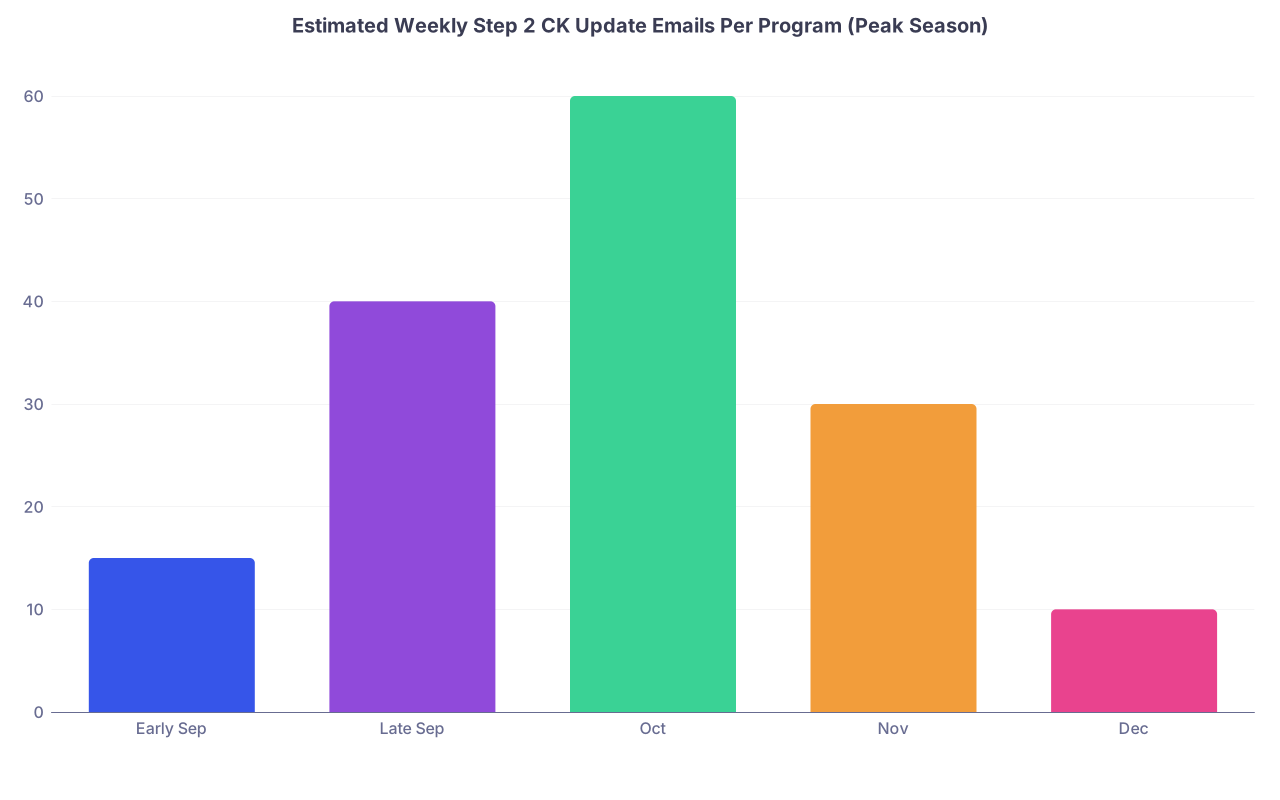
Here’s what they’re up against:
| Category | Value |
|---|---|
| Early Sep | 15 |
| Late Sep | 40 |
| Oct | 60 |
| Nov | 30 |
| Dec | 10 |
That’s per week. For one program. Multiply that by the number of programs you’ve applied to.
So when you send a copy-paste Step 2 CK email that screams “You are applicant #47 in my mail merge,” don’t be surprised when nobody replies.
The Classic Copy-Paste Step 2 CK Email: What’s Wrong With It?
Here’s the archetypal disaster. I’ve seen versions of this more times than I can count:
Dear Program Director/Coordinator,
I hope this email finds you well. I am writing to inform you that I recently took the USMLE Step 2 CK and achieved a score of 257. I remain very interested in your program and believe I would be a strong fit. Please let me know if you require any additional information.
Sincerely,
[Your Name]
On the surface, you might think: “What’s wrong with that? Polite. Informative.”
Program staff see something else:
- Generic template language (“I hope this email finds you well…”).
- No program-specific content.
- No ERAS AAMC ID.
- No subject line that helps them quickly sort or act.
- Obviously mass-sent to 60+ programs.
They also notice everything you didn’t do: You didn’t update ERAS first. You didn’t mention timing relative to their deadlines. You didn’t make it easy to find your file.
And copy-paste adds more landmines:
- Wrong program name (“I remain very interested in your Internal Medicine program” sent to a Family Medicine program).
- Different specialty mentioned than the one they actually offer.
- Old score reference: “I recently took Step 1 and Step 2 CK…” when Step 1 was in your ERAS months ago.
- Bizarre sentences that clearly came from a thread or advisor email.
That’s the red flag: not “this person cares about their application,” but “this person sends sloppy mass communication and expects us to do extra work to match and interpret it.”
The Biggest Red Flags Program Staff Notice (That You Don’t)
I’ll walk through the most common Step 2 CK email mistakes and how they land on the other side of the screen.
1. The “Spray and Pray” Mass Email
You write one generic email and BCC every program.
Or you personalize the first line and then paste the body.
Program staff see:
- Zero mention of their institution or program specifics.
- Phrases like “your esteemed program” that sound like a bad scholarship essay.
- The exact same wording that other applicants used because you all pulled from the same Reddit template.
What they infer:
- You’re applying widely and indiscriminately.
- Your “strong interest” means nothing.
- You don’t respect their time enough to at least make the update readable and targeted.
2. Not Updating ERAS First
If your Step 2 CK score is already reported to NBME/ECFMG, it generally will flow into ERAS. But delays happen. Still, your first question to yourself should be: “Is this in ERAS yet?”
The mistake: Sending the program an email before the score is actually in your ERAS transcript—and then never sending an updated transcript or letting them sort out the mismatch.
Program side reaction:
- They look in ERAS. No updated score.
- They have to either:
- Ignore the email.
- Manually note your score in some tracking sheet (almost nobody does this).
- Wait and check again later (they won’t remember).
If your email forces them to “hold that thought” and sync it later, you’ve made extra work. That’s a small but real strike against you.
3. Attaching Unofficial PDFs or Screenshots
You attach a screenshot of your Step 2 CK report. Or a weird cropped PDF from your NBME portal.
Program red flag:
- They do not want unverified test information in their email archive.
- They do not want to sort which documents are official vs self-reported.
- It creates a compliance and process headache.
They trust ERAS and official score reports. Your random attachment? Not so much.
4. The Braggy or Desperate Tone
Two opposite (but equally bad) extremes:
- Braggy – “I am excited to share that I scored in the 95th percentile on Step 2 CK and feel that I am an exceptionally strong candidate for your program.”
- Desperate – “I am very worried about not matching and hope this score will help you reconsider my application.”
Both put emotional labor on the reader.
Program staff are not your therapist, and they’re not your cheering section. They need concise, relevant information.
What works against you:
- Using your email to re-argue your entire candidacy.
- Emotional oversharing about anxiety, fear, or how much this means to you.
- Acting entitled: “I hope this score proves I deserve an interview.”
5. Sending Too Late or Too Often
Here’s the Step 2 CK timing trap:
- You think: “Better late than never.”
- They think: “We already built our rank list weeks ago.”
Or worse, you email:
- When you get the score.
- Again right before rank list certification.
- Again to “confirm you saw my previous message.”
You just became a high-maintenance applicant.

Timing missteps that hurt you:
- Reporting a mediocre Step 2 CK score late, when they’ve largely finalized interview invites.
- Sending updates during their insane weeks (pre-interview orientation, rank list week) and expecting thoughtful replies.
- Re-emailling multiple times asking, “Any update?” or “Did this help my chances?”
Specific Copy-Paste Phrases That Scream “Template” To Program Staff
You want to avoid sounding like the 200 other people using the same language. Here are phrases that are completely overused in Step 2 CK emails:
- “I hope this email finds you well.”
- “I am writing to update you on my application.”
- “I recently received my Step 2 CK score.”
- “I remain very interested in your esteemed program.”
- “I believe I would be a strong fit for your residency.”
What these phrases signal:
- You wrote this in 30 seconds.
- You didn’t think about what the program actually needs to know.
- You’re performing “professionalism” instead of communicating clearly.
Try this test:
If your email could be sent verbatim to every single program in the country without sounding weird, it’s probably bad.
When You SHOULD Email Programs About Step 2 CK (And When You Absolutely Shouldn’t)
Let’s get practical. Not every Step 2 CK outcome deserves an email. Some updates help; some do nothing; some backfire.
Here’s a rough guide.
| Scenario | Email? |
|---|---|
| Big jump from weak Step 1 to strong Step 2 CK | Yes |
| Step 1 pass only (no score) → strong Step 2 CK | Yes |
| Borderline Step 1 → average Step 2 CK | Maybe, only strategically |
| Strong Step 1 → weaker Step 2 CK | Usually no email |
| Failed Step 2 CK, then passed | Yes, but very carefully |
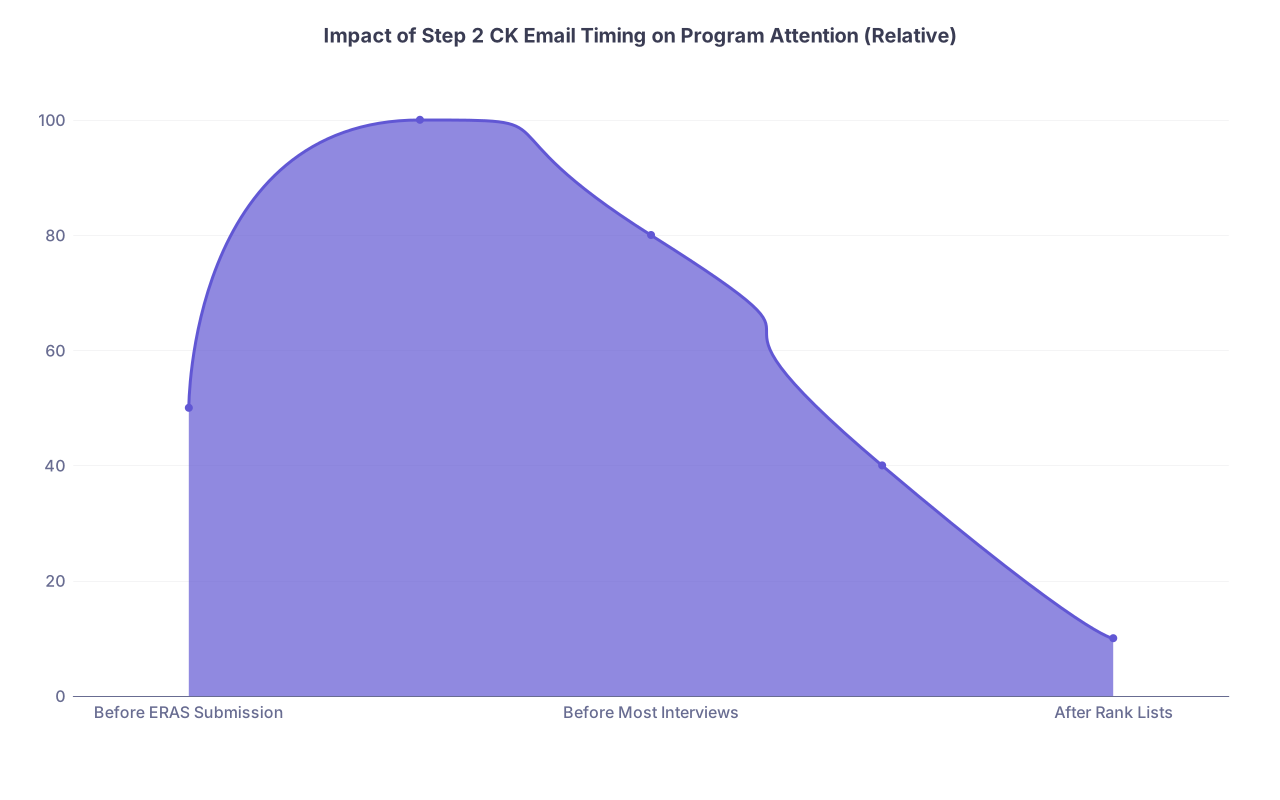
And timing:
| Category | Value |
|---|---|
| Before ERAS Submission | 50 |
| Within 1 week of Score Release | 100 |
| Before Most Interviews | 80 |
| Late Interview Season | 40 |
| After Rank Lists | 10 |
Interpret this simply:
- If you have a truly meaningful improvement or a first-time Step 2 CK result that changes your profile, an email can help—if sent early enough.
- If it’s late in the season and your score is just “fine,” your email is mostly noise.
How to Update Programs Without Triggering Red Flags
Let me show you what a non-cringe, non-copy-paste Step 2 CK update looks like.
Notice: It’s short. Clear. Respectful. And not written like a spam blast.
Example: Strong Step 2 CK After Average Step 1
Subject line:Application update – Step 2 CK score – [Your Name], AAMC [ID]
Body:
Dear Dr. Smith and the [Program Name] team,
I’m writing to share that my USMLE Step 2 CK score has been released and is now available in ERAS. I scored 250.
I remain very interested in [Program Name] because of your focus on [one specific, real feature—e.g., resident autonomy at your county site / strong primary care training / robust ICU experience].
Thank you for your time and consideration.
[Full Name]
AAMC ID: XXXXXXXX
That’s it. No attachments. No drama. No begging for an interview.
Notice what’s not happening:
- Not pretending you’re writing a unique love letter to this program while saying nothing specific.
- Not over-explaining or re-selling your whole application.
- Not using stiff, copied “esteemed program” language.
Example: Step 2 CK After a Step 1 Failure
This one requires more care. It’s higher risk, but doing nothing can also be a mistake.
Subject: Application update – Step 2 CK – [Your Name], AAMC [ID]
Dear Dr. Lee and the [Program Name] team,
I wanted to let you know that my USMLE Step 2 CK score has now been reported and is available in ERAS. I scored 232.
After my Step 1 failure, I significantly changed my study approach and schedule (dedicated weekly NBME practice, tutoring, and structured content review), and I’m relieved to have successfully passed Step 2 CK on the first attempt.
I remain very interested in [Program Name], especially your [specific feature], and I appreciate your time in reviewing this update.
Sincerely,
[Full Name]
AAMC ID: XXXXXXXX
Short acknowledgment of the failure. Clear improvement. No multi-paragraph apology tour.
Extra Subtle Mistakes That Quietly Hurt You
These are the things I see applicants do that they think are “professional” but that actually irritate program staff.
1. Overly Formal, Stiff Language
You’re not writing a grant proposal. You’re sending a simple update.
Bad: “I kindly request that you consider this additional information as you evaluate my candidacy for your esteemed residency training program.”
Better: “Thank you for considering this update as you review my application.”
2. Weird Fonts, Colors, or Signatures
You’d be surprised how many people have:
- Bright blue or pink fonts.
- Huge graphic signatures with quotes.
- Multi-line inspirational taglines.
Program staff are scanning hundreds of messages on cramped screens. Don’t make your email physically harder to read.
3. Long, Multi-Topic Emails
You try to do everything at once:
- Update Step 2 CK.
- Reiterate your interest.
- Ask about interview status.
- Ask about couples match.
- Explain why your LOR is delayed.
That’s not a Step 2 CK email. That’s a wall of text.
Break it up. If your Step 2 CK score is the update, then that’s the update. Don’t bury it in other noise.
4. Ignoring Program Instructions
Some programs clearly say: “Do not email us updates; please upload everything into ERAS.”
You email them anyway.
They now know two things:
- You don’t follow instructions.
- You’re willing to make their job harder for a tiny possible gain.
That’s a losing trade.

| Step | Description |
|---|---|
| Step 1 | Get Step 2 CK Score |
| Step 2 | Wait until in ERAS |
| Step 3 | No email or very selective |
| Step 4 | Skip email |
| Step 5 | Send short, specific email |
| Step 6 | In ERAS yet |
| Step 7 | Score changes profile? |
| Step 8 | Program allows updates? |
What Programs Actually Want From Your Step 2 CK Email
Here’s the part nobody bothers to tell you. When program staff are not annoyed, they’re actually very simple about what they want:
- Clarity – What’s your score and is it in ERAS?
- Context (if truly needed) – Very brief explanation if it’s correcting a previous weakness.
- Relevance – One line that shows you know who they are.
- Low friction – They can find your file in 3 seconds and move on.
That’s it.
They’re not grading your “professionalism prose.” They’re not scoring your email style.
They want you to:
- Respect their time.
- Give them information they can use.
- Not sound like a bot or a blast email.
If your Step 2 CK email does that, it helps. If it looks like 100 other copy-pastes, it doesn’t.
FAQ (Exactly 5 Questions)
1. Should I still email programs about Step 2 CK if ERAS already updated my score?
Sometimes, yes—but only if your score meaningfully changes how they might see you. If you had a weak or missing Step 1 and then a strong Step 2 CK, a short email can nudge them to re-open or reconsider your file. If both scores are already solid and consistent, the email adds very little and can just be more inbox noise. Always check that the score is visible in ERAS first; if it’s not, wait.
2. Is it ever okay to send a mass Step 2 CK update email to all programs?
You can send similar content to many programs, but you should not literally copy-paste the exact same message with zero customization or, worse, BCC everyone in one email. That’s how you end up with wrong program names, obvious template language, and a “this is spam” impression. Keep the structure similar, but at least tailor the program name and one specific detail so it doesn’t read like a broadcast.
3. What if my Step 2 CK score is lower than my Step 1 score?
In most cases, don’t email just to point out a weaker Step 2 CK. Programs will see it in ERAS anyway. An email draws attention to the comparison and tempts you to over-explain, which rarely helps. The main exceptions: if you’re addressing a prior failure, major delay, or specific concern that a mentor or advisor (who understands your specialty) explicitly agrees is worth clarifying.
4. How many times is it acceptable to email a program about my Step 2 CK score?
Once. One clear, concise email per program about your Step 2 CK score is enough. If they don’t respond, you don’t send reminders asking if they saw it or whether it changed your interview chances. Program staff are overloaded; silence is the default, not a personal rejection. Repeated follow-ups move you into the “high-maintenance” category, and that’s not where you want to be.
5. Who should I address the Step 2 CK email to—the PD or the coordinator?
Address both if possible: “Dear Dr. [PD Last Name] and the [Program Name] team,” or “Dear Dr. [PD Last Name] and Ms. [Coordinator Last Name].” Many coordinators triage emails and route key updates to the PD. You don’t need to obsess over perfect titles; getting names and program correct matters more than over-formal salutations.
Open your Step 2 CK update draft right now and read the first two sentences out loud. If they sound like something 500 other applicants could have written word-for-word, rewrite them until they sound like you—and not a template trying to impress a robot.