
Last recruitment season, a PD I know at a mid‑tier internal medicine program opened an applicant’s file, saw a 224 Step 1 (pass/fail era preview score), then scrolled to Step 2 CK: 280. He literally laughed and said, “Oh, this kid figured it out.” That applicant moved from “maybe” to “must interview” in under ten seconds.
Another file? Great letters, solid school, nice personal statement. Step 1 okay. Step 2 CK: 222. The room went quiet. Somebody said, “What happened on the wards?” That applicant never made it to the interview pile.
Let me walk you through what really happens with Step 2 CK once your file hits a residency ranking meeting. Because by the time you see your Match result, the hidden damage or advantage from that one score has already been baked in.
The Quiet Rule: Step 2 CK Is the New “Real Board Score”
Programs will never put this in their glossy brochures, but behind closed doors, Step 2 CK has become the de facto objective ranking tool now that Step 1 is pass/fail.
Here’s the internal logic faculty use:
- Step 1 now tells them almost nothing. Pass/fail destroyed its sorting power.
- They still need something standardized to compare hundreds of applicants.
- Step 2 CK is closer to actual clinical work, more predictive of board passage, and still has a 3-digit number.
So Step 2 CK quietly becomes the “real” score they care about.
I’ve sat in rooms where the PD literally said, “Forget Step 1, let’s sort this list by Step 2 only.” Then they start discussion from the top down. No drama. Just a spreadsheet, a filter, and your future moving up or down 100 lines in an instant.
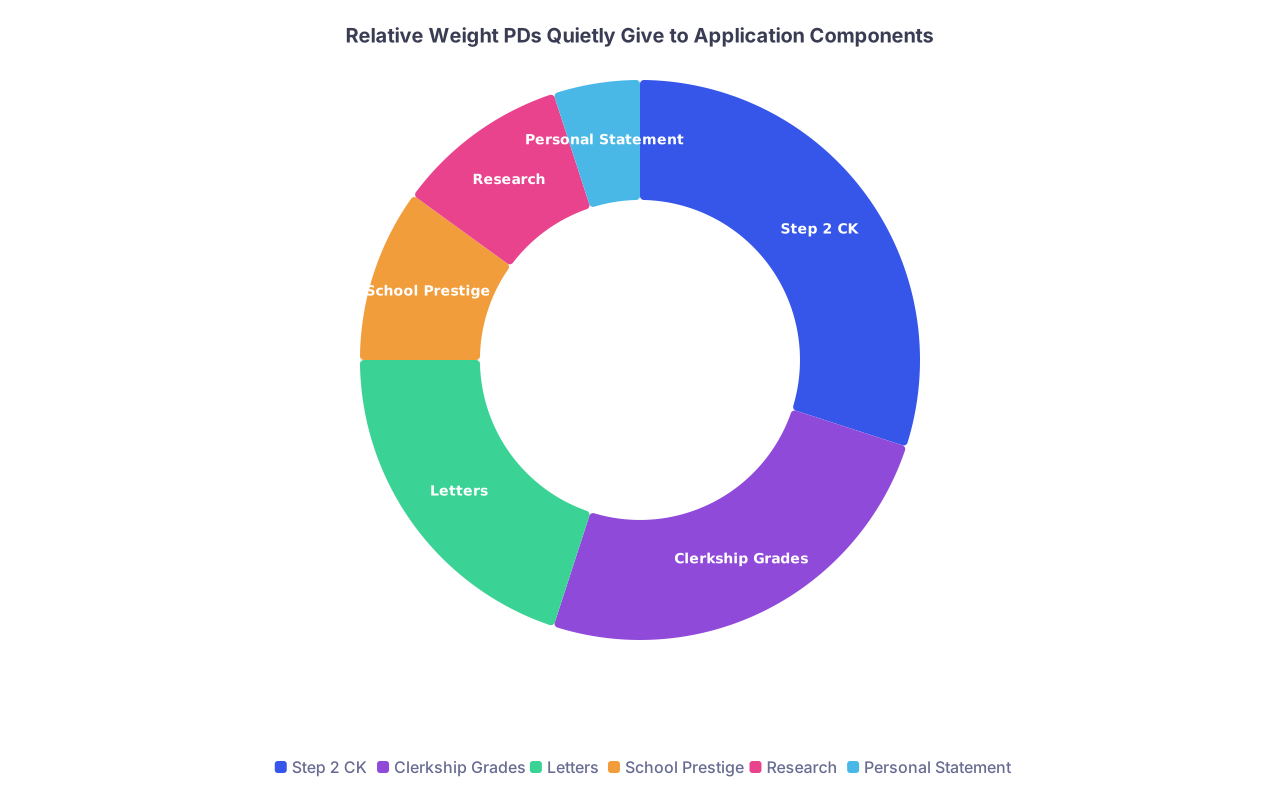
| Category | Value |
|---|---|
| Step 2 CK | 30 |
| Clerkship Grades | 25 |
| Letters | 20 |
| School Prestige | 10 |
| Research | 10 |
| Personal Statement | 5 |
Do all programs do this? No. But enough do—and especially in competitive and mid‑competitive specialties—that ignoring Step 2 CK is malpractice on your own career.
Here’s what PDs are actually thinking when they look at that score:
- “Can this person pass our boards on first try?”
- “Does this score match what the MSPE and narratives claim?”
- “Will this resident be the one requiring remediation conferences at 6 pm on a Friday?”
They are not thinking “Is this fair?” They are thinking, “Will this person be my problem for three to seven years?”
The First Gate: How Step 2 CK Gets You an Interview (Or Doesn’t)
Before anyone argues about your incredible character and leadership, someone—often a coordinator or chief—runs filters. That’s the unglamorous truth.
The Hard Filter Line
Most programs have an internal “do not rank below this” Step 2 threshold. They almost never publish it. They almost always use it.
You’ll hear numbers thrown around in meetings:
- “Can we agree on 230 as the floor?”
- “Surg Onc wants 245+ if possible this year.”
- “For FM, we can go down to 220 if the rest is good.”
Some examples I’ve actually seen:
| Program Type | Quiet Step 2 CK Floor |
|---|---|
| Academic IM (mid‑tier) | 230–235 |
| Community IM with boards pressure | 220–225 |
| Competitive IM subspecialty pipeline | 245+ |
| University General Surgery | 240–245 |
| Community FM | 215–220 |
These aren’t universal, but they’re in the ballpark. And remember: floors move. If the applicant pool is strong, the floor rises. Bad year? They quietly relax it.
The “Auto‑Invite” and “Auto‑Worry” Zones
There are three zones most PDs mentally place you into when they see Step 2 CK:
- Auto‑invite / serious contender – For many IM programs, that’s usually 255+; for general surgery maybe 260+. They’ll still review your app, but you start high on the list. If other pieces aren’t terrible, you’re getting an interview.
- Yellow zone – 230–250 for IM, 235–255 for surgery. You live or die by everything else: letters, school, clinical comments, research.
- Concern zone – Below their quiet floor or close to it. They ask, “Why? Any red flags? Shelf failures? Struggling on wards?” You need strong counter‑evidence to stay in consideration.
I watched a PD at a community IM program go through a stack and literally mark them: “strong score,” “okay,” and “problem.” That shorthand controlled who they actually talked about.
You might be thinking: “What if I have a 220 but amazing research and letters?” That gets exactly one conversation. One. And you’re fighting upstream from the first second your file is opened.
Inside the Ranking Meeting: How Step 2 CK Shifts Your Position
Once you get the interview, people assume scores stop mattering. They don’t. The weight changes, but the number isn’t gone from anyone’s mind.
Here’s what actually happens during ranking discussions.
1. The Spreadsheet Sorting Trick
Picture this: it’s February, 9 pm, everyone’s exhausted, cases ran late. They’ve interviewed 120 applicants for 18 spots. A chief or coordinator projects an Excel or ERAS-exported sheet:
- Name
- School
- Step 1 (pass/fail)
- Step 2 CK
- Interview score
- “Overall impression” comments
Someone inevitably says, “Sort by interview score.” Then someone else quietly says: “Can we add a Step 2 sort within that so our top interviewees with higher Step 2 stack up?” They click the sort. You either glide up or slide down.
Nobody is evil here. They’re tired, they want a board‑safe class, and Step 2 CK is a quick “comfort” variable.
2. Tie‑Breakers and “Gut Checks”
I have heard this exact sentence more times than I can count:
“Applicant A and B interviewed similarly. Who has the better Step 2?”
If the difference is small (250 vs 253), they shrug. But 238 vs 261? The conversation ends fast. The higher Step 2 gets the higher rank almost every time unless there’s a major professionalism concern.
This is why you’ll see apparently minor score differences snowball into huge rank list separations. Not because they’re obsessing over 5‑point gaps. Because when they’re rushing, higher just feels safer.
3. Reconciling Conflicting Impressions
Common scenario: one faculty member loves you; another was lukewarm. Someone says, “But their Step 2 is 268, and comments from their home clerkships are glowing.” Someone else says, “Their Step 2 is 226, and they had a ‘needs improvement’ in medicine.”
Which way do you think the room tilts?
That’s the quiet role Step 2 plays—breaking internal disagreements. It becomes the “objective” reality they can all point to. Even though you and I both know test performance is only one piece of the story.
Red Flags, Spikes, and Stories: When Step 2 CK Demands an Explanation
PDs don’t just look at the raw score. They look at the pattern.
Upward Trajectory: Mediocre Step 1, Strong Step 2
These are the people who make PDs nod. “They figured out how to study. They improved clinically.”
A few patterns that help you:
- Step 1: barely passed, Step 2: 250+
- Weak pre‑clinical grades, stellar clerkship comments + strong Step 2
- DO school with modest COMLEX but very strong Step 2 CK
I watched an applicant with a marginal Step 1 (old scoring era, low 220s) and a 261 Step 2 jump over dozens of applicants from “better” schools. Why? PD: “I care way more about what you did once you actually saw patients.”
If that’s your story, spell it out in your MSPE addendum or personal statement. Some PDs really do like a comeback narrative—when the numbers support it.
Downward Slide: Strong Step 1, Weak Step 2
Here’s where people get hammered.
Program directors see Step 1 high and Step 2 significantly lower and think:
- Burnout
- Poor time management during clinicals
- Could not translate basic science strength into clinical reasoning
They start digging: any failed shelves? Any concerning comments like “struggled with independent decision‑making” or “needed closer supervision”?
If the drop is >20–25 points equivalent (in the old scale mindset), you need a story: illness, family crisis, exam timing disaster. Not a sob story—just a professional explanation. If you give them nothing, they invent their own narrative. It’s rarely flattering.
Shelf Correlation
Many programs, especially university hospitals, are quietly pulling shelf data from the MSPE if your school includes it. Some PDs will literally say:
“They barely passed several shelves and their Step 2 is 225. This is not a fluke. This is who they are as a test taker.”
That scares them more than a one‑off bad test. Because it predicts board failures, which PDs are judged on. Low board pass rates hurt accreditation and reputation. So they become very jumpy about any sign you’re borderline.
| Category | Value |
|---|---|
| Step 2 CK | 30 |
| Clerkship Grades | 25 |
| Letters | 20 |
| School Prestige | 10 |
| Research | 10 |
| Personal Statement | 5 |
(Values here reflect how often these patterns help vs hurt you in discussions—upward trajectory and both high are favored heavily.)
Specialty Differences: Who Obsessively Cares and Who Just Needs “Safe Enough”
Not all specialties use Step 2 CK the same way. But every single one of them looks at it.
High‑Competitiveness Fields
Think dermatology, ortho, ENT, plastics, neurosurgery, IR, competitive EM and anesthesia programs.
Insider truth: in these specialties, Step 2 CK has replaced Step 1 as the unofficial screen for “are you even in the running?”
- 260+ – You’re in the serious contender pool if the rest of your app is aligned.
- 250s – You need stronger research, letters, and maybe home advantages.
- <240 – You’re swimming upstream hard unless something else is off‑the‑charts (e.g., first‑author major publications, national presence).
These programs are flooded with applicants. They use Step 2 like a chainsaw to cut the pile down.
Core Specialties (IM, Peds, OB/GYN, Psych, Gen Surg)
These programs care, but they can be more flexible—especially mid‑tier and community places.
What they do:
- Set an internal floor.
- Give extra weight to higher scores when they’re nervous about board pass rates.
- Use Step 2 to validate strong narrative impressions (“They interviewed great and have a 260? Perfect.”).
One OB/GYN PD I know literally keeps a whiteboard: “>245: low board worry; 230–245: standard risk; <230: potential board risk—needs justification.” Every applicant gets silently dropped into a bucket.
“Value Fit” Fields (FM, Psych at some programs, certain prelims)
They’ll tell you, “We’re holistic.” Many of them mean it. But there’s always a line.
Usually the logic is:
- Below X score (maybe 215–220), there must be an explanation or strong redemption arc.
- Between X and Y, they care more about fit and interpersonal skills.
- Very high scores sometimes even raise a different concern: “Will they actually come here, or are they using us as backup?”
So, yes, in some community FM or psych programs, too high a Step 2 compared to their historic average makes them suspect you’ll rank them low. I’ve seen those conversations.
Situations Where Step 2 CK Completely Controls the Narrative
There are a few scenarios where Step 2 CK carries far more weight than average. If you fall into one of these, understand how PDs are thinking.
1. No Step 1 Score / Late Step 2
If you’re in a pass/fail Step 1 world and you take Step 2 late (after apps go out, or worse, after rank lists are forming), you’re giving PDs nothing objective to feel safe about.
Common outcome:
- Interview invite decisions made without a score.
- Then your Step 2 comes back mediocre or low. Now they’re stuck—they liked you, but the score scares them.
I’ve seen PDs bump such applicants down the rank list mid‑February, even after a good interview, because the score landed late and poorly.
2. IMG / DO Applicants to MD‑Heavy Programs
For these groups, PDs lean much harder on Step 2 CK. Why?
- They’re less familiar with your school’s grading and rigor.
- Some are suspicious—wrongly, but still—that your MSPE might be inflated.
- They want reassurance you can hang with their MD cohort.
So a DO with a 260 Step 2 can absolutely outcompete an MD with a 240 for certain programs. I’ve seen it. But the reverse is also harshly true: a DO with a 225 Step 2 trying to break into a strong university IM program is fighting gravity.
3. Prior Academic Problems
Any of these in your file:
- Remediated course
- Failed shelf
- Decelerated curriculum
- LOA for academic reasons
Step 2 CK becomes the jury. Nail it, and PDs tell themselves, “They turned it around.” Miss it, and they say, “Pattern confirmed.”

| Step | Description |
|---|---|
| Step 1 | Open Application |
| Step 2 | Look at Step 2 score |
| Step 3 | Check Step 2 for redemption |
| Step 4 | Standard discussion |
| Step 5 | Likely screen out |
| Step 6 | Flag as improvement |
| Step 7 | Consider high risk |
| Step 8 | Any academic flags |
| Step 9 | Score above internal floor |
| Step 10 | Strong Step 2 |
This is why I tell students with any academic hiccup: Step 2 is not optional. It’s the hearing where you’re either acquitted or convicted.
How To Strategize Step 2 CK With This Reality In Mind
You’re not going to rewrite the system. But you can play it intelligently.
Timing: When to Take It
You want Step 2 CK:
- High enough that you’re proud for PDs to see it
- Early enough that it’s in your ERAS at the time of interview invitations
For most students, that means late spring to mid‑summer before application season. Pushing it to September “to have more study time” usually backfires. You lose invites. And if the score disappoints, there’s no recovery.
If your practice tests are weak, delay a bit. But delay into July/August, not October.
Score Choice: To Hide or Not To Hide
In most specialties, not releasing a Step 2 when you could have is interpreted as “they’re hiding something.” Programs will often say outright in meetings: “If Step 2 is missing this late, assume it’s bad.”
If you took it and bombed early (rare but happens), you have a tricky choice:
- Don’t release: You get fewer interviews, but some programs may give you the benefit of the doubt.
- Release: You may get dropped immediately at some, but others will appreciate honesty.
In highly competitive fields, a poor Step 2 is almost impossible to hide. People share impressions informally. I’m blunt with students: if Step 2 is truly bad, you may need to recalibrate specialty choices more than play games with score release.
What To Say If They Ask About It
Yes, some interviewers ask directly: “Can you talk about your Step 2 performance?”
Acceptable structure:
- Briefly acknowledge the number (don’t dodge).
- Give a concise, non‑excuse context if needed (illness, mistimed exam, etc.).
- Pivot immediately to evidence you function at a higher level: strong shelf turns later, honors in key clerkships, concrete examples of strong clinical reasoning.
What you do not do: ramble about test anxiety for five minutes or blame the exam.
FAQ: What PDs Won’t Put In Writing About Step 2 CK

1. “How bad is a ‘borderline’ Step 2 for a non‑competitive specialty?”
If you’re talking family medicine, psych, peds, or community IM: a borderline score (say 215–225) is not an instant death sentence. But it pushes you into the pile where everything else has to pull its weight—especially your clinical comments and fit with the specialty.
What hurts more than the raw number is a pattern: borderline Step 2 plus mediocre comments, no strong advocate, generic PS. A single low number with otherwise solid signs of being a reliable, hardworking clinician? Many programs will still rank you reasonably.
The unspoken threshold is this: can they picture you passing your boards on the first try? If your score is low but still above past pass rates and your narrative is strong, they’ll take that chance.
2. “Will a very high Step 2 offset weak research or an average school name?”
Inside many mid‑tier and even some higher‑tier programs, absolutely yes.
I’ve seen mid‑rank US MD students with 260+ Step 2 beat out T10 grads with 240s for interview invites. PDs will say things like, “I don’t care where you went if you can crush boards and function clinically.”
Research is currency mostly for competitive specialties and academic career trajectories. For general IM, peds, OB/GYN, psych, EM, a sky‑high Step 2 plus strong wards reputation is more persuasive than some weak poster at a national meeting.
Where research still wins over Step 2: niche academic programs, physician‑scientist tracks, and ultra‑competitive subspecialty‑feeder places. But at the average strong university IM program? 260+ speaks very loudly.
3. “If my Step 2 is great, can a bad interview still sink me?”
Yes. And it happens more than you think.
A 265 Step 2 will get you in the door and place you high in the pre‑interview ranking. But a truly bad interview—arrogant, uninterested, poor communication, strange affect—can crater you. I’ve seen people with stellar scores pushed near the bottom of the rank list because faculty wrote, “Would not want on my team.”
But here’s the nuance they won’t tell you: a great Step 2 plus a “meh” interview usually still gets you ranked decently, especially if they’re unsure and tired and you’re “safe.” A great score plus a disastrous interview moves you down. A weak score plus a “meh” interview? That’s how you disappear between lines 120–180 on a list designed for 18 spots.
Key points to walk away with:
- Program directors quietly treat Step 2 CK as the real sorting score now that Step 1 is pass/fail—and they use it at multiple stages: screens, tie‑breakers, and conflict resolution.
- Patterns matter more than one number: upward trajectory and redemption from earlier struggles help you; downward drift and shelf consistency hurt you.
- You cannot control how they think, but you can control timing, preparation, and how you frame your score—so that when that spreadsheet goes up on the projector, you’re more likely to move up than vanish.