
The silent way strong applicants lose interviews is not a bad score. It is hiding a good one.
If you do not send an updated Step 2 CK score sheet, you are practically volunteering to be filtered out at a lot of programs. Quietly. Automatically. Without anyone ever reading your personal statement.
Let me be blunt: in the current match era, failing to update programs with a solid Step 2 CK score is not a small oversight. It is a strategic error that costs interviews.
Why Step 2 CK Matters More Than You Think
Programs care about Step 2 CK. Some will pretend they “holistically review” everything first. Many do not. They screen.
Here is what actually happens behind the scenes.
A coordinator or chief resident runs a spreadsheet: Applicant, School, Step 1 status, Step 2 CK, etc. A filter gets applied: “Show only applicants with Step 2 CK ≥ X.” Anyone with:
- No Step 2 CK on ERAS
- “Score pending” with no updated sheet
- Or a vague email that says “took it, waiting”
often lands in a lower priority group or the direct “no” pile for early invites.
Now combine that with the Step 1 pass/fail change. Step 2 CK has become:
- The only standardized numeric score across all applicants
- The main objective signal for readiness, especially in competitive specialties
- A convenient, lazy filter when there are 3,000+ applications to sort
If you leave your strong Step 2 CK hidden in PDF on your desktop instead of visible in ERAS or sent to programs, programs can only assume one thing: it is weak, or you are not serious.
I have watched applicants with a mediocre Step 1 but a great Step 2 CK swing from “probably no invite” to “top of the list” purely because that new score sheet arrived in time.
You cannot afford to make this particular mistake.
The Core Mistake: Treating “Score Available” and “Score Sent” as the Same Thing
Your Step 2 CK score being available to you does not mean it is visible to programs.
Different problems show up repeatedly:
- You took Step 2 CK late (August–October), and the score came back after your ERAS submission. You never pushed an update.
- You uploaded it to ERAS, but never verified it actually transmitted to all the programs you already applied to.
- You assumed, “If they care, they will ask.” They usually will not. They will just invite someone else.
- You have a low Step 1 and planned to “redeem” yourself with Step 2 CK, but then you forget to actively send the proof.
Here is the brutal reality: programs rarely chase missing information from applicants they have not already fallen in love with. The burden is on you to make your best data impossible to miss.
When Not Sending Step 2 CK Hurts You the Most
The harm is not the same for every applicant. It is vastly worse for some categories.
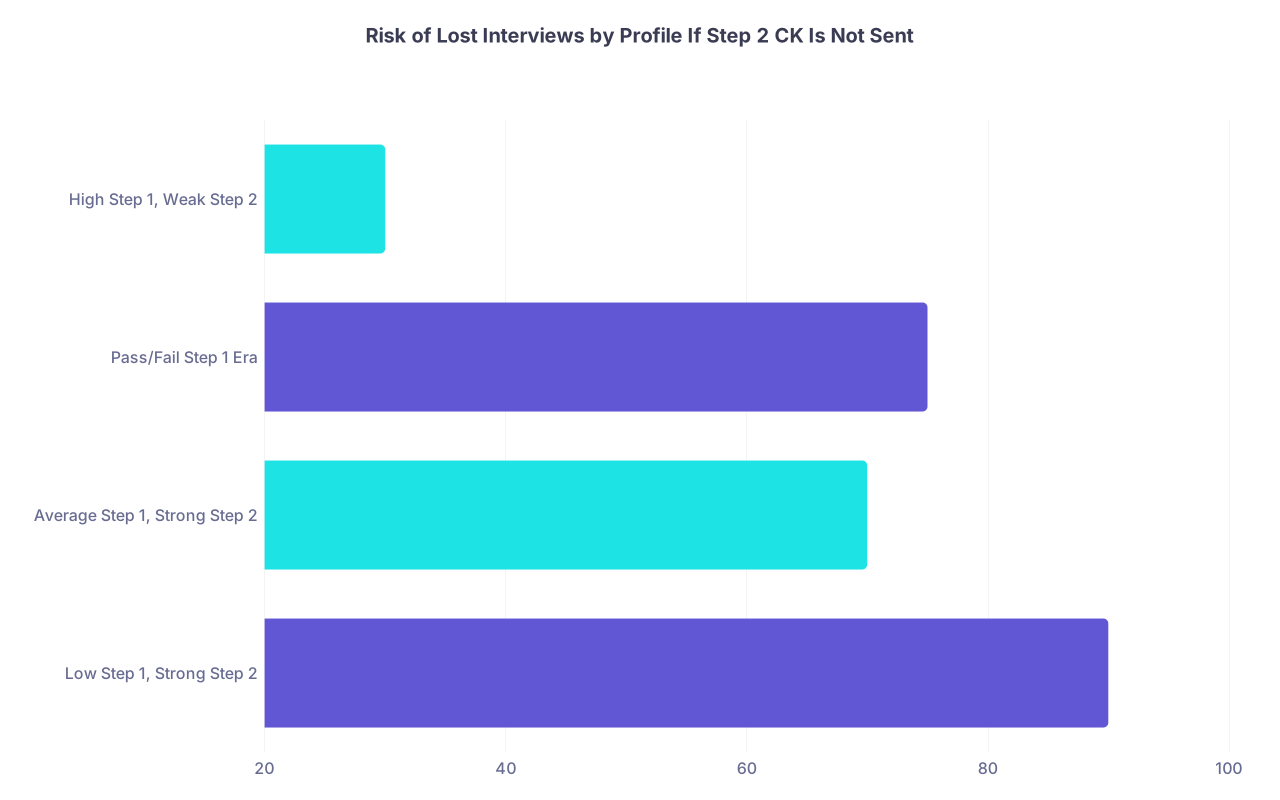
| Category | Value |
|---|---|
| Low Step 1, Strong Step 2 | 90 |
| Average Step 1, Strong Step 2 | 70 |
| Pass/Fail Step 1 Era | 75 |
| High Step 1, Weak Step 2 | 30 |
1. Low Step 1, Strong Step 2 CK
This is the classic redemption arc. Step 1: 205. Step 2 CK: 245. I have seen this profile get into very respectable internal medicine and anesthesia programs.
But here is the catch: it only works if programs actually see the 245.
If you:
- List “Step 2 CK planned” in ERAS
- Take it in late summer
- Then never send the updated score sheet
your file still looks like: marginal Step 1, no objective improvement, riskier hire.
Programs are not mind readers. They are busy. They have 50 other applicants with the same low Step 1 but clear evidence of improvement. Those people get your interview slot.
2. Pass/Fail Step 1 Era Applicants
If your Step 1 shows “Pass” only, Step 2 CK becomes the main standardized comparison tool. When that field is empty, you are a question mark. Programs do not like question marks.
Not sending a solid Step 2 CK here sends an unspoken message: either:
- You have not taken it (which worries them for board pass rates)
- Or you took it and did not do well (which scares them even more)
Either way, many programs will just move on.
3. Borderline or Average Step 1, Improvement on Step 2
Say Step 1: 220. Step 2 CK: 238. Not world-shattering. But a clear upward trend. It takes you from “average, maybe risky” to “growing, likely to pass boards.”
If that information is missing, you look stagnant.
4. IMG / FMG Applicants
For IMGs, numbers matter even more. Whether programs admit it or not, USMLE scores are a crude but heavily used filter.
I have seen IMGs with 250+ on Step 2 CK win interviews at mid-level university programs specifically because that score could not be ignored. If they had never sent that updated sheet? They would have been buried in the 1,000+ applicants with incomplete or weak data.
How Programs Actually Screen – And Where You Get Cut
Let us walk through how your missing Step 2 CK costs you in practice.

| Step | Description |
|---|---|
| Step 1 | Applications Received |
| Step 2 | Initial Filter |
| Step 3 | Low Priority Group |
| Step 4 | Reject or Hold |
| Step 5 | Review by Faculty |
| Step 6 | Interview Offer Pool |
| Step 7 | Maybe Later Review |
| Step 8 | Step 2 CK visible? |
| Step 9 | Score above cutoff? |
If your Step 2 CK is missing or not updated:
- You drop into the “low priority / incomplete” bucket (Box D / I)
- That bucket might get a cursory glance weeks later, if they have spots left
- For many programs, it never gets serious review
This is why your friend with similar extracurriculars got 12 interviews and you got 4. Not because you are worse. Because on paper, they looked safer and more complete.
Red Flags That You Are About to Make This Mistake
If any of these sound like you, you are in the danger zone:
- Your Step 2 CK score came out after you submitted ERAS, and you did not log back in to update score reporting.
- You are telling people, “I think it automatically updates” without confirming.
- You only mentioned your new score in a paragraph of your personal statement instead of the official score section.
- You took Step 2 CK close to or after ERAS opening and decided, “I will just let programs wait.”
- You assume your MSPE or dean’s office will send the updated score for you.
They usually will not. Or they will do it late. Or for only some programs.
How to Correctly Send and Highlight Your Updated Step 2 CK
Here is how to avoid being the applicant who quietly loses interviews over a technicality.

Step 1: Confirm It Is Officially Released
First, verify on the NBME / USMLE portal that:
- Your Step 2 CK score is posted
- The official PDF score report is available
If you only have an email notification and not a full score report, wait until the official report is ready.
Step 2: Update ERAS (or Your Relevant Application System)
Log into ERAS (or CaRMS, NRMP, etc., depending on your region) and:
- Make sure USMLE Step 2 CK is selected for release
- Confirm that “Score available” is reflected correctly
- If you are an IMG using ECFMG, verify that your updated USMLE transcript is processed and ready for transmission
Do not assume that ticking a box once in August covers a late September score. Check the actual transcript date.
Step 3: Check Which Programs Already Have Your Old / Incomplete Transcript
Here is where people mess up.
They think: “It is on ERAS now; everyone can see it.” Not always.
Some programs download transcripts early and do not refresh them often. That means they might have your “pre–Step 2 CK” version sitting in their system.
If ERAS or your portal shows when the transcript was last transmitted, check that date. If it predates your Step 2 CK score release, assume many programs do not have the updated version.
Step 4: Decide If You Need Direct Emails
For borderline or competitive situations, a direct short email to programs can help, especially:
- If you took Step 2 CK later than they usually prefer
- If your Step 2 CK meaningfully changes your competitiveness (e.g., +20 points compared to Step 1, or a very high score)
- If you are an IMG relying heavily on numbers
What you should not do: send a three-paragraph essay begging them to look at your new score. Keep it surgical.
Example structure:
- Subject: “Updated Step 2 CK Score – [Name], AAMC ID [#]”
- 2–3 concise lines: you recently received your Step 2 CK score, score value, improvement vs Step 1 if impressive, and that the official transcript has been updated in ERAS.
Then stop. No emotional story. No “Please please invite me.”
The Hidden Cost: Lost Second-Look Opportunities and Waitlist Movement
Not sending your updated Step 2 CK hurts you beyond the first wave of invites.
Programs often reorder their rank lists or invite additional applicants later in the season when:
- Someone cancels an interview
- They realize their current pool is weaker than desired
- They want to balance more strong test-takers for board pass rate security
Guess who gets pulled from the “maybe” pile during this phase?
Applicants with:
- Clear, strong Step 2 CK scores
- Demonstrated upward trends from Step 1
- No missing score data
If your Step 2 CK never made it into your file, you will not suddenly be “discovered” when they reconsider the pool. You will remain just another incomplete or average-looking file in a pile no one has time to re-review carefully.
Common Rationalizations That Will Hurt You
I hear the same flawed justifications repeatedly. Let us deal with them one by one.
“I do not want to draw attention to Step scores.”
You already did. The moment you listed Step 1 and Step 2 CK as “planned” or “pending,” programs know to look for them. Hiding a strong Step 2 CK does not reduce attention. It just keeps you looking incomplete.
“My Step 2 CK is not amazing, just slightly better.”
Example: Step 1: 222, Step 2 CK: 231. Not spectacular. But it still signals you can at least maintain performance and likely pass boards. Programs prefer an upward or stable trend.
Leaving that improvement unseen leaves you looking static. Static is risky.
“If they care that much, they will email me.”
No. They have thousands of applicants. Contacting you for updates is extra work with little upside when there are many applicants with fully visible, complete data.
“I am waiting for interview invites first, then I will share it selectively.”
By the time you realize invites are sparse, the first and often most important wave is over. Trying to rescue the season with a late score email in December is damage control, not strategy.
Who Can Get Away With Not Sending It?
Very few people, and even they are playing with fire.
Maybe:
- A US MD from a top-tier school
- With an already high Step 1 (pre–pass/fail)
- Applying to a less competitive specialty
- With insane research and home program backing
Even then, some PDs will privately ask, “Why is Step 2 CK missing? Did they bomb it?”
If that is not your profile, you do not have the leverage to treat Step 2 CK as optional information.
Quick Comparison: What Programs See With vs Without Updated Step 2 CK
| Scenario | What Your File Looks Like |
|---|---|
| Low Step 1, no Step 2 CK | Academically risky, likely to be cut |
| Low Step 1, strong Step 2 CK | Improved, worth an interview look |
| Pass Step 1, no Step 2 CK | Incomplete, unknown board risk |
| Pass Step 1, solid Step 2 CK | Safe bet for board pass rate |
| IMG, no Step 2 CK | Weak / incomplete, rarely prioritized |
| IMG, high Step 2 CK | Competitive on numbers, more viable |
You want to be in the right-hand column of those “with Step 2 CK” rows. Not sending your updated sheet drops you straight back into the left-hand column.
Timeline Traps: When Timing Makes This Mistake Deadly
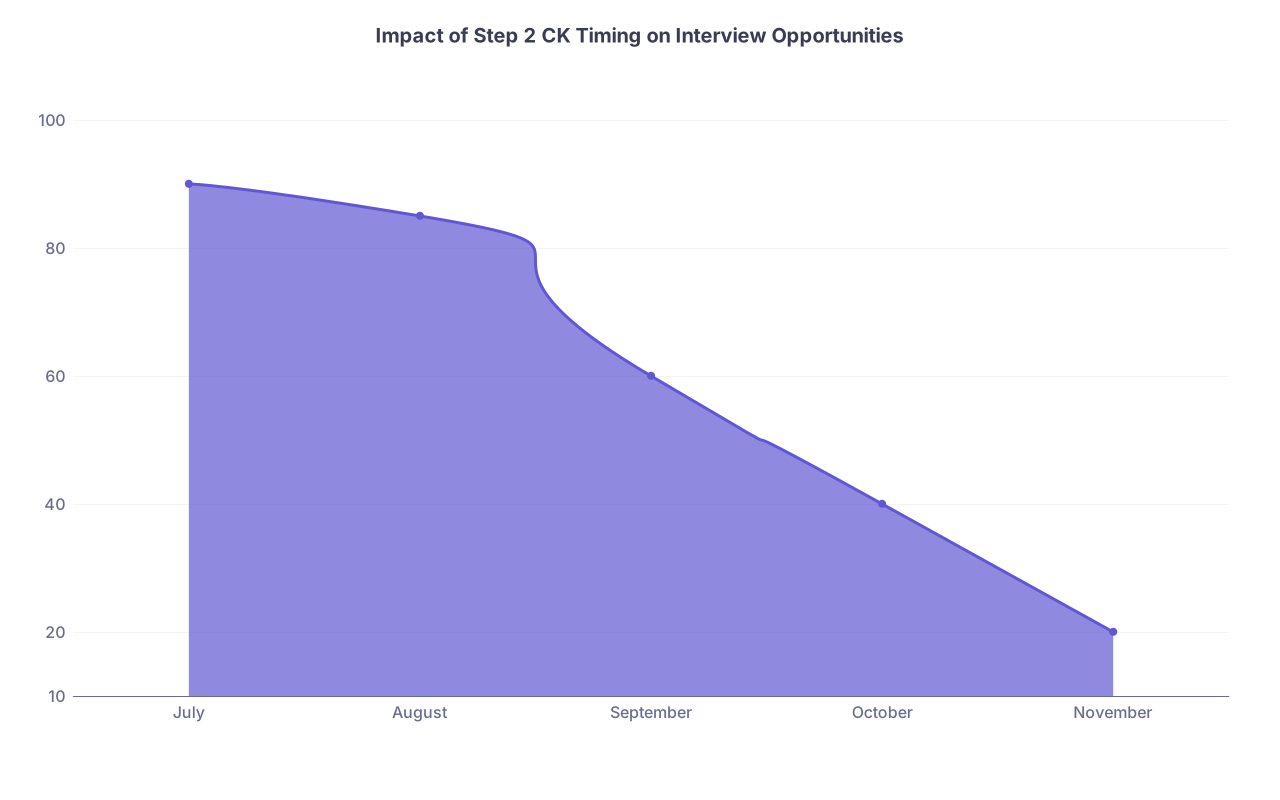
| Category | Value |
|---|---|
| July | 90 |
| August | 85 |
| September | 60 |
| October | 40 |
| November | 20 |
The later you take Step 2 CK, the more brutal the penalty if you do not update programs fast.
- July / Early August result: If you update ERAS promptly, you are fine.
- September result: You are already missing early filters at programs that pre-screen. Delay in sending this is costly.
- October or later result: You are playing catch-up. Not pushing the score out immediately almost guarantees you will miss prime interview windows.
If you have a late score:
- You cannot rely solely on automatic ERAS updates.
- You should strongly consider a concise email to key programs, especially your realistic and top-choice ones.
- You must ensure your updated USMLE transcript is actually transmitted, not sitting un-refreshed.
FAQs
1. My Step 2 CK is only a few points higher than Step 1. Should I still send it?
Yes. A stable or slightly upward trend is better than a blank space. Programs care about evidence that you can at least maintain performance and likely pass boards. Even a modest improvement signals no decline. Not sending it forces them to guess, and they tend to assume the worst.
2. What if my Step 2 CK is lower than Step 1? Will sending it hurt me?
Possibly, but hiding it is worse. Many programs now require a Step 2 CK score before ranking, especially in the pass/fail Step 1 era. If they discover a hidden low score late, it looks evasive. If you are significantly lower, you can emphasize strengths elsewhere, but you still need to release the score. An honest, slightly weaker score is less damaging than appearing incomplete or deceptive.
3. Do I really need to email programs, or is updating ERAS enough?
For many applicants, updating ERAS is sufficient, if done promptly and correctly. But if your Step 2 CK meaningfully boosts your competitiveness (big jump from Step 1, high score as an IMG, or late-part-of-season result), a short, professional email to selected programs helps ensure they actually notice it. Think of emails as targeted reinforcement, not a replacement for properly updating ERAS.
Key points to walk away with:
- A strong Step 2 CK that programs never see might as well not exist. Failing to send it costs interviews you could have had.
- Do not assume automatic updates. Confirm your ERAS/USMLE transcript is current and transmitted, and strategically highlight major improvements.
- In the current match environment, an “incomplete” or hidden Step 2 CK is treated as a liability. Do not make that avoidable mistake.