
The myth that a 250+ on Step 2 CK automatically makes programs love you is flat-out wrong.
I’ve sat with program directors as they rejected people with 255s and 260s. Not because the score was bad. Because everything around that score set off alarms.
Let me walk you through how this really works behind those closed-door meetings where they decide who gets invited, who gets ranked, and who quietly disappears into the “reject” pile.
The Hard Truth: A 250+ Is Impressive… But Not a Shield
Inside PD offices, a 250+ Step 2 CK is considered “strong” in almost every specialty. But that’s not the whole story.
Here’s the part students don’t like to hear:
We don’t look at the 250+ and say, “Done. Automatic interview.” We say:
“Okay, good score. Now, what’s wrong with this application?”
Yes, that’s literally how some PDs approach it. Especially in competitive fields. They start with your weaknesses, not your strengths. A great score buys you a closer look, not a free pass.
Where a 250+ can still raise concerns:
- When it doesn’t match the rest of your academic story
- When it smells like “overcompensation” for something else
- When it sits on top of red flags that you hoped the score would erase
So the real game is not “How high is your Step 2?” The game is “What story does your Step 2 tell in context?”
Scenario 1: Huge Step 1 → Step 2 Gap (And Not the Direction You Think)
Everyone worries about a low Step 1 and high Step 2. That usually helps you. What actually spooks PDs more is the opposite: a significantly lower Step 2 than expected for someone with a stellar Step 1.
But even with a high Step 2, there’s a nuance people miss.
When A 250+ Still Looks “Off”
Here are patterns PDs quietly talk about:
| Pattern Type | Example (Step 1 → Step 2 CK) |
|---|---|
| Expected growth | 225 → 245 |
| Big positive jump | 215 → 250 |
| Strong but flat | 245 → 248 |
| Slight concerning dip | 250 → 242 |
| Very high then moderate | 260 → 252 |
The problem isn’t the raw number. It’s the trajectory.
I’ve heard variations of this more than once in review meetings:
“If they tested at 260 once and now they’re at 250, what changed? Burnout? Effort? Personal issues?”
Is that always fair? No. Does it happen? Yes.
If your Step 2 is 250+ but:
- Your Step 1 was 260+, and
- Your MS3 clerkship comments describe “variable engagement” or “needs consistent motivation”
People start connecting dots you don’t want connected.
That said, if you improved from a mediocre Step 1 to a 250+ Step 2, that’s usually read as: “grit, maturity, clinical focus.” That works in your favor, especially in IM, FM, Peds, Psych, and even mid-tier Surgery programs.
The concern only comes when the score trend doesn’t fit the rest of the file. PDs hate inconsistency more than they hate imperfection.
Scenario 2: The “Score Monster” With No Substance Behind It
This is a profile every PD can describe:
- 252 Step 2 CK
- 3.2–3.3 clinical GPA
- Mostly “Pass” on rotations, maybe one High Pass
- Comments: “Quiet on rounds,” “Needs to improve ownership,” “Weak presentations”
- No real leadership, no ongoing projects, just a few random bullet points on the CV
Internally, this applicant is labeled: test-taker, not clinician.
I’ve watched an associate PD at a big IM program literally scroll straight past a 255 Step 2 because:
“Looks like they studied for tests and disappeared on the wards.”
Here’s the truth you won’t hear on Reddit: above a certain threshold, more points don’t help much. For many programs, that threshold is around 245–250. Above that, the marginal benefit of each extra point is tiny compared to:
- Strong narrative from letters
- Sustained excellence on core clerkships
- Good fit for the specialty
If the file screams “I live in UWorld and nowhere else,” that 250+ starts to look like a liability. It makes faculty ask: Do I want this person managing sick patients at 2 a.m., or just filling in answer bubbles?
Scenario 3: The 250+ Sitting Next to Quiet Red Flags
This is the most uncomfortable scenario, but it’s the one you need to understand.
I’ve seen this exact file in a selection meeting:
- Step 1: 231
- Step 2: 253
- One repeated clerkship (Surgery)
- Dean’s Letter: “Required additional time to meet clinical expectations in the OR”
- LOR from Surgery: “Ultimately met expectations after additional coaching”
On paper, if you only saw the scores, you’d think: “Safe.”
In the room, the reaction was: “No thanks.”
Programs will absolutely reject a 250+ Step 2 applicant if any of these are in the mix:
- Course/clerkship failures or repeats accepted without a compelling story
- Unexplained leave of absence
- Unprofessionalism comments (chronic lateness, attitude, poor communication)
- Pattern of “barely passing then acing exams”
The logic goes like this:
“They can crush a standardized test. Cool. Can they handle a service with 15 patients, 12 pages of notes, 20 messages, and an attending breathing down their neck? Because their actual performance history says… maybe not.”
If you have these soft red flags, a 250+ is not enough. You need to control the narrative hard through your personal statement, your MSPE/Dean’s letter, and—most importantly—your letters.
Scenario 4: Stepping Into the Wrong Neighborhood (Score vs Specialty Reality)
Now let’s talk mismatch. Program directors are ruthless about this.
In competitive specialties, a 250+ is just “fine.” Not “wow.” Not “we must have this person.” Especially for:
- Dermatology
- Plastic Surgery
- ENT
- Ortho
- Integrated Vascular or CT
- Some high-end Radiology and Anesthesia programs
Here’s what PDs actually see on their dashboards:
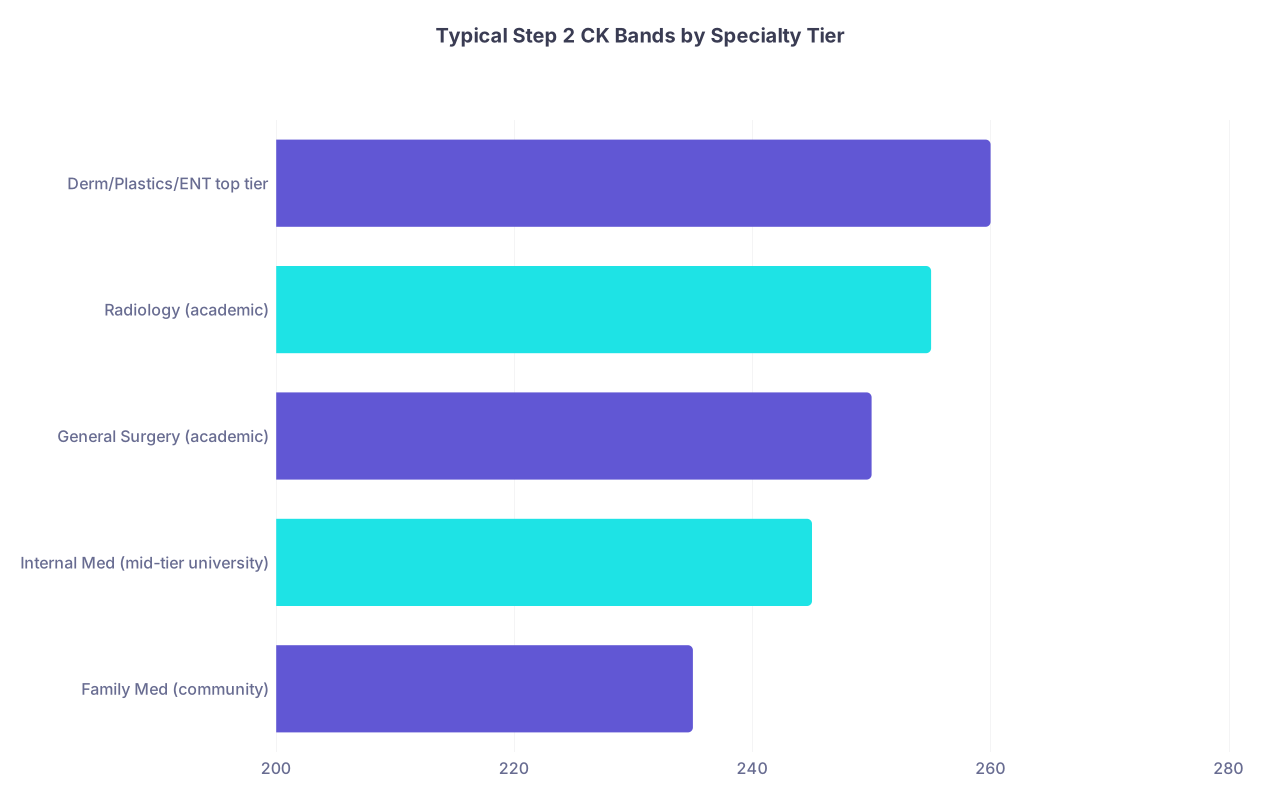
| Category | Value |
|---|---|
| Family Med (community) | 235 |
| Internal Med (mid-tier university) | 245 |
| General Surgery (academic) | 250 |
| Radiology (academic) | 255 |
| Derm/Plastics/ENT top tier | 260 |
So a 252 for Derm? In that world, you might be below the median for many places. That doesn’t mean you’re dead. But it means the score alone won’t pull you into contention without:
- Serious research with publications
- Strong mentorship letters from known names in the field
- Departmental advocacy from home or away rotations
PDs notice when you chase a tier that doesn’t match the rest of your file. If you have:
- 252 Step 2
- No home program in that competitive field
- Minimal or late research
- Generic letters
They interpret that as unrealistic judgment. And they don’t want residents who can’t read the room.
On the flip side, if you’re applying IM, Peds, Psych, FM, or mid-tier EM or Anesthesia with a 250+, now your score really means something. That’s when a high Step 2 gets you flagged as “top of the stack” if your application isn’t leaking elsewhere.
Scenario 5: Step 2 Timing and the “Why Did They Wait?” Question
Here’s another ugly truth: timing games make PDs suspicious.
I’ve heard conversations like:
“They sat on Step 2 and uploaded in December. Why? Boards anxiety? Barely passed? Were they trying to hide a mediocre score until after interview invites?”
Even with a 250+, a late score can raise questions. The thinking:
- If the score is strong, why wait?
- If they delayed to boost their app, were they struggling clinically and over-focusing on tests?
- Were they trying to hedge a weak Step 1 or bad clerkships and hoping the number would rescue them?
Is that always true? No. Plenty of people have legitimate reasons: illness, scheduling chaos, late MS3 year, etc. But when PDs are scanning hundreds of applications at 11 p.m., they’re not doing forensic analysis on your life. They’re making quick judgments.
You want your strong Step 2 visible early in the process, not trickling in after most interview invites are already sent.
Scenario 6: The 250+ With Terrible Fit
Another thing students underestimate: PDs obsess over “fit.” That word is overused but very real.
And yes, your 250+ can actually hurt you here if it makes you look like a flight risk.
Think about it from their perspective. A mid-tier community program in the Midwest sees:
- Step 2: 257
- Top 20 med school
- A couple of brand-name research projects
- Personal statement talking about academic medicine and global health
- All away rotations at coastal, big-name academic centers
The PD looks at this and says:
“We are not this person’s first choice. Or second. Or tenth.”
So even though the score is great, they may not invite you because they assume you’ll rank them low or not at all. They’d rather spend an interview spot on someone with a 238 who clearly wants to be there and fits their profile.
Fit flags that cancel out a great Step 2:
- Personal statement clearly targeted to highly academic, research-heavy programs
- No geographic or personal connection to the region, and you didn’t explain why you’re applying there
- Letters from only “elite” settings and nothing community-oriented
- CV that screams “I want to be a superstar academic in a big city” while applying to small or rural programs
Your Step 2 becomes just another piece of evidence that you’re “too competitive” for them. That’s a real phrase people use in rank meetings.
Scenario 7: When Attitude and Red Flags Trump Numbers
Let me be blunt. Nothing dies faster in a rank meeting than “Great score, weird person.”
I’ve seen this:
- Candidate with a 254 Step 2
- Interviewed at a strong academic IM program
- Came across as arrogant, dismissive of community hospitals, irritated by questions about work-life balance
In the debrief, one faculty said:
“I don’t care what they scored. I am not spending three years working with that.”
They pushed that applicant near the bottom of the rank list. Meanwhile, someone with a 238 who was thoughtful, humble, and clearly coachable jumped ahead.
Here’s the part nobody tells you directly: once your Step 2 is “good enough” for a program’s baseline (usually somewhere in the 235–245+ range), your interpersonal performance becomes the main filter.
If your application already screams “I’m a test score and not much else,” interview missteps reinforce that bias. Then your 250+ actively works against you. You look like the stereotype: “brilliant and impossible to work with.”
How PDs Actually Weigh a 250+ Step 2 CK
Let me break down how PDs mentally bucket a strong Step 2 when they’re reviewing piles of apps.
Roughly, the inner monologue looks like this:
- “Score over 250. Okay, they’re academically solid. I don’t have to worry about them passing boards.”
- “Now, do they look like a problem?”
- Any failures? Repeats? Unprofessionalism? Big red flags in MSPE?
- “Do they fit our program?”
- Geography, type of hospital, academic vs community, vibe from personal statement
- “What do the letters say?”
- Hard worker vs “book smart but passive”
- “If I give them an interview, is there a non-zero chance I’d want them managing my patients at 3 a.m.?”
If the answer to #2–5 is no, then the 250+ doesn’t save you. It just becomes a frustrating detail in an otherwise rejectable file.
What To Do If You Have a 250+ and You’re Worried
Let me be practical now.
1. Be Honest About Your Weak Spots
Look at your app the way a slightly cynical PD would:
- Any failures or repeats?
- Consistent Honors / High Pass in core clerkships, or a lot of “Pass”?
- Any comments about professionalism, communication, or reliability?
- Weak or generic letters?
Pretending these don’t matter because you have a good score is how people get burned on Match Day.
2. Fix the Narrative, Not the Number
You can’t change your Step 2 now. But you can:
- Get at least two letters that explicitly talk about your work ethic, reliability, and growth
- Use your personal statement to address legitimate bumps (succinctly, without sounding defensive)
- Have your advisors advocate for you to programs where you’re a realistic fit
- Choose programs that actually match your profile, not just their brand name
Programs forgive a lot when the story hangs together: “Improved over time, takes feedback, shows up, good with patients.”
3. Be Strategic With Where You Apply
A 252 Step 2 does not make you an automatic fit for the most elite programs. But it can make you a top candidate at solid mid-tier academic or strong community programs—if your behavior and letters back it up.
You want to land where your score is an asset, not an expectation you have to constantly live up to.
FAQ: Inside the PD Mind on Step 2 CK
1. Is there any Step 2 score above which PDs stop caring about the exact number?
Yes. Once you’re above a certain bar (often ~245–250, depending on specialty), the difference between 252 and 262 doesn’t move the needle much. At that point, letters, clerkship performance, professionalism, and fit matter way more. Hyper-fixating on squeezing out 3 more points is far less valuable than getting a killer letter or a strong away rotation.
2. Does a big jump from Step 1 to Step 2 ever worry PDs?
Generally no—big improvements from Step 1 to Step 2 (like 218 → 250) are seen as a positive trajectory. The only time it raises questions is if your clinical performance and comments don’t match that improvement. If your test scores say “star” but your ward behavior says “bare minimum,” then they start wondering what’s real.
3. Can a 250+ overcome a failed class or repeated clerkship?
Not by itself. Programs will want to see a clear explanation, clear improvement afterward, and strong support in your MSPE and letters. If a repeated clerkship ends with “performed at or above expectations thereafter” and your Step 2 is strong, many programs will give you a chance. If the narrative is hand-wavy or defensive, the score will not save you.
4. How late is “too late” for Step 2 if I’m aiming for interviews?
If your score—especially a strong one—does not hit ERAS until November or December, many programs will have already sent most invites. A 250+ uploaded early in the season can bump you into the “interview” pile. The same 250+ in December might just be a “good to know” detail for rank meetings—if you even got an interview in the first place.
5. For mid-tier programs, can a 250+ actually hurt me as a “flight risk”?
Yes, it can. If your app screams “I belong at a coastal academic powerhouse” and you apply to a small or mid-tier community program with no explanation, they may quietly assume you’re using them as a safety and that you’ll rank them low. If you want those programs seriously, you have to show it—through your personal statement, geographic ties, or direct communication—so that your high score looks like a strength, not a warning sign.
Key takeaways:
A 250+ Step 2 CK is a strong score. But it is not a magic eraser. Program directors use it to confirm you can handle boards, then immediately scan for red flags, fit issues, and evidence of who you are on the wards. If the rest of your application is inconsistent, weak, or misaligned with the programs you’re chasing, that impressive number turns into a frustrating footnote—not a golden ticket.