
What happens when a program director pulls your ERAS application, looks at your Step 2 CK section, and something doesn’t add up?
I’ve watched it happen. PD scrolling. Frowning. Then the quiet line that should terrify you:
“Why doesn’t this match what they wrote in their personal statement?”
That’s how trust dies in 10 seconds.
This isn’t about whether your Step 2 CK score is “good enough.”
This is about whether you look sloppy, evasive, or dishonest when you report it.
Let’s walk through the ways applicants screw this up and make PDs question them—sometimes permanently.
Why Step 2 CK Reporting Is Under a Microscope Now
Step 1 went pass/fail. PDs want a number to anchor your application. Step 2 CK became that number.
So they stare at it. Hard.
Not just the score. The timeline, the context, and how you report it across:
- ERAS
- MSPE (Dean’s Letter)
- Transcript
- Your CV
- Personal statement
- Email communications
If there’s a mismatch? They assume one of three things:
- You’re careless.
- You’re hiding something.
- You don’t respect details—which in medicine is a big red flag.
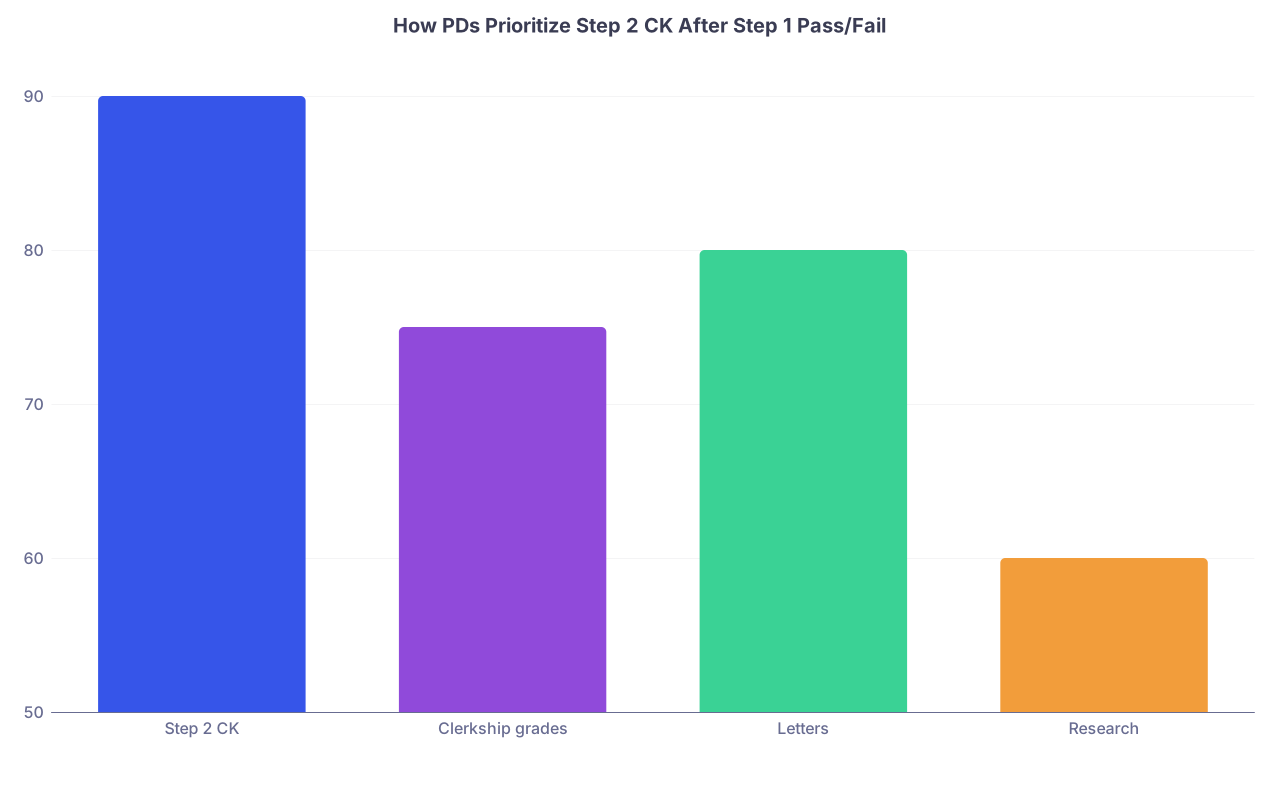
| Category | Value |
|---|---|
| Step 2 CK | 90 |
| Clerkship grades | 75 |
| Letters | 80 |
| Research | 60 |
The mistake you must avoid: thinking “Eh, it’s all in there somewhere, they’ll figure it out.”
No. They won’t chase down your truth. They’ll just not rank you.
Mistake #1: Inconsistent Scores Across ERAS, CV, and Personal Statement
This is the classic “I tanked my credibility with one lazy edit” mistake.
How people screw this up
You’d be surprised how often I see:
- ERAS: Step 2 CK – 252
- CV (PDF upload): Step 2 CK – 248
- Personal statement: “Proud of improving from a 240 on Step 1 to a 245 on Step 2 CK”
- Transcript: 248
It happens because:
- They used an old draft of their CV.
- They copy–pasted from an earlier email or school form.
- They “rounded” or remembered wrong.
- They rewrote personal statements and forgot to update numbers.
To a PD, this doesn’t look like “small typo.” It looks like:
“If you can’t keep your own one exam score straight, what else are you sloppy about?”
How to avoid looking unreliable
Do this once, right after your official score is released:
Open your NBME/USMLE official score report.
Write down the score exactly as listed.
Update every single location where scores appear:
- ERAS Step exams section
- CV (Word and PDF versions)
- Personal statement(s)
- Any school application portal or supplemental forms
- Prewritten email templates (if you mention scores)
Save a “final” master file with the correct score. Mark older versions as “OLD – DO NOT USE”.

Hard rule:
- Never “estimate” or “remember” your score from memory in written documents.
- Always confirm from the actual PDF.
Mistake #2: Hiding a Low Step 2 CK Score With Vague Language
This one PDs are hypersensitive to. Because they’ve seen it too many times.
The red flag phrases
Applicants write things like:
- “I’m pleased to have passed Step 2 CK.”
- “I recently completed Step 2 CK and am proud of my performance.”
- “I showed resilience and improvement on Step 2 CK.”
But… no number.
When a PD reads that, their brain translates it as:
“Score is bad. Applicant is dodging the number.”
And they’re usually right.
Step 2 CK is not optional data. If you’re going to mention it in your personal statement, email, or interview, use the actual number or don’t bring it up at all.
When you think you’re being clever—but aren’t
Some applicants with a 220–225 for a competitive specialty try to “soften” it:
“I improved from a borderline Step 1 performance and was pleased to pass Step 2 CK with a solid score.”
PDs have seen that exact phrasing hundreds of times. It’s coded language for “score under your average resident.”
It doesn’t make your score look better. It makes you look evasive.
The right way to handle a weaker score
Be direct, be precise, and then move on:
- “I scored 223 on Step 2 CK, which reflects a significant improvement from my earlier foundational struggles. More importantly, my clinical evaluations and sub-internship performance show how I apply knowledge with consistency on the wards.”
Or don’t mention it at all in the statement and let your ERAS speak for itself. But:
- Never half-mention Step 2 CK without the number.
- Never describe it with fluff adjectives and no data.
Mistake #3: Mishandling Fails, Retakes, and Score Delays
PDs will forgive a failure more easily than they’ll forgive lying or games around a failure.
The problem isn’t the red mark. It’s the cover-up.
Common self-sabotaging moves
I’ve seen:
- Applicants omitting a failed Step 2 CK from their CV while it clearly appears on the transcript.
- Listing only the most recent score and pretending the fail never happened.
- Blaming “technical issues” with vague language: “There were complications with my first attempt.”
That last one is especially suspicious. PDs have heard horror stories of applicants blaming “computer glitches” when they simply failed.
How your attempt history actually looks to PDs
They see:
- Number of attempts
- Each score
- Timing
If your ERAS says:
- “Step 2 CK: 238 (Passed)”
…but your transcript shows:
- Attempt 1 – Fail
- Attempt 2 – 238 (Pass)
They’re not mad about the first fail. They’re mad you tried to hide it.
How to handle non-passing attempts the non-stupid way
You must:
- Be factually accurate in ERAS: it will display attempts and outcomes.
- On your CV, if you list scores, include attempts honestly:
- “USMLE Step 2 CK: 238 (second attempt)”
If asked about it in a statement or interview, avoid drama, avoid stories, and avoid 2-page essays about your feelings:
- Brief context
- Clear ownership
- Concrete improvement
Example:
“I failed Step 2 CK on my first attempt during a period of personal instability that I handled poorly. I adjusted my study structure, sought mentorship, and passed on the second attempt with a 238. That process directly led to the disciplined routine I used to excel in my sub-internships.”
What you don’t do:
- Blame Prometric.
- Blame your school.
- Act like the fail is a mystery.
Mistake #4: Timing Games and Vague “Score Pending” Statements
Here’s the ugly truth: some applicants try to play chicken with PDs.
They take Step 2 CK late, hover over the “release scores to ERAS” button, and think:
“If it’s high, I’ll release it. If not, I’ll pretend I’m still waiting.”
PDs have seen this pattern so many times it’s practically its own red flag.
Where people get burned
Typical scenario:
- ERAS says: “Step 2 CK: Pending”
- Your MSPE: mentions “Completed Step 2 CK in August”
- It’s now November.
- No score.
The program coordinator: “If they took it in August, the score exists. Why are we not seeing it?”
PD conclusion: “They’re hiding a bad score, and they think we’re too stupid to notice.”

| Step | Description |
|---|---|
| Step 1 | Take Step 2 CK |
| Step 2 | Scores visible to programs |
| Step 3 | Score pending on ERAS |
| Step 4 | Less suspicion but still vague |
| Step 5 | PD suspects hiding score |
| Step 6 | Application trust drops |
| Step 7 | Release score quickly |
| Step 8 | MSPE mentions exam date |
Reasonable vs suspicious timelines
- Took exam late September → score pending in mid-October → reasonable
- Took exam in July → still “pending” in November → they know you’re gaming it
If there’s any legitimate delay (investigation, hold, identity issue), you say that clearly when appropriate, not “oh yeah, I just haven’t decided to release it yet.”
Clean way to handle timing
- Plan to have Step 2 CK taken and reported before apps if you’re in a competitive field or have a borderline Step 1.
- Once score is released, immediately release it to ERAS.
- If there is a genuine NBME/USMLE delay or review:
- Inform your school.
- Be ready to explain concisely if directly asked.
- Do not make vague “complications” comments in writing without specifics.
Mistake #5: Sloppy Reporting of Score Date and Sequence
Most applicants forget PDs don’t just look at your number—they look at when you took it.
And whether your story makes chronological sense.
The subtle inconsistencies that kill confidence
I’ve seen:
- Applicant says in personal statement: “After receiving my Step 2 CK score in October, I dedicated the rest of fourth year to strengthening my clinical skills on sub-internship.”
- MSPE timeline: Step 2 CK taken in January.
- ERAS: Score release February.
Or:
- Says: “My Step 2 CK performance, taken before most of my third-year clerkships…”
- But transcript shows exam taken after core rotations.
Some of you are making these mistakes because you’re bad with dates. PDs don’t know that. They’re seeing someone who can’t keep their life timeline straight.
Why the exact timeline matters
Step 2 CK timing tells PDs:
- Did you procrastinate out of fear?
- Did you take it after all major rotations (advantage)?
- Did you delay it to give yourself more study time?
- Did you have clinical grades already when you took it?
If your words contradict your official documents, it doesn’t matter why. It looks dishonest.

What to do instead
- Before mentioning Step 2 CK timing anywhere (personal statement, emails):
- Open your official report.
- Note the test date and report date.
- Use simple, accurate phrasing:
- “I took Step 2 CK in July after completing my core clerkships.”
- “I received my Step 2 CK score in September, early in fourth year.”
If you can’t remember exact months, don’t invent them. Use relative phrases that can’t be disproven:
- “After most of my core clerkships”
- “Before starting my sub-internships”
Mistake #6: Editing Your Story Between Programs and Getting Caught
Here’s where people get a little… sneaky. And PDs talk.
The “custom story per program” trap
Some applicants try to tailor their Step 2 CK “narrative” differently across programs:
- To competitive academic programs:
- “My 252 Step 2 CK score reflects my interest in academic medicine and complex cases.”
- To community programs:
- “My 252 Step 2 CK score isn’t the most important part of my application; I’m proudest of my clinical work ethic.”
That part is fine. Tone shifting is normal.
Where they get into trouble is with inconsistent explanations for:
- A poor score
- A fail
- A large delay
- A late exam
One PD hears: “Family illness affected my Step 2 CK preparation.”
Another: “I struggled initially with test anxiety and time management.”
A third reads in your statement: “Balancing heavy leadership roles during my Step 2 CK preparation taught me time management.”
You look like someone just picking whichever excuse plays best.
And yes—PDs do talk. Same specialty, same region, same interview trail? Your story will get compared.
| Situation | Inconsistent Story Snippets | Consistent Story Snippet |
|---|---|---|
| Step 2 CK fail | Family illness / anxiety / leadership | One clear reason, same phrasing everywhere |
| Late exam timing | “Planned gap year” vs “schedule issues” | “School schedule pushed me into late summer” |
| Score dip | “Test day issue” vs “content gap” | “Underestimated question style, corrected” |
The right way: one story, told briefly, the same way
If you must explain any Step 2 CK irregularity:
- Choose the true, primary reason.
- Phrase it once.
- Reuse the same explanation—almost word for word—everywhere it comes up:
- Personal statement (if you must)
- Interview answers
- Advisor letters (if aligned)
- Emails if directly asked
You’re not being robotic. You’re being consistent. That’s what PDs trust.
Mistake #7: Overexplaining or Emotionally Dumping About Your Score
PDs are not your therapist. They’re not looking for a three-paragraph emotional saga about your Step 2 CK journey.
I’ve read personal statements where:
- Half the statement is about the exam.
- The tone is “this score ruined my life.”
- Every paragraph circles back to Step 2 CK like a black hole.
It screams fragile.
Signs you’re oversharing about Step 2 CK
- More than 2–3 sentences in your personal statement about it.
- You mention it in multiple parts of the statement (intro + middle + conclusion).
- You use words like “devastating,” “crushing,” “traumatizing” to describe the exam.
- Every “resilience” story you tell is about test prep.
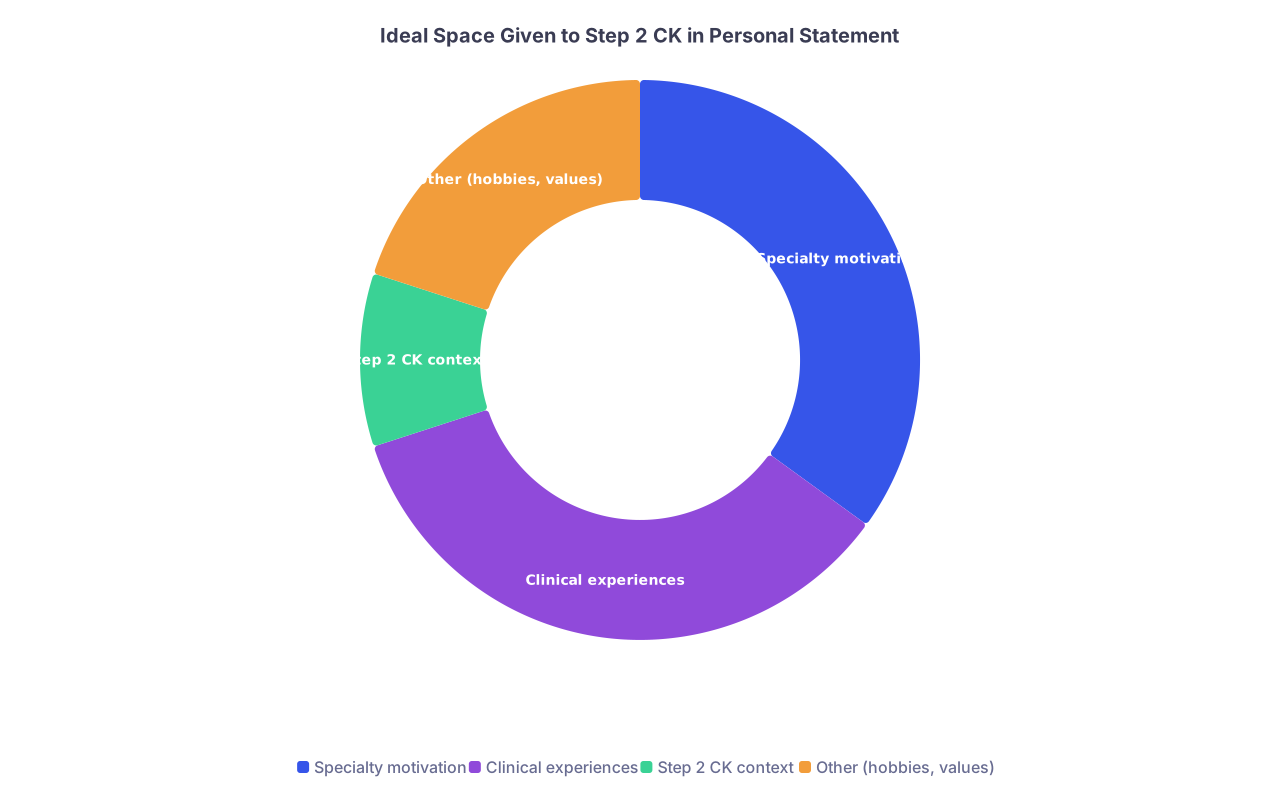
| Category | Value |
|---|---|
| Specialty motivation | 35 |
| Clinical experiences | 35 |
| Step 2 CK context | 10 |
| Other (hobbies, values) | 20 |
Your Step 2 CK story should never swallow your whole application.
What PDs actually care about
- Are you honest about your score and attempts?
- Are you stable under pressure?
- Did you learn something that shows up as better performance on the wards, not just higher practice QBanks?
So:
- Mention once, with context if needed.
- Show how the outcome is reflected in your current behavior, not your feelings.
Example of appropriately brief:
“I scored 226 on Step 2 CK, lower than I had aimed for. I responded by tightening my clinical preparation and feedback routines, which directly contributed to strong evaluations and honors in my sub-internships.”
Then stop. Move on.
Mistake #8: Ignoring How Step 2 CK Interacts With Your Whole Application
The worst reporting error isn’t a typo. It’s presenting your Step 2 CK in isolation and pretending PDs won’t cross-reference it.
They absolutely do.
Programs look at Step 2 CK in the context of:
- Step 1 (even if pass/fail, the comments and timing matter)
- Shelf scores
- Clerkship grades
- Sub-I performance
- Class rank (if provided)
They’re scanning for coherence:
- Strong Step 2 CK + weak clinical evals → “Great test taker, poor clinician?”
- Average Step 2 CK + stellar evals, leadership, and letters → “Solid resident candidate.”
- Big jump from Step 1 to Step 2 CK → “Maturity and growth.”
- Big drop from Step 1 to Step 2 CK → “What happened?”

The subtle reporting mistakes here
- Bragging about your Step 2 CK like it compensates for multiple failed rotations. It doesn’t.
- Writing: “My Step 2 CK score demonstrates my strong clinical reasoning” when your clinical evaluations say the opposite.
- Claiming: “Step 2 CK helped confirm my readiness for residency” when you took it late and barely passed.
They’re not looking for spin. They’re looking for alignment.
So if your Step 2 CK is your strength—fine. Highlight it.
But make sure your words match your record.
FAQ: Step 2 CK Score Reporting Errors
1. Should I include my Step 2 CK score in my personal statement at all?
Usually no. Programs already see it on ERAS and your transcript.
Include it only if:
- You’re explaining a noticeable discrepancy (big jump or drop), or
- Your Step 2 CK is a clear outlier strength for an otherwise unremarkable record.
If you include it, be exact, be brief, and do not build your whole essay around a test score.
2. What if I made a small typo in my CV score and already submitted ERAS?
If the difference is minor (e.g., 247 vs 248), you still fix it. Here’s what to do:
- Correct all future versions immediately (PDF, Word, any portal uploads).
- If you uploaded the wrong CV to ERAS, upload a corrected version and label it clearly (e.g., “Updated CV – Corrected Step 2 CK score”).
- Do not spam programs with apology emails over a 1–2 point typo, but be ready to own it calmly if asked.
3. I failed Step 2 CK once but now have a solid score. Should I explain it in my personal statement?
Only if:
- You’re in a competitive specialty, and
- You can explain it concisely with clear improvement.
Do not turn your statement into a failure memoir. One short paragraph is enough.
If your later performance (shelves, sub-Is, letters) is strong, let those carry most of the weight.
4. Can I ask my school to hold my Step 2 CK score from MSPE if it’s low?
Almost never. Most schools have fixed policies: if the score exists by a certain date, it goes in.
Trying to “negotiate” this looks desperate and usually gets back to advisors who will not be amused.
Your energy is better spent:
- Strengthening other parts of your application.
- Getting strong letters.
- Applying smartly to a realistic spread of programs.
5. If my Step 2 CK score is pending, should I email programs when it releases?
Yes, if:
- You applied to them already,
- The score is meaningfully helpful (e.g., strong for your specialty, or significantly better than Step 1/pass concerns).
Keep it short:
“I wanted to share that my Step 2 CK score was released this week: 246. I’ve updated ERAS to reflect this. Thank you for your consideration.”
No attachments. No essays. Just the data.
Key points to walk away with:
- PDs don’t just judge your Step 2 CK score—they judge how you report it. Inconsistencies and vagueness are bigger red flags than a mediocre number.
- Use one accurate, consistent story about your Step 2 CK (score, timing, attempts) everywhere. No games, no spin, no emotional dumping.