
Only 27% of applicants with a Step 2 CK ≥255 actually adjust their rotation and letter strategy based on their systems score breakdown.
The rest just quote the three-digit score and hope programs “get the picture.” They do not. Programs are busy, risk‑averse, and pattern‑driven. You have to show them the pattern.
Let me break this down specifically: your Step 2 CK systems score profile is one of the most underused tools for targeting away rotations, tailoring letters of recommendation, and even choosing which programs to prioritize on your list. If you are still thinking of your score as a single number, you are playing a shallow game in a very deep pool.
1. What Systems Scores Actually Mean (And Why Programs Care More Than You Think)
Step 2 CK is reported to you as a three‑digit score. But behind that, NBME slices your performance by:
- Content area (e.g., internal medicine, surgery, pediatrics)
- Physician tasks (e.g., diagnosis, management)
- Organ systems (e.g., cardiovascular, GI, musculoskeletal, psychiatry, OB/GYN)
Most people glance at it once, say “oh, I’m weaker in psych,” and move on. That is lazy analysis.
Programs do not see your full NBME performance breakdown. But they infer it from two places:
- How you perform and are described on rotation
- How convincingly your application “matches” your supposed strengths
Your systems profile is your internal map. You use it to choose where to show up and shine so that the letters and rotation narratives align with what your Step 2 CK data say you are good at.
Here is the principle:
You are not trying to convince programs you are good at everything. You are trying to create a coherent, believable story of clinical strength that maps onto the specialty you want.
2. Reading Your Systems Profile Like a Program Director
Stop thinking “I got a 246, that is who I am.” For this exercise, ignore the total score. Focus on the subscores, relative to each other.
You are looking for three things:
- Systems where you are clearly above your own average
- Systems where you are clearly below your own average
- Patterns that align (or clash) with your target specialty
Step‑by‑step way to interpret your breakdown
You will have something like:
- Cardiovascular
- Respiratory
- GI
- Renal
- Musculoskeletal/skin
- Endocrine
- Neuro
- Psych/behavioral health
- Women’s health
- Pediatrics, etc.
Each is shown as a bar relative to test takers. Do this:
Identify your “top tier” systems
Anything clearly in the “higher” or “very high” band. For a 240–250 scorer, that might be 3–4 systems. For a 260, it might be most of them, but still with relative differences.Identify your “liability” systems
Not just “low” compared to national, but low relative to your other systems. If everything is high except psych, psych is a liablity comparatively even if it is still “average” nationally.Map systems to specialties
This is where students are sloppy. You do not need to be strong in all cardiac to go into cardiology, but it helps if your cardiovascular and internal medicine–related management domains are clearly strong.
Here is a concrete mapping table to keep it grounded.
| Target Specialty | Systems/Areas That Quietly Matter Most |
|---|---|
| Internal Medicine | Cardiovascular, Respiratory, Renal, Endocrine, Hematology/Oncology, Infectious Disease |
| General Surgery | GI, Musculoskeletal/Skin/Soft Tissue, Trauma, Perioperative Management |
| Pediatrics | Peds, ID, Respiratory, Development/Behavior, Neonatal |
| Psychiatry | Psych/Behavioral, Neuro, Substance Use, Ethics/Communication |
| OB/GYN | Women’s Health, Endocrine, Hemorrhage/Acute Care, Fetal/Newborn |
| EM | Trauma, Cardiovascular, Respiratory, Toxicology, Procedures/Acute Mgmt |
If your systems strengths and your career interest are completely misaligned, you have two choices:
- Reconsider specialty, or
- Use rotations and letters to show that your “on paper” profile underestimates your clinical performance in that domain.
Both are valid. But you have to choose intentionally, not by inertia.
3. Using Systems Scores to Target Rotations: Not All Auditions Are Equal
This is where almost everyone leaves money on the table. They schedule away rotations based on geography, reputation, or timing. Not on where they can win given their Step 2 CK profile.
You should use your systems profile to make three decisions:
- Which type of programs to target (academic vs community, strong vs weaker in certain subspecialties)
- Which specific rotations to request or stack
- Where you need to quietly repair a narrative weakness
3.1. Targeting programs based on your profile
Say you are applying Internal Medicine with this Step 2 CK profile:
- Strong: Cardiovascular, Renal, Endocrine, ID
- Average: GI, Heme/Onc
- Weaker: Psych, Women’s Health, Pediatrics (all still within pass territory, just clearly lowest)
You have two strategic moves:
- Pick programs that pride themselves on complex medical management: big academic IM programs, strong ICU experiences, transplant centers, VA systems.
- Avoid overexposing yourself on rotations where your weaker systems are center stage unless you are actively trying to rehab that weakness.
Smart use case: You request an ICU month, a CCU (cardiac) month, and a general medicine ward month at a program with strong heart failure and renal services. Your evaluations will naturally lean into what Step 2 CK already proves you do well.
Compare that to a student who signs up for:
- One random “International Elective”
- One Outpatient Primary Care at their home institution
- One Endocrine research month
They get generic letters that say “hard-working” and “pleasant.” You get a letter that says “excelled on CCU handling complex multi-system shock cases; unusually strong clinical reasoning for level.”
That is not subtle. Programs notice.
3.2. Choosing specific audition rotations
Think in terms of showcase vs patchwork.
Showcase rotations:
Rotations that amplify your existing strengths and let you rack up concrete, memorable wins. These should align with your best Step 2 CK systems.
Patchwork rotations:
Rotations that help you address a clear weak area that might raise program concerns if completely ignored.
Example: Applying EM with this Step 2 CK pattern:
- Strong: Trauma, Cardiovascular, Respiratory, Renal
- Weaker: Peds, Psych
You might structure fourth year like this:
- August: EM audition at Program A — main ED (showcase)
- September: EM audition at Program B — trauma‑heavy site (showcase)
- October: Pediatric EM at home institution (patchwork, also covers weakness)
- November: Inpatient psych consults (patchwork, also genuine skill builder)
Now your application screams:
“Yes, my Step 2 CK shows relative weakness in peds and psych. I knew that. I went and fixed it clinically. Here are concrete attending comments to prove it.”
You have taken a liability and preemptively managed it.
3.3. Geographic and program competitiveness targeting
Your systems performance can help you avoid overreaching or underreaching.
- If your overall Step 2 CK is just at the average for your specialty, but your systems relevant to that specialty are clearly strong, you can still realistically target mid‑tier academic and strong community programs.
- If your overall score is high but your specialty‑critical systems are mediocre, you may need to prioritize programs that value “holistic” impressions and strong clinical letters more than raw board strength in that narrow domain.
For example, an applicant to OB/GYN with 260 overall but only “average” women’s health and endocrine may have a harder time at the hyper‑academic places that expect Step 2 CK to match their specialty rigor. A regional academic program with strong mentorship and emphasis on teaching can be a better fit if your letters strongly counterbalance the subscore.
4. Designing Your Letter Strategy Around Systems Strengths
Most students think “I just need three strong LORs.” Not precise enough. You need:
- At least one letter that matches your specialty’s core systems profile
- At least one letter that addresses any glaring mismatch between your Step 2 CK and your target specialty
- If possible, a letter that speaks to progression: “I saw this student improve this specific area”
4.1. Match letters to systems, not just to departments
Say you are going into Internal Medicine.
Lazy version:
- One letter from IM ward attending
- One letter from cardiology elective
- One letter from research PI
Strategic version (assuming strong cardio/renal/endocrine subscores):
Medicine ward attending at a site heavy in complex multi‐system cases
Ask them explicitly to comment on your reasoning with cardio–renal–endocrine overlap, ICU cross‑over, etc.Cardiology or Nephrology attending with a reputation for being demanding
Ask them to comment on both knowledge and ability to manage unstable patients.A subspecialty or ICU attending who saw you independently handle cross‑cover calls or step‑up care decisions.
This reinforces the systems‑driven management strengths your Step 2 CK already indicates.
You are not just collecting letters. You are building a triangulated picture: boards + rotations + narrative all saying the same thing.
4.2. Using letters to patch weak systems
If your Step 2 CK shows a relative weakness in a system central to your specialty, a letter can either:
- Ignore it and hope programs do not notice. (They will.)
- Directly or indirectly counter that narrative.
Example: Surgery applicant, profile:
- Strong: GI, trauma, musculoskeletal
- Weaker: Endocrine, perioperative medical management
You set up:
A general surgery acting internship where you aggressively read on perioperative endocrine management, diabetes control, adrenal insufficiency. You ask targeted questions on rounds.
A letter request to that attending, where you say (out loud, in person):
“My Step 2 CK profile showed endocrine and perioperative medicine as relatively weaker areas, so I have been working on that. If you feel it is honest and appropriate, I would appreciate if you could comment on my performance managing those issues on this rotation.”
Do not script them. Do not put words in their mouth. Just signal the area you are trying to shore up. Good attendings respond well to that level of self‑awareness.
4.3. Who NOT to ask for letters
If your Step 2 CK shows:
- Weak psych/behavioral
- Weak communication/ethics style tasks
- Weak OB/GYN systems
…then asking for a letter from:
- The attending who constantly had to correct your communication with families
- The OB attending who berated you for missing hemorrhage signs
- The psych attending who described you as “book smart but struggles to engage patients”
…is self‑sabotage. Use those people as internal feedback, not references.
Your referee selection should correct for your Step 2 CK weak points, not amplify them.
5. Integrating Systems Scores into ERAS, Personal Statement, and Interviews
Programs never see your detailed Step breakdown. But you can reference your own data in smart, subtle ways across the application.
5.1. ERAS activity entries: align with systems strengths
If Step 2 CK shows strong cardiovascular and renal performance and you are applying IM:
Your top‑weighted experiences should heavily feature:
- Cardiology subinternship
- Nephrology consults
- ICU/CCU experience
- Research or QI in those systems
The language in your descriptions should echo the same themes:
- “Gravitate toward complex multi‑system problems”
- “Particularly interested in cardio–renal syndromes and hemodynamic optimization”
- “Frequently managed patients with cardiogenic and septic shock in the ICU”
You are mirroring what the Step 2 CK subscores already suggest about you.
5.2. Personal statement: acknowledge, do not obsess
Do not start your personal statement with your score. Ever. But you can, in one or two lines, show that your exam performance matches your interests.
Example (IM applicant, strong pulmonary/ID/renal):
“The rotations that challenged me most were also the ones that made physiologic sense to me – pulmonary, infectious disease, and nephrology. It is not an accident that these are the same areas in which I performed strongest on Step 2 CK; they are where the puzzle pieces of pathophysiology and clinical judgment come together.”
If you have a glaring mismatch (e.g., weak OB systems but applying OB/GYN), you can choose either to ignore it or address it:
“My early shelf and Step 2 CK performance in women’s health forced me to confront the difference between theoretical knowledge and real clinical judgment. I overcorrected first by reading more; what helped more was seeking out rotations with high acuity obstetric patients. Under supervision, I learned to translate book knowledge into actual triage and operative decisions, and my attending evaluations began to reflect that shift.”
Own it once, show concrete action, then move on.
5.3. Interview talking points: be ready with specifics
Programs may not say “Your OB subscores were low,” but they will say:
- “Tell me about a weakness in your application.”
- “Is there any part of your record you are concerned about?”
- “What would your subinternship attendings say you have improved most in?”
Best candidates answer with data‑anchored responses.
Example:
“On my Step 2 CK breakdown, my women’s health and OB questions were my lowest relative area. I was not happy with that. So I asked to rotate on our high‑risk OB service and focused on hemorrhage and hypertensive emergencies. By the end of the month I was the one calling out early signs on rounds, and my attending commented in my evaluation that I had become very reliable in recognizing and escalating those cases. It is still an area I track closely, but I no longer consider it a blind spot.”
That is how you turn a subscore liability into an asset demonstrating insight and growth.
6. Specialty‑Specific Systems Targeting: Concrete Scenarios
Let me give you a few real‑world style scenarios. This is where students usually ask, “OK, but what would you actually do with my profile?”
6.1. Internal Medicine, mid‑tier score, high‑yield subsystems
Profile:
- Step 2 CK: 239
- Systems: High cardio, high renal, high endocrine, average GI, low psych
Target: University‑affiliated IM, medium competitiveness.
Strategy:
Rotations:
- Inpatient IM Sub‑I at home hospital (early, aim for honors and a letter)
- MICU or CCU sub‑I (audition at a realistic academic program)
- Nephrology elective (home; deep dive into complex volume/electrolyte cases)
Letters:
- Medicine Sub‑I attending
- ICU or CCU attending
- Nephrology attending who can comment on complex patients
Application narrative:
- Emphasize interest in multi‑system physiology and hemodynamics (cardio–renal–endo)
- Downplay psych weakness by not making it central; ensure psych evals in MS3 were solid
- If asked about weaknesses, mention psych knowledge gap early that was addressed through targeted reading and cross‑service consult experience
6.2. EM, strong acute systems, weak pediatrics
Profile:
- Step 2 CK: 247
- Systems: High trauma, cardio, respiratory, toxicology; low peds
Target: EM at large academic plus some county programs.
Strategy:
Rotations:
- EM audition at high‑volume, mixed adult site
- EM audition at trauma‑heavy site
- Pediatric EM or inpatient pediatrics with strong attending engagement
- Optional: PICU if available
Letters:
- Two EM letters from core rotations
- One pediatric EM or PICU letter emphasizing your comfort with sick kids
Interview framing:
“My Step 2 CK profile flagged pediatrics as a comparatively weaker area. I knew I would see a lot of kids in EM, so I prioritized a dedicated pediatric EM rotation. I asked specifically for critical cases and procedural exposure, and by the end of the month I was taking first pass at most of the moderate to severe cases under supervision. That rotation changed my comfort level substantially.”
You are now a very safe EM applicant with a clear growth narrative.
6.3. OB/GYN, borderline score, good women’s health subscores
Profile:
- Step 2 CK: 225 (borderline for some OB programs)
- Systems: High women’s health, average endocrine, average surgery areas
Target: Community‑based OB/GYN, regional academic programs.
Strategy:
Rotations:
- OB/GYN Sub‑I at home
- OB/GYN away at realistic community program
- MFM or high‑risk OB if possible
Letters:
- Two strong OB/GYN letters from hands‑on rotations
- One medicine or surgery letter emphasizing work ethic and reliability with acutely ill patients
Application frame: You are not going to win on sheer score. You must win on “this person actually does OB/GYN well and loves it.”
So your narrative is:
“Yes, my total Step 2 CK is modest, but within that, my women’s health and OB content was a strength. More importantly, my attending evaluations in OB/GYN subinternships show I convert that foundation into safe, decisive bedside care.”
7. Quantifying Where to Focus: A Simple Framework
If you like structure, use a small scoring rubric to decide where to invest your energy.
Assign each major system a 1–5 score in each category:
- Step 2 CK performance (1 = very weak, 5 = very strong relative to self)
- Importance to your specialty (1 = minor, 5 = central)
- Current clinical confidence (1 = avoid, 5 = love)
Then multiply:
Total = CK score × importance × confidence
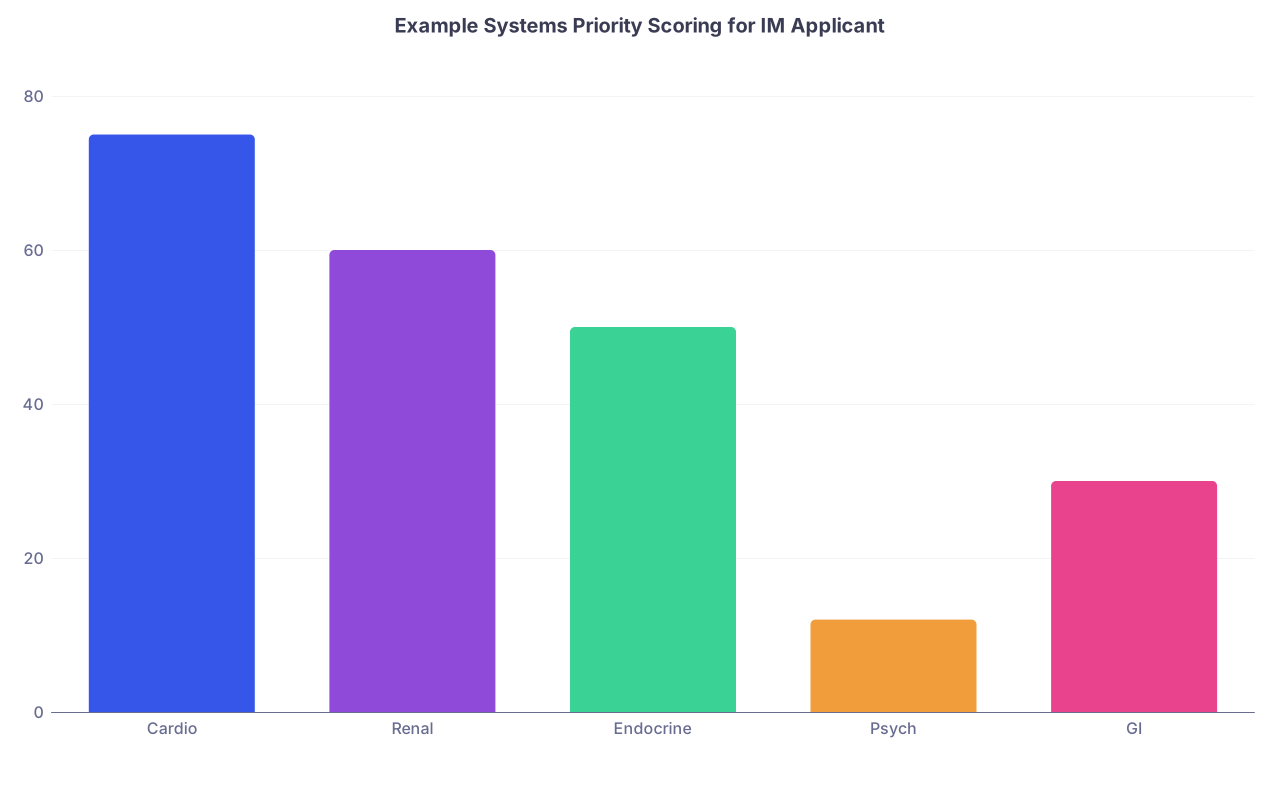
| Category | Value |
|---|---|
| Cardio | 75 |
| Renal | 60 |
| Endocrine | 50 |
| Psych | 12 |
| GI | 30 |
Now:
- High total score → “showcase” systems (build rotations + letters here)
- High importance but low CK or confidence → “patchwork” systems (dedicated targeted rotation)
- Low importance + low scores → do not ignore, but do not center them in your narrative
This is much cleaner than hand‑waving. You can literally sit with your Step 2 CK report and a notepad and do this in 20 minutes.
8. Timeline: When to Do What With Your Step 2 CK Data
Mistake I see all the time: students take Step 2 CK, look at the score once, then bury the report somewhere in their email. Then September hits and they scramble.
Use a simple timeline.
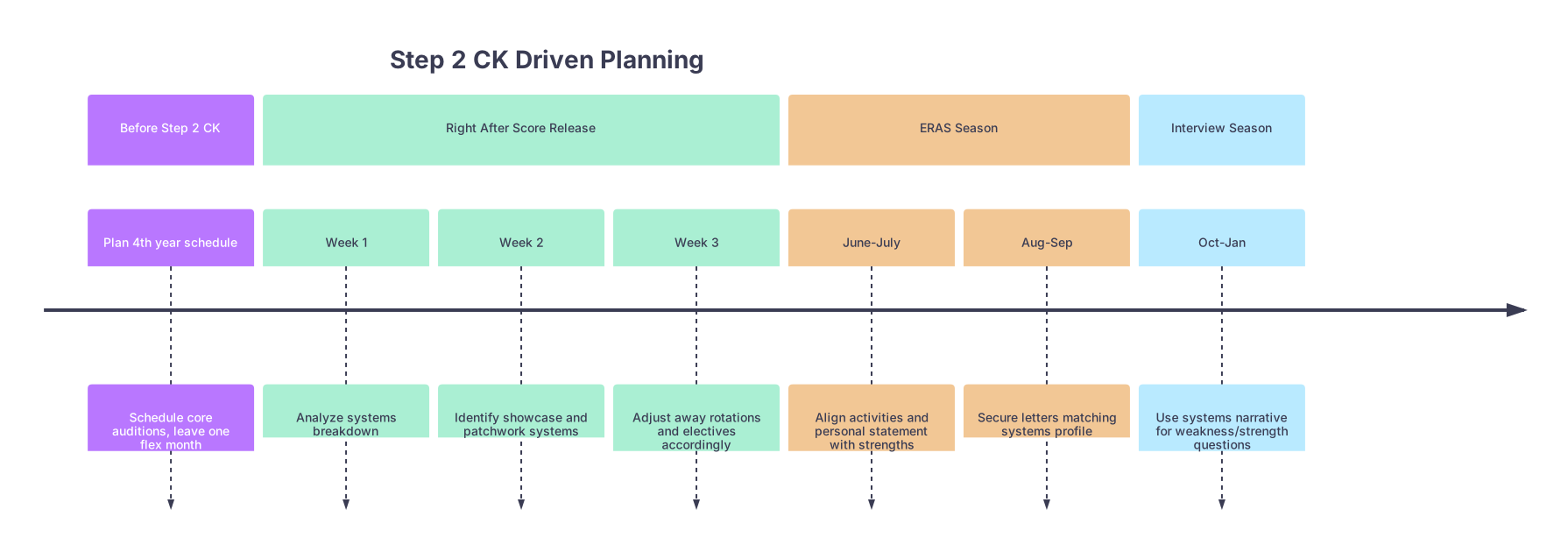
| Period | Event |
|---|---|
| Before Step 2 CK - Plan 4th year schedule | Schedule core auditions, leave one flex month |
| Right After Score Release - Week 1 | Analyze systems breakdown |
| Right After Score Release - Week 2 | Identify showcase and patchwork systems |
| Right After Score Release - Week 3 | Adjust away rotations and electives accordingly |
| ERAS Season - June-July | Align activities and personal statement with strengths |
| ERAS Season - Aug-Sep | Secure letters matching systems profile |
| Interview Season - Oct-Jan | Use systems narrative for weakness/strength questions |
The critical period is the 2–3 weeks after score release. That is when you:
- Decide whether to add or swap an away rotation
- Decide which attendings to prioritize for letters
- Decide how you will frame strengths and weaknesses for ERAS and interviews
If you are already into September and reading this late, you can still salvage some of it by:
- Adjusting who you ask for letters
- Reframing your personal statement and interviews
- Choosing electives later in the year that shore up weaknesses, so that if you need to SOAP or reapply, the story is tighter.
9. Common Dumb Moves With Systems Scores (And How To Avoid Them)
I have to call these out because they come up every single year.
Ignoring a glaring specialty mismatch
Example: Applying psych with your lowest systems in psych/behavioral. If you love psych, fine, but then your rotations and letters must scream that you are much better clinically than that subscore. Do not just hide it.Over‑correcting based on one weak domain
Example: One weak OB/GYN subscore and you suddenly drop OB/GYN as a career despite loving the clerkship, honors on the rotation, and strong evals. Exams are one data point, not destiny.Using Step 2 CK systems to “brag” in your personal statement
“I scored in the top decile on cardiovascular questions” is tacky. It reads as insecure. Let your letters and actual performance illustrate that.Asking for letters from “big names” who barely supervised you
Your systems strengths mean nothing if the letter says, “I worked with them for 2 half‑days in clinic.” Depth beats prestige.Not discussing your Step 2 CK strategy with at least one mentor
Someone who has read hundreds of applications can immediately tell you what jumps out, what can be ignored, and where you must compensate.

10. Quick Specialty Snapshots: What Systems Really Move the Needle
To anchor you, here is a fast summary of what systems most often matter per specialty when PDs read between the lines.
| Specialty | Systems and Themes to Highlight |
|---|---|
| IM | Cardio, Resp, Renal, Endocrine, ID, complex chronic disease |
| Surgery | GI, trauma, periop care, musculoskeletal/skin, acute abdomen |
| EM | Trauma, cardio, resp, tox, procedures, risk stratification |
| OB/GYN | Women’s health, obstetric emergencies, hemorrhage, endocrine |
| Peds | Peds, resp, ID, development, neonatal care |
| Psych | Psych/behavioral, neuro, substance use, communication/ethics |
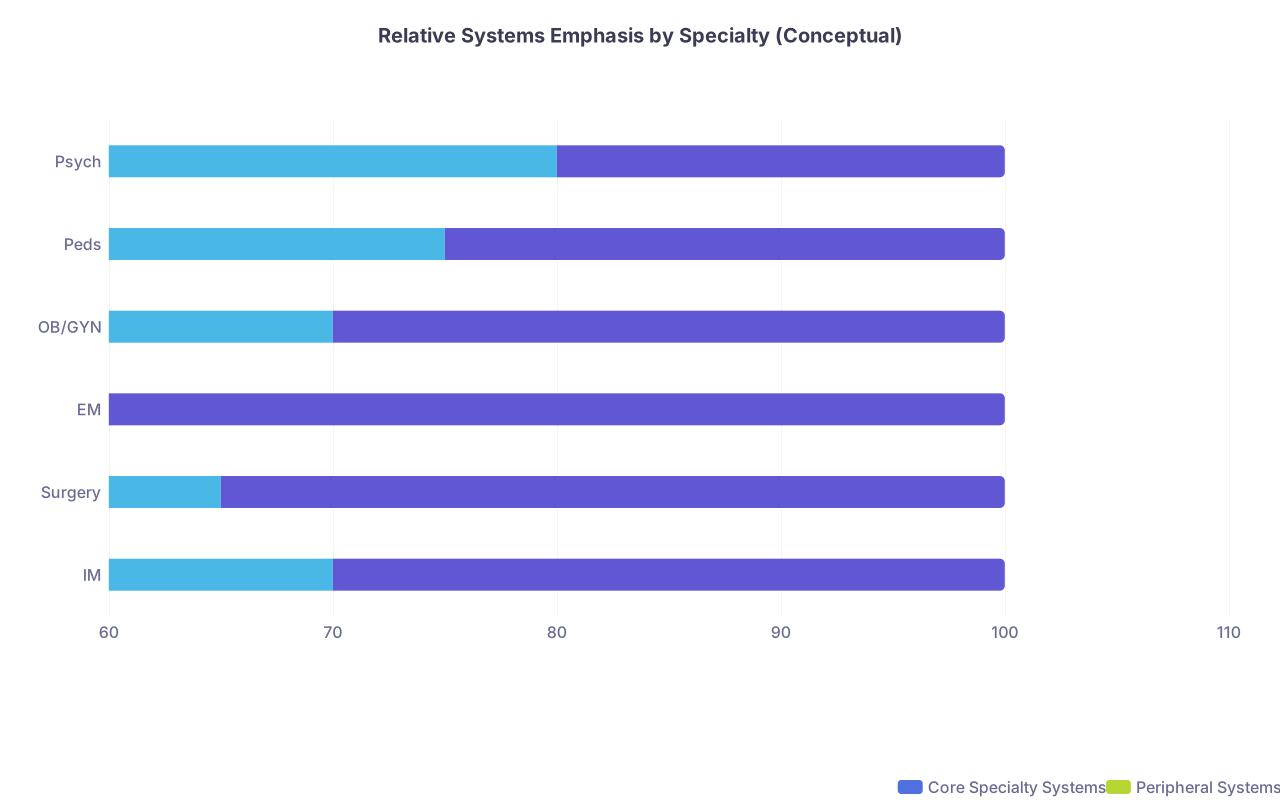
| Category | Core Specialty Systems | Peripheral Systems |
|---|---|---|
| IM | 70 | 30 |
| Surgery | 65 | 35 |
| EM | 60 | 40 |
| OB/GYN | 70 | 30 |
| Peds | 75 | 25 |
| Psych | 80 | 20 |
And yes, there is overlap. A high cardio subscore helps in IM, EM, even anesthesia. That is the point. You use what you have.

FAQ (Exactly 6 Questions)
1. Do residency programs actually see my Step 2 CK systems breakdown, or only the three‑digit score?
Programs only receive the scaled score and pass/fail status. They do not see your NBME content or systems analysis. The systems breakdown is for you. You use it to select rotations, letters, and narrative emphasis so that what they do see lines up with a coherent story of your strengths and progress.
2. If I have a weak system that is central to my chosen specialty, should I switch specialties?
Not automatically. One weak area on a single exam is not a mandate to abandon a field you enjoy and perform well in clinically. You should look at the pattern: clerkship grades, narrative comments, your day‑to‑day comfort. If all data say you struggle with a domain that is core to the specialty, then yes, it is time for honest reflection. If only Step 2 CK is out of step, use targeted rotations and letters to show that your real‑world performance is stronger than that one subscore suggests.
3. How many audition rotations should I do to “show off” my strongest systems?
For most core specialties, two audition rotations in your target field are enough if they are high‑quality and supervised by attendings who know you well. Beyond two, the returns diminish unless you are significantly compensating for a weaker Step 2 CK or trying to break into an especially competitive region. Focus more on depth (strong engagement, clear responsibilities, standout evaluations) than on collecting a long list of away rotations.
4. Is it ever smart to mention a specific Step 2 CK system weakness in my personal statement?
Only if you can pair it with a concrete story of how you addressed it and can show external validation (rotation evals, specific attending comments) that you improved. One short paragraph at most. If the weakness is minor or not central to your specialty, you can usually leave it alone. If it is central and glaring, addressing it once, with a plan and evidence of growth, is better than pretending it does not exist.
5. How do I pick which attendings to ask for letters when my strongest systems and my best interpersonal fit are not the same person?
Content alignment matters, but credibility and enthusiasm matter more. A letter from an attending in a slightly less relevant system who clearly knows you, supervised you closely, and can describe specific clinical behaviors beats a generic “solid student” letter from the “perfect” subspecialty. Ideally you get both: one letter that is system‑aligned with your specialty and one from a setting where your professionalism and clinical reliability were unmistakable.
6. If my overall Step 2 CK score is mediocre but my core specialty systems are strong, can I still target academic programs?
Yes, especially in moderately competitive fields. Academic programs care about residents who can handle their patient mix and contribute meaningfully to teams. A 225–235 applicant with clearly strong core specialty systems, honors on related clerkships, and very strong, specific letters from relevant rotations will often be more attractive than a higher scorer with a flat or mismatched profile. You will not be competitive for the very top‑tier places, but a well‑constructed application can still land you solid academic interviews.
Key points, condensed:
- Your Step 2 CK systems breakdown is a strategic blueprint, not a curiosity. Use it to choose rotations and letters that highlight what you actually do well.
- Showcase your strongest systems where they matter most for your specialty, and use targeted rotations and honest narratives to repair or contextualize weak areas.
- Build a coherent story across scores, rotations, letters, and interviews so that everything the program sees points to the same conclusion: you are a safe, capable, and specialty‑aligned future resident.