
Most students look at their Step 2 CK report for five seconds, find the three-digit score, and ignore the most valuable data on the page. That is a mistake.
You are not just “checking a score.” You are staring at a strategy document for your entire residency application. If you read it properly.
Let me break this down specifically.
1. The Anatomy of the Step 2 CK Score Report
First rule: stop thinking the report is just a number. It is four things:
- An outcome (your 3-digit score)
- A context (performance relative to others)
- A diagnostic map (content strengths and weaknesses)
- A timing signal (for programs reviewing your file)
If you only use #1, you are leaving a lot on the table.
What is actually on the report?
Depending on when you took the exam, the layout may vary slightly, but the components are consistent:
- Your three-digit score
- The passing score and mean score
- A performance bar/graph compared to the mean
- Content area performance profile (systems and physician tasks)
- Test date and reporting date
- Retake info (if applicable)
Here is the mental picture I want you to have:
- Top third: headline numbers and graphical bar showing where you fall relative to the mean and passing threshold.
- Middle: detailed breakdown by content areas and tasks.
- Bottom: fine print, explanatory notes, sometimes test form info.
That middle section is where residency strategy lives.
2. Interpreting the 3-Digit Score: What It Actually Means for Match Strategy
You already know higher is better. That is not helpful. Let us get specific about how programs actually react.
The raw number vs. the “program filter” reality
Most programs do not “holistically” review every applicant. They pre-filter. The 3-digit Step 2 score is one of the first filters, especially now that Step 1 is Pass/Fail.
Think in terms of buckets, not just “good” or “bad”.
| Score Range | General Interpretation | Typical Strategic Posture |
|---|---|---|
| ≥ 260 | Distinction-level | Compete at top programs nationally |
| 250–259 | Strong | Broad options, including competitive specialties |
| 240–249 | Solid | Competitive for most IM, Peds, Neuro, OB, EM; selective for Derm/Ortho/ENT with strong app |
| 230–239 | Adequate | Fine for many community and some academic programs; selective in competitive fields |
| 220–229 | Below competitive for top tiers | Lean toward less competitive specialties/programs; strengthen other parts |
| < 220 | Concerning for some programs | Need careful list curation, strong narrative and letters |
Are there exceptions? Absolutely. But if you ignore these buckets, you are flying blind.
How different specialties “see” your Step 2
Let me be blunt. A 240 in Pediatrics is not the same as a 240 in Dermatology.
Competitive ROAD specialties (Derm, ENT, Ortho, Plastics, Ophtho):
250+ is where you start to feel “in the game” at mid–upper tier programs. Below 240, you are fighting an uphill battle unless you have heavyweight research and strong departmental backing.Mid-high competitiveness (Radiology, Anesthesia, EM, Gas, some Surgery):
240+ is generally “good,” 250+ is a bonus. Below ~230 starts to close some doors at powerhouse academic centers.Core fields (IM, Peds, FM, Psychiatry, Neuro, OB/GYN):
230+ usually acceptable widely. 240+ keeps you comfortable at better academic programs. 220–229 is workable but you must be smart with your list.
If you tell me, “I have a 236, can I match Derm at a top 10?” I am going to be honest: highly unlikely. Someone should tell you that straight.
Relative placement matters more than you think
Look closely at the bar graph: it often shows:
- Passing score
- Mean score
- Your position as a mark on that line
This is your national percentile proxy. A score above the mean tells programs: this applicant performs above the average USMLE taker. The further right you are, the more confidence they have in your test-taking and basic clinical reasoning.
3. Performance Profile: The Most Misused Section on the Report
This is where nearly everyone wastes an opportunity.
Your performance profile is broken down by:
- Content areas (e.g., Medicine, Surgery, Pediatrics, Psychiatry, OB/GYN)
- Sometimes by systems (cardio, pulmonary, GI, etc.)
- Physician tasks (e.g., Diagnosis, Management, Communication, Systems-based practice)
The bars are usually:
- Centered vertically at the mean performance of test takers
- Extended to the right (you performed above average)
- Or left (below average)
People glance, say “oh, I was low in OB,” and move on. No. This section should shape:
- Your away rotation choices
- How you talk about yourself in your application
- What you fix before intern year
How to read the bars intelligently
Look for three patterns:
- Global weakness: most bars are shifted left.
- Isolated system/task weaknesses.
- Discordant pattern with your chosen specialty.
Examples:
You want EM, but your acute management / emergency scenarios are clearly below the mean. That is a flag. Programs in EM want evidence you can handle acuity. It does not mean you are out, but you should:
- Make sure your SLOEs and narrative emphasize fast-paced clinical strengths.
- Nail your EM rotation exams and shelf.
- Avoid letting this weakness show up again on in-service exams.
You want IM and your internal medicine–heavy content is at or above average, but OB/Peds content drops. That is fine. IM PDs care infinitely more about the relevant buckets.
You want OB/GYN and you are weak in women’s health, OB scenarios, and surgical decision-making. That is a real issue. You will need:
- Strong OB/GYN clerkship grades and narrative comments.
- Great letters from OB attendings who can say you perform above your test profile.
- Possibly a strong Step 2 shelf or APGO exam performance to counterbalance.
Content weakness vs. real-world concern
Not every “below mean” bar matters for every specialty.
Rough priority rule:
- Directly related to your specialty: huge.
- Shared across all specialties (acute management, diagnostic reasoning, professionalism/ethics): very important.
- Marginal to your chosen field: lower impact, unless pattern is global.
If your whole graph leans left, the concern is not just knowledge gaps. Programs start worrying about:
- Board pass rates (they are judged on these)
- Your ability to pass specialty boards later
- How much remediation you will need as an intern
That affects how they rank you relative to someone with a similar CV but stronger testing.
4. Step 2 CK in Context: Step 1, Clerkships, and Timing
Step 2 does not live alone. PDs look at it next to:
- Step 1 (even though it is now Pass/Fail, they still see it)
- Clerkship grades / clinical evaluations
- Shelf exams
- Timing of your test and score release
Step 1 vs Step 2: the “trajectory” story
Programs like trajectories. Let me give you common patterns and what they signal.
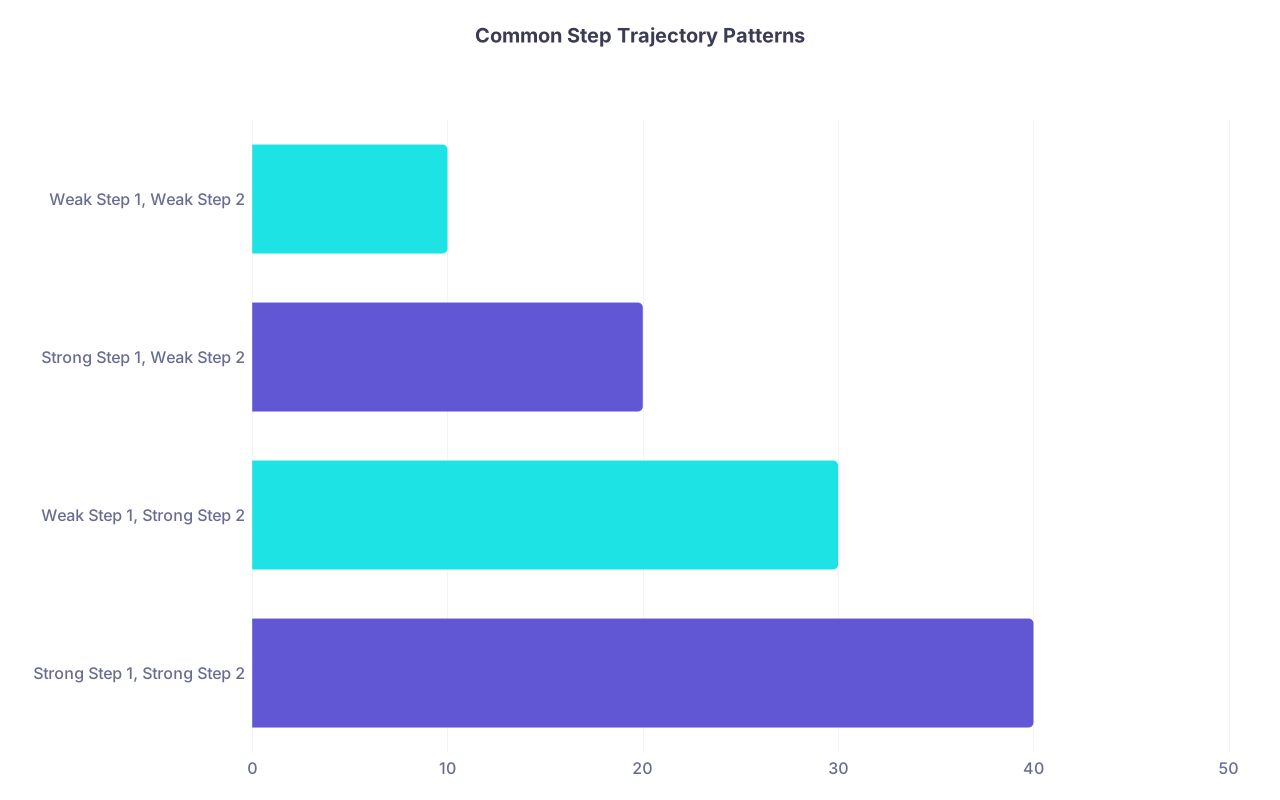
| Category | Value |
|---|---|
| Strong Step 1, Strong Step 2 | 40 |
| Weak Step 1, Strong Step 2 | 30 |
| Strong Step 1, Weak Step 2 | 20 |
| Weak Step 1, Weak Step 2 | 10 |
(Values here are conceptual, not actual percentages.)
- Strong Step 1, strong Step 2: Ideal. Confirms consistency. No one complains.
- Weak Step 1, strong Step 2: Extremely powerful redemption arc. This can reopen doors you thought were closed. Use it explicitly in your personal statement and advisor letters: “They showed marked improvement.”
- Strong Step 1, weak Step 2: Programs get nervous. They worry Step 1 was a fluke, or you peaked early. You must lean hard on clinical performance, letters, and a strong narrative.
- Weak Step 1, weak Step 2: You need a careful, conservative strategy, a realistic specialty selection, and excellent mentorship.
Even with Step 1 now P/F, program directors still think in this framework: “Did this person rise when things got more clinical and complex, or not?”
Clerkship grades vs Step 2: alignment or mismatch
If you have:
- Honors in Medicine, Surgery, OB, and a mediocre Step 2 → Some PDs will interpret this as “good clinician, weaker standardized tester.” That is not fatal, but it does make them nervous about board exams.
- Mediocre clinical evals but a 260+ Step 2 → Red flag in the opposite direction: “great test taker, but does the student function well on the wards?”
You want your Step 2 to reinforce the story your clerkship grades tell. If it does not, you must explain it somewhere (MSPE advisor comment, personal statement, or at least in your own mental narrative for interviews).
Timing: when you took Step 2 and why it matters
If you took Step 2:
- Early (spring of third year) and did well: that is a clear strength. Shows preparation and confidence.
- Late (after ERAS submission) with a prior weak Step 1 or uncertain specialty: programs have to decide whether to rank you without that data. Some will hold off, many will not. They are busy.
Late strong score: helps primarily for the SOAP or next cycle, unless programs specifically held your file.
If you had a bad Step 1, the best practical play was usually: take Step 2 early, score well, and have that number on ERAS when applications go out. If you did not, you cannot change that now, but understand how PDs will interpret the timing.
5. Using the Report to Shape Your Residency Strategy
This is the part students rarely do properly. You should use your score report to actively shape:
- Specialty choice
- Program list composition
- Away rotations
- Application narrative
Specialty choice: where your score helps vs hurts
I am not telling you to abandon your dream specialty based solely on a number. But you have to be honest.
Rough approach:
- Look at NRMP Charting Outcomes (for your year or closest available).
- Look at the median Step 2 CK scores for matched vs unmatched applicants in your target specialty.
- Compare your score. Place yourself realistically.
If you are 1+ SD below the mean of matched applicants in a hyper-competitive specialty, you will need:
- Strong home department support
- Heavy research in that field
- Stellar letters from known faculty
- Possibly a backup specialty
Ignoring that data is how people end up in the SOAP in tears.
Program list building: “reach / target / safety” using your score
Treat your Step 2 as a primary quantitative anchor for list building.
Example: You want Internal Medicine, score 238.
Reasonable breakdown:
- Reach: major academic IM programs where typical matched applicants have 245–250+ (you can sprinkle a few, especially in your region).
- Target: solid university-affiliated and strong community IM programs where typical scores sit in the 230s–240s.
- Safety: community programs and newer/home-state programs with wide score ranges.
Apply the same logic to any specialty, just shift the numerical expectations.
Away rotations: aligning strengths and weaknesses
Your content profile can guide where you should shine on away rotations.
Examples:
You are going for Ortho, and your musculoskeletal/trauma-related content bars are strong, but your general medicine is weak. Do not choose rotations where you will be repeatedly exposed as shaky on basic medicine on consults. Instead, maximize opportunities where your MSK knowledge shows.
You are going for EM and your acute care bars are slightly below mean, but your communication and systems-based practice are strong. On EM aways, you should:
- Over-prepare for high-yield acute management (sepsis, chest pain, respiratory failure, anaphylaxis).
- Let your communication skills be seen: family discussions, handoffs, teamwork. Letters can then truthfully counterbalance the modest Step 2 performance: “Despite a moderate board score profile, this student has outstanding clinical judgment in the ED.”
6. Step 2 CK in the Eyes of Different Program Directors
You need to understand the psychology here. I have sat in rooms where PDs actually say these things.
Academic powerhouse PD
Typical mindset:
- “We want residents who will pass boards on the first try and keep our metrics clean.”
- “High Step 2 means less worry on my end. I do not have the bandwidth to remediate basic knowledge deficits.”
- “If the score is below our historic resident average, I need a reason to take the risk.”
For these programs, a high Step 2 is a currency. It buys you leniency on weaker parts of your application (within reason).
Mid-tier academic / strong community PD
Mindset is more balanced:
- “We want someone who can do the work and not struggle on in-service, but we can help them grow.”
- “I care about whether they are teachable and clinically solid.”
- “A 230 vs 245 does not matter if one has incredible letters and the other seems disengaged.”
Here, a solid but not stellar Step 2 can easily be overcome by clinical excellence, strong letters, solid interpersonal skills.
Resource-limited or newer program PD
This one surprises students.
- They often put more weight on Step 2. Why? They may not have the educational infrastructure to rescue someone who fails in-training exams.
- They are terrified of board failures because it can harm accreditation.
So a weak Step 2 can hurt you at both extremes: top-tier (for prestige metrics) and resource-limited (for survival metrics). Another reason to read your report as a strategic tool, not a trophy.
7. Concrete Moves After You Get Your Score Report
Let us get tactical. You are sitting with the PDF up on your laptop. What now?
Step 1: Snapshot your situation
Write down:
- Step 2 CK score: ___
- Step 1: Pass / (if numeric previously, note it)
- Intended specialty: ___
- Target program tier: (top academic / mid academic / community / mixed)
- Any obvious below-mean content bars: list them.
This is your starting snapshot.
Step 2: Adjust your application message
If your Step 2 is a strength:
Mention it briefly in your personal statement in the context of clinical growth:
“As my third year progressed, I found that the clinical reasoning I had honed on the wards translated into a strong performance on Step 2 CK, which I see as a reflection of skills I will continue to build in residency.”Ask letter writers (selectively) to reference it if it aligns with how they see you:
“Their strong Step 2 score mirrors the clinical judgment I see daily.”
If your Step 2 is a weakness:
- Do not write a full-page apology. One short, direct acknowledgment if necessary:
“Although my Step 2 CK performance did not fully reflect the progress I have made clinically, I have prioritized systematic practice and feedback since then, which is reflected in my clerkship evaluations and shelf scores.”
Then prove it with:
- Shelf scores
- Honors
- Strong, specific comments in your MSPE
Step 3: Targeted remediation for intern year
This is the part almost no one does, and it hurts them later on in in-service exams.
Use your performance profile to create a mini study plan before residency.

| Step | Description |
|---|---|
| Step 1 | Review Score Report |
| Step 2 | Plan Broad Review |
| Step 3 | Target Specific Systems |
| Step 4 | Select Question Bank and Schedule |
| Step 5 | Use Specialty Resources |
| Step 6 | Track Progress Monthly |
| Step 7 | Reassess Before Intern Year |
| Step 8 | Global or Focal Weakness |
Examples:
- Weak in pulmonary and critical care content → Before IM or EM residency, spend 2–3 weeks doing targeted ICU/pulm questions (e.g., MKSAP, UWorld IM pulm block) and reading.
- Weak in OB content before FM or OB residency → Do a structured review of antepartum/postpartum complications, high-yield OB guidelines, and emergencies.
Your future self, sitting for your in-service exam, will thank you.
8. Common Misinterpretations and Bad Advice You Should Ignore
I hear the same nonsense repeated every cycle.
“Only the 3-digit score matters; no one reads the breakdown.”
Wrong. Some PDs ignore it, but many do not. Especially if your overall score is borderline or if they are deciding between two similar applicants.“If you are not 250+, you cannot match a competitive specialty.”
Also wrong. Do high scores help? Of course. But I have seen applicants with 230s match ENT or Ortho because they had massive research, strong home support, and superb clinical narratives.“A weak Step 2 means you should give up on academics.”
Not necessarily. It may shift which academic centers are realistic, but plenty of mid-tier university programs care more about work ethic, reliability, and teachability than whether you scored 238 or 248.“Programs will understand if you had a bad test day; just explain it.”
Overused excuse. One sentence in context is fine. A long story about how your roommate’s dog was sick the week before? That usually backfires.“You should hide your Step 2 score as long as possible if it is weak.”
In the current environment, that strategy almost always hurts more than it helps. Many programs will not rank you highly without Step 2, especially if Step 1 is P/F. Delayed reporting screams “something is off.”
9. Putting It All Together: A Realistic Example
Let me walk you through a concrete scenario.
Student A:
- Step 1: Pass on first attempt
- Step 2 CK: 236
- Clerkships: Mostly High Pass, Honors in Medicine and Surgery
- Specialty interest: Emergency Medicine
- Step 2 performance profile: Above mean in acute care, diagnostic reasoning; slightly below mean in OB/GYN and psychiatry content
Strategy:
- Step 2 score: Solid but not stellar for EM. Enough for most mid–upper tier programs if the rest is good.
- EM is acute care–heavy; their profile aligns: strong in acute scenarios. That matches the specialty. Good.
- Weak OB/Psych content is not a deal-breaker for EM.
What they should do:
- Apply broadly: mix of academic and community EM programs, not just the biggest names.
- Emphasize acute care strengths in personal statement and interviews.
- Use SLOEs from EM rotations to reinforce “performs above test score on the floor.”
- Do not waste time apologizing for the 236; focus on strengths and alignment with EM culture.
Contrast with Student B:
- Step 1: Pass
- Step 2 CK: 223
- Clerkships: Some Pass, some High Pass, narrative comments “needs more independence” in Medicine
- Specialty interest: Orthopedic Surgery
- Performance profile: Below mean across most surgical and MSK content
Blunt truth: this is a serious mismatch.
Strategy:
- Strong recommendation: consider a less competitive surgical field (e.g., General Surgery at broad range of programs, or a medicine field) or a non-surgical specialty that still satisfies their interests.
- If absolutely committed to Ortho, they will need:
- Heavy research (likely already in progress)
- Very strong home department backing
- Possible preliminary surgery year or reapplying pathways
The Step 2 report in this case is a reality check, not a death sentence. But ignoring it would be reckless.
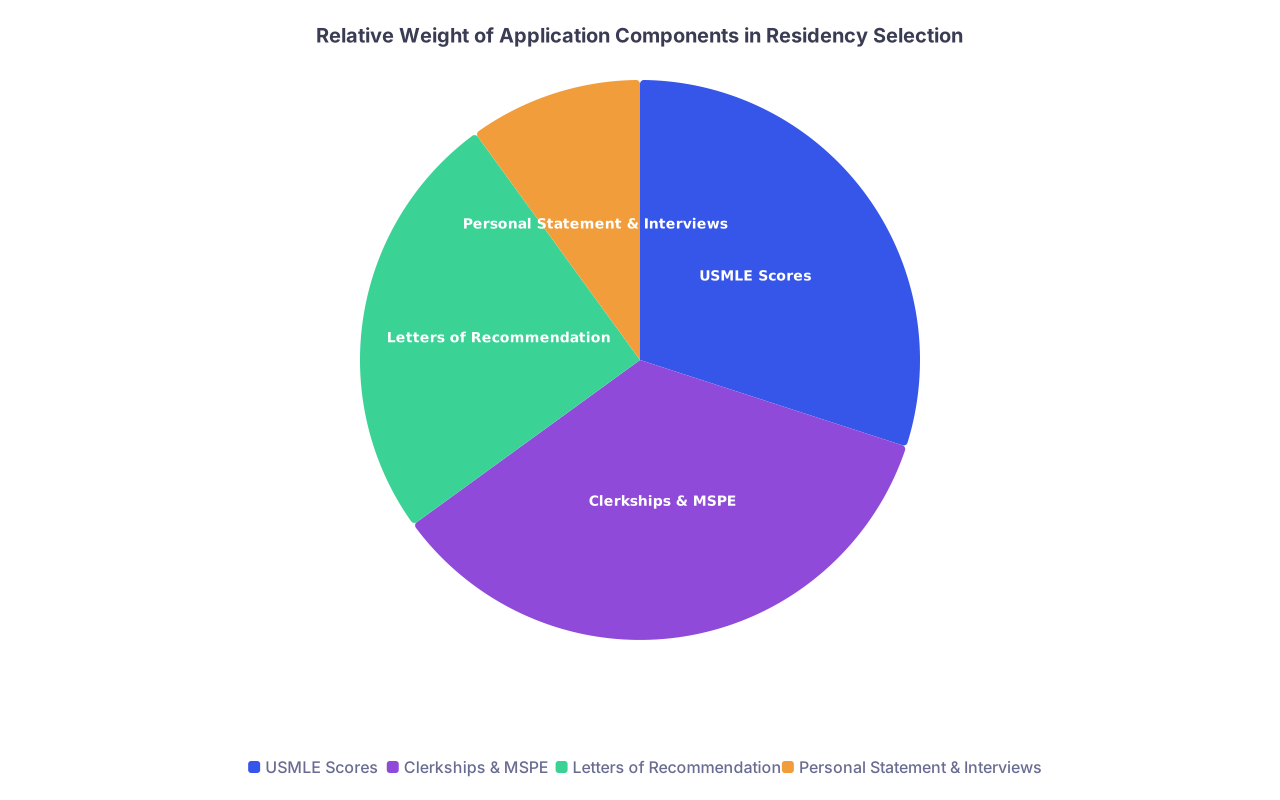
| Category | Value |
|---|---|
| USMLE Scores | 30 |
| Clerkships & MSPE | 35 |
| Letters of Recommendation | 25 |
| Personal Statement & Interviews | 10 |
These percentages vary by program and specialty, but the point is clear: USMLE scores, including Step 2, are a major piece, not the whole puzzle. Your score report is a tool to optimize the entire picture.
FAQs
Should I delay taking Step 2 CK to study longer if I am worried about my score?
Usually no. For most applicants, testing by late summer before ERAS opens is better than pushing into the fall. A timely, solid score beats a marginally higher but very late score that programs may not see before interviews. The exception: if your practice scores are catastrophically low and you are clearly not ready, a short, focused delay with an explicit study plan makes sense.Do residency programs see my full Step 2 CK performance profile or just the 3-digit score?
Programs see the official score report, which includes both. Many PDs focus on the 3-digit number and pass/fail status, but some will skim the content breakdown, especially if they are on the fence about you or if your score is borderline. You must assume that at least someone will see the whole thing.If I failed Step 2 CK once and passed on a retake, how should I address it?
Directly and briefly. Acknowledge the failure, indicate what you changed (specific study strategies, question-based learning, structured schedule), and show the improvement with the passing score and any subsequent exam performance. Avoid emotional over-sharing or long justifications; programs care mostly about whether the underlying problem is fixed.Is a very high Step 2 CK score enough to compensate for weak letters or mediocre clerkship comments?
No. A 260+ will open doors and get you attention, but terrible or lukewarm letters, professionalism concerns, and poor MSPE narrative comments will torpedo you despite the score. The test score buys the benefit of the doubt. It does not erase behavior or performance issues on the wards.Should I mention my exact Step 2 CK score in my personal statement?
Usually no. Programs already see it on your ERAS application and score report. Reference it only if it plays a specific role in your story—for example, a clear upward trajectory from a weak Step 1, or a turning point in your clinical development. When you do mention it, keep it to one line integrated into a broader narrative about growth, not a bragging point.
Key takeaways:
- Your Step 2 CK report is not just a number; it is a strategic map for specialty choice, program targeting, and intern-year preparation.
- The way your score and content profile align (or clash) with your chosen specialty heavily shapes how PDs perceive you.
- Use the report proactively—adjust your narrative, your list, and your study focus—rather than treating it as a static verdict on your future.