
Step 2 CK and Clinical Reasoning: Item Structures Programs Value Most
It is late September. You are on your medicine sub‑I, your phone is exploding with ERAS “application downloaded” emails, and your PD just said during noon conference: “Step 2 CK matters a lot more now that Step 1 is pass/fail. We look for evidence of clinical reasoning.”
You nod, but what does that actually mean. “Evidence of clinical reasoning” based on a multiple‑choice test?
Let me be specific: programs are not just looking at your three‑digit CK score. They are implicitly (and sometimes explicitly) inferring how you think clinically from which kinds of CK items you are likely good at. They see certain item structures as far closer to what residents do at 2 a.m. than others.
If you want a Step 2 CK score that actually reassures PDs about your readiness, you need to understand those item patterns and train the same mental muscles. Not just memorize guidelines.
We will walk straight into that.
1. What Programs Secretly Want From Your Step 2 CK Score
Programs use Step 2 CK as a proxy for three things:
- Can you safely manage a real, undifferentiated patient?
- Can you operate under constraints (time, incomplete data, conflicting information)?
- Can you prioritize correctly when everything looks important?
Step 1 used to signal raw knowledge and test‑taking horsepower. Step 2 CK now carries that, plus the expectation that you can function on the wards. PDs talk about this openly on interview panels. You will hear lines like:
- “Step 2 CK told us who could actually think like an intern.”
- “We look at CK for clinical maturity and judgment.”
- “High CK with good clerkship comments is very reassuring.”
They are not imagining you working through standalone “What’s the mechanism?” items. They are picturing you doing exactly what certain CK item formats force you to do:
- Reprioritize when the last line unexpectedly changes the urgency.
- Ignore noise and zero in on the one vital abnormality that changes management.
- Decide whether to call the attending, call a consult, or just handle it.
To make that concrete, we need to break CK down by item structure, not by organ system.
2. The Item Types That Best Map to Real Clinical Reasoning
Not all Step 2 CK questions are created equal. Some are essentially glorified Step 1. Others are mini‑OSCEs in text form.
Programs care most about the latter.
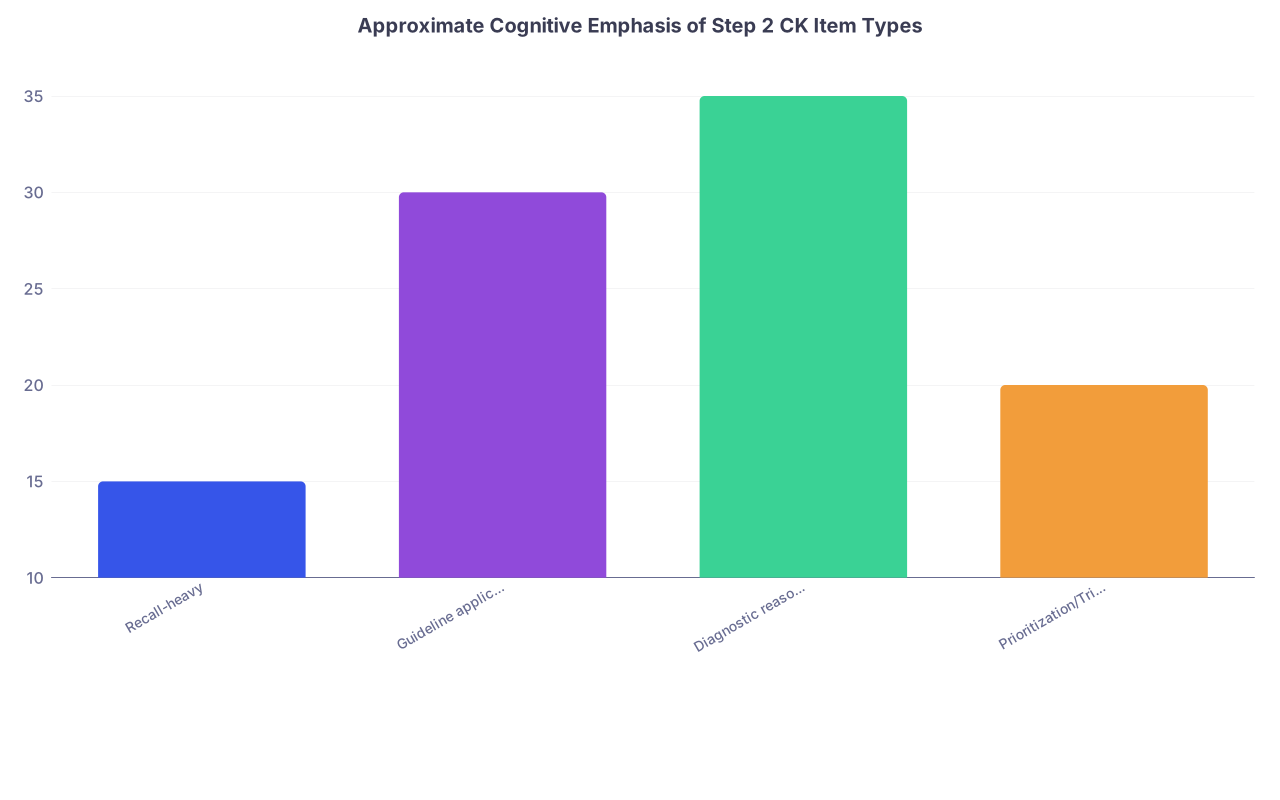
| Category | Value |
|---|---|
| Recall-heavy | 15 |
| Guideline application | 30 |
| Diagnostic reasoning | 35 |
| Prioritization/Triaging | 20 |
These proportions are approximate, but they match what you feel doing UWorld: the bulk of points are in diagnosis and management, wrapped inside realistic vignettes.
2.1 Classic “What Is the Next Best Step?” Management Vignettes
These are the bread and butter. Long stem, lots of labs, then:
- “What is the most appropriate next step in management?”
- “Which of the following is the best initial test?”
- “Which intervention is most likely to improve outcome?”
Programs like the reasoning here because:
- It tests whether you know the sequence of care, not just isolated facts.
- It punishes shotgun thinking. You cannot order everything.
- It rewards recognition of red flags and time sensitivity.
Example pattern (you have seen this a hundred times):
- 62‑year‑old with chest pain. History, risk factors, exam, basic labs, EKG.
- Borderline troponin, maybe nondiagnostic EKG.
- Answer options: stress test, immediate cath, CT angio, GI workup, reassurance.
This is the same cognitive task you will face on call:
A patient is “kind of worrying” but not crashing. You decide: admit to tele and trend, send to cath now, or call GI? The CK question forces you to compress that workflow into one decision.
Programs infer: if you can consistently pick the right next step over dozens of vignettes, you probably will not make catastrophic triage mistakes at 3 a.m.
2.2 Undifferentiated Complaint → Diagnosis
Step 2 CK is full of “no diagnosis yet” stems where your job is pure pattern recognition and prioritization of differentials:
- “What is the most likely diagnosis?”
- “Which of the following is the underlying cause of this presentation?”
- “Which diagnostic study would confirm the diagnosis?”
These map tightly to daily intern work:
- Chest pain that could be ACS, PE, aortic dissection, esophageal rupture, GERD.
- Fever post‑op: atelectasis, pneumonia, UTI, line infection, DVT/PE, C. diff.
Programs value performance in this structure because:
- It tests whether you build a differential, not just recognize a named disease.
- It checks that you can distinguish “looks similar but deadly” vs “looks similar but benign.”
- It simulates sign‑out handoffs: “This is likely X, but I’m watching for Y and Z.”
If your practice approach is “search the stem for the one keyword that gives away the answer,” you will get destroyed by the better‑written questions in this category. They are designed to see whether you can integrate:
- Epidemiology
- Time course
- Risk factors
- Exam nuance
- Key discriminating labs or imaging
and then commit.
2.3 Urgency / Triage / “Most Appropriate Next Step Right Now”
Now we are closer to the judgement calls programs care about most.
These questions make you sort “important” from “immediate”:
- “What is the most appropriate next step in management?”
- Answer choices range from imaging, outpatient follow‑up, nonurgent consult, empiric treatment, to emergent intervention.
Key feature: Several answers are reasonable eventually. Only one is correct right now.
Classic Step 2 CK structures here:
- Septic patient with hypotension: IVF vs. broad‑spectrum antibiotics vs. pressors vs. imaging.
- Trauma patient: airway, breathing, circulation tasks disguised inside text.
This is where CK actually approximates what PDs see as “clinical reasoning”: ordering decisions appropriately sequenced by urgency.
If you repeatedly choose “confirm with more imaging” over “stabilize first,” your score will show it. And programs will not like that. They do not want a PGY‑1 who would order CTAs on a hypotensive trauma patient before securing airway and volume.
2.4 Risk‑Benefit, Contraindications, and Trade‑offs
Another pattern programs value: questions where more intervention is not necessarily better.
You see:
- Elderly patients with comorbidities → which screening test is appropriate?
- Pregnant patients → what drug / imaging choice is safest and effective?
- Patients with underlying renal disease, coagulopathy, QT prolongation, etc.
These questions are less about “can you quote the guideline” and more about:
- Do you know which risks are absolute vs acceptable?
- Do you understand the hierarchy: treat the mother vs protect the fetus vs both safely?
Real life: You will have to say “no, we are not doing that test / drug” even when someone is pushing for it. Programs want interns who are not cowed by reflex over‑testing. CK risk/benefit items are an attempt to measure that backbone.
2.5 Multi‑Step Reasoning Items (Hidden Two‑Question Chains)
Some CK items are stealth two‑ or three‑step chains packed into one stem:
- Identify the underlying disease or pathophysiology.
- Predict the likely complication or associated finding.
- Choose the appropriate management for that consequence.
For example:
- Stem describes untreated hyperthyroidism.
- Last line: new onset atrial fibrillation.
- Question: “What is the most appropriate pharmacologic therapy now?”
You must:
- Recognize thyrotoxicosis (first step).
- See link to AF with RVR (second step).
- Choose beta‑blocker or rate control approach that is safe (third step).
Programs like this structure because it feels very much like cognitive load during a real call: you are never solving one problem at a time. You are managing a chain reaction.
3. How Item Structure Connects to ACGME Competencies
Residency programs are evaluated (and think) via ACGME core competencies. Step 2 CK has, over the years, bent its blueprint to approximate those.
| Item Structure Type | Dominant ACGME Competency |
|---|---|
| Next‑best‑step management | Patient Care |
| Undifferentiated diagnosis | Medical Knowledge |
| Triage and urgency decisions | Systems‑based Practice |
| Risk‑benefit and contraindication | Practice‑based Learning / Ethics |
| Multi‑step reasoning chains | Clinical Reasoning (cross‑cutting) |
Programs are not naïve. They know CK is imperfect. But when they see:
- High CK + strong narrative comments: “This student thinks like a PGY‑1.”
- They relax.
When they see:
- High CK + comments like “scattered,” “needs frequent redirection,” “struggles with prioritization.”
- They get nervous, because that means you might be very good at recall, but poor at the item structures above that demand prioritization and synthesis.
So yes—item structure matters. Even if PDs never explicitly say, “I value your triage‑style items the most,” they are reacting to the same underlying reasoning.
4. The Item Types Programs Care Less About (But You Still Have to Pass)
Some CK content has weaker direct mapping to clinical reasoning. It still matters for your score, but it does not impress programs in the same way.
4.1 Pure Fact‑Recall and One‑Liner “Most Specific Test” Items
Examples:
- “Which enzyme deficiency is associated with this condition?”
- “What organism is most likely causing this infection?”
- “Which autoantibody is most specific for this disease?”
These are essentially Step 1 throwbacks. Yes, they must be correct. No, nobody thinks they measure your ability to manage a cross‑cover list of 20 patients.
You should learn them efficiently, but do not confuse excellence here with excellence in clinical reasoning. PDs do not.
4.2 Isolated Epidemiology / Biostats Without Clinical Context
There is a subset of questions that are:
- Straight survival curve reading.
- Abstract sensitivity / specificity / PPV items.
- Pure study design labeling without affecting a management choice.
These do align with “practice‑based learning,” but they are not what attendings have in mind when they say “this student has sharp clinical reasoning.” They are academic skills.
For scoring purposes, you still need these points. Just recognize that crushing biostats will not compensate for weak management or triage reasoning in the eyes of a PD.
5. Training the Item Structures Programs Value: How to Practice Like a Resident
You cannot cram clinical reasoning. You train it like a skill.
The mistake I see repeatedly: students run through Qbanks trying to boost their percentage but never consciously practice the structure of decisions programs care about.
Let me outline what targeted training looks like.

5.1 For “Next Best Step” Management Items
You must start thinking in algorithms, not random facts.
Strategy:
- For each high‑yield condition (ACS, stroke, sepsis, GI bleed, COPD exacerbation, DKA, etc.), build a small handwritten algorithm:
- Initial stabilization.
- First diagnostic test.
- First‑line therapy.
- Escalation steps.
- When doing questions, pause after reading the stem and ask: “Where am I in the algorithm?” before seeing the answers.
If you cannot place the patient on the algorithm timeline (“pre‑diagnosis,” “post‑imaging but before antibiotics,” “post‑initial management, now with a complication”), you will struggle with the sequencing that programs value.
5.2 For Undifferentiated Diagnosis Items
You need a consistent, fast way of building a differential.
Create mental “buckets” (especially for presenting complaints):
- Chest pain: cardiac (ACS, pericarditis, dissection), pulmonary (PE, pneumothorax, pneumonia), GI (GERD, esophageal spasm, rupture), MSK.
- Shortness of breath: airway, parenchyma, vasculature, chest wall, metabolic/hematologic.
- Syncope: cardiac arrhythmia, structural, reflex, orthostatic, neurologic, metabolic.
During Qbank:
- Before reading the options, force yourself to list 3–5 possibilities.
- Then map each to what in the stem supports or argues against it.
- Only then look at answer choices.
It is slower at first. Then it becomes automatic. That is exactly what you will do when you pick up a chart: “could be X, Y, Z; what will change my mind?”
5.3 For Triage / Urgency Items
This is where most students under‑train.
You have to rewire your brain to think in threats to life first, convenience second.
Create a simple internal hierarchy when reading stems:
- Airway / Breathing / Circulation compromised?
- Time‑sensitive irreversible damage (stroke window, STEMI, testicular torsion, cord compression)?
- High‑risk decompensation (sepsis, GI bleed, impending tamponade)?
- Everything else.
When doing questions:
- Identify whether the patient is sick or not sick before you dive into nuance.
- Translate vital signs into a word: “unstable,” “borderline,” “stable.”
- Any “unstable” patient → interventions that stabilize, then refine diagnosis.
If you treat stable outpatients like emergent ED cases on CK (or vice versa), your score will reflect that confusion. So will your on‑call performance.
A practical drill:
- Take a block of questions, and for each stem, annotate “sick vs not sick” and “needs intervention in minutes/hours/days.”
- Check against the explanation. Over time you calibrate your instincts.
5.4 For Risk‑Benefit / Contraindication Items
Here the goal is to internalize a small set of absolute no‑go’s.
Make condensed lists for:
- Drugs in pregnancy (ACE inhibitors, warfarin, isotretinoin, etc.).
- Imaging with radiation vs. no radiation in pregnancy.
- Renal function cutoffs for certain meds and contrasts.
- Major drug‑drug interactions that show up frequently (QT prolongers, serotonergic combinations, etc.).
Then, in questions:
- Explicitly ask: “Is there anything in this stem that should stop me from my usual choice?”
- If yes, your job becomes: “What is the next‑best safe option that still achieves the goal?”
This maps nicely to real life: you will spend a shocking amount of residency deciding what to use when the ideal drug is contraindicated.
5.5 For Multi‑Step Chain Reasoning Items
You want to stop thinking of each CK stem as a self‑contained “fact check” and instead see the sequence:
- “What is going on?”
- “What is the likely complication or consequence?”
- “What can I do about that specific consequence?”
One training approach:
- After reading a stem (before the question), pause and predict:
- The likely diagnosis.
- At least one complication that could show up.
- Then check what the actual question is. Often it will be one of your predicted consequences.
Doing this over and over wires your brain to think one or two moves ahead—the exact skill PDs describe when they say a student “anticipates issues.”
6. How This Plays into Different Specialties’ Expectations
Different programs emphasize different parts of CK’s cognitive spectrum. They will not tell you in this language, but the patterns are obvious.
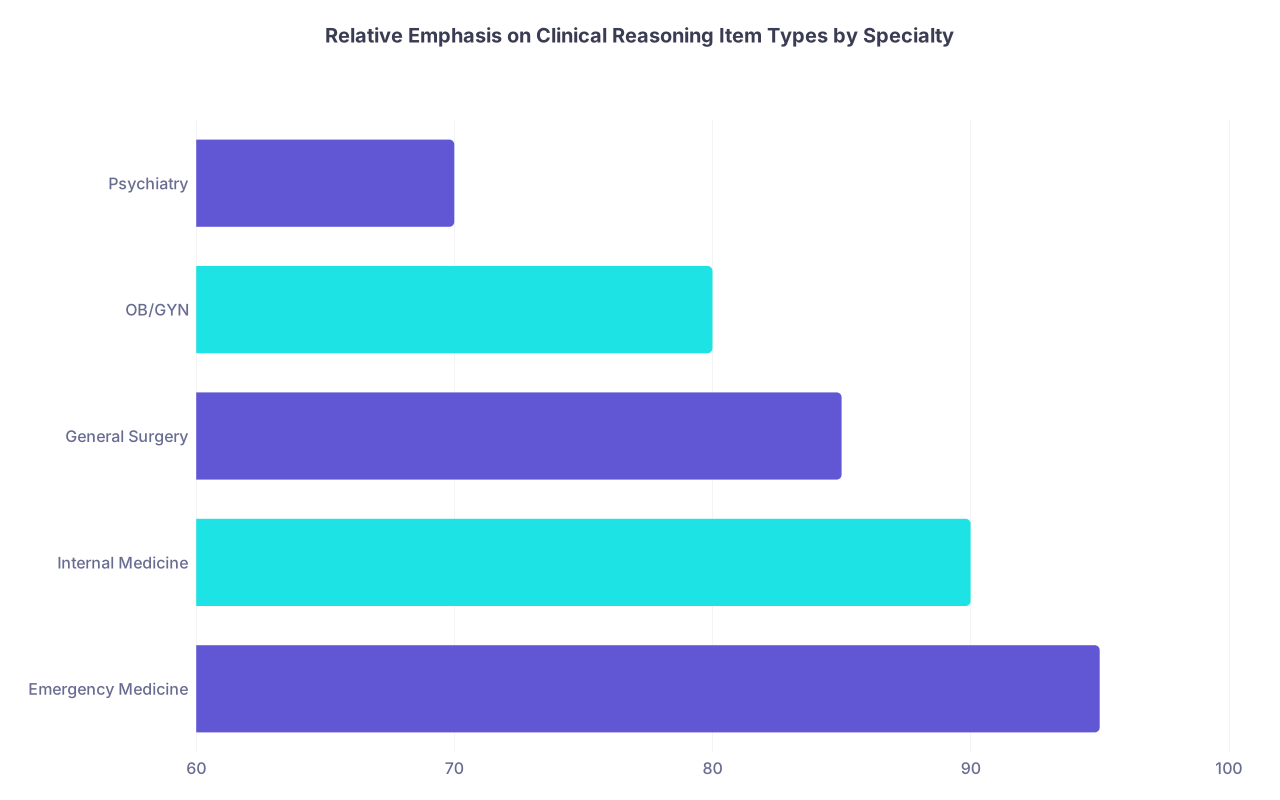
| Category | Value |
|---|---|
| Emergency Medicine | 95 |
| Internal Medicine | 90 |
| General Surgery | 85 |
| OB/GYN | 80 |
| Psychiatry | 70 |
Interpretation: all specialties care, some care obsessively.
- Emergency Medicine: Lives and dies on triage/urgency and undifferentiated diagnosis. EM PDs care tremendously whether you can think through “most appropriate next step right now.”
- Internal Medicine: Heavy focus on multi‑step reasoning chains, complexity management, and long differentials. They look at CK as a stress test of diagnostic thinking.
- Surgery: Very focused on perioperative management, acute abdomen, trauma—high‑stakes next‑best‑step items. They want to know you will not miss a surgical belly.
- OB/GYN: Obstetric emergencies, triage of fetal/maternal distress, and contraindications in pregnancy. Again, “right now” decisions.
- Psychiatry: Slightly different flavor—side‑effect profiles, drug interactions, risk‑benefit around suicidality and safety. They care more about longitudinal reasoning and risk assessment.
If you are applying to a field with lots of acute care (EM, surgery, OB, critical care‑oriented IM), you simply cannot be mediocre at the triage‑style CK items and expect programs to ignore it. They are choosing between applicants who can already think like junior residents under pressure.
7. Reading Your Own Performance the Way Programs Will
During dedicated, you will live in Qbank dashboards. Use them smartly: not just topic‑wise (renal, GI, OB) but item‑structure wise.
You cannot see that directly in UWorld or NBME, but you can infer from the question stems you miss.
Look at a recent block. For each incorrect:
- Label it by structure: “next‑best step,” “undx presentation,” “triage,” “risk‑benefit,” or “pure recall.”
- Track patterns over a week.
If you see:
- You are crushing recall but consistently missing triage and next‑best‑step questions,
- That is a red flag. Your eventual CK score may be lower than your apparent “knowledge base” would suggest. And even if the raw score comes out okay, the underlying weakness will show up on rotations—and in letters.
If, instead:
- You are solid on management and triage but sloppy on facts,
- That is far more fixable with time and Anki. Programs prefer this pattern because it means your underlying way of thinking is sound.
Be honest with yourself: Step 2 CK is not just about the three‑digit number. It is an x‑ray of your decision‑making. You want that x‑ray to look like a resident’s, not a trivia champ’s.
8. How to Talk About Step 2 CK in Your Application (Without Sounding Fake)
You will not write, “I excel at triage‑style item structures” in a personal statement. That would be absurd. But you can align how you talk about yourself with the reasoning skills CK actually measures.
For example, in your experiences / PS / interviews:
- Emphasize situations where you:
- Prioritized several sick patients at once.
- Chose not to order a test or intervention because the risk‑benefit calculus was wrong.
- Anticipated complications and had a plan ready.
- Tie these to feedback you have received:
- “My senior on MICU remarked that I was able to quickly identify the sickest patient and start the right interventions.”
- “My OB/GYN attending noted that I was calm and systematic during an emergent postpartum hemorrhage.”
What you are doing here is showing that the same cognitive abilities Step 2 CK measures in its best item structures are already visible in your real‑world behavior.
Programs notice that alignment.

| Step | Description |
|---|---|
| Step 1 | Step 2 CK Practice Performance |
| Step 2 | Identify Strong Item Structures |
| Step 3 | Identify Weak Item Structures |
| Step 4 | Align With Specialty Needs |
| Step 5 | Targeted Remediation |
| Step 6 | Stronger Application Narrative |
9. If You Are Late in the Cycle: Triaging Your Own Prep
A lot of people read this kind of analysis after they are already mid‑prep. So let me be blunt about what to do if your exam is 4–6 weeks away.
- Preserve breadth: do not abandon entire content areas. But.
- If you must choose, prioritize reps on:
- Next‑best‑step vignettes.
- Triage/urgency cases.
- Undifferentiated presentations.
- For every miss in those buckets:
- Write down where in the algorithm you made the wrong assumption.
- Sketch the correct sequence for that condition.
You are trying to recalibrate your habits, not just patch gaps. Even a month of disciplined focus on these item structures can shift your behavior in ways programs will feel during interviews and rotations.
Closing: What Programs Actually Care About
Let me strip this down.
Programs care less about whether you can regurgitate obscure enzyme names and more about whether you can think like an intern on call. The Step 2 CK items that matter most for that are next‑best‑step management vignettes, triage/urgency questions, undifferentiated diagnosis stems, and multi‑step chain reasoning.
You improve those skills by training the structure of your thinking—algorithms, differentials, prioritization—not just memorizing guidelines. Qbank review should be labeled by decision type, not just organ system.
A strong Step 2 CK score built on solid performance in those item structures sends a message programs understand instantly: this applicant is unlikely to be dangerous or lost on day one. That is exactly the reassurance PDs are hunting for in a post‑Step‑1‑pass/fail world.