
It’s late November. Your CK score just posted. You are toggling between your ERAS dashboard and the NBME page, heart rate a little too high for someone supposedly on an “elective.”
You have a 247. Or a 259. Or a 231.
Whatever the number is, you are now asking the only question that really matters:
“What does this specific CK score actually mean to a Pediatrics PD? To an Internal Medicine PD? To that Surgery PD who trained at a program where they eat interns for breakfast?”
Let me walk you through how each of these three worlds reads the exact same CK transcript very differently.
1. Big Picture: Why CK Became the New Currency
Step 1 is pass/fail. That pushed almost all the numerical triage pressure onto CK.
Program directors are not subtle about this. I have seen emails that literally say, “Given Step 1 pass/fail, we will use Step 2 CK more heavily to stratify applicants.” Translation: CK is the score that determines if your file gets a serious read or a polite “no interview” click.
The key nuance:
Pediatrics, Internal Medicine, and Surgery are not looking for the same thing from your CK score.
They are all looking for:
- Evidence you will pass the boards on first try
- Evidence you can handle the cognitive load of their residency
- A simple, fast way to sort a thousand applications into 300 they will read
But how high that bar is, and what extras they want to infer, are specialty-specific.
2. Typical CK Ranges: Where You Actually Sit
Let’s set some rough numbers. These are directional, not gospel, but they match how PDs talk behind closed doors.
| Tier Label | Pediatrics | Internal Medicine | General Surgery |
|---|---|---|---|
| Board risk zone | < 220 | < 220 | < 225 |
| Below average pool | 220–235 | 220–235 | 225–240 |
| Solid / competitive | 236–250 | 236–250 | 241–255 |
| Strong upper tier | 251–260 | 251–260 | 256–265 |
| Elite outlier | > 260 | > 260 | > 265 |
Those bins are not cutoffs. They are mental buckets. PDs will not say, “We only take >250,” but they absolutely will say, “Our average CK last year was 252, so we like to stay in that range unless the file is otherwise exceptional.”
3. How Pediatrics PDs Read Your CK Score
Pediatrics is often painted as “less score-obsessed.” That is partially true. But I have sat in peds rank meetings where someone said: “I love this applicant, but a 219 CK worries me. We do not need another board failure year.”
What CK represents to a Pediatrics PD
Three main things:
- Board safety – Are you a low, medium, or high risk for failing the American Board of Pediatrics (ABP) exam?
- Baseline workhorse intelligence – Not genius. Just “Can this person read, synthesize, and recall under time pressure?”
- Consistency with your ‘kid doctor’ brand – Does your academic profile match the caring, communication-heavy, often complex pediatric medicine you claim to love?
They are not using CK to find “rockstar surgeons.” They are using it to avoid remediation headaches and protect their board pass rates (which ACGME and applicants both judge).
Peds PD’s mental buckets
< 220–225:
Red flag. They worry about:- Board failure risk
- Struggling with NICU/PICU call and complex patients
These applicants can still match peds, especially community or smaller programs, but they need strong compensating factors: - Very strong clinical comments (“top 5% student ever”)
- Great peds letters from known faculty
- Evidence that the low score is an outlier (strong shelf exams, strong preclinical record)
220–235:
Acceptable but not exciting. You are in the “we will interview you if other pieces are strong” range. Peds PDs will look harder at:- Any pattern of marginal academic performance
- Shelf scores in peds, IM, OB
- US clinical experience if you are an IMG
236–250:
This is the “sweet spot” for many categorical peds applicants. PD sees:- Likely to pass boards
- No cognitive concern
- They can now focus on fit: do you like kids, can you communicate, are you a team player?
> 250:
Two reactions.
At mid-tier or community programs: “This person is probably headed to a children’s hospital or more academic program, but if they apply to us, we are very happy.”
At top places (CHOP, Boston Children’s, Cincinnati, Texas Children’s): “Good. This takes cognitive worry off the table. What else do they bring?”
One subtle Peds-specific read
If you want subspecialty (NICU, heme/onc, cards), a strong CK is interpreted as: this person will probably be research-oriented and wants fellowship. That is not a negative, but peds PDs will sometimes ask: “Will they stay in general pediatrics or disappear after three years?” That affects how they talk about “fit,” especially at programs that need generalists.
4. How Internal Medicine PDs Read Your CK Score
Internal Medicine sits in the middle. More numerically serious than pediatrics overall, less brutally score-driven than surgery, but very stratified: community IM vs academic IM vs elite IM are different universes.
What CK represents to an IM PD
Four things, very concretely:
- Predictor of ABIM board performance – They watch their board pass rate like hawks. Low rates hurt reputation, ACGME standing, and recruiting.
- Signal of cognitive horsepower – IM is cognitively dense: multiple problems, complex pathophysiology, diagnostic reasoning. That all correlates with test performance.
- Filter for fellowship potential – Cards, GI, heme/onc, pulm/crit PDs all stare at CK. So IM PDs use your CK as part of “future fellowship pipeline” thinking.
- Shortcut for ranking and interview invites – IM gets huge application volumes. They need numeric shortcuts.
IM PD’s mental buckets
< 220:
At many academic IM programs, this triggers, at minimum, a pause. Concerns:- Higher risk of failing ABIM boards
- Struggles with ICU, ED, complex inpatient rotations
These applicants are still fine for many community IM programs, but they will likely need: - Strong core clerkship comments
- Clear explanation if there is a trend (Step 1 pass on second try, etc.)
- Possibly already having CK in hand early (late CK with low score is a bad combo)
220–235:
Competitive for many community and some mid-tier academic IM programs. PDs will read the file to see:- Is there an upward trend? (Step 1 pass/fail with strong shelves, then 232 CK)
- Are there other strengths: research, strong IM letters, leadership?
236–250:
This is the bread-and-butter range for solid academic IM. Think university-affiliated programs that are not MGH/Brigham/UCSF level but have fellowships in every subspecialty.
A 240–245 with good letters, strong IM shelf, and some research is a very classic “this person will get multiple interviews” profile.251–260:
Now you are in the running for top academic IM if the rest of the app matches:- Strong school or strong performance at a lesser-known school
- At least some scholarly activity
- Honors in IM, good subspecialty letters
CK in this range tells an IM PD:
“This person can handle a very academic environment and is likely to be competitive for fellowship.”
> 260:
Flagged as “academic star potential” on first glance, especially if combined with honors, AOA/GHHS, and research. At places like UCSF, Hopkins, MGH, a 260+ does not guarantee anything, but it gets your file read respectfully.
CK and your fellowship signaling
IM PDs know that:
- Cards/GI/heme-onc PDs look at CK, IM ITEs, and research.
- A strong CK suggests you are unlikely to be filtered out from fellowship interviews later.
If you say “I want cardiology” with a 221 CK and no research, people will internally roll their eyes. Fair or not. You are telegraphing mismatched ambition.
You can still do cardiology from a low CK; it just becomes much more dependent on stellar residency performance and networking. But your CK already set the baseline impression.
5. How Surgery PDs Read Your CK Score
Surgical PDs are not running psychometrics in their head. They are thinking two things:
- Will this person pass ABSITE and boards, or will they be the reason we have awkward letters from the ACGME?
- Does this score match the “performer” profile we want in our OR-heavy, competitive environment?
Surgery is brutally straightforward about this: they like high CK scores. They do not apologize for it.
What CK represents to a Surgery PD
Three layers:
Proxy for ABSITE performance
ABSITE is an annual in-training exam. Programs obsess over it. A string of low ABSITE scores hurts fellowship placement and signals weak teaching. PDs try very hard to avoid residents who will live at the bottom of the ABSITE distribution.Grit + cognition
CK is taken during intense clinical rotations. Doing well suggests you can grind, study post-call, and still perform. That is exactly what surgery expects.Culture fit for high-intensity training
Fair or not, a 260+ CK is often interpreted as: “This person is ambitious and used to outperforming peers, which fits our culture.”
Surgery PD’s mental buckets
< 225:
At many categorical general surgery programs, especially academic ones, this is a serious concern. Some PDs basically will not consider these unless:- There are exceptional letters from big-name surgeons
- The applicant already did an away with them and crushed it
- There is a compelling story (severe life event, documented major upward trend, etc.)
They are thinking:
“This applicant may struggle with ABSITE and written boards. We are already watching our numbers.”225–240:
This is the “borderline but possible” band for many programs. At community surgery programs or smaller academic ones, this can be perfectly acceptable with strong rotations and letters. But at big names, this range will compete at a disadvantage.241–255:
Very solid territory. For many mid-tier academic general surgery programs, a 245 with good letters is exactly what they want. PD sees:- Likely decent ABSITE performance
- No major concern about reading or test taking
- Can now focus on the rest: OR potential, technical skill signals, teamwork
256–265:
Strong, very competitive. At many well-known programs, this gets attention. They will now scrutinize:- Surgical clerkship comments (“natural in the OR,” “stayed late,” “drove the team”)
- Sub-I/away rotation performance
- Evidence you are not just a test-taker but someone who can operate and survive 80-hour weeks.
> 265:
“Weaponized” CK. Does not guarantee an interview at MGH/Brigham/UCSF, but it removes the “academic ability” question. If you are not getting interviews at top programs with this score, the problem is somewhere else in the application (personality, red flags, weak letters, questionable professionalism).
6. How Programs Actually Use CK to Filter: Not Just “High vs Low”
Program directors rarely sit and discuss a 243 vs a 247 in depth. They use CK mostly in three concrete ways.
1. Interview screen thresholds
Many programs set internal bands like:
- Auto-review if CK > X
- Review if 220–X, but only with supporting strengths
- Rare / PD-only review if < 220 (or < some internal number)
They will not publish this. But they build Excel filters or ERAS filters.
You see this most strongly in:
- Competitive surgery programs
- Upper-tier academic IM
- Some large pediatric academic centers
2. Flagging “board risk” for internal discussion
During selection or rank meetings, low CK scores get flagged. Typical exchanges:
- Pediatrics: “She has a 218 CK. I love her peds letter, but we have had trouble with low board scores. Do we want to take that risk again?”
- IM: “He is at 224 CK with marginal shelves. If we match him, we will have to watch him closely for ITE and have a remediation plan.”
- Surgery: “This is a 230 CK applicant. Great letters, good away rotation. Are we comfortable with ABSITE risk if we take them over a 255 from another school?”
3. Sorting by “firepower” where volumes are high
For programs with 3000+ applications, they simply cannot read every file in detail. So they do this:
- Create a numerical composite: CK + class rank + number of honors, etc.
- Sort descending
- Start reading from the top until they fill a pool
CK is often the fattest weight in that composite now that Step 1 is pass/fail.
7. Score Scenarios: How Each PD Interprets the Same Number
Let’s run a few example CK scores and see what they signal in each specialty. This is how PDs actually think.
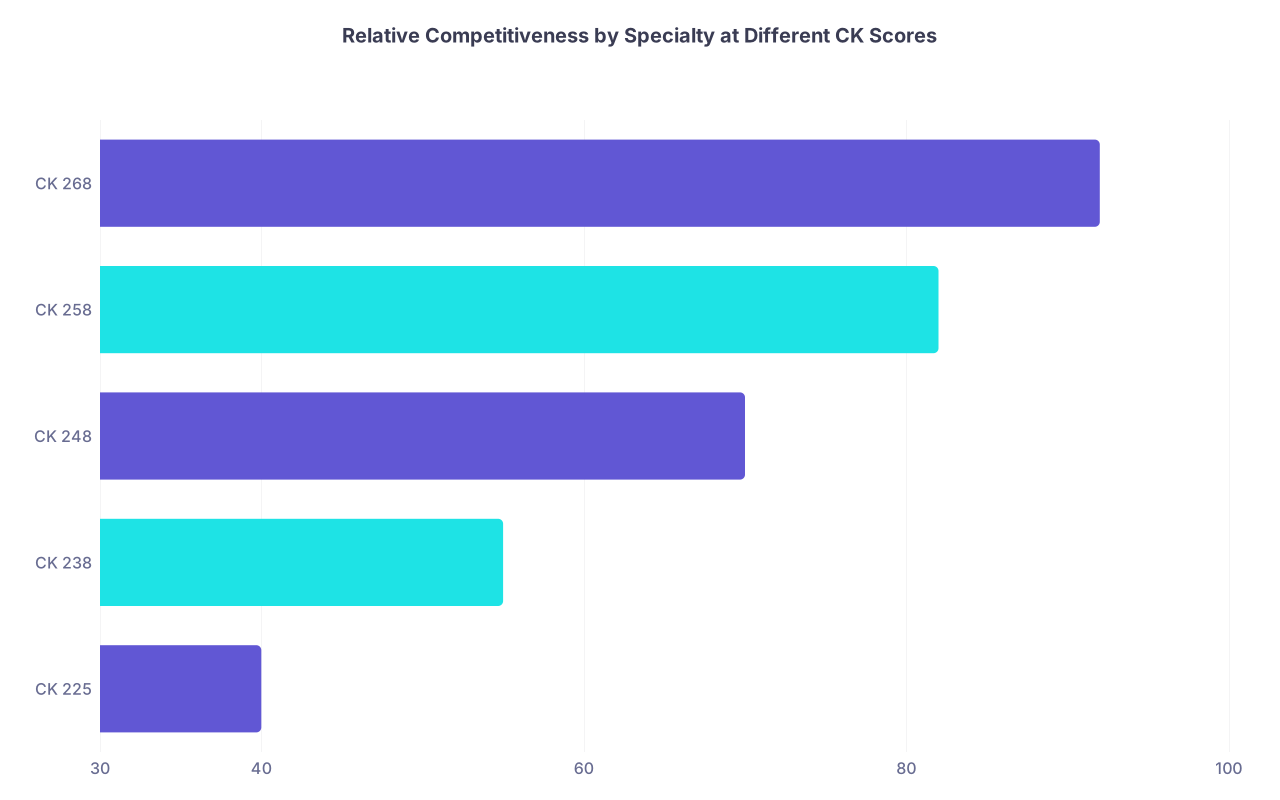
| Category | Value |
|---|---|
| CK 225 | 40 |
| CK 238 | 55 |
| CK 248 | 70 |
| CK 258 | 82 |
| CK 268 | 92 |
(The values above are conceptual “percentile of program openness,” not official data.)
Scenario A: CK 225, mid-tier US MD
Pediatrics PD:
“Fine. Not amazing, not terrifying. Let’s see: peds letters, clerkship comments, any NICU/PICU exposure. If personality and fit are good, we can work with this.”IM PD:
“Borderline for academic, comfortable for many community programs. Does the file show upward trajectory? Any evidence they struggled earlier but rebounded?”Surgery PD:
“This is on the low side. I need a reason to take them: a phenomenal away at our institution, strong letters from surgeons I trust, or clear contextual story. Otherwise, many similarly strong files with 240+.”
Scenario B: CK 238, DO student with strong clinical comments
Peds PD:
“Very workable. 238 CK with strong US pediatrics rotation comments is more than enough. DO is not a barrier for us if clinical performance is solid.”IM PD:
“238 is very solid. For many university-affiliated DO-friendly IM programs, this is in their target band. They will check: IM letters quality, research if any, and your COMLEX too.”Surgery PD:
“238 from a DO school can be competitive for some community and smaller academic programs, especially if they had strong surgery rotations and maybe an away. In the big-name surgery world, still a bit of an uphill battle.”
Scenario C: CK 248, US MD, mid-tier school, no AOA
Peds PD:
“Great. Zero score concern. Let us focus on peds interest, advocacy, child health experiences.”IM PD:
“248 is in a comfortable Academic IM zone. Combined with decent research and strong IM letters, they will likely get a good spread of interviews, possibly some top-20 IM.”Surgery PD:
“248 is strong; they will definitely be read carefully. If they have strong sub-I comments and evidence of OR dedication, they are a serious candidate across many academic programs.”
Scenario D: CK 258, IMG with solid US letters
Peds PD:
“Excellent score; it helps offset IMG bias. Now we want to know: US clinical experience? Communication skills? Visa issues? If those are fine, this is highly interviewable.”IM PD:
“A 258 from an IMG is gold. It pushes you past many US grads numerically. Programs will scrutinize your clinical exposure, English fluency, and letters, but this score is a major asset.”Surgery PD:
“High CK from an IMG is necessary but not sufficient. For many categorical surgery spots, they still want: US sub-I/away with strong letters from US surgeons. But 258 gets you noticed.”
Scenario E: CK 268, US MD, strong research
Peds PD:
“Impressive, especially if aiming for subspecialty. But if you only talk about being ‘a top researcher’ without connecting to children and families, some purely community peds programs may worry you will be overqualified or not stay general.”IM PD:
“This is elite. With real research and strong letters, you are in serious contention for Hopkins/UCSF/MGH level. They will judge you more on research potential, professionalism, and how you fit their academic culture.”Surgery PD:
“268 is a weapon. If paired with strong away performance, you will be a competitive candidate at big-name programs. Now the PD is asking: Are you coachable? Can we stand being around you for 5–7 years? Do your letters describe a team player or a diva with high scores?”
8. Timing: When CK Is Available Matters Almost As Much As The Number
Program directors care about when your CK score lands in ERAS.

| Step | Description |
|---|---|
| Step 1 | ERAS Opens |
| Step 2 | Used in Initial Screen |
| Step 3 | File Held or Screened By Step 1/School |
| Step 4 | Score Can Rescue or Hurt |
| Step 5 | Score Irrelevant For This Cycle |
| Step 6 | CK Available? |
| Step 7 | Score Arrives Before Rank? |
CK ready by September / early October:
Used in initial screening. For many applicants this is ideal.CK pending until November/December:
PDs may:- Hold your file
- Offer fewer interviews while waiting
- Use Step 1 pass/fail plus other metrics in the meantime
Low CK released late:
Worst case. They already liked your narrative, then see a 215 CK on December 1. You can slide down their internal ranking unless everything else is outstanding.
For surgery especially, a late weak CK can absolutely hurt. I have watched PDs say, “We liked them, but this score worries me. Move them down.”
9. How To Frame Your CK Score In Your Application
You cannot change the number. You can change the story around it and what PDs infer from it.
If your CK is below your specialty’s “sweet spot”
For each of Peds / IM / Surgery:
Pediatrics: Show that you shine in real-world pediatrics.
- Strong narrative about working with kids, clear commitment
- Excellent peds letters, especially from known faculty
- If there was a reason for the low score (illness, family crisis), address it briefly and concretely in your personal statement or dean’s letter, not as a melodrama but as context plus evidence of resilience.
IM: Emphasize upward trajectory and reliability.
- Shelf scores improved over time
- Strong IM clerkship and sub-I comments
- Concrete examples of handling complex patients and reading extensively
Surgery: Lean on performance and work ethic.
- Stellar sub-I / away rotation comments (“worked like an intern,” “stayed late”)
- Letters that explicitly say you are above average cognitively despite the score
- Genuine OR enthusiasm and concrete technical progress (simulation, suturing skills, etc.)
If your CK is strong but not matched by the rest of your application
PDs get suspicious of “test-taker only” profiles.
- For all three specialties, make sure your application shows:
- Strong teamwork comments (nurses and residents liked working with you)
- Professionalism, reliability
- Actual interest in that field, not just generic “I like medicine and scored well”
10. Quick Specialty Comparisons: What The Same CK Score Signals
| CK Score | Pediatrics PD Reads It As… | IM PD Reads It As… | Surgery PD Reads It As… |
|---|---|---|---|
| 225 | Safe but watch boards, look at overall fit | Borderline for academic, fine for community | Board/ABSITE risk flag, need strong compensating data |
| 240 | Very comfortable, boards likely OK | Solid for many academic programs | Competitive mid-tier if performance matches |
| 250 | Great, zero cognitive concern | Strong for top academic consideration | Strong; in running for many academic programs |
| 260 | Overkill but welcome, think subspecialty/fellow | Elite academic potential, fellowship pipeline asset | Highly desirable; removes cognitive performance doubt |
| 270 | Impressive, may be overqualified for some sites | Top 1–2% applicant pool academically | Star-level; now soft factors and OR performance matter |
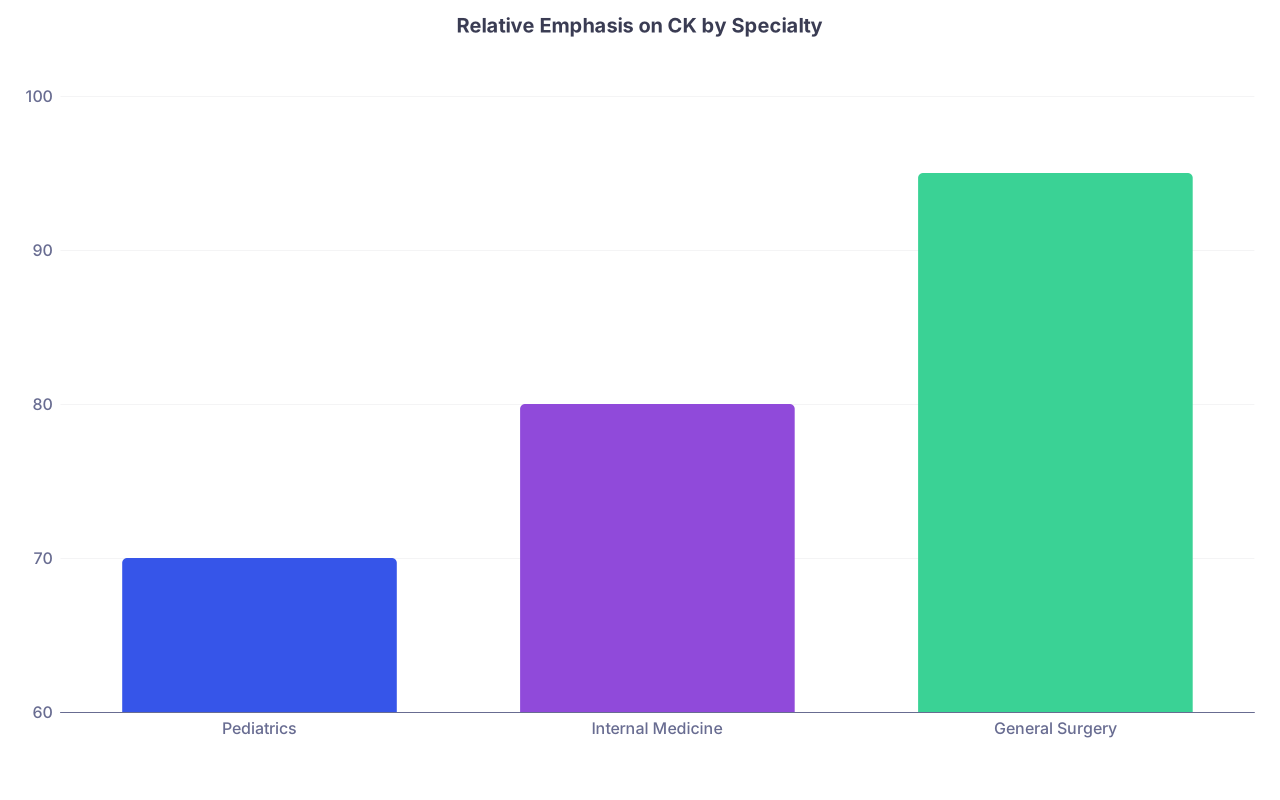
| Category | Value |
|---|---|
| Pediatrics | 70 |
| Internal Medicine | 80 |
| General Surgery | 95 |
(Values represent rough “importance weight” out of 100.)
FAQ (Exactly 5 Questions)
1. I want Pediatrics with a CK of 223. Am I in trouble?
Not automatically. Many peds programs will be comfortable with a 223, especially if your clinical performance, peds letters, and narrative are strong. You may have a harder time at the very top children’s hospitals, but you are still very matchable in pediatrics. You should apply broadly and make sure your peds-specific experiences are compelling.
2. How high does CK need to be for a competitive academic IM program?
For a solid university-affiliated academic IM program, 236–250 is typically in the comfortable zone, assuming your other metrics (clerkships, letters, some research) line up. For truly elite IM (MGH, Brigham, UCSF, Hopkins), 250+ plus a strong overall academic and research profile gives you a realistic shot, but there is no single cutoff.
3. Is a 240 CK too low for general surgery?
No, but context matters. A 240 CK from a US MD with excellent surgery clerkship and sub-I performance can absolutely match general surgery, including many academic programs. At the most competitive surgical programs, that 240 will be on the lower side, so you will need standout letters and away rotations to compete with the 250–260+ crowd.
4. Should I delay applying until I have my CK score?
For Peds and IM, if you expect CK to be a clear strength relative to your current file, it is usually better to have it visible early. For Surgery, applying without CK can hurt at programs that use it heavily in initial screening. The trade-off is timing: a late application (November) with a great CK can still struggle compared with an on-time application with a slightly lower score.
5. Can a very strong CK compensate for weak research if I want an academic career?
Partially. In all three specialties, a strong CK buys you respect and reassures PDs about your cognitive ability. But for an academic trajectory—especially in IM and Peds—sustained research productivity and strong mentorship matter more for long-term success. A 260 CK with zero research may match well but will not magically convert you into a top academic candidate without follow-through during residency.
Key takeaways:
- CK is the main numerical currency now, but Pediatrics, IM, and Surgery interpret the same score very differently.
- Surgery leans hardest on CK as a proxy for ABSITE and board performance; IM uses it for board risk and fellowship potential; Peds cares mainly about board safety and then moves quickly to fit.
- You cannot change the number, but you can shape what it signals by aligning your letters, experiences, timing, and narrative with what each specialty’s PD is actually looking for.