
What happens when you realize, halfway through fourth year, that your Step 2 CK score is the only number programs really care about now—and you treated Step 2 prep like an afterthought during MS3?
Let me be very clear: Step 2 CK is no longer a “nice-to-have” exam. For many programs, it is the standardized metric they use to filter residency applications since Step 1 went pass/fail. I have watched otherwise strong applicants panic in August of M4 because they made lazy decisions during MS3 that quietly sabotaged their Step 2 score.
You do not need to study 6 hours a day on every clerkship. But you do need to avoid the traps that sink people every single year.
Below are the biggest Step 2 CK prep mistakes MS3s make during core clerkships—and how to not be one of them.
Trap #1: Treating Each Shelf as “Separate” from Step 2 CK
The worst mindset I hear on rotations:
“Shelves are just to pass the clerkship. Step 2 is future me’s problem.”
That is how you end up relearning internal medicine twice. And doing it worse the second time, when the stakes are higher.
Reality: the NBME subject exams and Step 2 CK are built from the same blueprint and the same style of clinical reasoning. If you treat clerkships as isolated hoops and not as a unified Step 2 training program, you guarantee:
- Fragmented knowledge
- Massive inefficiency
- Burnout when you start “Step 2 studying” from near-zero in M4
Here is the pattern I see too often:
- MS3 crams only for the specific shelf (OB, peds, etc.) using random PDFs.
- Does few or no questions during the actual rotation.
- Forgets 70% of the content 2 months later.
- Starts “Step 2 prep” in March M4, realizes they have to relearn all of IM, OB, peds, psych, surgery, and neuro.
- Panics, rushes, scores below where they should have.
Do not make this mistake.
During each clerkship, your mental script must be:
“I am building my Step 2 foundation right now.”
You want a single continuous question-based spine across the year, mostly UWorld, that you keep hitting rotation after rotation. The content changes, but the system is unified.
If you silo each shelf, you pay for it later. Always.
Trap #2: Wasting the Question Bank Year
Your MS3 year is the one time in your life when doing clinical questions every day is both natural and directly aligned with your work. Most students squander it.
Two common, equally bad patterns:
- “I’ll save UWorld for dedicated.”
- “I’ll just do UWorld casually without tracking anything.”
Both are traps.
If you “save” UWorld for dedicated, here is what actually happens:
- You limp through shelves with random resources.
- Your shelf scores are mediocre to weak.
- During dedicated, you are doing UWorld questions for the first time, which is the least efficient way to use that resource.
- You never benefit from spaced repetition across the year.
On the flip side, if you burn through UWorld during MS3 without structure, you end up with:
- Incomplete coverage of weaker rotations (often psych, peds, OB)
- No way to identify patterns in your mistakes (e.g., always missing endocrine, nephro, or stats)
- A false sense of “I’ve done all the questions, I’m fine,” when you actually are not.
The efficient, grown-up way to use questions during clerkships looks more like this:
- Use UWorld (or AMBOSS, but pick one primary) for each rotation.
- Finish most of the rotation-specific questions during that block.
- Track weak topics after each block.
- Leave a reasonable chunk of questions (especially mixed sets) for Step 2 dedicated.
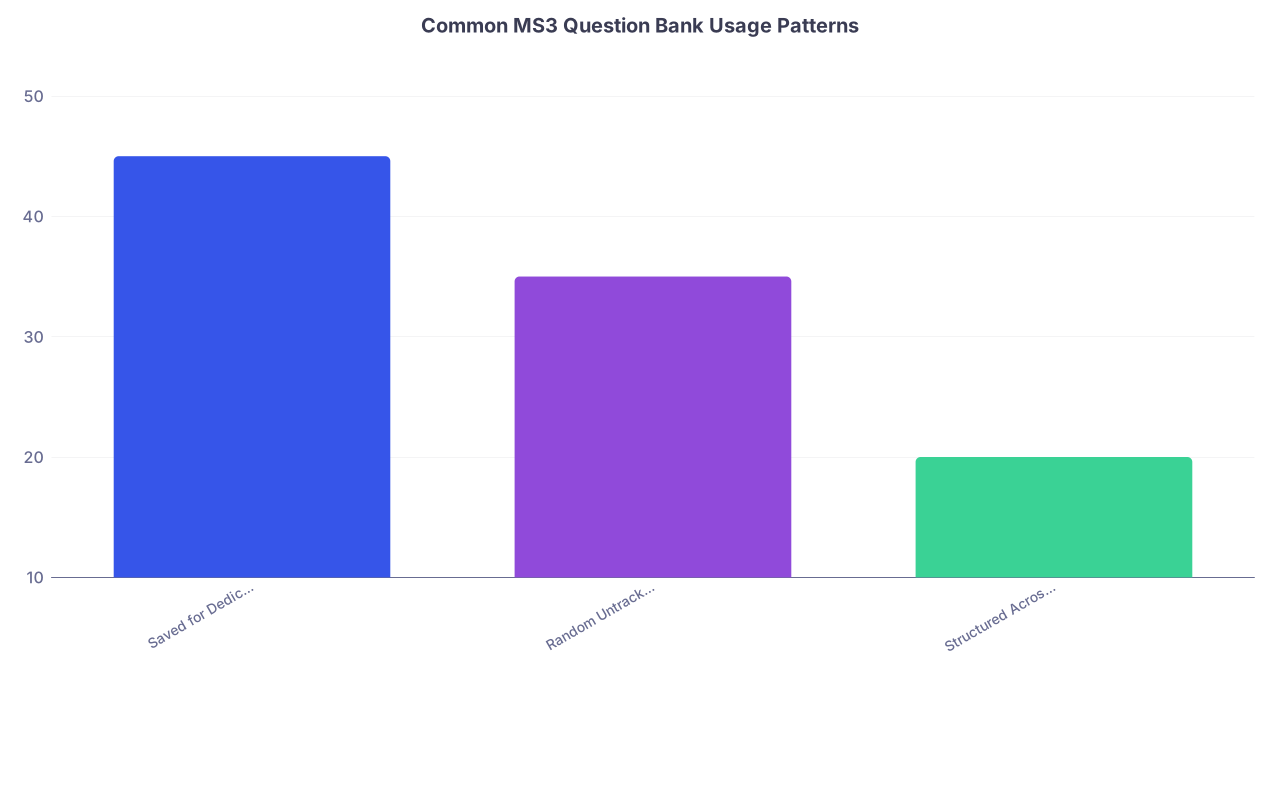
| Category | Value |
|---|---|
| Saved for Dedicated | 45 |
| Random Untracked | 35 |
| Structured Across Year | 20 |
Do not hoard your question bank. And do not burn it without intention. Either extreme costs you points on Step 2.
Trap #3: Letting “Being a Good Team Player” Destroy Your Study Time
I have seen this a hundred times: a conscientious MS3 who never says no, stays until 9 pm to “help,” and then wonders why they have the lowest shelf scores in their class.
Here is the uncomfortable truth:
Some residents and attendings will happily exploit your anxiety about being perceived as “lazy” or “not a team player.”
If you let everyone else’s convenience dictate your time, your Step 2 prep dies slowly.
The mistakes here look like:
- Agreeing to pre-round on 12 patients alone “for the experience,” then having no mental bandwidth left to study.
- Staying for every single late discharge, even when the intern explicitly says, “You can go.”
- Volunteering for extra call and weekend coverage every time.
- Spending 2+ hours per night on exhaustive SOAP notes that will not affect your grade.
You do not need to be a ghost. But you cannot sacrifice consistent Step 2 prep on the altar of “I always stayed late.”
The balance:
- Be present and engaged during work hours.
- Ask: “Is there anything else I can help with before I head out to study?”
- When work naturally slows and you are clearly not needed, leave. Do not loiter, hoping someone notices your martyrdom.
A strong clerkship comment like “Reliable, present, shows initiative” plus a respectable Step 2 score beats glowing “always here” comments with a mediocre score every time in residency selection.
Trap #4: Ignoring Weak Rotations Because “I’m Not Going Into That Specialty”
The student who wants ortho or derm and mentally checks out of psych, peds, or OB. Classic. And very predictable.
Step 2 CK does not care what specialty you think you want. It punishes huge gaps.
Programs know this, especially in competitive fields. They are not just asking, “Can this person do surgery?” They are asking, “Is this applicant safe and solid across medicine?”
If your Step 2 breakdown shows:
- Very low peds
- Very low OB
- Barely passing psych
you send a loud message that you selectively cared. Not a good look.
More importantly, your aggregate score suffers. Those “weak rotations I blew off” questions add up to 10–20 points missing from your final CK score. That is the difference between being above vs below a competitive specialty’s screening cutoff.
| Ignored Area | Typical Step 2 Question Share | Potential Score Loss* |
|---|---|---|
| Pediatrics | Moderate | 5–7 points |
| OB/GYN | Moderate | 5–7 points |
| Psychiatry | Low–Moderate | 3–5 points |
| Neurology | Low–Moderate | 3–5 points |
*Rough conceptual estimates, not exact psychometrics.
You do not need to become a pediatrician. You do need to know:
- Basic vaccine schedules
- Common pediatric emergencies
- Neonatal resuscitation priorities
- Key pregnancy complications and their management
Letting yourself mentally disengage because “I’ll never do this again” is immature and expensive.
Trap #5: Cramming for Shelves with PDFs and Ignoring Explanations
You know the “10-day crash plan with 300-page PDF” everyone circulates? That approach is how you memorize noise and miss patterns.
Here is the specific trap:
- You do minimal daily studying during the rotation
- One week before the shelf, you panic
- You cram a high-yield PDF, skim through question banks at high speed
- You never deeply read explanations or learn why the wrong answers are wrong
Yes, you may scrape by on the shelf. But for Step 2:
- You have shaky conceptual understanding
- You cannot handle multi-step reasoning or multi-system questions
- You keep making the same pattern errors (e.g., always missing next best step vs initial stabilization vs most accurate diagnostic test)
The exam is not testing “What is the side effect of this drug?” in isolation anymore. It is testing:
- What is happening pathophysiologically
- What you do first
- What you do next
- What you absolutely do not do
Those sequences are learned in question explanations, not in passive content dumps.
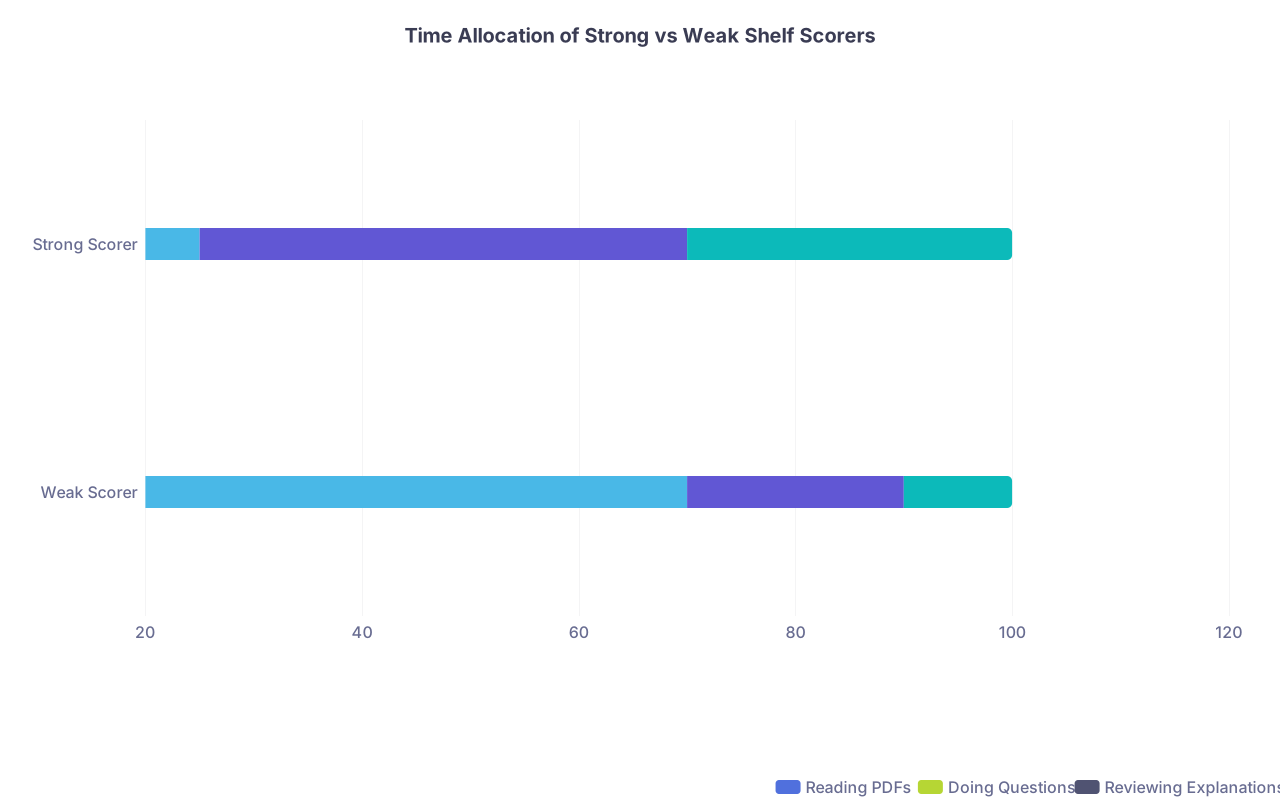
| Category | Reading PDFs | Doing Questions | Reviewing Explanations |
|---|---|---|---|
| Weak Scorer | 70 | 20 | 10 |
| Strong Scorer | 25 | 45 | 30 |
If your shelf strategy is 80% PDFs and 20% shallow questions, you are building a fragile foundation for Step 2. That fragility shows when vignettes get a bit more complex.
Trap #6: No Longitudinal Review—Letting Knowledge Rot Between Rotations
Another classic error: acting like once you finish your IM rotation, internal medicine knowledge will kindly stay in your brain until Step 2. It won’t.
If you never touch IM again until 6 months later, here is what you can expect:
- You forget nuanced management (e.g., heart failure medication sequencing, COPD exacerbation steps, nuanced anticoagulation decisions).
- You remember only the “big names” but not subtleties.
- On Step 2, you miss questions that require those subtleties.
The students who perform best on Step 2 have some form of light, continuous review across the year. Not 3 hours a day. But structured repetition.
That can look like:
- 10–15 mixed questions a few times a week, no matter the rotation
- A small deck of targeted Anki or flashcards for things you consistently miss
- A monthly “systems day” where you hit a few questions in IM, peds, OB, psych, etc.

| Step | Description |
|---|---|
| Step 1 | Rotation Questions |
| Step 2 | Identify Weak Topics |
| Step 3 | Create Brief Notes or Cards |
| Step 4 | Weekly Mixed Review Sets |
| Step 5 | Reassess Performance |
The mistake is going all-or-nothing: either you obsessively review everything (and burn out), or you do nothing until dedicated. Find the middle path. Light but consistent.
Trap #7: Delaying Step 2 CK Until It Is Strategically Too Late
This one is lethal for residency applications.
With Step 1 now pass/fail, many programs want a Step 2 score in hand when they review ERAS applications. If you delay Step 2 into late fall because you “did not feel ready,” you tie your own hands.
Common harmful timing patterns:
- Taking Step 2 after ERAS submission, so your application is screened without your score
- Pushing Step 2 into November/December, then underperforming and having no chance to “recover” that cycle
- Waiting to schedule until after all rotations, then being at the mercy of testing center availability and getting a date too late
A weak Step 2 score is bad.
An absent Step 2 score when others have one is also bad for many specialties, especially competitive ones.
You want Step 2 scheduled so that:
- You have completed the core rotations (especially IM, surgery, peds, OB, psych)
- You still have several months before ERAS submission
- If something truly catastrophic happens (illness, personal crisis), there is still theoretical room to pivot or adjust the rest of your application strategy
Do not wait until you “feel fully ready.” No one feels fully ready. Schedule intelligently and then make your MS3 habits support that timing.
Trap #8: Ignoring Your Mental Bandwidth and Burning Out
Another way students sabotage Step 2: they try to be perfect on rotations, perfect on shelves, perfect in research, and then they wonder why by the time Step 2 dedicated hits, they are mentally fried.
Burnout does not help your score. It wrecks retention, focus, and stamina on exam day.
The particular Step 2-related burnout traps:
- Stacking your hardest clerkships back-to-back (e.g., IM → surgery → ICU sub-I) and then trying to “do Step 2 dedicated” immediately after
- Refusing to take even one weekend fully off across an 8–10 week stretch
- Setting ridiculous daily question quotas you never meet, then feeling like a failure constantly
- Letting anxiety drive you into endless resource-hopping instead of mastering a few
You are not a robot. Step 2 CK is a 9-hour endurance test. Showing up exhausted and bitter because you ran yourself into the ground all MS3 is an avoidable disaster.
Protect your future score by:
- Picking 1–2 core resources and sticking with them
- Giving yourself defined, protected time off (even half-days) during brutal rotations
- Allowing your question volume to flex with rotation intensity instead of rigid, unrealistic rules
Trap #9: Not Integrating Clinical Experience With Exam Prep
This one is more subtle but separates average scorers from excellent ones.
Many MS3s live two separate lives:
- Clinical life: “What does my attending want? How do we round?”
- Exam life: “What does the NBME want? What’s the highest yield?”
They never connect the two.
On the wards, they simply do what residents say. In questions, they treat vignettes as alien puzzles. Zero integration.
The high performers constantly cross-link:
- After seeing a real patient with DKA, they review the DKA algorithm that night and then hammer related questions
- When a consultant criticizes their understanding of chest pain workup, they go home and do 10–15 ACS/PE/aortic dissection questions
- They use real cases to anchor algorithms, not just abstract mnemonics

If you treat your clinical days and your study days as totally separate worlds, your brain never builds the rich network that Step 2 questions reward. You end up memorizing lists instead of building flexible reasoning.
You should constantly ask yourself on rotations:
“How would this case show up on Step 2?”
“What would the NBME test here: next best step, diagnosis, complication, or management tweak?”
If you skip that step, you leave a lot of free learning on the table.
Trap #10: No Honest Data on Your Performance Until It Is Too Late
The last trap is probably the most preventable: flying blind.
Many MS3s spend the year with no realistic sense of where they stand:
- They never do mixed blocks under timed conditions
- They “review” but do not track categories they consistently miss
- They delay NBMEs because they are “not ready yet”
- They focus on the percentage correct from an easier qbank and ignore how that translates to NBME-style difficulty
Then, a few weeks before Step 2, they finally take an NBME and discover they are scoring 15–20 points below their goal. There is no time left to turn that around.
Avoid this. You do not need daily stats dashboards, but you do need periodic reality checks.
Reasonable checkpoints during MS3:
- After IM + surgery: a mixed block of questions and honest review of weak subjects
- Mid-year: one NBME or school-provided CCSE if available, no excuses
- Before setting your Step 2 date: another NBME, even if it bruises your ego
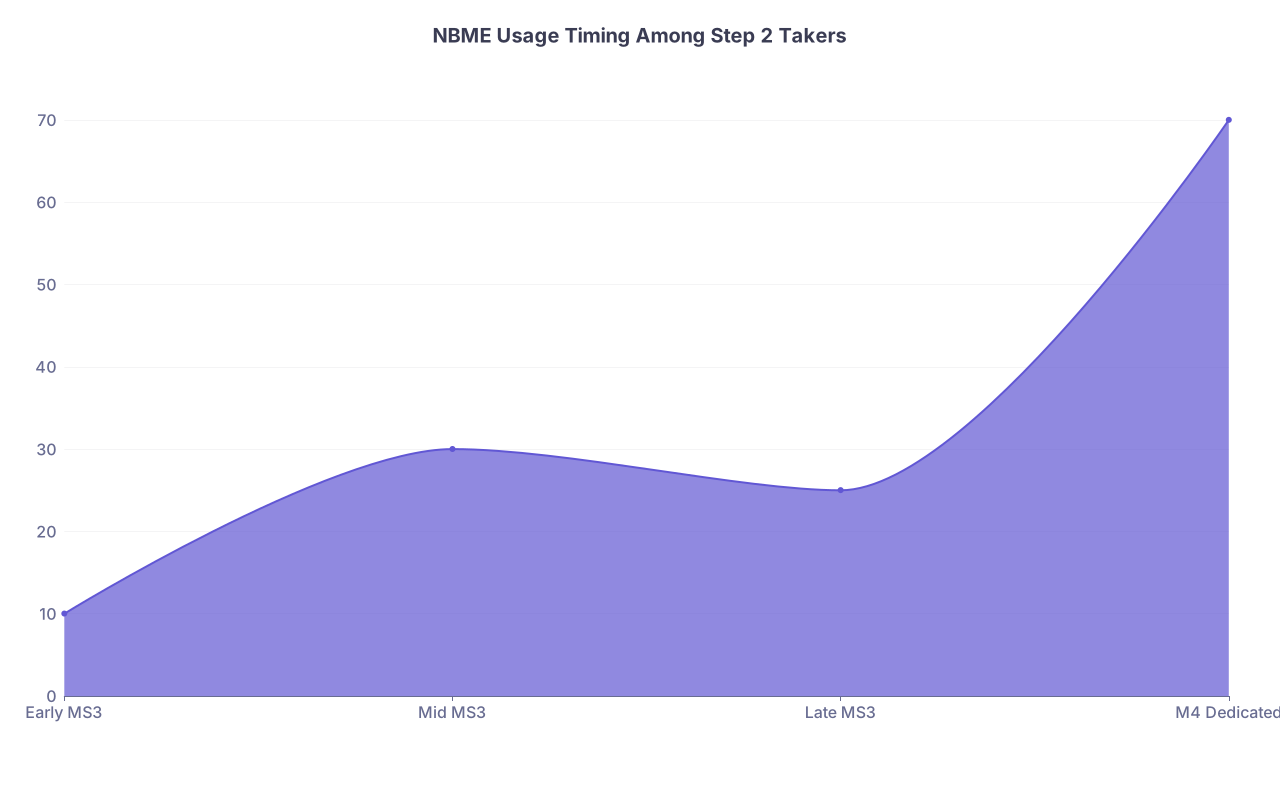
| Category | Value |
|---|---|
| Early MS3 | 10 |
| Mid MS3 | 30 |
| Late MS3 | 25 |
| M4 Dedicated | 70 |
The mistake is letting anxiety prevent you from gathering data. Avoiding a practice test does not change your real level of preparedness. It just hides it from you until it is possibly too late.
Putting It Together: A Safe, Sanity-Preserving Approach
You do not need a 20-page master plan. You do need to avoid the dumb, common pitfalls.
If you remember nothing else, remember this:
- Shelves are Step 2 training, not separate games.
- Use UWorld (or similar) across the year with intent, not all at once or randomly.
- Protect your study time from pointless over-working. Being exploited is not “professionalism.”
- Do not blow off entire rotations just because they are not your future specialty.
- Use clinical cases as springboards into targeted question review.
- Get objective data (NBMEs) early enough to matter.
- Schedule Step 2 so programs actually see your score.
You are not competing against perfect robots. You are competing against other tired MS3s, many of whom will fall into the very traps you just read about. Your job is simpler: do not copy their mistakes.
FAQs
1. How many questions per day should I aim for during core clerkships?
Avoid rigid, guilt-inducing numbers. Instead, think ranges anchored to rotation intensity. On lighter rotations (psych, neurology at some schools), 40–60 questions daily is reasonable. On heavy services (surgery, inpatient IM), 20–30 high-quality, fully reviewed questions is safer. The mistake is going days with zero questions because “it was busy” and then trying to cram 150 at once.
2. Is it a mistake to use more than one question bank for Step 2 prep?
Using multiple qbanks can become a trap if it dilutes depth. One primary, high-quality bank (usually UWorld) used thoroughly, with explanations carefully reviewed, is far better than superficially touching two or three. If you add a second (e.g., AMBOSS), do it for targeted reinforcement after you have exhausted and learned from your main bank, not as parallel, unfocused practice.
3. When should I schedule Step 2 CK relative to my core clerkships?
You want Step 2 after your major cores (IM, surgery, peds, OB/GYN, psych) but early enough that programs see your score before or soon after ERAS submission. For most students, that means sometime between late June and mid-August of M4. The common mistake is pushing it to October or later purely out of fear, then having an absent or late score when applications are screened.
4. Do poor shelf scores always predict a poor Step 2 CK score?
Not always, but repeated weak shelves across several rotations without course correction is a very loud warning sign. One off-shelf on a brutal rotation is survivable. A pattern of low shelves plus inconsistent question practice almost always precedes underwhelming Step 2 scores. The mistake is ignoring that signal and assuming “dedicated will fix it” without changing your habits.
5. How do I balance research, extracurriculars, and Step 2 prep during MS3?
The mistake is loading your most research-heavy period on top of your hardest clerkships and then pretending you will “just study at night.” Be realistic. During demanding rotations, protect a minimal, non-negotiable block of questions and explanations daily, and let research move slower. During lighter blocks or dedicated research time, you can ramp up study volume. If something has to give temporarily, it should not be the consistent, question-based learning that protects your Step 2 score.
Open your calendar and clerkship schedule right now. Find the next four weeks and block off specific, realistic daily windows for questions and explanation review—20–60 minutes, depending on the rotation. If it is not on the calendar, it will be the first thing that gets sacrificed.