A low Step 2 CK score does not end your residency career. It just removes the option to be sloppy from this point forward.
If you scored below expectations on Step 2 CK, you are not “done.” You are in a hole. Different situation. Different rules.
I have watched people with mediocre or outright bad Step scores match into strong programs. I have also watched applicants with the same numbers crash and burn because they flailed for six months and hoped it would “work out.”
The difference is not luck. It is structure.
This is your structure: a 4‑phase recovery plan that assumes the score is already in, you are not happy with it, and you still want a real shot at residency.
We will work through:
- How bad is “bad”? (Reality check and triage)
- Phase 1 – Stabilize and clarify your position
- Phase 2 – Rebuild your file ruthlessly
- Phase 3 – Communicate smartly with programs
- Phase 4 – Contingency planning if things still go sideways
None of this is theoretical. This is the stuff that actually moves the needle.
Step 0 – How Bad Is “Bad”? Get Your Situation on Paper
You cannot fix anything while you are still in the “I blew it, my life is over” loop. So first: quantify.
Pull out a piece of paper or open a blank doc. Write down:
- Your Step 2 CK score
- Your Step 1 status (Pass/Fail + any attempt history)
- Your specialty target(s)
- Your clinical grades and any honors
- Research output (none / minimal / some / strong)
- Red flags: LOA, professionalism issue, prior failures, etc.
Now, compare your Step 2 CK to typical ranges for the specialties you are considering.
| Specialty Tier | Example Specialties | Step 2 CK Competitive Range* |
|---|---|---|
| Ultra-competitive | Derm, Ortho, Plastics, ENT | 250+ |
| Competitive | EM, Anesthesia, Radiology | 240–250 |
| Mid-competitive | IM, Gen Surg, OB/GYN | 235–245 |
| Less competitive | Peds, Psych, FM, Neuro | 225–240 |
*Not cutoff scores. Rough ranges where successful applicants commonly land.
Now categorize your score relative to your chosen field:
- Category A – Slightly below target
You are ~5–10 points below typical matched applicants in your field. - Category B – Clearly below target
You are ~10–20 points below typical range. - Category C – Substantially below / at‑risk
You are >20 points below typical range or near pass threshold.
Also ask:
- Did you fail Step 2 CK?
Different level of problem. Fixable, but requires a re-take and a different timeline.
This categorization matters because your strategy and aggressiveness change with each category.
Now we build the 4‑phase plan on top of that reality.
Phase 1 – Stabilize: Stop the Spiral and Clarify the Damage
Phase 1 is about two things:
- Stopping self-sabotage
- Getting precise data so you do not over‑ or under‑react
1. Debrief your score like a morbidity & mortality
Treat this like an M&M, not a therapy session.
Ask yourself:
- Did I actually prepare properly?
- How many UWorld questions did I complete? (Number. Not “most.”)
- How many NBME/CCSAs did I take, and what were the scores?
- Did I finish content review or just skim?
- Did my practice scores predict this?
- If yes, this is not a “fluke”; the exam did exactly what the data predicted.
- If no, what changed? Fatigue, illness, anxiety, timing, life event?
- Were there clear weak systems or disciplines?
- Look at your score report breakdown. Where are you below average?
You are looking for controllable variables. Not to beat yourself up. To decide what you can actually fix in the rest of your application.
2. Talk to someone who will be brutally honest
You need an attending, clerkship director, advisor, or dean who:
- Has actually sat in rank meetings or program selection discussions
- Will not sugarcoat to “make you feel better”
In that meeting, bring:
- Your Step 2 CK score report
- Your full CV
- Your preferred specialty list (ranked: dream, realistic, backup)
- Any prior exam history
Ask directly:
- “With this file, what specialty range do you think is realistic?”
- “If I insist on [X specialty], what tier of programs should I realistically target?”
- “What are my strongest levers now: away rotations, research, letters, or switching specialty?”
If you are Category B or C, expect to discuss:
- Widening or changing your specialty list
- Taking an extra research or prelim year
- Aggressively targeting less competitive programs or geographic regions
Harsh truth: many students waste 6–9 months clinging to a doomed target specialty. Then scramble when they finally accept reality. Do not be that person.
3. Decide your specialty plan early
By the end of Phase 1 you should have:
- A primary specialty target
- A backup (and sometimes a second backup) that you are genuinely willing to do
- A clear sense of geographic flexibility (the more flexible, the better)
Lock this down now. The rest of the plan depends on it.
Phase 2 – Rebuild: Make the Rest of Your Application Unignoreable
Your score is a fixed liability. Your task now: make every other part of your file an asset.
1. Clinical performance: maximize what reviewers actually trust
Program directors care about:
- How you perform with real patients
- What attendings say about you when they are not being polite
That means:
- Shelf exams and clerkship grades
- If shelves are still in progress, treat them like mini Step 2 do‑overs.
- Aim for honors in your core rotations from now on, especially in your chosen field.
- On‑service reputation
- Be the student that residents fight to have back on their team.
- Show up early, know your patients cold, anticipate admits and discharges, follow through on orders.
If you are still in clinical rotations, shift your energy:
- Less time scrolling forums about your score
- More time reading on your actual patients, using:
- UpToDate
- Pocket Medicine / specialty handbooks
- Attending‑recommended guidelines
A mediocre Step 2 + outstanding clinical narrative = still matchable.
A mediocre Step 2 + “average” or “quiet” on the wards = big problem.
2. Letters of recommendation: you cannot afford lukewarm
Low Step 2 + generic letters is a death combo.
You need strong, detailed letters that say:
- You function above your level of training
- You are reliable, teachable, hard‑working
- You handle complexity and uncertainty well
- You add value to a team
To get those letters:
Target the right people
- Attendings who directly supervised you for several weeks
- Program directors or clerkship directors who saw you work consistently
- Well‑respected faculty in your target specialty
Ask at the right time
- Ask while your performance is fresh. Ideally at the end of the rotation.
- Use language like: “Do you feel you know me well enough to write a strong letter of recommendation for residency?”
Equip your letter writers
- Provide:
- Your CV
- A short “letter packet” with 3–5 bullet points of specific cases or patients you handled that demonstrate your strengths
- Your personal statement draft if available
- If you are comfortable, you can note: “My Step 2 score is not representative of my clinical performance. I would be grateful if you could comment on my strengths in this area.”
- Provide:
No, you do not need them to write a pity letter about your score. You need them to supply real, positive data that counters the numerical weakness.
3. Research and scholarly output: differentiate where others are lazy
If you are in Category B or C, research can help, especially in IM, Neuro, Peds, Psych, or academic‑leaning programs.
You are not trying to become a first‑author NEJM success story in 8 months. You are trying to show:
- Intellectual curiosity
- Ability to complete projects
- Ownership and follow‑through
Concrete steps:
- Identify 1–2 faculty in your target specialty. Email concise, focused messages:
- Who you are (school, year)
- Your interest in their field and (briefly) why
- What you are looking for: “Is there any ongoing project where an additional motivated student could realistically help with data collection, chart review, or drafting a case report over the next 3–6 months?”
- Prefer:
- Short‑timeline projects – retrospective chart reviews, QI projects, case reports
- Things that can realistically yield at least an abstract or poster before ERAS submission
If timing is tight, aim for:
- Submitted abstracts to local or national conferences
- Institutional poster days
- Even well‑structured QI projects that can be listed with deliverables
Do not disappear for a year “doing research” with no output. Programs know that pattern: it often means disorganization or lack of follow‑through.
4. Personal statement and ERAS application: control the narrative
You have two options with a weak Step 2 CK:
- Hide and hope “they do not notice” (they will)
- Acknowledge it briefly and redirect within a strong overall story
Use your application to paint a coherent picture:
- Why this specialty
- What sustained experiences support that
- How you handle adversity and improve
Be careful with how you reference the score:
Bad:
“Despite my disappointing Step 2 score, I am actually a very hardworking student…”
Better:
“Standardized exams have not always reflected my strength in clinical reasoning. On the wards, I have consistently excelled in managing complex patients, as reflected in my evaluations and letters. I seek a residency where direct patient care, teamwork, and growth matter as much as test performance.”
Short. No over‑explaining. Then move on to concrete strengths.
Phase 3 – Communicate Strategically With Programs
You cannot control what programs think when they see your score. You can control what else they see and how often they see your name.
1. Build a rational program list (not a fantasy bracket)
I have seen students with 225–230 Step 2 apply to 70 derm and ortho programs and almost nothing else. That is not “shooting your shot.” That is denial.
Use a tiered approach tailored to your category.
For Category A (slightly below):
- Apply broadly within your target specialty
- Include a decent number of mid‑ and lower‑tier academic and community programs
- Consider a small secondary list of a less competitive specialty as a true backup (even if you rank it lower)
For Category B (clearly below):
- Target:
- Community programs
- Newer programs
- Programs in less desirable locations
- Strongly consider dual‑applying to a less competitive specialty where your score is within or close to range
For Category C (substantially below or near fail):
- You almost always need:
- Dual‑application strategy
- Maximal geographic flexibility
- Very broad list (often 60–80+ programs across specialties)
- And a serious conversation with your dean about prelim/TY or reapply pathways
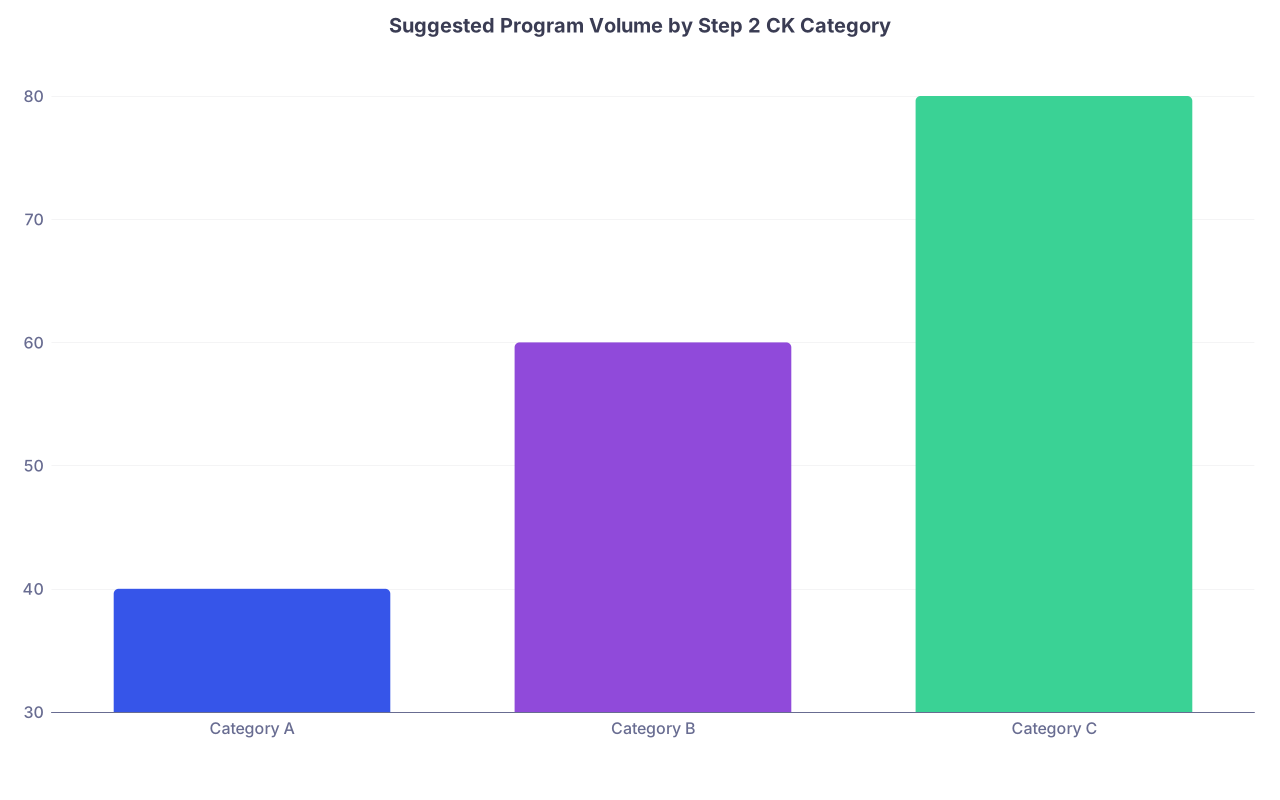
| Category | Value |
|---|---|
| Category A | 40 |
| Category B | 60 |
| Category C | 80 |
Numbers are approximate, but the point is clear: lower scores require broader application nets.
2. Use away rotations and audition electives intelligently
Away rotations can help, but only if:
- Your clinical performance is genuinely strong
- You are socially aware and easy to work with
- You are not chronically exhausted or burned out
If your Step 2 is weak and you know you are an excellent clinician, aways become high‑leverage:
- Target 1–2 programs where:
- You are realistically competitive
- You would be happy to match
- There is some connection or prior student pipeline from your school
On those rotations:
- Treat every day as a month‑long interview
- Learn the culture quickly: do residents stay late? Pre‑round extensively? How do they present?
- Ask for mid‑rotation feedback and adjust immediately
Quite a few “borderline” applicants have matched at the exact place they did an away because they made themselves known and trusted.
3. Letters of interest and post‑interview communication
Do not spam every program with “I am very interested” emails. Everyone does that. It becomes noise.
Instead:
Before interviews:
- A short, targeted email can help at programs where:
- You have geographic ties
- You did a rotation
- You have a faculty champion who knows someone there
Structure:
- One short paragraph about who you are and your interest in their program
- One concrete tie (family, prior training, research overlap)
- One line acknowledging that your Step 2 is below their typical average, paired with one clear strength
- A short, targeted email can help at programs where:
Example:
“I recognize my Step 2 score is below the average for your residents, but on the wards I have consistently been rated at the top of my class, especially in complex inpatient medicine. I hope you will consider my application in the context of my clinical performance and strong letters.”
- After interviews:
- Respect program rules about post‑interview communication.
- If allowed, send:
- 1 genuine thank‑you with specifics
- 1 “this program is ranked highly” message if true
Do not beg. Do not offer long explanations for your score at this stage unless asked.
4. How to answer questions about your Step 2 in interviews
You will probably get some variation of: “Can you tell me about your Step 2 score?” or “What happened there?”
Here is the structure that works:
- Own it briefly
- Provide a concise explanation if there is a real factor
- Pivot to what you learned and specific improvements
Example:
“I was disappointed with that score. I underestimated the time I needed for dedicated study while finishing a heavy inpatient rotation, and I did not adjust quickly enough. Since then, I have approached my ICU and sub‑I months with a much more disciplined schedule, and my evaluations and shelf scores have reflected that. My performance on the wards is a far better representation of how I handle complex clinical material.”
What you do not do:
- Blame the exam
- Blame the school
- Give a 5‑minute saga about every detail of your life at the time
Own. Explain. Pivot. Done.
Phase 4 – Build a Real Contingency Plan (Not a Fantasy Backup)
Even with a perfect recovery plan, some applicants with low Step 2 scores will not match. That is reality.
Ignoring that possibility is irresponsible. You need a contingency before Match Week.
1. Decide your “line in the sand”
Ask yourself:
- Is matching anywhere in my chosen specialty this year the priority, even if it is a small or less‑known program in an undesirable location?
- Or is it more important to aim for a stronger fit, with the willingness to:
- Take a preliminary year
- Do research and reapply
- Or pivot specialties next year?
You cannot optimize for all three: specialty, location, and prestige. With a weak Step 2, you are usually choosing one.
2. Understand your options if you do not match
The big buckets:
- SOAP into another specialty or a prelim/TY year
- Common pivots: FM, IM prelim, Peds prelim if available, transitional year.
- You will need:
- A pre‑written short statement for why you are a good fit for these tracks
- Updated letters that are at least somewhat generic (not exclusively for your original specialty)
- Research or non‑categorical year and reapply
- Works best if:
- You are aiming at IM, Neuro, Peds, Psych, or another field that respects research productivity
- You have a clear plan with a mentor who has a track record of getting people into residency later
- Works best if:
- Consider specialty change for next cycle
- Many strong physicians ended up in their eventual field on the second attempt.
- The key is not wandering for a year. You want:
- Meaningful clinical exposure
- A clear narrative for the change
- New letters in the new specialty
Build a simple decision tree for yourself now.

| Step | Description |
|---|---|
| Step 1 | Start - Awaiting Match |
| Step 2 | Proceed to Residency |
| Step 3 | Target backup specialties and prelim |
| Step 4 | Accept best fit offer |
| Step 5 | Join research group and plan reapply |
| Step 6 | Work in clinical role and pivot |
| Step 7 | Reapply next cycle |
| Step 8 | Matched? |
| Step 9 | SOAP Spots Available? |
| Step 10 | Research or Gap Year? |
Having this mapped out now means Match Week will be stressful, not chaotic.
3. Fix the real exam weakness if you will ever need high‑stakes tests again
If your Step 2 CK was low because:
- You have never had a structured approach to board prep
- You run out of time on exams
- Your test anxiety is so high you basically dissociate
Then before the next major exam (Step 3, in‑training, boards), you must:
- Do a formal diagnostic of your test‑taking process:
- Do timed blocks and record what you think on 5–10 questions per block.
- Review not just content, but how you chose answers.
- Fix specific issues:
- If timing: rigid rule for moving on after a set limit per question
- If anxiety: work with counseling or a performance psychologist, not just “trying harder”
- If content gaps: structured read + active recall (Anki, spaced repetition), not just endless questions
A single bad Step 2 is survivable. A pattern of weak board performance across multiple years is much harder to explain.
Putting It All Together: Your 4‑Phase Recovery Blueprint
You are not going to “feel” your way out of a low Step 2 CK. You need a concrete plan.
Here is the condensed blueprint:
Phase 1 – Stabilize and clarify
- Categorize your score (A, B, or C relative to your specialty).
- Get blunt feedback from an experienced advisor.
- Decide your primary and backup specialty strategy early.
Phase 2 – Rebuild your application
- Crush current and upcoming rotations; become the resident’s favorite student.
- Secure strong, specific letters that highlight clinical excellence.
- Add fast‑moving research or QI projects if feasible.
- Use your personal statement and ERAS to acknowledge and redirect, not dramatize.
Phase 3 – Communicate with intention
- Build a realistic, broad program list based on your category.
- Use away rotations to showcase your strengths at realistic targets.
- Send targeted, not spammy, interest messages.
- Answer score questions with ownership, brevity, and a pivot to growth.
Phase 4 – Prepare real backups
- Decide now what you value most: specialty, location, or program reputation.
- Map SOAP, prelim, research, or reapply pathways before Match Week.
- Address the actual exam‑taking weaknesses so this does not become a career‑long pattern.
You got a lower Step 2 CK than you wanted. That happens. What matters now is very simple: you either build a disciplined response or you let this score define your trajectory.
Pick the first option. Then execute it without drama.