
The way most students write Dean’s Letter addenda for Step 2 CK is weak, vague, and easy for programs to ignore. You are not going to do that.
You are going to treat this addendum like a surgical note: precise, concise, and intentional. No excuses. No drama. Just a clear explanation, evidence of improvement, and a focused ask.
This is fixable. Even if your Step 2 CK is lower than you wanted. Even if you failed. Even if you improved but the narrative is messy.
Let’s build a strategy and then give you an actual template you can adapt today.
1. When You Actually Need a Dean’s Letter Addendum for Step 2 CK
Not everyone needs an addendum. Over-explaining can hurt you just as much as staying silent.
You should seriously consider asking for a Dean’s Letter (MSPE) addendum related to Step 2 CK if:
- You failed Step 2 CK on the first attempt.
- You barely passed with a score that looks inconsistent with the rest of your application.
- You had a large drop from Step 1 → Step 2 CK (for example, Step 1 240s → Step 2 CK 220s).
- You had a significant personal / health / logistical issue that directly affected performance.
- You had a major rebound: Step 1 was weak or a fail, Step 2 CK is much stronger, and you need to frame the improvement.
You generally do not need an addendum if:
- Your Step 2 CK is a little below your target but still normal for your specialty.
- You are just “disappointed” but everything else in the file is consistent.
- You do not have a clear, concise explanation that you can back up.
The addendum is not free. Programs will read it looking for signs of maturity, responsibility, and judgment. If you are just venting or rationalizing, skip it.
2. What Programs Actually Want to See in a Step 2 CK Addendum
I have read versions of these letters that made programs more skeptical, not less. Why? Because they did at least one of the following:
- Blamed everything on external factors (“the testing center was loud,” “my roommate was sick,” “I do not test well”).
- Wrote a multi-paragraph sob story.
- Never accepted responsibility.
- Made promises without evidence (“I am confident I will excel in residency” with nothing to prove it).
Here is what programs are looking for instead:
Ownership
- A clear acknowledgment of the result.
- No spin. No euphemisms.
- Example: “I failed Step 2 CK on my first attempt in June 2024.”
Specific context (not a saga)
- One or two short sentences about what happened.
- Focused and concrete (illness, compressed timeline, family emergency, documented learning issue, etc.).
- No emotional overshare.
Evidence of change / improvement
- Shelf exam trend.
- Dedicated practice test scores.
- Re-take result (if already improved).
- Concrete change in habits / structure.
Reassurance about future performance
- Explain why this is unlikely to recur in residency.
- Show that you have a sustainable system now.
Professional tone and length
- 1 page max. Most of you should be at ½ page.
- No grand language. No “lifelong dream” paragraphs. This is not a personal statement.
If your draft does not hit those five points, it is not ready.
3. Where and How This Addendum Shows Up
You are not writing a random PDF to upload “somewhere.” You are asking your Dean’s office to include a short, formal explanation in (or appended to) your MSPE / Dean’s Letter.
Different schools handle this differently:
- Some will insert a short paragraph directly into the MSPE in the exam section.
- Some will attach a separate institutional addendum or “student statement” that accompanies the MSPE.
- Some are very strict and will only add text that they write themselves based on your draft.
So your workflow looks like this:
- Draft your addendum (following the strategy below).
- Meet (or email) your Dean or Student Affairs / Academic Affairs office.
- Present:
- Your concern (Step 2 CK outcome).
- A clear, short draft.
- Any supporting data (practice tests, clerkship improvement, retake results).
- Ask for:
- Inclusion of a brief explanatory statement in the MSPE.
- Their guidance on length and wording to match school standards.
Do not surprise them last minute. They control the document.
4. Strategy: How to Frame Your Step 2 CK Narrative
You want to answer three questions in the reader’s mind:
- What happened?
- What did you do about it?
- Why should I trust you now?
Let’s break that down into a usable structure.
A. Open with the fact, not the story
Bad opening:
“Throughout medical school I have faced many challenges, but I have always been resilient and dedicated…”
Good opening:
“I failed Step 2 CK on my first attempt in June 2024.”
Or:
“My Step 2 CK score of 223 does not reflect my usual academic performance, as seen in my clerkship evaluations and Step 1 score.”
You lead with the data. That alone signals maturity.
B. Give brief, factual context
Use 1–2 sentences. The goal is clarity, not sympathy.
Examples:
- “My first attempt occurred during a period when I was managing an acute health issue, including two emergency department visits within three weeks of my exam date.”
- “I scheduled Step 2 CK immediately after back‑to‑back sub‑internships and significantly underestimated the dedicated study time required.”
Bad context:
- “I was stressed, exhausted, and overwhelmed.”
- “I have always struggled with standardized tests.”
Programs are tired of vague “test anxiety” with no evidence of management. If you mention it, you must pair it with treatment or structured support.
C. Show what changed, with evidence
This is the part most students gloss over with vague language like “I improved my study habits.” Useless.
You need concrete interventions plus proof. For example:
Specific behavior changes:
- Switching to UWorld with full pass and incorrect review.
- Weekly meetings with learning specialist.
- Documented accommodations process.
- Standardized schedule (e.g., 40 questions/day, weekly NBME).
Measurable outcomes:
- Shelf exams improved from 55th → 75th percentile.
- NBME practice scores rising over 3–4 tests.
- Step 2 CK retake score significantly higher.
To make this very clear, here is how that “evidence” might actually look across time:
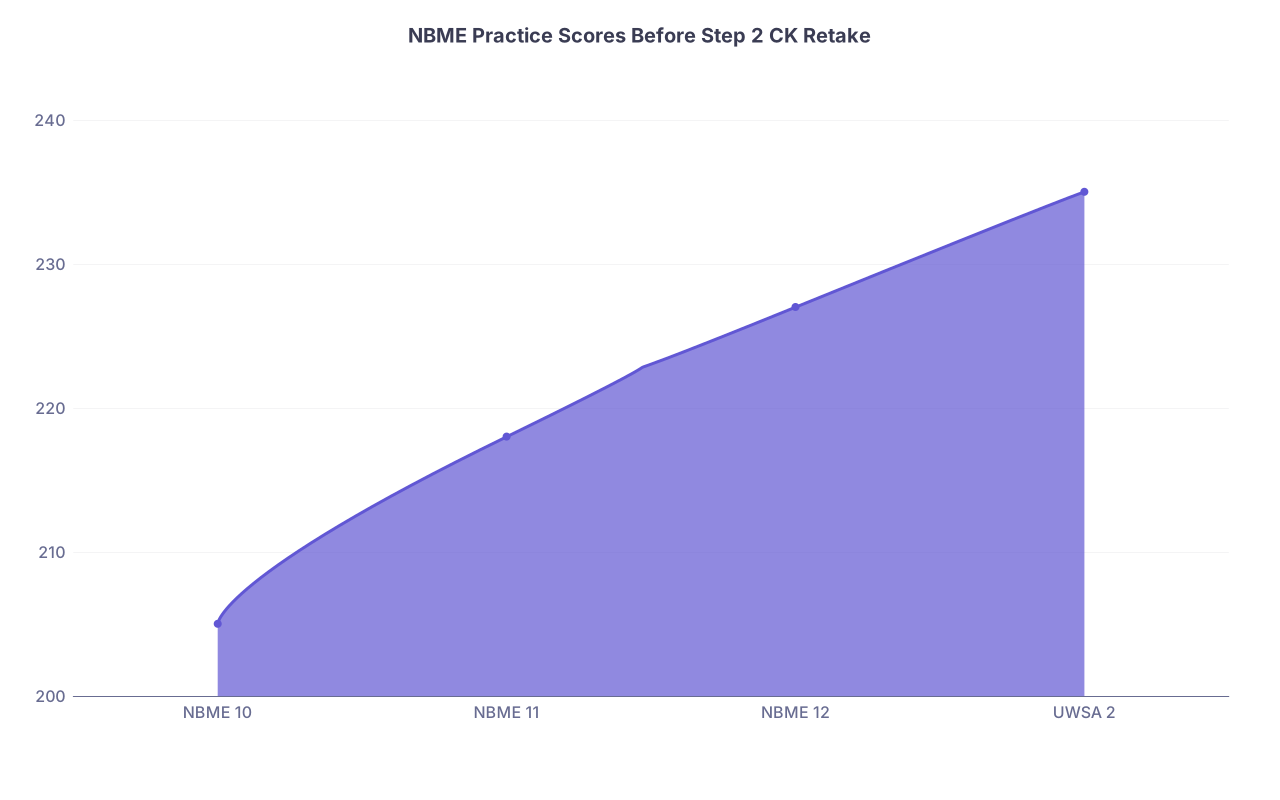
| Category | Value |
|---|---|
| NBME 10 | 205 |
| NBME 11 | 218 |
| NBME 12 | 227 |
| UWSA 2 | 235 |
You do not put the chart in your letter, obviously, but that is the kind of trajectory you want to summarize in a sentence or two.
Example sentence:
“After restructuring my schedule and working closely with our learning specialist, my NBME practice scores increased from 205 to 227, and I achieved a 236 on my Step 2 CK retake.”
D. Close with targeted reassurance
Last paragraph should answer: “Why will this not happen again during residency?”
Examples:
- “Through this process I learned to recognize early signs of burnout, seek help promptly, and protect focused study time. The strategies that allowed me to improve on my second attempt are the same ones I will carry into in‑service exams and board preparation during residency.”
- “The changes I implemented—structured daily question review, scheduled practice exams, and early feedback seeking—have become part of my routine, and I am confident they will support consistent performance in residency.”
No need for big promises. Just connect actions → future reliability.
5. Template: Dean’s Letter Addendum for Step 2 CK
You are going to customize this. Do not copy‑paste without editing. Programs see patterns.
Use this as the text you propose to your Dean’s or Student Affairs office.
Template – Step 2 CK Addendum (Fail then Pass)
To residency program directors,
I failed Step 2 CK on my first attempt in June 2024. This result does not reflect my usual performance in the clinical environment, and I appreciate the opportunity to provide brief context and describe the steps I have taken since.
My first attempt occurred during a period when I was managing an acute health issue that required two emergency department visits and ongoing follow‑up in the month leading up to the exam. I chose to proceed with the scheduled date rather than postpone the test. In retrospect, that decision, combined with reduced preparation time, contributed significantly to my result.
Following this outcome, I met with my advisor, our learning specialist, and Student Affairs to develop a structured remediation plan. I completed a full, timed pass of UWorld, took multiple NBME practice exams with progressive improvement, and increased the number of full‑length, exam‑condition practice tests. I also addressed my health issue with my treating physician and returned to my baseline level of functioning before rescheduling the exam.
On my second attempt in October 2024, I passed Step 2 CK with a score of 237. This aligns more closely with both my Step 1 performance and my clinical evaluations, including honors in Medicine and Surgery clerkships. The process of remediating this exam taught me to identify limitations early, seek help quickly, and build a sustainable, structured approach to high‑stakes assessments.
I understand that my initial failure may raise concerns, and I do not take that lightly. The systems I now use for time management, question‑based learning, and self‑monitoring will guide my preparation for in‑service exams and board certification in residency. I am committed to maintaining the level of performance reflected in my second attempt and my clinical work.
Sincerely,
[Your Name]
Template – Step 2 CK Addendum (Single Low Pass / Unexpectedly Low Score)
To residency program directors,
My Step 2 CK score of 223 is lower than I and my faculty expected based on my prior performance, including a Step 1 score of 239 and consistent strong clerkship evaluations. I would like to offer brief context and describe how I have responded.
I took Step 2 CK in July 2024 after completing back‑to‑back sub‑internships and significantly underestimated the dedicated study time required. My preparation relied heavily on passive review and limited timed question blocks, and I did not complete a full schedule of practice NBME examinations before the test date. This approach was insufficient for the exam’s style and breadth.
After receiving my score, I met with my faculty advisor and our learning specialist to analyze my preparation. I shifted to a more active, question‑based strategy with daily timed blocks, systematic review of missed questions, and scheduled full‑length practice exams. I applied this approach to my remaining clerkships, during which my shelf exam performance improved from the 55th to approximately the 75th percentile, and my clinical evaluations remained strong.
While I am unable to change the original Step 2 CK score, the changes I implemented have led to more consistent performance across standardized assessments. The structure I have built—regular self‑testing, early feedback seeking, and protected study time—is now part of my routine and will guide my preparation for in‑service exams and board certification during residency.
Sincerely,
[Your Name]
Template – Step 1 Weak, Step 2 CK Strong (Reassurance / Positive Framing)
Sometimes you want the addendum to highlight a positive turn, especially if Step 1 was a fail or low pass and Step 2 CK is much stronger. This is less “damage control” and more “clarifying the trajectory”.
To residency program directors,
I recognize that my Step 1 performance was below the level typically seen in applicants to your programs. I would like to briefly describe how I addressed this and why I believe my Step 2 CK performance and clinical work better represent my current abilities.
After Step 1, I worked closely with our learning specialist to diagnose specific weaknesses in my study approach, including limited use of timed practice questions and inconsistent review of missed material. Together, we built a structured schedule centered on daily question banks, spaced repetition, and regular self‑assessment using NBME practice exams.
I applied this new approach throughout my core clerkships. As I progressed, my shelf exam scores improved from approximately the 30th percentile on my first exam to the 70th percentile or higher on later rotations, and my clinical evaluations consistently described strong preparation and growth. Using the same system for Step 2 CK, I achieved a score of 241, which is more aligned with my performance in the clinical environment.
The process of remediating my earlier weaknesses has made me a more deliberate and self‑aware learner. The habits I developed—structured study time, frequent self‑testing, and early course correction—are now ingrained in how I approach new material. I believe this trajectory is a more accurate reflection of how I will perform on in‑service examinations and board certification in residency.
Sincerely,
[Your Name]
6. How to Tailor the Template Without Shooting Yourself in the Foot
You must adapt the wording to your real situation. But do not “freestyle” too much. There are some landmines.
A. Do not overshare
You do not need your entire medical history or family drama. For health or personal issues:
Acceptable:
- “acute health issue requiring emergency care”
- “family emergency requiring travel and caregiving responsibilities”
- “ongoing treatment for anxiety, now well managed with therapy and medication”
Not acceptable:
- Graphic descriptions.
- Naming specific diagnoses that create more bias than clarity (use general terms unless school counsel says otherwise).
- Emotional confessionals.
If you are not sure how much to say, draft the lean version, then show it to your Dean’s office. They have seen what works.
B. Avoid blame language
Watch for any sentence that implies:
- “The exam was unfair.”
- “The testing environment ruined everything.”
- “The score is entirely out of my control.”
You can mention real logistical issues (fire alarm, computer crashes) only if:
- They were documented with the testing center, and
- You also take responsibility for your own piece.
Example:
“On the day of my exam there was a prolonged testing center disruption, which was documented with the NBME. While this contributed to my stress and timing difficulties, I also recognize that my preparation strategy was not optimal, particularly my lack of timed full‑length practice.”
C. Match your specialty’s expectations
Some specialties are far less forgiving of Step issues (derm, ortho, plastics, neurosurgery, certain fellowships later). Others (FM, psych, peds) will look much more at trajectory and clinical fit.
You still write the same kind of letter, but:
For highly competitive specialties:
- Emphasize your structured, high‑level studying.
- Mention any additional exam success (e.g., strong COMLEX, in‑service practice experiences, research that required heavy reading and synthesis).
For primary care specialties:
- Emphasize reliability, follow‑through, and your ability to perform on clinical teams.
- Connect your new systems to patient care (e.g., reading deeply, following up on complex problems, ownership behaviors).
| Specialty Type | Emphasis in Addendum |
|---|---|
| Competitive surgical | Rigor, data, quant scores |
| Competitive medical | Trend, analysis, structure |
| Primary care | Reliability, growth, team |
| Hospital-based (EM, Anes) | Performance under pressure, pattern recognition |
7. Coordinating with Your Dean’s Office Without Losing Control
This part is political. You want your narrative in the MSPE, but your school has policies.
Here is a simple protocol that works at most institutions:

| Step | Description |
|---|---|
| Step 1 | Identify Step 2 CK issue |
| Step 2 | Draft 1 page addendum |
| Step 3 | Gather supporting data |
| Step 4 | Meet Student Affairs |
| Step 5 | Revise with Dean input |
| Step 6 | Dean writes summary |
| Step 7 | Confirm final MSPE text |
| Step 8 | Submit ERAS with MSPE |
| Step 9 | School allows student language |
What you bring to the meeting:
Your draft (printed).
A 1‑page summary of:
- Step scores (Step 1, Step 2 CK attempts/scores).
- Shelf exam percentiles (before/after changes).
- Any official documentation of health / personal issues (if relevant and appropriate).
A clear request:
- “I would like a brief explanatory statement included in the MSPE regarding my Step 2 CK history, based on this draft. I am very open to your edits and to aligning with school policy.”
Stay collaborative. The Dean is not your enemy. They are also protecting the school from looking like it glosses over exam issues.
8. Common Mistakes That Make Your Addendum Backfire
Here is the blunt list I wish more students saw before sending anything out.
Writing more than one page
- Over 1 page screams: “I am still not over this.”
- Target: ½ to ¾ of a page.
Using emotional or theatrical language
- “Devastated,” “shattered,” “heartbroken,” etc. leave the wrong impression.
- You can say “disappointed” once, then move to action.
Making excuses instead of owning decisions
- “I had no choice but to take the exam then.” (Usually false.)
- Better: “I chose to proceed rather than postpone, and that was a mistake.”
No evidence of change
- If your letter is all story and zero numbers, it looks hollow.
- Find at least one objective metric of improvement.
Contradicting other parts of your application
- If your personal statement says you “thrive under pressure,” but your addendum says you collapsed under normal exam stress with no plan, that is a mismatch.
- Be honest but coherent.
9. How This Fits Into the Bigger Residency Application Strategy
The Dean’s Letter addendum is not the only place you can frame Step 2 CK.
You want a consistent narrative across:
MSPE / Dean’s Letter
- Brief, factual explanation.
- Institutional voice or your statement embedded.
Personal Statement
- Do not turn it into a Step 2 CK essay.
- At most, 1–2 sentences if your score or fail is central to your growth story.
- Keep the main focus on why this specialty + who you are as a clinician.
Interviews
- Have a 20–30 second verbal version of your story:
- What happened.
- What you changed.
- How you are now stronger for it.
- Have a 20–30 second verbal version of your story:
Here is what that verbal script could look like:
“I failed Step 2 CK on my first attempt. I was dealing with a health issue at the time and made the mistake of not rescheduling. After that, I worked with our learning specialist, restructured my studying around timed questions and full‑length practice exams, and addressed my health. On my second attempt I scored a 237, which is more in line with my clerkship performance. The process really forced me to build better systems for preparation and self‑monitoring, which I have carried into every rotation since.”

You keep the same basic structure everywhere. That consistency is what reassures people you are not spinning different stories.
10. Concrete Steps You Can Take Today
You do not need to “think about this” for a week. You can move this forward in the next 24–48 hours.
Here is a simple, actionable checklist:
| Step | Task |
|---|---|
| 1 | Write a 3–4 sentence factual summary |
| 2 | List objective evidence of improvement |
| 3 | Draft addendum using one template |
| 4 | Cut to ½–¾ page, remove emotion words |
| 5 | Schedule email/meeting with Dean’s office |
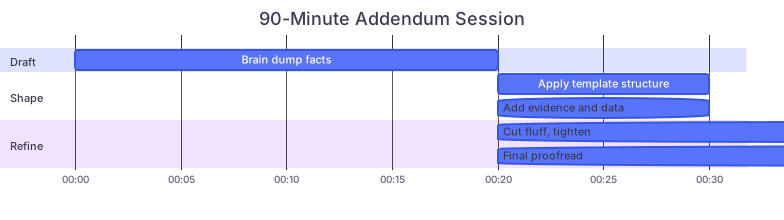
And if you want to be even more concrete, structure your actual writing time like this:
| Task | Details |
|---|---|
| dateFormat HH | mm |
| axisFormat %H | %M |
| Draft: Brain dump facts | a1, 00:00, 00:20 |
| Shape: Apply template structure | a2, 00:20, 00:30 |
| Shape: Add evidence and data | a3, 00:30, 00:20 |
| Refine: Cut fluff, tighten | a4, 00:50, 00:20 |
| Refine: Final proofread | a5, 01:10, 00:20 |

11. Final Thought – And Your Next Step
Programs do not expect perfection. They expect honesty, pattern recognition, and course correction. A Step 2 CK misstep is a data point, not a life sentence, if you handle it like a professional.
Your next step is simple:
Open a blank document and write the first two sentences of your addendum, starting with the exact score or outcome. No story. No justification. Just the fact.
Once that is on the page, you can build the rest of the letter around it.