
The way most applicants use their Step 2 CK score reports is lazy—and it costs them interviews.
You are sitting on one of the strongest pieces of objective evidence in your entire application. If all you do is copy the three-digit score into ERAS and move on, you are wasting it.
This is about turning that PDF into a weapon: a focused study narrative that reassures program directors, explains your trajectory, and quietly answers every concern they might have about your readiness.
Let me show you exactly how to do that.
Step 1: Stop Treating Your Score Report Like Just a Number
First, reframe what you are holding.
Program directors do not only see “246” or “221.” They see:
- Your performance relative to the mean
- Your consistency across content areas
- Your ability to improve from Step 1 (or recover from it)
- Your potential to handle boards in residency
Step 2 CK has become the default standardized metric since Step 1 went pass/fail. That means:
- Borderline Step 2 CK = red flag to investigate
- Strong Step 2 CK = green light to trust you clinically
- Big jump from Step 1 → Step 2 CK = evidence of maturity and work ethic
- Drop or flat performance with weak subscores = something you must explain
You need a narrative that makes sense of your data. Not spin. Not excuses. A coherent story that lines up with your scores, your clerkship performance, and your future goals.
Step 2: Read Your Step 2 CK Report Like a Program Director
You cannot build a narrative if you do not understand what the report actually tells people.
Print it out. Grab a pen. Now walk through it as if you are deciding whether to interview yourself.
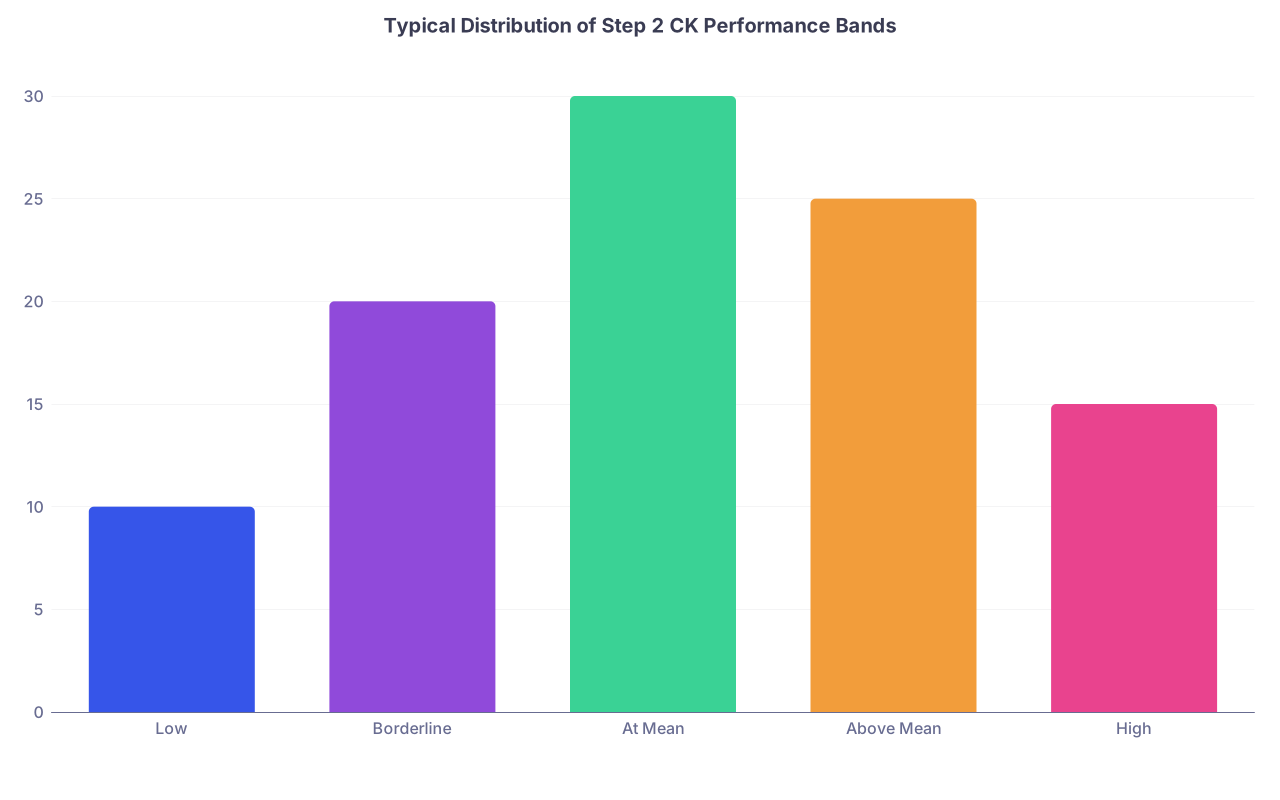
| Category | Value |
|---|---|
| Low | 10 |
| Borderline | 20 |
| At Mean | 30 |
| Above Mean | 25 |
| High | 15 |
1. Overall score and percentile band
Ask yourself:
- Is my score:
- Clearly strong for my target specialty?
- Acceptable but not impressive?
- Below what most programs expect?
Rough ranges (not perfect, but reality-based):
| Category | Score Range (Approximate) | Interpretation for PDs |
|---|---|---|
| Weak | < 225 | Concern about clinical knowledge |
| Borderline | 225–235 | Needs context or clear upward trend |
| Solid | 236–245 | Comfortable for most non-ultra-competitive |
| Strong | 246–255 | Competitive almost anywhere |
| Very strong | > 255 | Asset for score-sensitive specialties |
You will never write those numbers in a personal statement, but you must think with this level of clarity.
2. Step 1 → Step 2 CK trajectory
Even if Step 1 is pass/fail on your transcript, you still know how that prep went.
- If your Step 1 was weak / borderline and Step 2 CK is clearly higher level:
- Your narrative: “I grew. I fixed my process. I can handle boards now.”
- If your Step 1 was strong and Step 2 CK is flat or lower:
- Your narrative: “I maintained high performance while adding real clinical responsibility. Here is what that looked like.”
If you actually have a numerical Step 1 in your file that programs will see, and you improved ≥10–15 points on Step 2 CK, that is narrative gold. You will use it.
3. Content area subscores
This is where most applicants blow past the goldmine.
Some PDs glance straight at:
- Medicine-related systems (cardio, pulm, GI, renal, heme/onc)
- Care of acutely ill / emergency problems
- Patient safety and quality improvement
- Systems-based practice (orders, management plans)
You should:
- Circle every content area where you are below or borderline relative to the mean
- Put a box around every area clearly above the mean
This will show you:
- Where you actually improved from shelf exams
- Where your “weaknesses” are not weaknesses anymore
- Where you still look vulnerable (and therefore what your narrative must address)
4. Question format and timing-related data (if present)
If your report or your prep platform gave you any data like:
- Lower performance on multi-step reasoning questions
- Weakness in biostatistics / ethics
- Struggles with time management
Capture that. Time pressure and complex reasoning weaknesses are red flags in residency. You need to either show improvement or show real steps you took to address them.
Step 3: Extract the Three Core Themes of Your Story
You do not need ten themes. You need three.
Those three will repeat—subtly—across your:
- Personal statement
- Experiences section
- MSPE / school letter addendum (if you are lucky enough to influence it)
- Interview answers
Here is the structure that works.
Theme 1: Your global trajectory
This is the “arc” PDs care about.
Pick one:
- “Consistent high performance from preclinical to Step 2 CK”
- “Clear upward trend culminating in strong Step 2 CK”
- “Temporary dip followed by focused recovery and strong Step 2 CK”
You will prove this with:
- Step 2 CK score and band
- Clerkship grades / honors, especially in core rotations
- Specific changes you made in study strategy between Step 1 and Step 2 CK
Theme 2: Your clinical strengths (connected to subscores)
Do not say “I like internal medicine” without proof. Use your score report:
Examples:
- “Strong performance in multi-system and acute care questions aligns with my interest in EM / IM and my strong evals in ICU and ED rotations.”
- “High performance in pediatrics and systems-based practice content reflects both my Step 2 CK subscores and my honors in pediatrics and family medicine.”
- Core rotation strengths
- Letters of recommendation
- Specific clinical anecdotes
Theme 3: Your targeted improvement plan
This is where most people sound vague. You will not.
Use Step 2 CK subscores to define:
- One or two areas that were historically weak
- What you did differently for Step 2 CK
- How you will continue this work heading into residency and in‑training exams
Example:
- “Earlier in medical school, my neurology performance lagged behind my other systems. For Step 2 CK, I built a focused block schedule that included daily UWorld neuro questions and weekly case-based reviews with a resident mentor. That turned a prior weak area into a strength, as reflected in my above-mean neuro subscore. I plan to carry that same structure into my intern year board prep.”
That is specific. That sounds like someone who will not sink on in‑service exams.
Step 4: Turn the Numbers into a Study Process Story
Now you connect the dots: not just “I got this score,” but “here is how I work.”
“Study narrative” really means: a repeatable, disciplined process you can describe in concrete steps.

| Step | Description |
|---|---|
| Step 1 | Step 2 CK Score Report |
| Step 2 | Analyze Overall Score |
| Step 3 | Review Subscores |
| Step 4 | Identify 2 Strengths |
| Step 5 | Identify 2 Weaknesses |
| Step 6 | Link to Clerkship Honors |
| Step 7 | Define Improvement Plan |
| Step 8 | Write ERAS Experiences |
| Step 9 | Shape Interview Answers |
Build a “before → during → after” story
Before Step 2 CK
- What was not working with your prior study methods?
- How did shelf exam feedback or Step 1 experience shape your plan?
During Step 2 CK prep
- What exact system did you use?
- How did you handle weaknesses identified during prep?
- What did you do in the final 4–6 weeks?
After Step 2 CK
- What the actual score and subscores showed
- How you interpreted that data
- What you changed in your ongoing learning as a result
Example skeleton you can adapt:
“Early in clerkships, my shelf scores in surgery and OB were solid but not exceptional, and I saw a pattern of missing multi-step management questions. For Step 2 CK, I built a structured 10-week plan: daily mixed UWorld blocks with aggressive error logging, weekly ‘systems days’ focused on weak areas (neuro and rheum), and a final 3-week period of full-length practice exams and targeted review of missed biostatistics and ethics questions. The result was a Step 2 CK score of 249, with above-mean performance in medicine-related systems and patient safety content. Those habits—structured review, tracking errors, and building targeted question sets—are the same ones I am carrying into my in-training exam preparation.”
That is a study narrative. Concrete. Traceable. Believable.
Step 5: Weave the Narrative into Your ERAS Application
Now we plug this into the actual application components.
1. Personal statement: subtle, not a score essay
Do not write a Step 2 CK statement. You are not applying to USMLE.
You drop one short paragraph that:
- References Step 2 CK only once, if at all
- Focuses on process, not bragging
- Ties performance to clinical growth
Example for an IM applicant:
“My early shelf exams taught me a useful lesson: enthusiasm alone does not translate into reliable clinical judgment. I began dissecting every missed question and every unclear patient encounter, building a system for tracking patterns and closing knowledge gaps. That process—honed over my medicine and ICU rotations and culminating in a strong Step 2 CK performance—has been less about chasing a score and more about learning to think like an internist: systematic, curious, and unwilling to let uncertainty slide.”
You want the reader to infer: “OK, this person can handle our boards and our patients.”
2. ERAS “Experiences” section: link behaviors to outcomes
When you describe academic or teaching experiences, connect them very lightly to your test performance trajectory.
For example:
Teaching role:
“Led weekly case-based Step 2 review sessions for third-year students, focusing on multi-step management reasoning and high-yield internal medicine topics. This teaching role reinforced my own transition from memorization-focused studying to pattern recognition and clinical reasoning, which paralleled my improvement from early shelf scores to my final Step 2 CK performance.”
Research or QI project:
“Participated in a patient safety QI project on medication reconciliation errors, which later informed my approach to Step 2 CK questions in systems-based practice and patient safety domains.”
You are quietly reinforcing: “What I worked on clinically showed up in my score report.”
3. MSPE / Dean’s letter: provide your school with ammo
If you have any input into the MSPE or a supplemental note from an advisor, you can feed them language that links your growth to Step 2 CK.
Something like:
“Over the course of clinical rotations, [Name] demonstrated a clear upward trajectory in both clinical evaluations and standardized testing, culminating in a Step 2 CK score that reflects strong readiness for residency and in-training examinations.”
They may not use it verbatim, but you have planted the idea.
Step 6: Prepare Direct, Data-Backed Interview Answers
This is where your Step 2 CK report really pays off.
You will almost certainly get some version of:
- “Tell me about your Step scores.”
- “You did well on Step 2 CK; what worked for you?”
- “I see some variation in your subscores—how do you interpret that?”
Walk in with rehearsed, honest, tight answers that use your report data.

Scenario 1: Strong Step 2 CK, average Step 1
Structure your response:
- Acknowledge Step 1 honestly (without over-explaining)
- Emphasize the process changes you made
- Point to Step 2 CK as evidence of that improvement
Example:
“My Step 1 performance was solid but not where I wanted it to be, and it reflected a study approach that was too focused on memorization and not enough on application. During clerkships, especially on medicine and ICU, I started building a much more deliberate system—daily question blocks, structured error review, and asking residents to walk me through management decisions I had missed. That change in process is what drove my Step 2 CK performance into a stronger range, particularly in the internal medicine and acute care content areas, and it is the same approach I plan to use for our in‑service exams.”
Scenario 2: Flat or slightly lower Step 2 CK vs strong Step 1
You cannot hide this. You explain it.
Key moves:
- Do not sound defensive
- Emphasize maintenance of a high level while adding responsibilities
- Point at subscores and real-world performance
Example:
“My Step 1 and Step 2 CK scores are in a similar range, and I am proud of that consistency given the added clinical responsibilities during that time. What changed for me was not the overall score band, but how I got there. Step 2 CK required me to integrate what I was seeing on inpatient services into exam-style reasoning, and my subscores in medicine-related systems and patient safety reflect that. My focus now is applying that same disciplined approach to the knowledge base of [specialty] so that I show the same consistency on in‑service exams.”
Scenario 3: Subscore weakness that might matter for your specialty
Example: You are applying EM and your “care of acutely ill patients” band is at or just below the mean.
Attack it directly:
“One area I paid particular attention to on my Step 2 CK report was the band for care of acutely ill patients. My performance there was at the mean, which did not reflect the comfort I was developing in the actual ED and ICU. I went back through my practice exams and realized I was occasionally over-thinking management steps and second-guessing first-line interventions. I have since focused on rapid recognition of classic presentations and committing first-line management to muscle memory, and my subsequent ED rotation evaluations and mock codes with residents have reflected much stronger performance. I plan to keep using that feedback loop in residency—exam data, clinical evaluations, targeted practice.”
That is what programs want: someone who uses data to adjust, not someone who makes excuses.
Step 7: Use Your Score Report to Plan for Residency Exams
The narrative does not end when you submit ERAS. Smart applicants connect Step 2 CK to future in‑service and board performance.
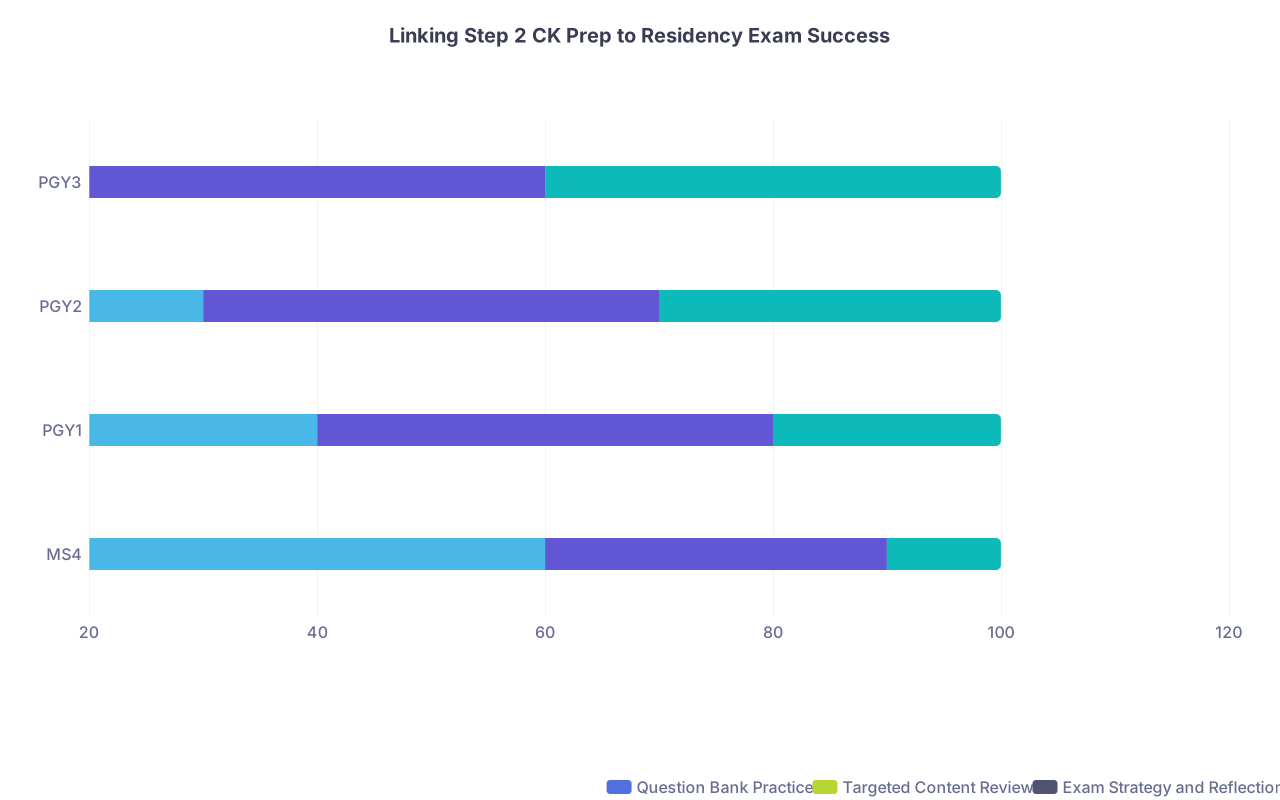
| Category | Question Bank Practice | Targeted Content Review | Exam Strategy and Reflection |
|---|---|---|---|
| MS4 | 60 | 30 | 10 |
| PGY1 | 40 | 40 | 20 |
| PGY2 | 30 | 40 | 30 |
| PGY3 | 20 | 40 | 40 |
Build and verbalize a simple, credible forward plan:
- Identify 1–2 subscores you want to protect or improve
- E.g., “systems-based practice” and “biostats / ethics”
- Define how you will embed these into residency:
- Plan to use your specialty question bank on a regular schedule
- Join or start a small board review group
- Maintain an error log for tricky topics you encounter on service
Say something like this in interviews:
“The biggest thing Step 2 CK taught me is that I do best when I have a structured system: regular questions, immediate error analysis, and periodic full-length assessments. I already know from my Step 2 CK subscores that biostatistics and ethics require more repetition for me, so I plan to build those into my board prep from the start of PGY1 rather than waiting for PGY3 panic season.”
Program directors hear: “This person will not tank our in‑service numbers and make my life harder.”
Common Pitfalls You Need to Avoid
Quick list of things that will quietly hurt you:
- Bragging about your score without connecting it to clinical performance
- Over-explaining a minor weakness—one low band is not a tragedy
- Blaming test day factors (noise, bad proctor, “I am not a good test taker”)
- Ignoring obvious discrepancies between your subscores and specialty choice
- Copy-pasting generic “I improved my test-taking skills” nonsense into every essay
Stay concrete. Stay honest. Always tie back to process and patient care.
Example: Putting It All Together (Internal Medicine Applicant)
Let me sketch a realistic composite.
Facts:
- Step 1: Pass, but struggled with preclinical exams
- Step 2 CK: 245 (solid–strong range)
- Subscores: Above-mean in cardiovascular, pulm, renal, patient safety; at-mean in neuro; slightly below in OB/GYN and psych
- Clerkships: Honors in IM and ICU, High Pass in others
Narrative:
- Theme 1 (trajectory): “Clear upward trend with clinical immersion—Step 2 CK confirms readiness”
- Theme 2 (strengths): “Strong foundation in medicine systems and patient safety”
- Theme 3 (improvement plan): “Neuro was a prior weak area; built a system, now stable; will keep reinforcing it in residency”
Personal statement paragraph:
“By the time I reached my internal medicine clerkship, I had learned the hard way that effort without structure does not produce consistent results. I began treating every patient and every missed question as data. On rotation, that meant tracking patterns in my attendings’ management decisions. In Step 2 CK preparation, it meant daily mixed question blocks, an error log organized by system, and weekly review sessions focused on high-yield internal medicine topics and patient safety scenarios. The result was more than a Step 2 CK score in a comfortable range—it was the realization that I could build a reliable process for clinical learning and board preparation, one that I am eager to carry into residency.”
Interview sound bite:
“My Step 2 CK subscores mirror my clinical experience: cardiovascular, pulmonary, and renal systems and patient safety are strengths that came directly from my medicine and ICU rotations. Earlier in third year, my neuro performance lagged, so I made it a specific focus in the last six weeks before Step 2 CK with dedicated question sets and weekly reviews with a neuro resident. That brought my neuro performance to the mean band. Going forward, I plan to keep neuro and patient safety on a fixed review schedule so that they remain strengths for in‑service exams.”
That is what a focused study narrative sounds like.

FAQ (Exactly 4 Questions)
1. Should I ever mention my exact Step 2 CK score in my personal statement?
Generally no. Let the score report and ERAS fields handle the number. In the statement, talk about the process that led to your performance and what you learned from it. The only partial exception: if your score is clearly above the usual range for an ultra-competitive specialty and directly tied to a research or teaching role, you might reference the band (“high range performance on Step 2 CK”) rather than the exact number.
2. How do I handle a mediocre Step 2 CK score if my shelves and clinical evals are strong?
Anchor your narrative in your clinical performance first. Emphasize consistent honors / strong evaluations, then frame Step 2 CK as one data point that is acceptable but not fully reflective of your day-to-day abilities. Show that you have already analyzed the report, identified weak content areas, and built a concrete plan for in‑service prep. Never pretend the score does not matter, but do not let it dominate the story.
3. Do program directors actually look at Step 2 CK subscores?
Some do, some do not—but you should assume the serious ones at competitive programs at least glance at them, especially if there are questions about fit or readiness. They are less interested in tiny variations and more interested in obvious patterns: repeated weakness in core systems relevant to the specialty, or big discrepancies between your stated strengths and your exam data. Your job is to ensure that your narrative makes sense of those patterns.
4. How much should I talk about “test-taking strategy” versus content mastery?
Keep “test-taking strategy” talk to a minimum. Program directors care far more about content mastery and clinical reasoning. You can mention things like pacing, review structure, and error logs, but always tie them back to understanding disease processes and management, not just gaming the exam. If all they hear is “I got better at multiple-choice tricks,” they will worry about your real-world performance. Focus on how your Step 2 CK prep improved your thinking, not just your score.
Key points:
- Your Step 2 CK report is not just a number; it is a data-rich story about how you learn and think.
- A strong narrative links trajectory, subscores, and study process directly to clinical performance and future board readiness.
- Every part of your application—from personal statement to interviews—should quietly reinforce that coherent, evidence-based study narrative.