
The obsession with Step 1 is dead. Programs are quietly replacing it with Step 2 CK as the real filter.
If you have a pass/fail Step 1 and you are not treating Step 2 CK like a make-or-break exam, you are making a serious mistake. The good news: you can absolutely use a strong Step 2 CK to offset the lack of a numeric Step 1. But you have to be deliberate, aggressive, and a little ruthless in how you prepare and how you present that score in your application.
Here is the playbook.
1. Understand the New Reality: Step 2 CK Is Your Primary Academic Signal
Before you start grinding UWorld questions, you need to understand the game you are playing.
Programs used to screen with Step 1. Now they do this:
- For older applicants: Step 1 + Step 2 CK filters.
- For your cohort: Step 2 CK + clerkship grades + school reputation.
Which means:
- Your Step 2 CK is now:
- Your only standardized numeric measure across schools.
- Your main way to show you can handle residency-level medical knowledge.
- The tiebreaker when your GPA and school name mean nothing to the committee.
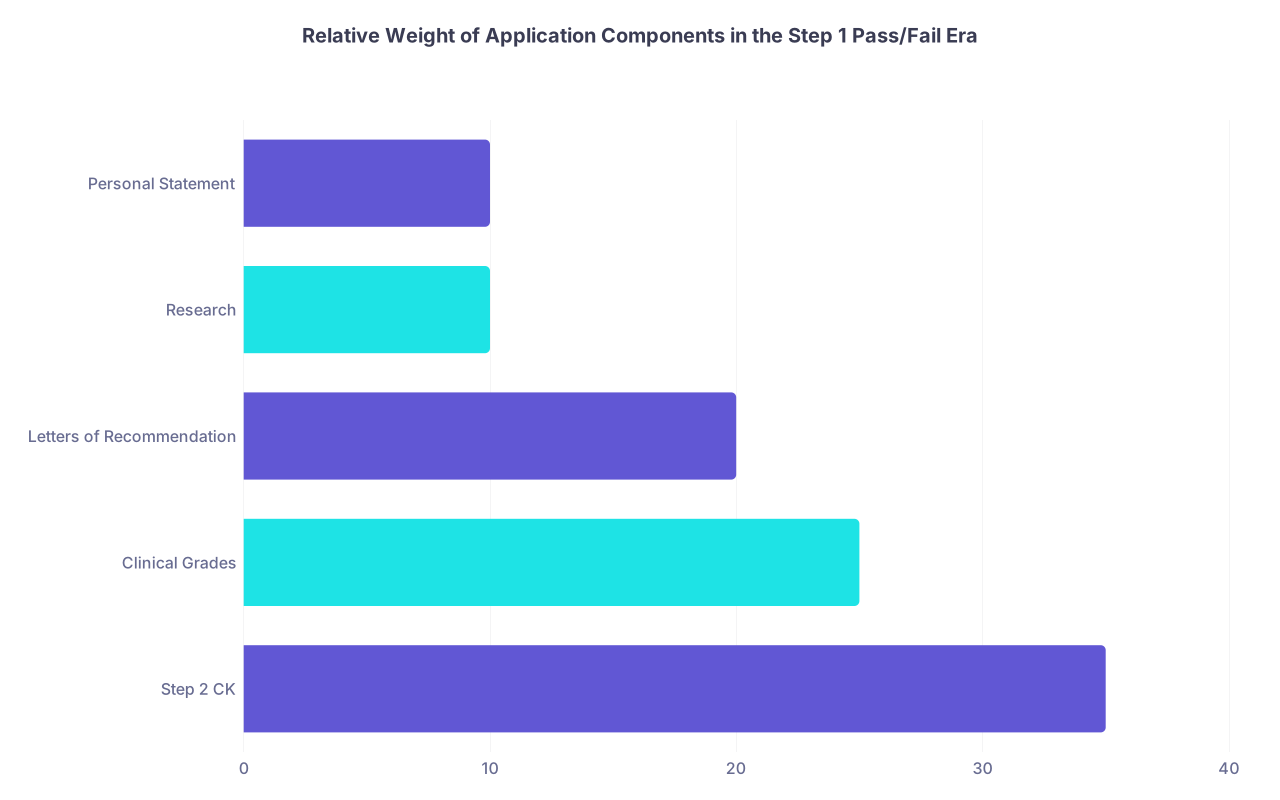
| Category | Value |
|---|---|
| Step 2 CK | 35 |
| Clinical Grades | 25 |
| Letters of Recommendation | 20 |
| Research | 10 |
| Personal Statement | 10 |
Bottom line:
A strong Step 2 CK does not just “help.” It becomes the central pillar of your academic profile. Especially if:
- You are coming from a less well-known school.
- Your pre-clinical performance was mixed.
- You are aiming for a competitive specialty.
What “strong” actually means
Stop thinking in vague terms. You are not aiming for “good enough.” You are aiming for a score that forces programs to take you seriously.
Here is a simple target framework:
| Specialty Tier | Example Specialties | Competitive Step 2 CK Target |
|---|---|---|
| Ultra-competitive | Derm, Plastics, Ortho, ENT, Neurosurg | 255–265+ |
| Competitive | Radiology, EM, Anesthesia, Urology | 245–255+ |
| Moderately competitive | IM, OB/GYN, Gen Surg, Neuro | 240–250+ |
| Less competitive | FM, Psych, Peds, PM&R | 230–240+ |
These are targets, not absolute cutoffs. But if you want Step 2 CK to offset the lack of a numeric Step 1, you should aim for the upper end of your specialty’s typical range, not the average.
2. Build a Step 2 Timeline That Works With ERAS, Not Against It
If you are serious about using Step 2 CK to strengthen your residency application, timing is not optional. Programs cannot value a score they do not see.
Your non-negotiable rule
Your Step 2 CK score must be available by the time programs start reviewing applications.
Translation: For ERAS, that means your exam should be taken no later than late July / very early August, depending on the year’s ERAS calendar and score release timeline (usually ~3–4 weeks after test date).
Here is a practical model timeline.
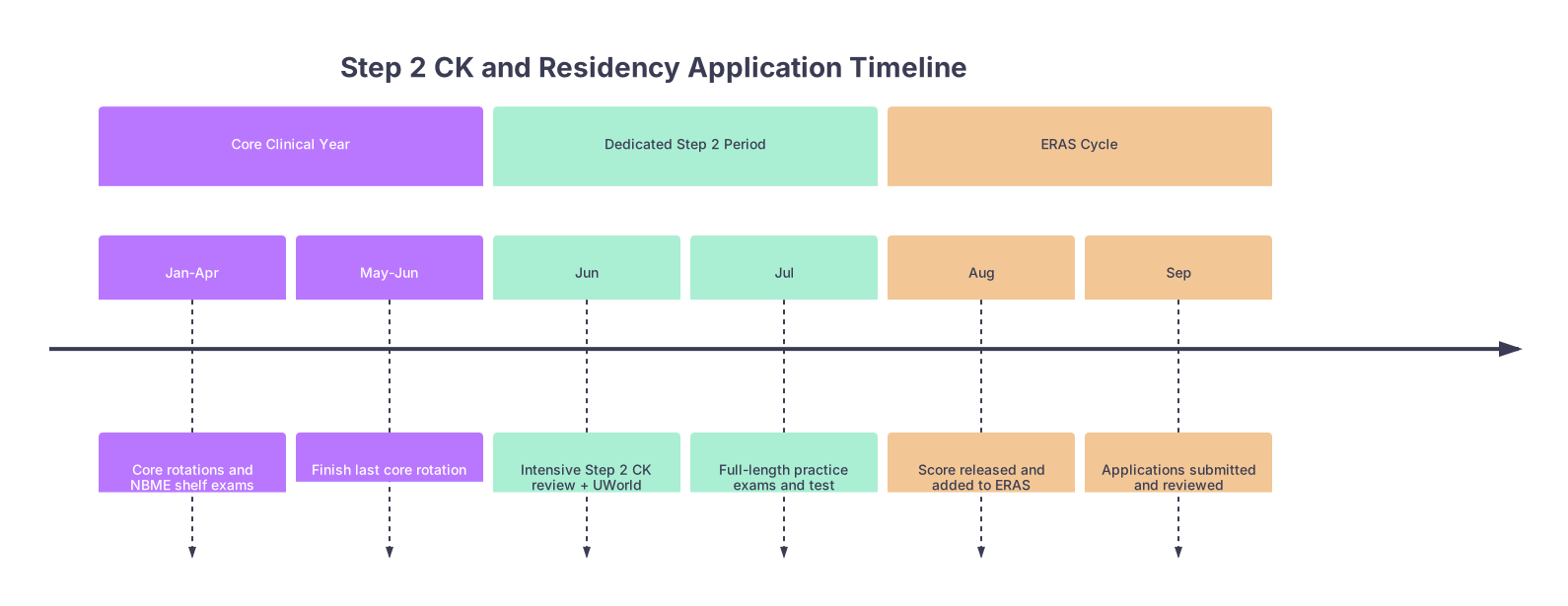
| Period | Event |
|---|---|
| Core Clinical Year - Jan-Apr | Core rotations and NBME shelf exams |
| Core Clinical Year - May-Jun | Finish last core rotation |
| Dedicated Step 2 Period - Jun | Intensive Step 2 CK review + UWorld |
| Dedicated Step 2 Period - Jul | Full-length practice exams and test |
| ERAS Cycle - Aug | Score released and added to ERAS |
| ERAS Cycle - Sep | Applications submitted and reviewed |
If you are still mid-clinical year
You have to parallel-process:
- Study for each shelf with Step 2 CK in mind.
- Use a single integrated resource set (more on that below).
- Start UWorld Step 2 before you finish all cores. Not after.
If you already finished cores
You can do a more traditional dedicated:
- 4–6 weeks full-time if you are aiming for 250+.
- 3–4 weeks if your shelves were strong and you want 240–245.
Do not take this exam “whenever I feel ready.” That mindset sinks applications because:
- Late exam → score not available for initial review.
- Programs often pre-screen in waves. If your score is missing in the early wave, you lose.
Plan backwards from ERAS, not forwards from your anxiety.
3. Design a Step 2 CK Study System That Produces a Real Score Jump
You do not need a unique or cute study plan. You need a ruthless and efficient one. Here is the skeleton that works, over and over.
Core resources (do not overcomplicate)
For 95% of students, this is the tight, high-yield list:
- UWorld Step 2 CK Qbank – non-negotiable anchor.
- NBME Step 2 practice exams – for calibration.
- UWSA 1 and 2 – for high-end score prediction.
- A text/video resource:
- AMBOSS (questions + articles) or
- OnlineMedEd (videos + notes) or
- Boards & Beyond (if you liked it for Step 1).
Pick one major content backbone. Not three. Depth beats resource hoarding.
Daily structure that does not waste time
Ideal full-time dedicated (6 days/week):
- 40–80 UWorld questions per day, timed, random, 2 blocks.
- 2–3 hours of targeted review of those blocks.
- 1–2 hours of content focused on weak areas.
- Short daily review of high-yield notes / flashcards.
If you are on rotations:
- 20–40 UWorld questions per day in mixed or rotation-specific mode.
- 1 hour of review.
- Use downtime on wards for quick article/flashcard review.
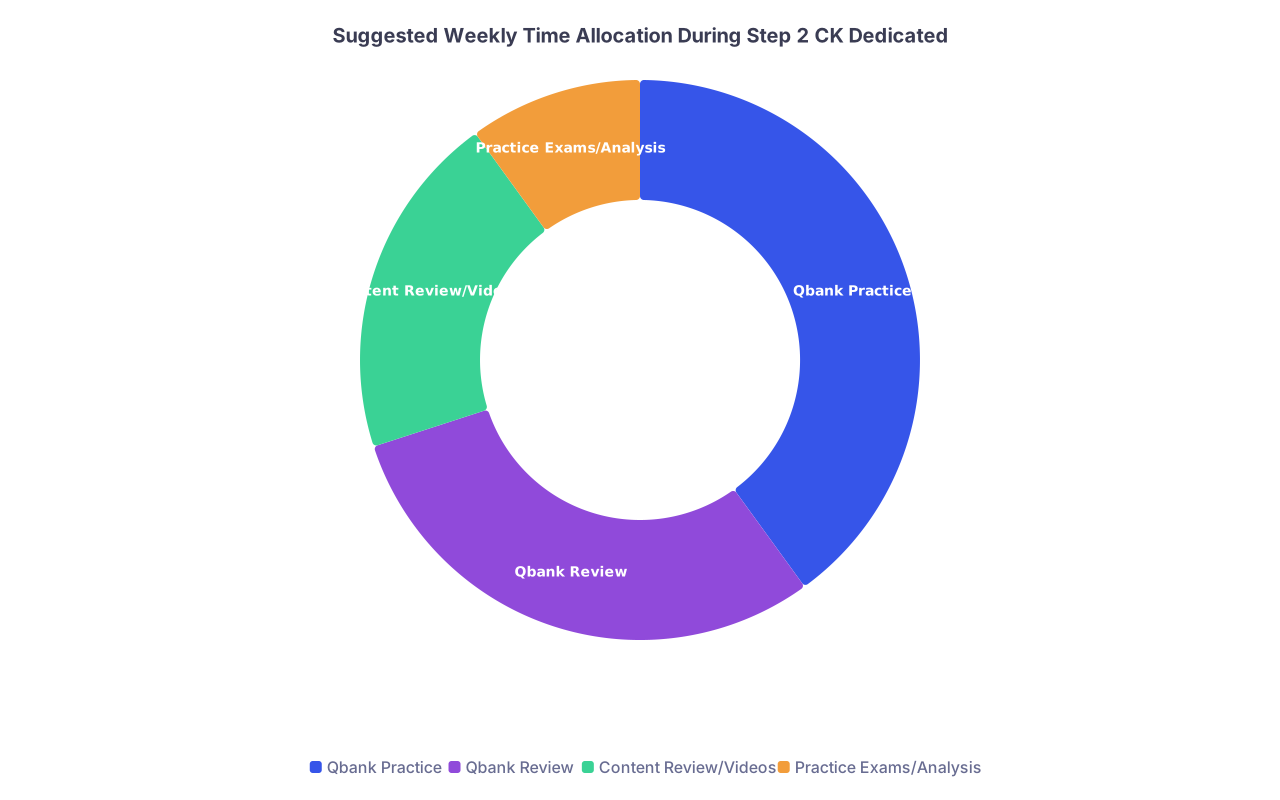
| Category | Value |
|---|---|
| Qbank Practice | 40 |
| Qbank Review | 30 |
| Content Review/Videos | 20 |
| Practice Exams/Analysis | 10 |
How many questions you should actually do
Aim for 100% of UWorld Step 2 done once, with:
- Timed mode
- Random blocks by the last 4–6 weeks
If you are gunning for a top score and have time:
- 1.3–1.5x UWorld (redoing incorrect or low-confidence questions) is reasonable.
- More than 2x is usually diminishing returns and often signals avoidance of harder tasks like NBME exams.
4. Use Practice Scores Strategically: When You Are Ready vs When You Are Lying to Yourself
I have seen this pattern countless times: students delay Step 2 for months because “my practice scores are not where I want them.” Six months later, they are still stuck in the same range, but now their ERAS window is closing.
You need a clear decision framework.
Benchmarks that actually matter
Use these as rough targets (not religious laws):
- NBME 9, 10, 11, 12:
- Within ~5–7 points of your real score most of the time.
- UWSA 2:
- Often slightly overpredicts but still useful for confidence.
A simple rule of thumb:
- If your last 2–3 exams (mix of NBME and UWSA) are consistently at or above your target range, you are ready.
- If they are within 5 points and trending up, you are likely ready with 1–2 more weeks of focused work.
- If your scores are flat or dropping, you do not need “more time”; you need a different strategy.
Practice exam schedule
During dedicated:
- Week 1–2: NBME (baseline)
- Week 3–4: NBME + UWSA1
- Week 5: NBME
- Week 6 (or last week): UWSA2
Never do a full-length exam within 48 hours of the real thing. Use those days for light review and sleep recovery.
5. Align Rotations and Step 2 Prep: Shelf Exams As Free Points
If you are still in cores, Step 2 CK prep starts now, not after rotations.
Treat every shelf as one chapter in your Step 2 preparation. That means:
- For IM, Surgery, Peds, OB, Psych:
- Use UWorld blocks aligned with your rotation.
- Supplement with NBME-style practice questions.
- Build notes / cards from shelf prep that you will reuse for Step 2.
You want to finish cores with:
- Strong shelf scores.
- A first pass of a large part of UWorld.
- A decent content base in all core disciplines.
This is how strong Step 2 scores happen “quietly,” without a brutal 8-week cram.

6. Presenting Your Step 2 CK Score So Programs Actually Notice It
Getting the score is step one. Making sure it gets maximum visibility in your application is step two.
You cannot change that Step 1 is pass/fail. You can change how you frame your academic story.
ERAS configuration
Basic but often missed:
- Release your Step 2 CK score to all programs as soon as it is available.
- Double-check that USMLE transcripts are updated and pushed to ERAS well before programs start downloading.
Where and how to highlight Step 2
Personal statement (briefly, not obsessively)
For example, one sentence is enough:“With Step 1 now scored as pass/fail, I made Step 2 CK a particular focus and scored a 252, reflecting my commitment to mastering clinical medicine at a high level.”
Do not write a paragraph about the test. You are not applying to be a professional exam taker.
MSPE / Dean’s letter (if your school allows input)
Some schools will reference your Step 2 CK in the summary. If they ask what to highlight, you can say:- “Please mention my Step 2 CK score of 247 as evidence of strong clinical knowledge in the new pass/fail Step 1 environment.”
Interviews
Be ready with a clean, confident framing:“With Step 1 pass/fail, I treated Step 2 CK as my main opportunity to demonstrate that I can handle the cognitive demands of residency. I structured my rotations and dedicated study around that goal, and I am proud of the 249 I achieved.”
Short. Direct. No drama.
7. Using Step 2 CK to Offset Other Weaknesses (Beyond Step 1)
A strong Step 2 CK can do more than compensate for a pass/fail Step 1. It can also:
Reassure programs if:
- You had a leave of absence.
- You have older preclinical academic issues.
- Your school is less known to them.
Counterbalance:
- Mediocre preclinical grades.
- Limited research (for some specialties).
- Slightly below-average clinical honors.
You still need to be realistic. A 260 Step 2 will not magically erase 3 failed rotations and weak letters. But with a clean record otherwise, a high Step 2 score is an exceptionally powerful signal.
| Weakness Type | Step 2 CK Role | How Strong It Needs To Be |
|---|---|---|
| Pass/fail Step 1 | Primary numeric metric | Upper range for specialty |
| Less-known school | Standardized comparison tool | ≥ national mean + 10–15 points |
| Modest clinical grades | Signal of strong clinical knowledge | Top quartile for specialty |
| Limited research | Shows academic rigor and discipline | Not a full substitute, but helps |
8. When Your Step 2 CK Is Not As Strong As You Hoped
Not everyone will hit their target. Some of you will end up with:
- A score slightly below your goal (e.g., 236 when you wanted 245).
- Or well below what you were aiming for.
Here is how to handle it without torching your application.
Step 1: Objective reality check
- Compare your score to:
- The national mean for that year.
- Your specialty’s match stats (NRMP data, program websites).
- Ask: “Is this fatal, or just not ideal?”
Often, scores that feel “bad” to you are still perfectly workable for many programs and specialties.
Step 2: Adjust strategy, not your entire identity
If your score is:
Within ~5–10 points of your target:
- You can still apply broadly to your desired specialty.
- Compensate with:
- Strong letters.
- Solid audition rotations.
- Tight, well-written application.
Clearly below specialty norms:
- You have hard choices:
- Apply more broadly to less competitive specialties.
- Add a parallel plan (e.g., apply to both IM and FM).
- Strengthen other parts (research year, extra rotations) if you have time.
- You have hard choices:
Do not spin this in interviews with nonsense like “I am actually glad it was not higher, because it humbled me.” People see through that. Own it, then pivot.
Example:
“My Step 2 CK score of 231 was below what I was aiming for. I reviewed my preparation, adjusted how I approached complex cases, and made sure my clinical performance and letters showed a deeper level of reasoning than the score reflects.”
Honest. Short. Then move on.
9. Specialty-Specific Nuances: Where Step 2 CK Matters Even More
Step 2 CK does not carry equal weight everywhere. Some specialties lean on it harder, especially in the post–Step 1 numerical era.
High-sensitivity specialties for Step 2
- Dermatology
- Plastic surgery
- Orthopedic surgery
- ENT
- Neurosurgery
- Diagnostic radiology
- Anesthesiology (in many programs)
- Emergency medicine
In these fields, Step 2 CK is often:
- An unofficial cutoff for interview offers.
- A fast way to rank applicants from schools the committee does not recognize.
If you are aiming at any of these, you really cannot treat Step 2 CK as just “another exam.” It becomes:
- Central to your strategy.
- A key reason to time your exam well before ERAS opens.
Primary care and other fields
For family medicine, pediatrics, psychiatry, and PM&R:
- Programs are often more holistic.
- A “good enough” Step 2 is usually sufficient if:
- You have strong clinical evaluations.
- You show real interest in the field.
- You do not have red flags.
But even there, a strong Step 2 helps you:
- Stand out for academic tracks.
- Get noticed at better-resourced programs.
- Recover from modest preclinical performance.

10. Mental Game: Not Letting Step 2 CK Dominate Your Life But Still Taking It Dead Seriously
You cannot grind effectively for 8–10 weeks if you are panicking the whole time.
Here is a quick protocol that keeps you functional:
- Set hard boundaries:
- Daily stop time (e.g., 9 pm: no more questions).
- One half-day off per week.
- Use objective data:
- Track practice scores and Qbank performance weekly, not hourly.
- Avoid endless “resource shopping”:
- If you catch yourself planning to buy a fifth resource, you are usually avoiding questions, not optimizing.
If anxiety is wrecking your focus:
- Short, structured exercise (20–30 minutes) daily.
- Fixed sleep window.
- If needed, short-term professional help. There is zero weakness in treating your brain like it matters.
FAQs
1. Do I really need to delay ERAS to wait for a higher Step 2 CK score?
Usually no. Submitting your ERAS late to chase an uncertain score bump often backfires. In most cases, you are better off:
- Taking Step 2 CK early enough that the score is available for on-time ERAS submission.
- Applying broadly with the score you have, unless your current practice exams are far below specialty norms.
2. How many NBMEs should I take before Step 2 CK?
At least 3, ideally 4:
- Mix NBME 9–12 with UWSA1 and UWSA2.
- Space them out over your dedicated period to monitor trends.
- Do a full, honest review of each, not just “check the score and move on.”
3. Does a high Step 2 CK score matter if my school does not give AOA or class rank?
Yes. In fact, it matters more. When programs cannot see numeric Step 1, class rank, or AOA, Step 2 CK becomes your clearest standardized academic signal. A strong score reassures them that you can handle the workload even if your transcript is less granular.
4. Should I mention Step 1 being pass/fail directly in my personal statement?
Briefly, if it helps frame your Step 2 CK score. One sentence is enough:
“With Step 1 now pass/fail, I viewed Step 2 CK as my main opportunity to demonstrate clinical knowledge, and my score of 248 reflects that focus.”
Do not write a paragraph about the scoring system. Show you understand the landscape, then move on to who you are as a future resident.
Key points to walk away with:
- Step 2 CK is now your primary objective academic signal. Treat it like a central part of your match strategy, not an afterthought.
- A strong Step 2 CK score can absolutely offset the lack of a numeric Step 1—if you time it wisely, prepare systematically, and highlight it intelligently in your application.