
The panic you feel when Step 2 CK posts late is justified. The way most students handle it is not.
If your Step 2 CK came back after ERAS submission, after token release, or even mid‑interview season, you are in a high‑leverage situation. Done right, a late score can quietly rescue your cycle. Done wrong, it can clutter inboxes, annoy coordinators, and change exactly nothing.
Let me walk you through the smart way to handle it—step by step—with real thresholds, concrete timelines, and templates you can paste directly into email.
1. First: Decide If Your Step 2 CK Score Is Worth Broadcasting
Not every late Step 2 score deserves an email blast. You need a decision rule, not vibes.
A. Understand what “helpful” actually means
Step 2 CK is most useful to programs when:
- Your Step 1 is pass only and they want an objective metric
- Your Step 1 is low / borderline and you just crushed CK
- You are applying to competitive specialties that heavily screen by score
- Programs have explicitly asked for Step 2 prior to rank list
On the other hand, broadcasting a mediocre or worse Step 2 can damage you when no one asked.
B. Use a simple threshold framework
Here is the blunt framework I use when advising students:
| Situation | Late Step 2 CK Effect |
|---|---|
| Step 1 pass only, CK ≥ 245 | Strongly helps, advertise |
| Step 1 low (e.g., <215), CK ≥ 235 and ≥ +15 above Step 1 | Helps, definitely share |
| Step 1 average for specialty, CK within ±5 points | Neutral, share passively via ERAS only |
| CK < Step 1 by ≥10 points | Risky, do not blast; only send if program requires |
| CK borderline or barely passing | Generally do not highlight; meet requirements quietly |
Numbers vary slightly by specialty, but this rule holds:
- Big improvement (≥10–15 points over Step 1 or clearly above specialty average): push it out
- Sideways move: let ERAS handle it, no targeted emails needed
- Downward move: be quiet unless a program asks or requires it
C. Sanity‑check against your specialty
Rough ballparks for “good” Step 2 scores (not absolute cutoffs, but useful anchors):
- Dermatology / Plastics / Neurosurgery: 250+
- Ortho / ENT / Radiology / Urology: 245–250+
- EM / Anesthesia / General Surgery: 240–245+
- IM / Peds / OB/Gyn: 235–240+
- Psych / FM / Neuro: 230–235+ (varies widely by program)
If your new CK score clearly pushes you into or closer to the strong range for your specialty, it is an asset. If it does not, you treat it as a checkbox requirement, not a selling point.
2. Timeline Reality: When “Late” Actually Matters
When exactly your score posts changes how you play this.
A. Common scenarios
Score posts before ERAS opens / before you submit
- Not really “late.” Just include it in ERAS and move on. No drama.
Score posts after ERAS submission but before programs download applications
- Many programs batch download. If you release scores quickly, some will see the updated report automatically.
- You rarely need individual emails unless your CK is a massive jump and you want to emphasize it to specific dream programs.
Score posts after programs have already downloaded applications and started screening
- This is the classic “late” scenario.
- Here, ERAS updates, but some programs will not re‑pull your file unless you flag the change.
Score posts during interview season
- Some programs are explicitly waiting on Step 2 to:
- Offer interviews
- Move you from waitlist to invite
- Rank you
- In this phase, targeted, concise outreach can actually move the needle.
- Some programs are explicitly waiting on Step 2 to:
Score posts close to rank list certification
- Programs may have soft or hard internal deadlines for receiving updated CK.
- At this stage, only email if:
- They told you they were waiting on CK
- Your CK is clearly favorable and you have an existing relationship (interviewed / signaled / strong connection)
B. How programs actually see updates
Here’s the unglamorous truth I hear from PDs and coordinators:
- ERAS updates score reports automatically
- But programs often:
- Do not re‑filter the whole pool after initial screening
- Do not get automatic alerts that a specific applicant’s score changed
- Rely heavily on initial sort lists
That is why smart alerting—targeted, respectful emails—is sometimes necessary.
3. Step‑by‑Step: Who To Alert, When, and How
Let’s build an actual protocol, not random emailing.
Step 1: Update ERAS immediately
Do this before you even think about emailing.
- Log in to your USMLE/ECFMG or NBME portal
- Ensure your Step 2 CK report is released to ERAS
- In ERAS, confirm that:
- The new CK score shows in your USMLE transcript
- Your designated programs are still selected to receive updated transcripts (they should be)
If your CK is weak and you are debating whether to release at all:
- If a program requires Step 2 by a certain date, you have no choice.
- If not required yet and you are very early in the cycle, talk to your dean’s office / advisor before releasing.
Step 2: Decide which programs deserve a direct email
You are not mailing everyone. That is how you get ignored.
Prioritize:
- Programs that explicitly required Step 2 before ranking/interview
- Programs that mentioned Step 2 in emails, website, or at info sessions
- Programs in which you have a strong connection:
- Home program
- Places where you rotated / did an away
- Geographic priority (partners, kids, visa needs, etc.)
- Dream reach programs where your CK is a clear upgrade to your file
For weak/average CK scores:
- Only proactively email if:
- They wrote “we need Step 2 to consider you further”
- You already interviewed and they told you directly to send it when available
Step 3: Choose the right timing
Here is a simple timing guide:
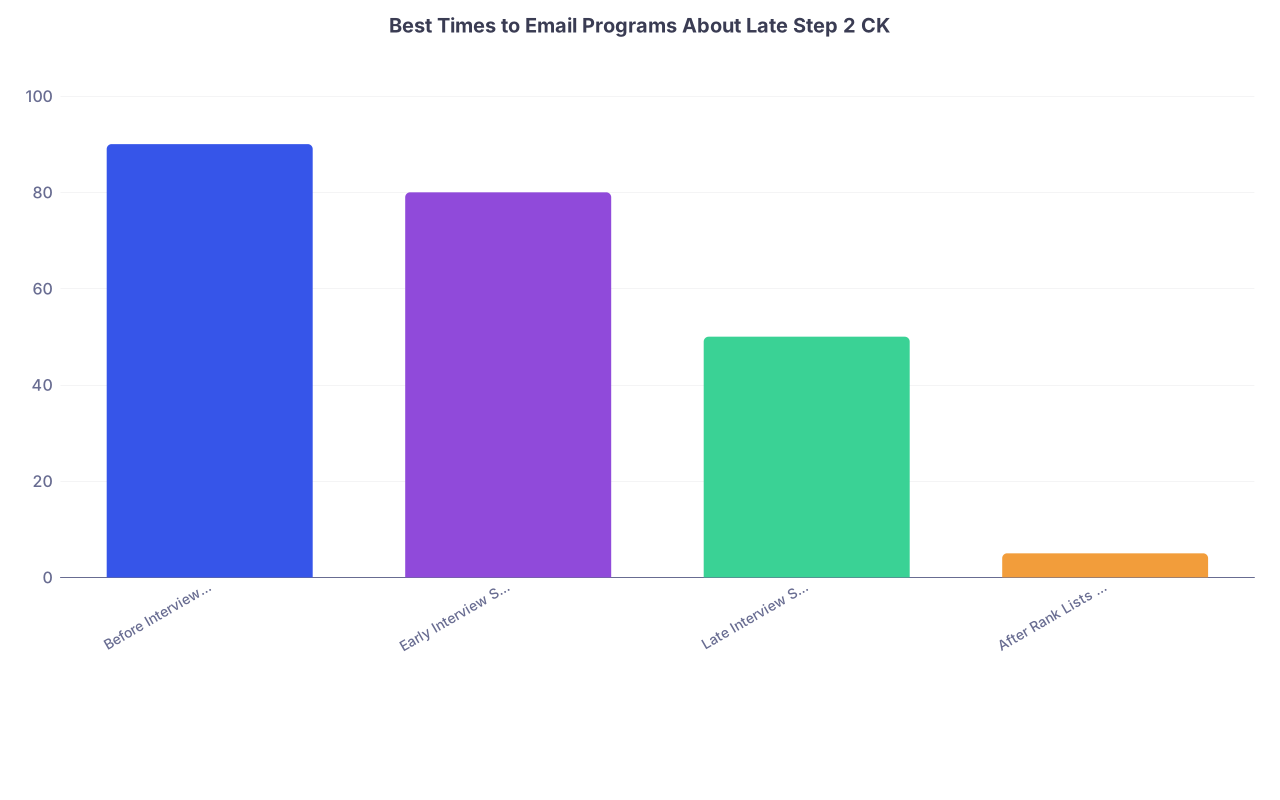
| Category | Value |
|---|---|
| Before Interview Season | 90 |
| Early Interview Season | 80 |
| Late Interview Season | 50 |
| After Rank Lists Submitted | 5 |
Interpretation:
- Before interview season: high impact, especially if invites are still going out
- Early interview season: still very useful
- Late interview season: moderate; can help if they are still offering slots or ranking
- After rank lists submitted: almost never helpful
Do not send “FYI my score is in” emails in March. That time is gone.
4. What To Actually Say: Email Templates That Work
Stop overthinking the wording. Programs do not want a novel. They want:
- Who are you
- Why they care about this update
- What you want them to do with it (implicitly or explicitly)
A. Strong Step 2 CK, no interview yet
Use this if your CK is clearly a plus and you have not interviewed at the program.
Subject line options (pick one):
- “USMLE Step 2 CK Score Update – [Your Name], ERAS ID [xxxxxxx]”
- “Application update: Step 2 CK score – [Your Name], ERAS ID [xxxxxxx]”
Email body:
Dear Dr. [Program Director Last Name] and Residency Selection Committee,
I hope you are doing well. I am writing to share an update to my application for the [Specialty] residency program at [Program Name].
My USMLE Step 2 CK score was recently released and is now available in ERAS: [Score]. This represents a [brief context if helpful, e.g., “significant improvement from my Step 1 performance” or “strong confirmation of my clinical knowledge”].
I remain very interested in [Program Name] because of [ONE SHORT SPECIFIC REASON – e.g., your strong inpatient training at a county hospital, emphasis on resident autonomy, or X subspecialty exposure]. I would be honored to be considered for an interview.
Thank you for your time and consideration.
Sincerely,
[Full Name]
ERAS ID: [ID]
[Medical School]
That is it. No attachment (they will see it in ERAS). No essay.
B. Strong Step 2 CK, already interviewed
You are not begging; you are closing the loop.
Dear Dr. [Last Name],
Thank you again for the opportunity to interview at [Program Name] on [date]. I enjoyed meeting the residents and learning more about your program.
I wanted to share that my USMLE Step 2 CK score was recently released and has been updated in ERAS: [Score].
My visit confirmed that [Program Name] is one of my top choices because of [ONE SPECIFIC FEATURE you appreciated – e.g., “the robust mentorship for residents pursuing cardiology fellowship”].
Thank you again for your time and consideration.
Best regards,
[Name]
ERAS ID: [ID]
Short, respectful, no pressure.
C. Average or slightly lower Step 2 CK, but program requested it
Here, you are fulfilling a requirement, not selling the number.
Dear [Program Coordinator Name] and Dr. [PD Last Name],
Per your previous communication regarding USMLE Step 2 CK, I wanted to let you know that my score has now been released and updated in ERAS.
Thank you for your time and for considering my application to [Program Name].
Sincerely,
[Name]
ERAS ID: [ID]
You do not need to put the score in the body if it is not flattering. They can see it in ERAS.
D. Very late score, program explicitly said “we need Step 2 to rank you”
This is straightforward:
Dear Dr. [Last Name],
Thank you again for the opportunity to interview at [Program Name]. During my visit, you mentioned that the program requires a Step 2 CK score before ranking applicants.
My Step 2 CK score has now been released and is available in ERAS. I wanted to be sure you were aware before your rank meeting.
[Optional, if true] I continue to feel that [Program Name] would be an excellent fit for my training and remain very interested in matching there.
Best regards,
[Name]
ERAS ID: [ID]
5. Avoid These Common, Costly Mistakes
People torpedo themselves with “updates” all the time. Do not be that applicant.
Mistake 1: Mass‑emailing every single program
Programs can smell a form letter. And they hate inbox clutter.
Fix:
- Limit direct outreach to a curated list:
- Programs that required CK
- Top‑priority programs
- Places where your CK meaningfully changes your competitiveness
Mistake 2: Writing emotional or apologetic emails
No one wants to read “I am so sorry my score came late, I was under a lot of stress…”
Programs only care that:
- You took it
- You passed
- The result is interpretable within their range
Fix:
- Keep tone professional, factual, future‑oriented
- No excuses, no backstory, no drama
Mistake 3: Over‑explaining a bad score in writing
Email is the worst place to litigate why your Step 2 is low. That turns into a permanent record.
If you absolutely need to explain:
- Do it in your MSPE (dean’s letter) or
- Briefly if asked in an interview, verbally
But do not send long explanations to 40 program coordinators.
Mistake 4: Forgetting the coordinator
Program coordinators run the operational side. They are usually the ones monitoring the shared inbox.
When in doubt:
- Address PD + selection committee
- CC the program coordinator (or send to their general program/contact email if that is how they prefer communication)
Mistake 5: Multiple “update” emails every week
One solid update is fine. Three near‑identical emails over 10 days are annoying.
Protocol:
- One initial update when CK posts
- Only follow up later if:
- You have substantial new information (e.g., AOA, publication accepted, major award)
- Or the program explicitly invited future updates
6. Special Cases: Fails, Retakes, and Visa‑Sensitive Applicants
Not everything is about a shiny 250.
A. If your Step 2 CK was delayed and you were worried (but it came back fine)
You do not need to explain the delay unless:
- A program asked “Have you taken Step 2?” and you said “Scores pending”
- They followed with “Please inform us when your score is available”
In that case, your update email can be simple:
I previously mentioned that my Step 2 CK score was pending. It has now been released and updated in ERAS.
Stop there.
B. If you failed Step 2 CK and then passed on a retake
This is delicate but not fatal if the second score is solid and timing allows.
Protocol:
- Do not email at the moment of failure.
- Retake as soon as realistically possible with clear improvement.
- Once the passing score posts:
- Make sure ERAS transcript is updated (they will see both attempts).
- Consider one explanatory email to select programs if:
- You are already in active communication
- Or they asked about your Step 2 status
That email should:
- Acknowledge the first result
- Emphasize the improvement and what you changed
- Be concise and non‑defensive
C. IMG and visa‑sensitive situations
Some programs will not rank IMGs or sponsor visas without a Step 2 CK score on file.
If you are an IMG:
- Earlier is better. Delayed CK can be lethal at highly selective, visa‑sponsoring places.
- When your score posts, I would:
- Update ERAS
- Email every program that either:
- Sponsors visas
- Has IMG‑friendly reputation and you care deeply about
Your email can explicitly mention your visa status only if that is critical and positive (e.g., “I will not require visa sponsorship”).
7. Quick Decision Tree: What You Should Do Today
Here is the clean mental flowchart I give students.

| Step | Description |
|---|---|
| Step 1 | Step 2 CK score released late |
| Step 2 | Update ERAS and email priority programs |
| Step 3 | Update ERAS only or email few top choices |
| Step 4 | Update ERAS and send brief required update |
| Step 5 | Update ERAS quietly, no mass emails |
| Step 6 | Score strong for specialty? |
| Step 7 | Clear improvement vs Step 1? |
| Step 8 | Program requires Step 2? |
If you follow that, you will not over‑ or under‑communicate.
8. How Programs Actually Interpret a Late Step 2
To calm your brain, here is what late CK usually means to them:
“Score posted late but is good”:
- “Fine, this confirms they can handle our floor. Maybe bump them up a bit.”
“Score posted late and is average”:
- “OK. Meets requirement. Next candidate.”
“Score posted late and is worse than Step 1”:
- “Concerning, but depends on entire file and letters.”
“Score never posted and we required it by X date”:
- “We probably will not rank or interview them unless there is a major reason.”
The point: the lateness bothers students much more than it bothers programs. The content of the score and the clarity of communication matter more.
FAQ (Exactly 4 Questions)
1. If my Step 2 CK is much better than Step 1, should I mention the specific point difference in my email?
No need. Programs can see both numbers in ERAS. You can say “improvement from my Step 1 performance” if you really want context, but avoid language that sounds defensive or obsessed with explaining the past. Let the numbers speak and keep the email clean.
2. Should I attach a PDF of my Step 2 CK score report to my email?
Generally no. Programs rely on ERAS as the official source of score verification. Attaching PDFs just clutters their records and raises questions about version control. The only exception: a program specifically asks you to send the report directly; then you follow their instructions exactly.
3. What if my score posted right before ERAS opening, but my school has not yet released my transcript?
Your job is to make sure the score is released to ERAS as soon as your school or ECFMG allows it, then verify that the updated transcript is attached to your applications. You do not need to pre‑emptively email programs about a score they will see normally when they first download your file, unless they have a strict early deadline and you know your transcript will clearly miss it.
4. Does sending a Step 2 CK update email ever hurt my chances?
A well‑written, concise, relevant update almost never hurts on its own. What hurts you is: sending too many emails, pushing a weak score as if it is a strength, or sounding unprofessional or desperate. If your CK is neutral or slightly weaker, limit outreach to programs that explicitly required Step 2 and keep your message strictly informational.
Key takeaways:
- Not every late Step 2 CK score deserves an email; strong, clearly helpful scores do.
- Update ERAS first, then send targeted, concise emails only to programs where it truly matters.
- Keep communication professional, brief, and factual—no essays, no drama, no mass‑mailing.