
It’s late January. You’re sitting there refreshing your email, interview season mostly done, obsessing over one question: “Do they care more about my Step 2 CK jump, or the fact that I’m barely top 50% in my class?”
Meanwhile, upstairs in a windowless conference room, your fate is being argued over. Out loud. By people who do not agree with each other.
Let me walk you into that room and show you what actually happens when Step 2 CK and class rank collide in final decisions.
What Really Sits On the Table: How Programs See Your Numbers
The fantasy is that programs look at you “holistically.”
The reality is that before they ever talk about your personality or your “fit,” they’re staring at something like this on a shared screen:
| Data Point | How It’s Used in Real Life |
|---|---|
| Step 2 CK Score | Primary objective metric post-Step 1 pass/fail |
| Class Rank | Context for performance vs peers |
| Clerkship Grades | Tie-breaker and narrative support |
| School Prestige | Unspoken bias amplifier |
On the big screen: columns for Step 2 CK, school name, class rank/percentile or quartile, AOA status, maybe a color-coded flag for “Honors in Core Clerkships” or “Red flag: remediation.”
That’s the starting battlefield.
Now the internal argument:
- The data-focused PD: “Step 2 CK is standardized. Class rank is not. I trust the exam.”
- The academic hawk: “Class rank shows four years of work. Anyone can have a good test day.”
- The old-school chair: “I’ll take the top 10% of any real school over some random sky-high score.”
You live or die by who wins that argument in that room. And it changes program by program.
The Uncomfortable Truth: Step 2 CK Is Now the Default Hammer
When Step 1 went pass/fail, programs quietly panicked. Every PD I know said some version of: “We’re screwed. We just lost our main screening tool.”
What filled the vacuum? Step 2 CK. Hard. Fast.
You can see this shift in how PDs talk behind closed doors:
- “What’s their Step 2? That’s the new Step 1.”
- “If Step 2 is under 230 for this specialty, I do not want them as a categorical.”
- “The class rank is mid, but Step 2 at 255? Bring them in.”
So let’s be blunt.
For most mid-to-large programs in moderately-to-highly competitive fields, Step 2 CK > class rank for:
- Screening for interviews
- Establishing a baseline “floor”
- Quick comparisons between unknown schools
The pattern I keep seeing:
You’re on the fence. Then someone says, “What’s their Step 2?”
If it’s strong, the mood shifts. If it’s weak, people stop arguing for you.
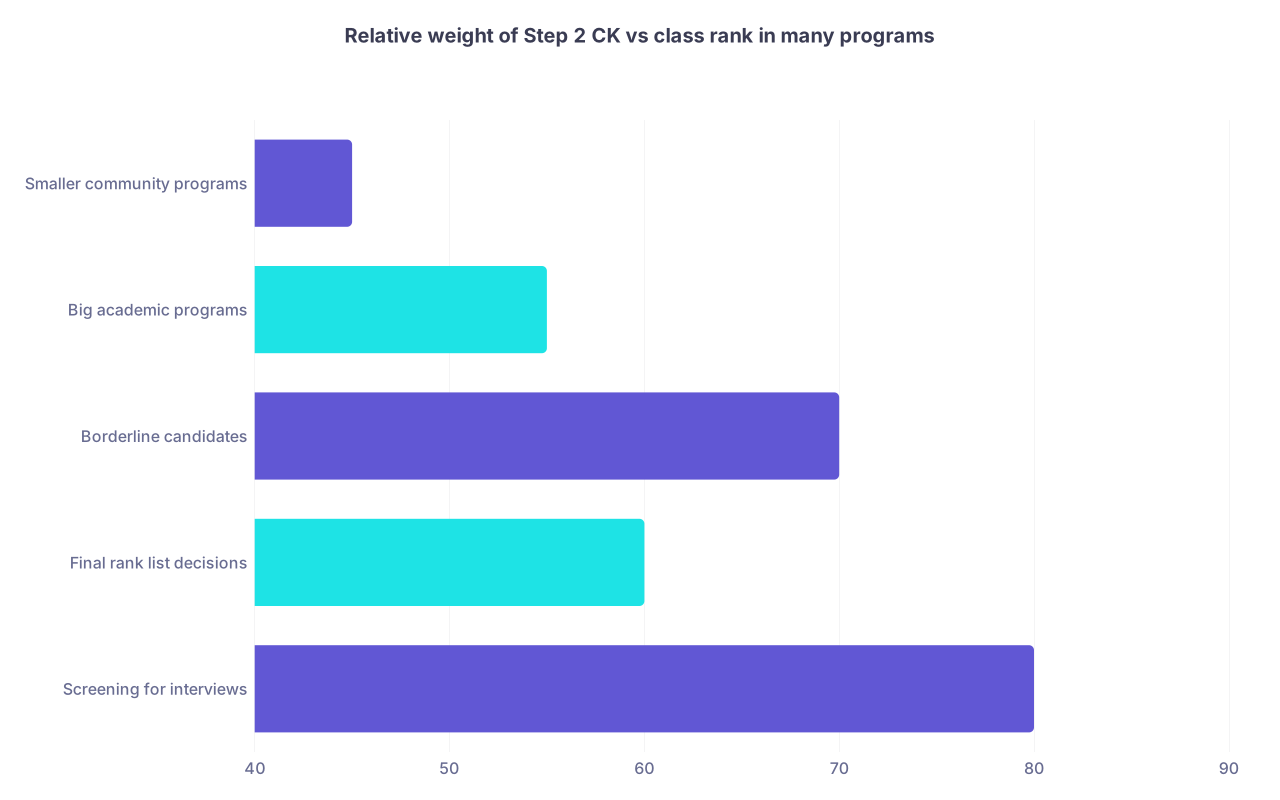
| Category | Value |
|---|---|
| Screening for interviews | 80 |
| Final rank list decisions | 60 |
| Borderline candidates | 70 |
| Big academic programs | 55 |
| Smaller community programs | 45 |
Are there exceptions? Absolutely. But if you want a baseline rule of thumb: in the current landscape, Step 2 CK is the primary objective yardstick unless a program is unusually academic or old-school.
The Problem With Class Rank: Why Committees Don’t Trust It
Here’s what faculty say when class rank comes up:
- “Top 20%… of where? That’s not the same at Stanford vs a new DO school.”
- “Their school gives Honors to 40% of the class. That rank is inflated.”
- “Our own med school doesn’t even do true rank anymore. Quartiles and ‘descriptors’ only.”
Class rank is messy. There are too many variables hidden behind that single line.
Differences that committee members talk about openly:
- Grading systems: Honors/HP/P vs straight Pass/Fail
- Curve severity: Some schools are brutal, some are “everyone passes with a B+”
- Grade inflation: Older faculty absolutely complain about this
- Clinical evaluation noise: One bad attending eval can tank a clerkship grade
So when some PD says, “They’re top 15% of class,” you’ll hear a counter:
“Yeah, but at a school where 60% got Honors in IM. Step 2 234 is more telling.”
This is why Step 2 CK tends to win as the tie-breaker.
It answers the question: can this person perform on the one standardized metric everyone in the country took under the same conditions?
Inside the Room: How the Debate Actually Sounds
Let’s run a few real-world composites I’ve seen, almost word for word.
Scenario 1: High Step 2, Mediocre Rank
Applicant:
- Step 2 CK: 256
- School: Mid-tier MD
- Class rank: 3rd quartile
- Clerkships: Mixed HP/H, maybe one Pass
In the committee room:
“Step 2 is excellent.”
“Rank is low though… third quartile?”
“How hard is their school?”
“Our last two residents from that place were solid.”
“Honestly, 256 tells me they’re smart enough. Maybe they matured late.”
“Any red flags in comments?”
“No, just ‘quiet but reliable’ type stuff.”
“Fine. Move them up a bit. Solid middle of the list.”
Lesson: The strong Step 2 rescues the narrative. The rank becomes “explained” as late bloom, grade harshness, or improvement arc.
Scenario 2: Top Rank, Average Step 2
Applicant:
- Step 2 CK: 233
- School: Well-known MD with rigorous grading
- Class rank: Top 10%
- Clerkships: Almost all Honors
In the room:
“They’re top 10% at [well-respected school]. That means something.”
“Step 2 is fine, not amazing.”
“That place grades hard. Honors on IM and Surgery aren’t easy.”
“Faculty comments look strong. I’d trust them.”
“Yeah, this is a worker, not a test ninja. I’ll take it.”
Here, class rank plus school reputation carries more weight. The moderate Step 2 doesn’t hurt much because it’s “consistent with strong but not superstar performance.”
Scenario 3: High Rank, Weak Step 2
Applicant:
- Step 2 CK: 219
- School: Mid-tier MD
- Class rank: Top 15%
- Clerkships: Mostly Honors, one HP
Committee:
“Top 15%, but 219 on Step 2?”
“That makes me nervous.”
“Any explanations? Illness? Note from the dean?”
“Nothing documented.”
“I’m worried they’ll struggle with boards and in-service.”
“I say we keep them low. Maybe lower-medium but not top half.”
You feel the shift? Class rank is now suspect. The unspoken thought: “Did they get soft grading and then crash on the one hard test?”
Step 2 is often treated as the sanity check on class rank claims.
Specialty Matters: Where Step 2 vs Rank Really Shifts
Not all rooms argue the same way. The weighting changes by specialty and program culture.
| Program Type | Step 2 CK Weight | Class Rank Weight |
|---|---|---|
| Big research university IM | High | High |
| Competitive surgical fields | Very High | Moderate |
| Community IM/FM programs | Moderate-High | Low-Moderate |
| Elite academic pediatrics | High | High |
| Newer/smaller programs | Very High | Low |
Here’s the pattern I see over and over:
Competitive surgical & procedure-heavy fields (ORTHO, ENT, NSGY, Urology)
They love Step 2 CK. Ranking meetings sound like:
- “Under 245? Don’t bother.”
- “The rank looks good but the Step 2 doesn’t match.”
- “Give me the 250+ with strong letters. We can teach the rest.”
Class rank still counts, especially at fancy institutions, but it’s the supporting actor, not the star. They want evidence of raw horsepower.
Internal medicine at academic centers
Here there’s more balance. Strong ACP-ish academic types in leadership actually care about class rank and AOA.
When they’re comparing two good applicants:
- “Both at 250-ish, but this one is AOA, top 10%.”
- “This one has top quartile with a 260 though.”
- “Pull up their clerkship comments.”
The debate becomes nuanced. But if your Step 2 is weak, no amount of nice rank fully saves you at big-name places.
Community and smaller programs
They don’t always get a detailed dean’s letter with exact rank. They see “upper third,” “middle third,” “satisfactory.” These are vague.
What’s clear and easy to use? One number: Step 2 CK.
You’ll hear: “We do not have time to decode their school’s ranking system. Just tell me the Step 2.”
Here, Step 2 can matter more simply because it’s the only consistent numerical anchor.
When Step 2 CK Can’t Save You (And When It Absolutely Can)
You need to understand where Step 2 has leverage and where it does not.
Step 2 CK can rescue you when:
- You had a mediocre preclinical record but your clinical performance and Step 2 show a sharp upward curve.
- Your school has known grade deflation, and your Step 2 confirms “this person is actually strong.”
- You’re coming from a less-known or lower-ranked school and need a standardized proof you’re competitive.
Faculty explicitly say:
“They came from [smaller DO or Caribbean school], but they pulled a 250+. That’s legit. I want to meet them.”
Step 2 CK cannot rescue you when:
- There’s a professionalism problem or bad narrative in comments.
- You failed multiple clerkships or had repeated remediation.
- There’s a big disconnect: great Step 2 but terrible evals like “does not show up,” “poor teamwork.”
I’ve seen this:
“Yeah, 254 is nice. But three separate comments about poor reliability? I do not want this headache.”
In other words: Step 2 is power. But it does not erase being difficult, lazy, or unsafe.
The Quiet Edge: How School Name Twists the Debate
This part no one likes to admit publicly, but they talk about it freely in the room.
Same Step 2. Same approximate rank. Different reactions.
Applicant A: 245, top 25%, Mid-tier MD
Applicant B: 245, top 25%, Top-10 MD powerhouse
The discussion:
“From [top powerhouse]? Yeah, that’s a strong candidate.”
“That school ranks hard. Their top 25% is basically other people’s AOA.”
“Push them up. They’ll be fine.”
For Applicant A from a less prestigious place, Step 2 and class rank are often scrutinized more:
“Do we know anyone from that med school? How have they done here?”
So yes: Step 2 and class rank are not weighed in a vacuum. Reputation acts like a hidden multiplier.
- High Step 2 + top school = “rock solid”
- High Step 2 + unknown school = “intriguing, but show me more”
- High class rank + top school = “impressive”
- High class rank + unknown/prestige-poor school = “depends on Step 2”
That last line is where Step 2 reclaims its throne as the “great equalizer.”
How This Plays Out on Your Actual Rank List Position
Let me show you a pattern I’ve literally watched play out on ranking day.
Programs often cluster candidates roughly like this:
- Tier 1: Automatic rank very high – strong Step 2, strong rank, strong letters
- Tier 2: Solid – one minor weakness (maybe Step 2, maybe rank)
- Tier 3: Risky / back half of the list – concern about one or more objective or narrative pieces
- NRMP: Not ranked – major concerns or just not enough enthusiasm
Where the Step 2 vs. rank debate matters most is Tier 2 vs Tier 3.
Example:
You and another applicant both had good interviews. Both “nice, normal, seemed fine.”
You: Step 2 243, middle third
Them: Step 2 232, top 10% at a similar school
Committee conversation:
“Which one goes higher?”
“I lean toward the 243. We know they can crush the boards.”
“Any red flags in the comments?”
“Not really, both are fine.”
“Okay, put 243 above 232.”
There it is. That’s how a ~10-point difference on Step 2 can literally move you 5–10 spots higher on a rank list, easily.
And 5–10 spots is the difference between matching there vs sliding somewhere else.
What You Should Actually Do With This Information
You’re not a passive victim in this debate. You can tilt it in your favor.
If your Step 2 is strong and your rank is weaker:
- Own the “late bloomer” or “upward trend” story in your personal statement and interviews.
- Make it easy for your letter writers to say: “They really came into their own on the wards.”
- Apply broadly; your score will open doors at places that might’ve ignored you based on rank from a lesser-known school.
If your Step 2 is weaker but your rank is strong:
- Lean heavily on your clerkship performance and narrative.
- Make sure your letters say: “Excellent clinical reasoning, reliable, strong team member.”
- Be realistic about the tier of programs. High-status academic places might still like your profile; highly Step 2–obsessed surgical programs may not.
And if both are average?
Then your selling point must be something else: glowing narrative, niche interest that fits the program, strong home rotation performance. You will not win a pure numbers fight, so do not try to.

| Step | Description |
|---|---|
| Step 1 | Application Received |
| Step 2 | Initial Screen |
| Step 3 | Reject or low priority |
| Step 4 | Offer Interview Pool |
| Step 5 | Interview and File Review |
| Step 6 | Higher rank tier |
| Step 7 | Middle or lower tier |
| Step 8 | Final Rank List |
| Step 9 | Step 2 above cutoff |
| Step 10 | Strong class rank or clerkships |
That’s the ugly but honest flow. Step 2 often gets you in the door. Class rank and narrative adjust your height on the final list.
FAQ (Exactly 4 Questions)
1. If I had a mediocre Step 1 (when it was scored) but a strong Step 2, will they still hold Step 1 against me?
Typically no. In most backroom discussions I’ve heard, a strong Step 2 is treated as the “final verdict.” People say things like, “They clearly improved,” or “They figured it out by clinical year.” If Step 1 = 215 and Step 2 = 250, the story becomes positive: growth, maturity, adjustment. Programs care more about the latest, not the oldest, number.
2. My school doesn’t publish exact class rank, only quartiles or vague phrases. Does that hurt me?
Not really, because a lot of schools do that now. Committees are used to “upper third” and “outstanding” language. What happens is that Step 2 CK takes on even more weight, along with core clerkship grades and narrative comments. You’re not penalized for lack of raw rank; you’re just judged more on your test score and the dean’s letter tone.
3. Is a very high Step 2 (e.g., 260+) enough to overcome being bottom half of the class?
Sometimes, but not always. At many places, yes, that will get you serious consideration and probably an interview, especially if the rest of your file is not a disaster. But in highly academic programs, bottom-half rank raises real concerns: “Why so low for four years if they’re this capable?” You’ll need a clear story and strong letters to reframe it as late development, not chronic underperformance.
4. For less competitive specialties, do they still care this much about Step 2 vs rank?
They care a bit less, but the pattern is the same. In family med, psych at non-elite places, community peds, etc., Step 2 is often just a minimum-competency check: “Above our floor? Fine.” Class rank rarely drives decisions unless it’s extreme (top 5% or bottom 5%). Fit, personality, and reliability in narrative comments carry more of the weight. But if your Step 2 is very low, no amount of nice rank erases concerns about board passage risk.
Key things to remember: Step 2 CK is now the default objective hammer, especially outside the most academic ivory towers. Class rank matters most when it’s clearly strong and backed by honors and narrative, and when your Step 2 is at least decent. And the real decisions are made in a room where people argue, compromise, and move names up and down based on both—plus how much they think they’ll like working with you at 3 a.m.