
The way most students react to their Step 2 CK score is wrong. They panic, cling to their original dream specialty, or swing wildly to something they barely understand. You can do better than that.
Step 2 CK is not just a number. It is a pivot point. Used correctly, it can help you recalibrate specialty choice, protect your match odds, and still land in a career you actually like waking up for.
I am going to walk you through exactly how to do that, step by step.
Step 1: Interpret Your Step 2 CK Score in Context, Not in Isolation
First fix: stop treating your Step 2 number like a verdict. It is one data point in a file full of data points. You need a structured way to interpret it.
Here is the framework I use with students and prelim residents who are trying to regroup after scores:
- Anchor your score to national performance
- Overlay specialty competitiveness
- Account for your overall application strength
- Define whether your score is: Enabling, Neutral, or Constraining
1. Anchor to national performance
Use percentiles and means, not vibes.
- Step 2 CK mean: typically around 245–250
- SD: about 15
- Rough rule of thumb:
- 260+ → clearly above average
- 250–259 → solidly above average
- 240–249 → around average / slightly above
- 230–239 → slightly below average
- <230 → below average
If you do not know your percentile, get it from:
- NBME / USMLE data tables
- NRMP Charting Outcomes
- Your dean’s office often has a quick reference
2. Overlay specialty competitiveness
A 245 means something different for psychiatry than it does for dermatology.
| Specialty Tier | Example Specialties | Competitive Step 2 CK Range* |
|---|---|---|
| Ultra-Competitive | Derm, Plastics, Ortho, ENT, Neurosurgery | 255+ (many matched >260) |
| High-Competitive | Radiology, Anesthesia, EM, Urology, Ophtho | 245–255+ |
| Moderate | IM (university), Gen Surg, OB/GYN, Neuro | 235–245+ |
| Less Competitive | FM, Psych, Peds, IM (community), Path | 225–235+ |
*These are rough directional numbers, not hard cutoffs. Programs vary.
3. Account for your whole application
Your Step 2 can be offset or amplified by other factors:
Big pluses:
- Honors in core clerkships (especially in the specialty you want)
- Strong letters from known faculty
- Home program in that specialty
- Solid research aligned with specialty
- AOA / Gold Humanism (for some fields)
Big minuses:
- Failed exams (Step attempts, shelf failures)
- Major professionalism concerns
- No exposure to the specialty you claim to love
- Weak or generic letters
So you might have:
- 238 with multiple honors, strong ortho research, and a chair letter → still in the ortho game at some programs.
- 252 with average clinical evals and no exposure to radiology → weaker than the score suggests.
4. Label your score honestly
Be ruthless here. For your target specialty, is your Step 2 CK:
- Enabling → boosts you; opens more doors than you expected.
- Neutral → will not help much, but will not block you either.
- Constraining → closes some doors; you will need a strategy pivot.
If you cannot say which one it is, you do not know your specialty well enough yet. That is a separate problem. Fixable, but still a problem.
Step 2: Decide What Kind of Pivot You Actually Need
Not every pivot means abandoning your dream specialty. There are levels of recalibration. Treat it like triage.
Level 0: No pivot – double down
Use this if:
- Your Step 2 is enabling or high-neutral for your specialty, and
- Your clinical performance is aligned with that.
Your move:
- Stay with your original specialty.
- Use the score to:
- Aim at more academic programs.
- Add a couple of stretch programs.
- Strengthen your application narrative (e.g., “consistent strong performance on clinical knowledge assessments”).
Level 1: Micro-pivot – adjust program list, not specialty
Use this if:
- Your Step 2 is low-neutral or mildly constraining for your first-choice specialty.
- You still have some strengths in that field (home program, research, strong letters).
Your moves:
- Shift from:
- “Derm at top-10 only” → include mid-tier, regionals, and maybe preliminary backup plans.
- “University-heavy gen surg list” → more community and hybrid programs.
- Apply broadly: geographically and by program type.
- Get realistic about:
- Fewer “top 10” targets.
- Emphasis on fit, geographic ties, and rotations.
Level 2: Smart pivot – adjacent specialties
Use this if:
- Your Step 2 is significantly constraining for your current specialty tier.
- But your core interests (procedural vs cognitive, inpatient vs outpatient) are clear.
Here you look for adjacent specialties that fit your personality and skills but have slightly lower score expectations.
| Original Target | Score Reality | Smart Adjacent Pivots |
|---|---|---|
| Dermatology | <250 | IM → Rheumatology later, Allergy/Immunology later |
| Orthopedics | <245 | Gen Surg, PM&R with MSK focus, IM with sports med path |
| Neurosurgery | <245 | Neurology, IM → Neurocritical care later |
| ENT | <245 | Gen Surg, IM with pulm/critical care later |
| Radiology | <240 | IM with cards interest, Pathology, Anesthesia (if other strengths) |
You stay true to the kind of work you like, just in a more statistically manageable field.
Level 3: Full pivot – rebuild the plan
Use this if:
- Step 2 is strongly constraining (e.g., <230) for competitive specialties.
- There are other red flags: failed exams, weak clinical records.
- You are late in the cycle with no strong niche.
Here you:
- Re-open the question: “What kind of doctor do I want to be?” without anchoring to one dream specialty.
- Prioritize:
- Match probability
- Geography (if critical to you)
- Long-term satisfaction over prestige
Common full-pivot landing spots:
- Family Medicine
- Psychiatry
- Pediatrics
- Community Internal Medicine
- Pathology (depending on your interest)
This is not defeat. This is you refusing to go unmatched.
Step 3: Map Your Score to Realistic Specialty Buckets
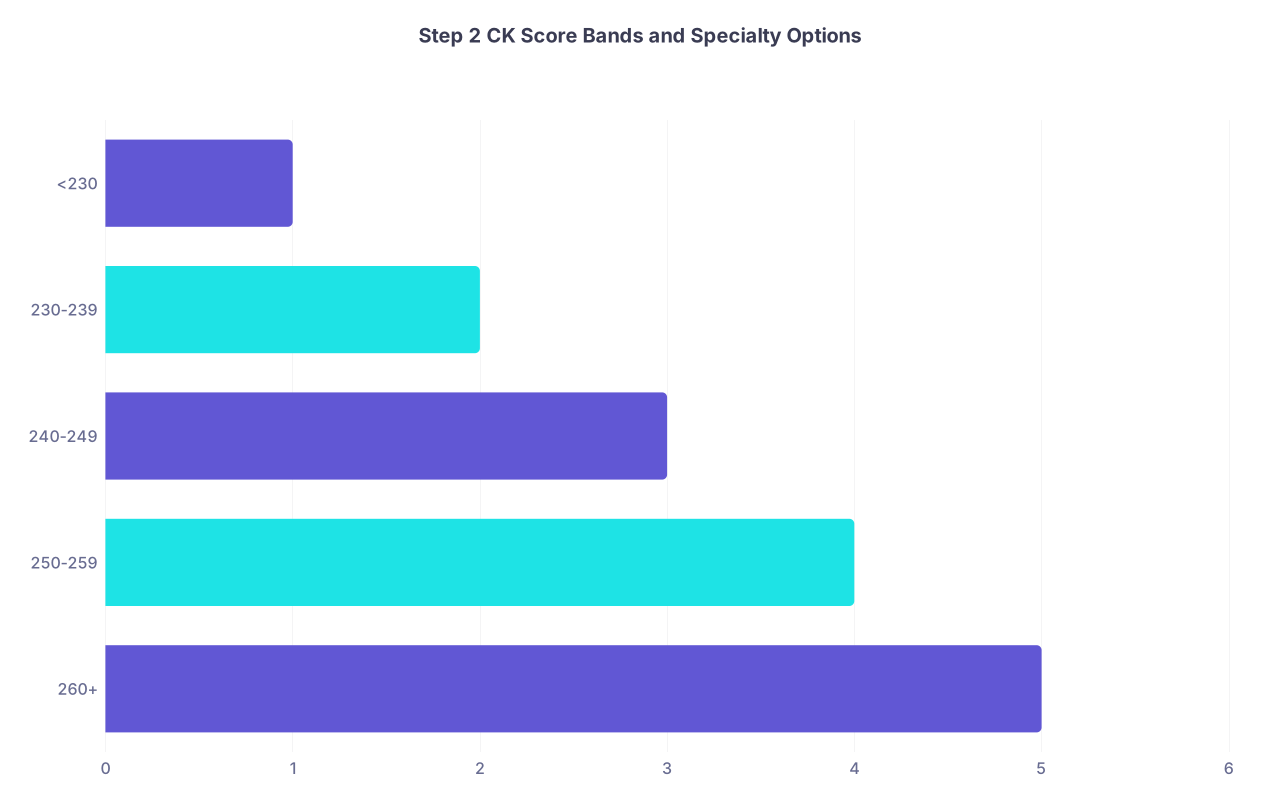
Let me make this more concrete. Assume average clinical performance, no major red flags.
| Category | Value |
|---|---|
| 260+ | 5 |
| 250-259 | 4 |
| 240-249 | 3 |
| 230-239 | 2 |
| <230 | 1 |
Now translate those bands to application strategy:
If you scored 260+
You are in a very strong position.
- Ultra-competitive fields (Derm, Plastics, Ortho, ENT, NSGY): in play.
- High-comps (Rads, Anes, EM, Urology, Ophtho): very attractive.
- Everything else: you overshoot the bar.
Your moves:
- If you love a moderately competitive field (IM, Peds, Psych), consider:
- Academic tracks
- Physician-scientist roles
- Leadership or QI-heavy programs
- If you were previously scared off a competitive field, re-open that door. Your score just gave you permission.
If you scored 250–259
You are still in a great spot.
- Ultra-competitive: still possible but more dependent on:
- Research
- Letters
- Home institutional support
- High-competitive: competitive and realistic.
- Moderate and less competitive: very safe if the rest of your app is not a disaster.
Your moves:
- Decide if you want to swing at ultra-competitive or go for a “balanced” lifestyle/interest specialty where your score gives you leverage.
- Use your score to:
- Aim for academic tracks.
- Target locations you actually want rather than “anywhere that will take me.”
If you scored 240–249
This is the “pivot zone” for a lot of people.
- Ultra-competitive: possible only with exceptional other factors (home derm program, multiple publications, champion letter).
- High-competitive: some risk at top programs; solid shot at many others.
- Moderate: good shot, especially if letters and rotations line up.
- Less competitive: very likely to match if you apply reasonably.
Your moves:
- Reassess ultra-competitive fantasies unless you are already an insider (home program, strong research, known faculty).
- For high-competitive fields (like rads, anes, EM):
- Apply broadly.
- Be realistic about “top 10” name brands.
- If you were aiming at something like gen surg or OB/GYN, you are in a good lane. Focus on:
- Strong letters
- Away rotations where they see you work
If you scored 230–239
Here is where fantasies and statistics really start fighting.
- Ultra-competitive: almost always unrealistic unless you have a wild compensatory factor and are willing to tolerate very high risk.
- High-competitive: possible at some programs if:
- You have strong clinical performance and great letters.
- You apply broadly and strategically.
- Moderate: very reasonable.
- Less competitive: high match probability with halfway decent application execution.
Your moves:
- If you were dead-set on an ultra-competitive field, you must decide between:
- High-risk strategy (small number go this route and win).
- Smart pivot to high/moderate fields where you can still do meaningful, interesting work.
- Strongly consider adjacent specialties that match your interests but are less cutthroat on scores.
If you scored <230
I will be direct: you must treat this as a structural constraint.
- Ultra-competitive: effectively closed doors except for extremely rare, highly supported cases. Do not build your life plan around being the exception.
- High-competitive: difficult and risky. Some programs may screen you out automatically.
- Moderate: possible if the rest of your app is strong, you have compelling story and letters, and you apply broadly.
- Less competitive: likely where you will have the most stable path to matching.
Your moves:
- Identify 1–2 specialties where:
- Your score is not a hard barrier.
- Your clinical evals and letters can shine.
- You can see yourself practicing without feeling miserable.
- Seriously consider a “safety-first” dual-application strategy:
- E.g., apply broadly to FM or Psych plus a more competitive field only if you have strong connection/research there.
Step 4: Rebuild Your Application Narrative Around the Pivot
Once you know what level of pivot you need, the real work begins: aligning your story, not just your specialty.
Students blow this frequently. They change specialties but keep their old narrative.
1. Clean up your “why this specialty” story
Your personal statement, interviews, and letters must no longer sound like you are hedging.
Bad version:
- “I have always been interested in dermatology, but after my clinical rotations I also realized I like internal medicine.”
Programs hear: “Did not get derm, settling for IM.”
Better version after a smart pivot:
- “Early in medical school I explored procedure-heavy fields, but my clinical rotations clarified that my strengths are in complex diagnostic reasoning, longitudinal care, and managing multi-morbid patients. Internal medicine offers the intellectual depth and patient relationships that fit both my skills and my long-term goals.”
You are not confessing your failed dream. You are articulating a sharpened understanding of fit.
2. Align your CV signals with the new plan
You cannot change the past, but you can reinterpret it.
- Former derm research?
- Reframe as: experience managing chronic inflammatory disease, QI in outpatient workflows, or patient-centered care in chronic illness.
- Ortho shadowing?
- Highlight: MSK exam comfort, team-based care in surgical environments, working with high-functioning teams.
Update:
- ERAS experiences descriptions
- “Most meaningful experiences” reflections
- Any upcoming research or QI proposals to align with new specialty
3. Get new letters intentionally
If you pivot post-Step 2 CK, you often lack strong letters in the new field.
Fix that with a clear plan:
- Schedule:
- A sub-I or acting internship in the new specialty as early as possible.
- An elective or two that gives you face time with letter-writers.
- When asking for a letter:
- Be honest but forward-looking.
- Example: “I initially considered [old specialty], but after [specific experience] and reflection, I am committed to [new specialty]. I would appreciate a letter that speaks to how I function on your team and my potential as a resident in [specialty].”
Step 5: Optimize Program List Strategy After the Pivot
Your score and pivot decision are only useful if they shape a rational program list.
Here is how to rebuild that list.
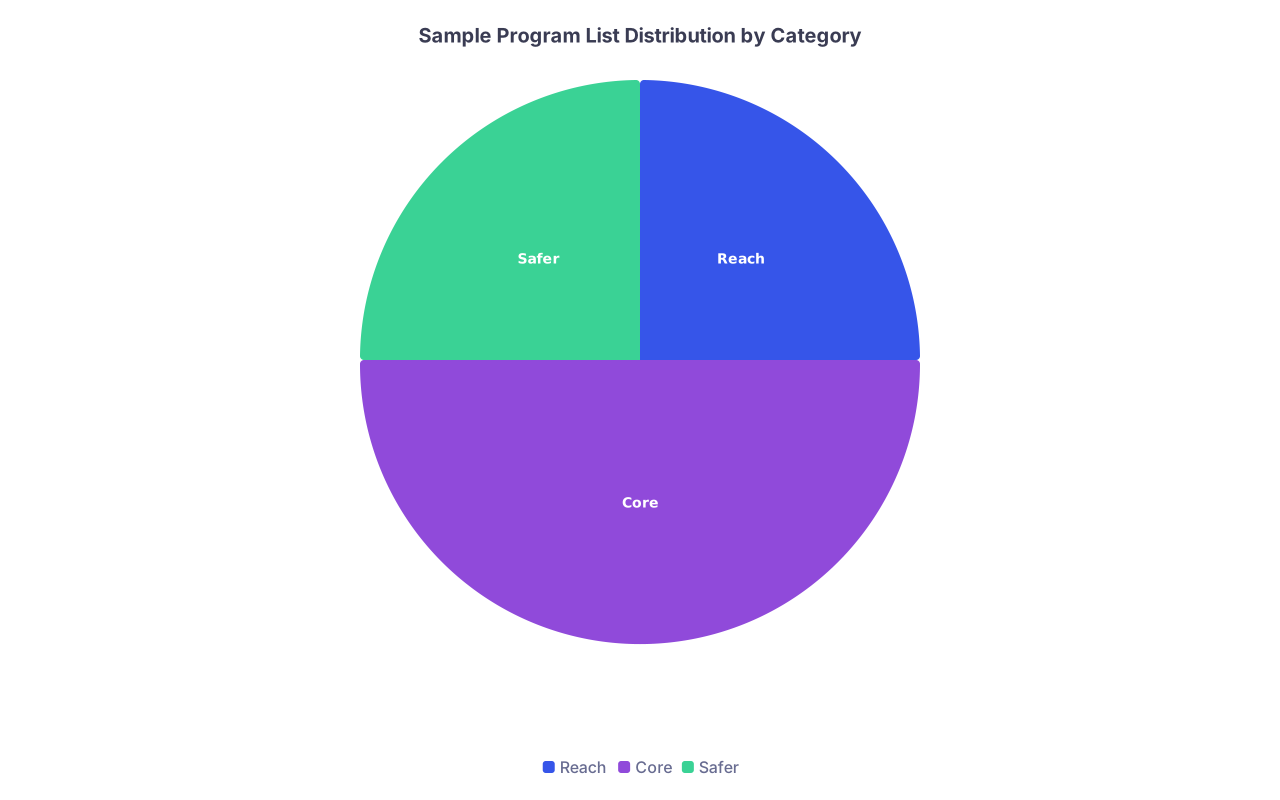
1. Categorize programs: Reach / Core / Safer
Use a simple three-bucket structure:
- Reach: your score is at or below program’s historical average; or prestige/location is highly competitive.
- Core: your score is around their average; realistic fit.
- Safer: your score is above their likely range; less desirable geography or prestige, but more secure.
For most:
- 20–30 programs: 5–7 reach, 10–15 core, 5–10 safer.
- If you have a constraining score or red flags: shift more heavily to core/safer.
2. Use data, not rumors
Stop relying solely on “this program is super competitive” hearsay.
- Look at:
- NRMP Charting Outcomes by Step 2 score for your specialty.
- Program websites: some still list minimum scores.
- Alumni match lists from your school: where do students with similar profiles match?
| Category | Value |
|---|---|
| Reach | 25 |
| Core | 50 |
| Safer | 25 |
3. Be ruthless about geography
If your Step 2 is constraining and you are pivoting:
- You cannot be picky about city prestige and guarantee safety.
- Decide:
- Is “big coastal city only” more important than matching? If yes, own the risk.
- If no, accept that some safer programs will be in less glamorous locations.
Step 6: Dual-Application and Backup Strategies (When You Really Need Them)
Some of you will be in the high-risk zone:
- Borderline Step 2
- Competitive specialty interest
- Weak school reputation
- Limited geographic flexibility
That is where backup strategies come in.
When dual-applying actually makes sense
It can be appropriate if:
- You are applying to a highly competitive specialty with a constraining score.
- You are okay, emotionally and practically, with either outcome.
Example:
- Primary passion: Anesthesia, Step 2 = 233
- Backup: Internal Medicine (community and mid-tier university)
Strategy:
- Build a credible application for both:
- Obtain at least 1–2 solid letters in each field.
- Personal statements that do not sound copy-pasted.
- Program list:
- 30–40 Anesthesia programs (broad).
- 25–30 IM programs with a tilt toward safer choices.
What you do not do:
- Apply to 15 derm programs and throw 5 FM apps as an afterthought with zero alignment. That just wastes everyone’s time.
Step 7: Emotional Debrief and Long-Term View
There is a psychological piece here that can blow up even the best strategy if you ignore it.
You might be:
- Grieving a dream specialty.
- Angry about an exam day that went badly.
- Embarrassed relative to your peers.
Fine. All valid. But you have to compartmentalize that long enough to make rational moves.
Two critical realities:
Residency choice is not your final form.
- IM → cards, GI, critical care, rheum, heme/onc.
- Peds → PICU, neonatology, peds EM.
- FM → sports med, palliative, academic FM, addiction.
- Psych → addiction, consult liaison, child, forensics.
Your daily work life will be shaped more by the “fit” of the field than the Step 2 number that got you in.
- Whether you enjoy talking to your patients.
- Whether you like procedures or dread them.
- Whether you can tolerate chaos vs prefer controlled environments.
I have seen plenty of students “lose” on Step 2 and “win” in long-term career satisfaction because their forced pivot pushed them into a better-matched field.
Step 8: A Concrete 2-Week Recovery Plan After Getting Your Score
Let me make this painfully practical. Here is a 14-day protocol you can follow after receiving your Step 2 CK score.

| Step | Description |
|---|---|
| Step 1 | Get Step 2 CK Score |
| Step 2 | Day 1-2 - Interpret Score in Context |
| Step 3 | Day 3-4 - Reality Check by Specialty |
| Step 4 | Day 5-7 - Decide Pivot Level |
| Step 5 | Day 8-10 - Adjust Narrative and Letters |
| Step 6 | Day 11-14 - Rebuild Program List |
| Step 7 | Start ERAS Updates and Outreach |
Day 1–2: Interpret your score properly
- Get percentile and national context.
- Compare to your specialty’s typical ranges.
- List all major pluses and minuses in your app on one sheet of paper. No more than 10 bullets.
Day 3–4: Specialty reality check
- For your current target specialty:
- Mark it as: Enabling / Neutral / Constraining.
- Ask one trusted mentor to sanity-check this.
- Pull up 2–3 alternative specialties you could tolerate, ranked by genuine interest.
Day 5–7: Decide pivot level
- Choose one:
- No pivot
- Micro-pivot (same specialty, different programs)
- Smart pivot (adjacent field)
- Full pivot (new lane)
- If smart or full pivot:
- Book meetings with: specialty advisor, dean, at least one resident in that field.
Day 8–10: Fix your narrative and letters
- Draft or revise:
- Personal statement aligned with the chosen specialty.
- ERAS experiences descriptions emphasizing what matches the field.
- Identify and contact:
- 2–3 attendings in the target field for letters or advocacy.
- Ask clearly and early.
Day 11–14: Rebuild your program list
- Create a spreadsheet:
- Column for program name, city, category (Reach/Core/Safer), notes.
- Aim for:
- 5–7 reach, 10–15 core, 5–10 safer (or heavier on safer if you are score-constrained).
- Confirm:
- You have at least some programs where your score is safely above their likely threshold.
Then start updating ERAS and reaching out proactively.
The Real Pivot: From Score Obsession to Strategy Execution
The mistake I see over and over: students staring at their Step 2 CK number like it is a personality test. It is not. It is a filter. A fairly blunt one.
Your job now is to:
- Interpret it honestly for the specialty you care about.
- Decide what level of pivot you actually need.
- Rebuild your story, letters, and program list accordingly.
- Execute without getting paralyzed by regret.
You can do that. Even with a “disappointing” score. Many have.
Here is your next actionable step:
Today, sit down and write out three columns on a single sheet of paper—“My Step 2 Facts,” “My Current Target Specialty Reality,” and “Possible Pivots.” Fill each column with at least five bullet points. Once you see it in front of you, you will know which pivot level you need. Then start implementing the 14-day plan above.