
The myth that residency programs obsess over your exact Step 2 CK number is overstated. The data shows most programs functionally use bands, thresholds, and buckets—not fine-grained distinctions between 249 and 251. But the bands they use, and where they set cutoffs, matter a lot more than applicants realize.
You are not getting in or rejected because you scored a 246 instead of a 248. You are getting in or rejected because you fell into the “sub‑240,” “240–249,” “250–259,” or “260+” bucket relative to your specialty and applicant pool.
Let’s go through what programs actually do with Step 2 CK data, how those silent bands work, and where a single point really can matter (because in a few places, it does).
1. What Programs Say vs What They Actually Do
Start with what program directors report. The NRMP Program Director Survey is your friend here.
In the 2022 NRMP Program Director Survey (the last one with pre–Step 1 pass/fail context, but the patterns still hold):
- 81% of program directors cited Step 2 CK as a factor in offering interviews.
- Mean importance rating for Step 2 CK: ~4.1 on a 5‑point scale (where 5 = “critical”).
- In competitive fields (derm, plastics, ortho, ENT, rad onc), that rating was even higher.
That alone tells you something: Step 2 CK has become the de facto numeric screen now that Step 1 is pass/fail. Programs need a sortable metric. They are not going to review 3,000 applications holistically from scratch.
But watch what happens when you compare this to how program directors describe their use of scores in conversations, conferences, and Q&A sessions:
- “We use a minimum Step 2 score to screen.”
- “We like to see applicants above 240.”
- “Most of our matched residents fall in the 250+ range.”
Notice the language. Minimums. Above a certain value. Ranges. That is banded thinking, not point-precision thinking.
I have sat in on selection committee prep meetings where the conversation literally sounded like:
“We will filter at 235 this year, 240 for non‑US applicants, and take a closer look at anyone 250+ as a strength.”
No one said, “We must prioritize 248 over 247.”
They do not have time for that, and they do not need that granularity.
2. The Hidden Score Bands Programs Actually Use
Programs do not publish these bands. But patterns from matched data, PD surveys, and internal discussions paint a consistent structure.
Think about bands like this for Step 2 CK:
- <220 – Red flag territory at most university programs in competitive specialties.
- 220–229 – Low end but possibly acceptable with compensating strengths, especially in less competitive specialties or community programs.
- 230–239 – Below average for competitive fields, average-ish for many IM/FM/psych/peds applicants.
- 240–249 – Solid band across most specialties. “No problem” for screening at many programs.
- 250–259 – Strong band; often correlated with matching into more competitive and academic programs.
- 260+ – Top-end numeric. Doesn’t guarantee anything, but it gets attention.
Now match that mental model with what we see in outcome data.
From Step 2 CK score distributions (public NBME/USMLE data) and NRMP outcome reports, rough national patterns:
- Mean Step 2 CK score for all examinees is usually around 245±2.
- US MD seniors matching into the most competitive specialties (derm, plastics, ortho, ENT, neurosurgery, IR/DR) often have mean Step 2 CK scores in the 250–255 range, with a meaningful tail above 260.
- Less competitive specialties (FM, psych, peds) typically see matched US MD means in the low‑ to mid‑240s.
Programs know this intuitively. They see their own prior residents’ scores in their spreadsheets. They compare them year to year. It becomes:
“We usually match people in the 250s.” → implicit band.
Here is a rough, practical segmentation that mirrors what many programs do behind the scenes:
| Step 2 CK Band | How Many Programs Often See It | Typical Interpretation |
|---|---|---|
| <220 | Rare in US MD applicants | Potential red flag, needs strong explanation |
| 220–229 | Minority of accepted applicants | Acceptable for less competitive fields with strengths |
| 230–239 | Common but below top-tier means | Fine for many IM/FM/psych/peds, weak for competitive fields |
| 240–249 | Very common among matched | Safe baseline for most fields, marginal for elite programs in top specialties |
| 250–259 | Strong segment | Competitive for many university and some top programs |
| 260+ | Upper tail | Major strength, especially for competitive specialties |
Is that exact for every program? Of course not. But if you look at match lists, survey data, and internal distributions from actual residency cohorts, this structure repeats.
3. How Programs Operationalize Scores in Screening
Now, the mechanics. How does a PD’s “we like 240+” turn into reality?
Most programs are not hand‑typing cutoffs into ERAS. They are using filters in their application management systems. Think spreadsheets, filters, and custom fields.
A common workflow (I have seen some version of this more times than I can count):
- Import applicant data from ERAS into a database/spreadsheet.
- Create a calculated field for Step 2 CK score.
- Apply numeric filters:
- “Show only Step 2 ≥ X for initial review.”
- Or: create categories like “<230”, “230–239”, “240–249”, “≥250”.
- Prioritize review of “top band” first when there are too many applications.
Which leads to a simple conclusion: programs code bands directly into their filters.
You can picture it like a histogram with a vertical line drawn at the cutoff. Everyone left of that line is either auto‑screened out or relegated to “review only if needed.”
Here is a conceptual example for a moderately competitive university internal medicine program:
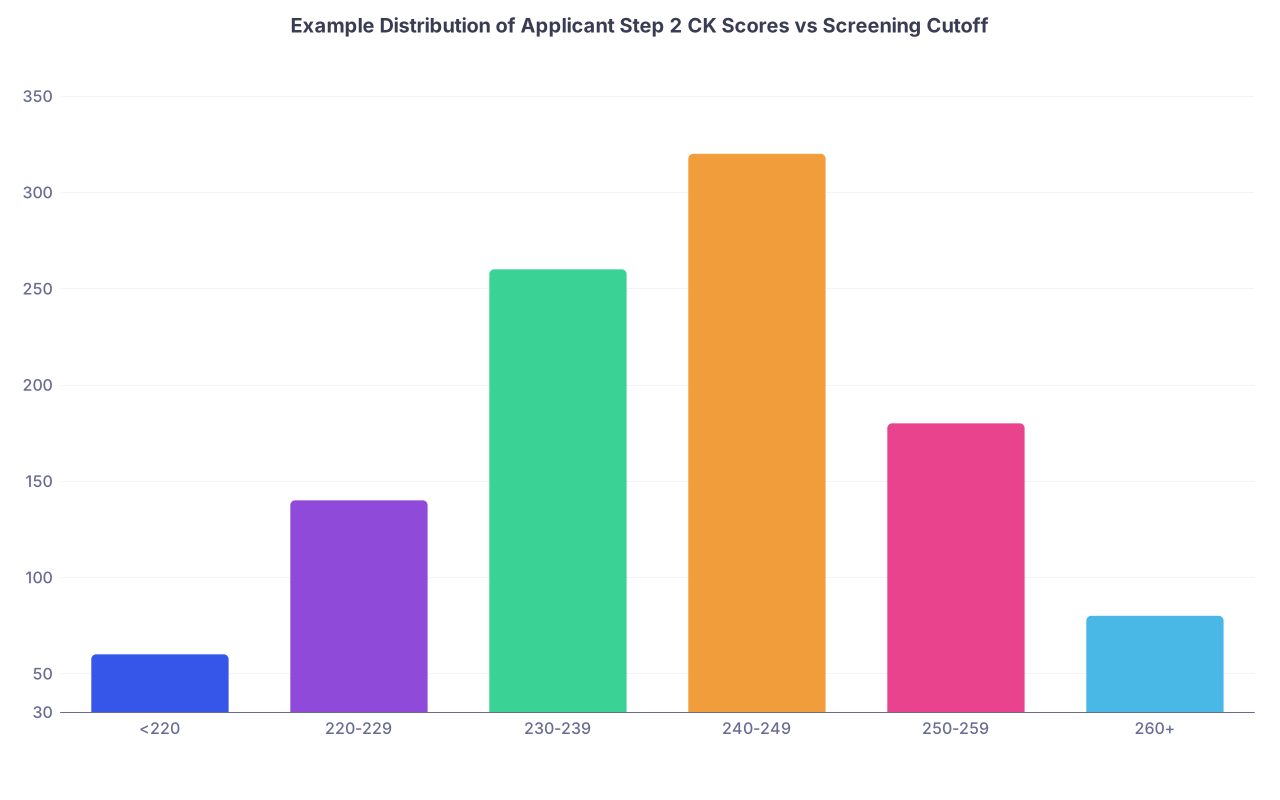
| Category | Value |
|---|---|
| <220 | 60 |
| 220-229 | 140 |
| 230-239 | 260 |
| 240-249 | 320 |
| 250-259 | 180 |
| 260+ | 80 |
If their screen is at 235, the 230–239 band gets partially cut. If they move it to 240 due to volume, suddenly all “below 240” are out for initial review.
Notice again: they are not arguing about 246 vs 248. They are deciding:
- “Below 240: no review unless exceptional.”
- “240–249: normal pool.”
- “250+: strong academic consideration.”
That is band-level decision-making.
4. Where Exact Numbers Do Matter
Saying programs use bands does not mean the exact number is irrelevant. It is just relevant in fewer and more specific scenarios than applicants imagine.
There are three common places your exact score can matter:
- Borderline candidates near a cutoff.
- Internal ranking within a band.
- Tie-breakers in small selection groups.
4.1 Borderline candidates
If a program sets a filter at “≥ 240” and you scored 239, that 1 point is the difference between being visible and being invisible.
This is not a philosophical debate. This is a spreadsheet filter.
I have watched coordinators ask: “We set 240 as our cutoff; this candidate is 238 but has a PhD and three first‑author publications. Do you want to look at exceptions?” That 2‑point gap triggered a manual discussion. But most borderline cases never get that attention.
You do not want to live on the wrong side of a numeric cutoff. This is where obsessing over “do I push for 250 or is 245 okay?” is misplaced. The correct question is: “Am I safely above the typical cutoff band for my specialty/program tier?”
Anesthesiology at a mid‑tier program might be comfortable with ≥230. ENT at a top academic center may start attention at ≥250. Different universes.
4.2 Internal ordering within a band
Once applicants have survived the screen and been marked as “review-worthy,” exact numbers often become one of several internal ranking tiebreakers.
Think of a program that has 150 applicants, all between 240–255, of similar overall quality. No big red flags. No superstar NIH‑funded CVs. The committee still has to prioritize.
In those cases, they might:
- Give 1–2 extra “points” in their scoring rubric for 255+ vs 245–254.
- Mark 250+ as “academic strength” in their notes.
- Use the exact score as part of a composite index along with clerkship grades and class rank.
The result: inside your band, a 259 might beat a 247 when everything else is equal. But that is a second‑order effect compared to being in the right band in the first place.
4.3 Tie-breakers in small groups
Final rank list days are messy. I have been in those rooms. People have favorites. The group argues about three borderline candidates for the last spot. Someone eventually says:
“Look, their applications are comparable. This one has a 254, these two are 244 and 246. Let’s put the 254 first.”
Is that always how it goes? No. But does it happen? Absolutely. Human beings like any excuse to justify a decision during fatigue. Numbers provide that.
Put differently: once you are deep in the interview or ranking pipeline, exact points can matter at the margins. But bands and holistic factors carry more weight earlier in the funnel.
5. Specialty Competitiveness: Different Band Cutoffs
The specialty you choose completely changes what “band” is competitive.
A family medicine program might treat 230+ as “solid.” A dermatology program might essentially ignore anything below 245–250 unless the rest of the file is extraordinary.
Here is a rough, data-driven comparative view, using typical average Step 2 CK scores for matched US MD seniors by specialty, blended with anecdotal cutoffs from PDs:
| Specialty Tier (Examples) | Typical Matched Mean Range | Competitive Band for Strong Consideration |
|---|---|---|
| Ultra-competitive (Derm, Plastics, Ortho, ENT, NSG, IR/DR) | 250–255+ | 250+ (260+ is a major asset) |
| Upper-mid competitive (Anes, EM, Rad, Gas, Uro) | 245–250 | 245+ (250+ strengthens significantly) |
| Mid-tier (IM academic, OB/Gyn, Neuro) | 242–248 | 240+ (245+ helpful for top programs) |
| Less competitive (FM, Psych, Peds, Path) | 238–245 | 230+ generally workable, 240+ attractive |
Again, these are not official cutoffs. They are the statistical reality of where matched applicants tend to cluster.
If your score is:
- Below the typical mean for your target specialty: you are now reliant on the rest of your application to carry you.
- At or above that mean: you are in the main competitive band.
- Well above that mean (≥10 points): your score becomes a strength instead of just “not a problem.”
6. How Step 2 Interacts with Step 1, Shelf Scores, and Class Rank
Programs do not read your Step 2 CK score in isolation. They put it in context with:
- Step 1 (pass/fail, but timing and retakes still matter).
- Clerkship grades and honors in core rotations.
- Shelf exam performance if your school reports it.
- Class rank or quartile, if provided.
Pattern matching is a big part of the game.
Here are common patterns I see programs react to:
Low Step 1, high Step 2 CK (e.g., Pass with borderline, then 255).
Interpretation: upward trend, demonstrated mastery under higher stakes. This can rescue your academic narrative. Programs like this story.High Step 1 (pre‑P/F) then average Step 2 (e.g., 250 → 240).
Interpretation: still fine, but sometimes framed as “plateau.” Not fatal, but the score stops being a major asset.Weak clerkship grades but high Step 2 (e.g., mostly passes, then 255+).
Interpretation: strong test taker, weaker on clinical evaluation. Some PDs trust Step 2 more; others will side‑eye the mismatch.Strong clinical record + solid Step 2 in the target band (e.g., honors in IM/Surgery + 245–250).
Interpretation: this is the sweet spot. No cognitive concerns, good evidence of real-world performance.
The data shows Step 2 CK correlates moderately with in‑training exam performance and board pass rates, which is one reason PDs take it seriously. It is not perfect, but for a high-volume program, it is a cheap proxy.
7. International Graduates and the “Silent Higher Cutoff”
If you are an IMG, the score band discussion gets harsher. Most programs quietly apply stricter thresholds for international medical graduates, especially for visas.
You will hear lines like:
- “We prefer IMGs with Step 2 > 240.”
- “We rarely interview IMGs below 245.”
I have seen actual program filters like:
- US MD/DO: Step 2 ≥ 230.
- IMG (no US clinical experience): Step 2 ≥ 240 or ≥ 245.
So again, bands. But you are shifted one band to the right.
If you are an IMG targeting internal medicine or pediatrics in the U.S., you should assume:
- <230 – Very challenging.
- 230–239 – Possible, but you are fighting uphill at many university programs.
- 240–249 – Reasonable shot if you have strong US clinical experience and letters.
- 250+ – Now you are in a competitive numeric band where programs take notice.
For more competitive specialties as an IMG, 250 often becomes the minimum realistic starting line, not the competitive edge.
8. Strategic Takeaways: How to Use This as an Applicant
Now the part that actually matters to you: how to think about your own score.
8.1 Convert your score into a band and compare to your target
First, decide which of these you fall into:
- <230
- 230–239
- 240–249
- 250–259
- 260+
Then match that against your target specialty and the kind of programs you want (community vs mid-tier academic vs elite academic):
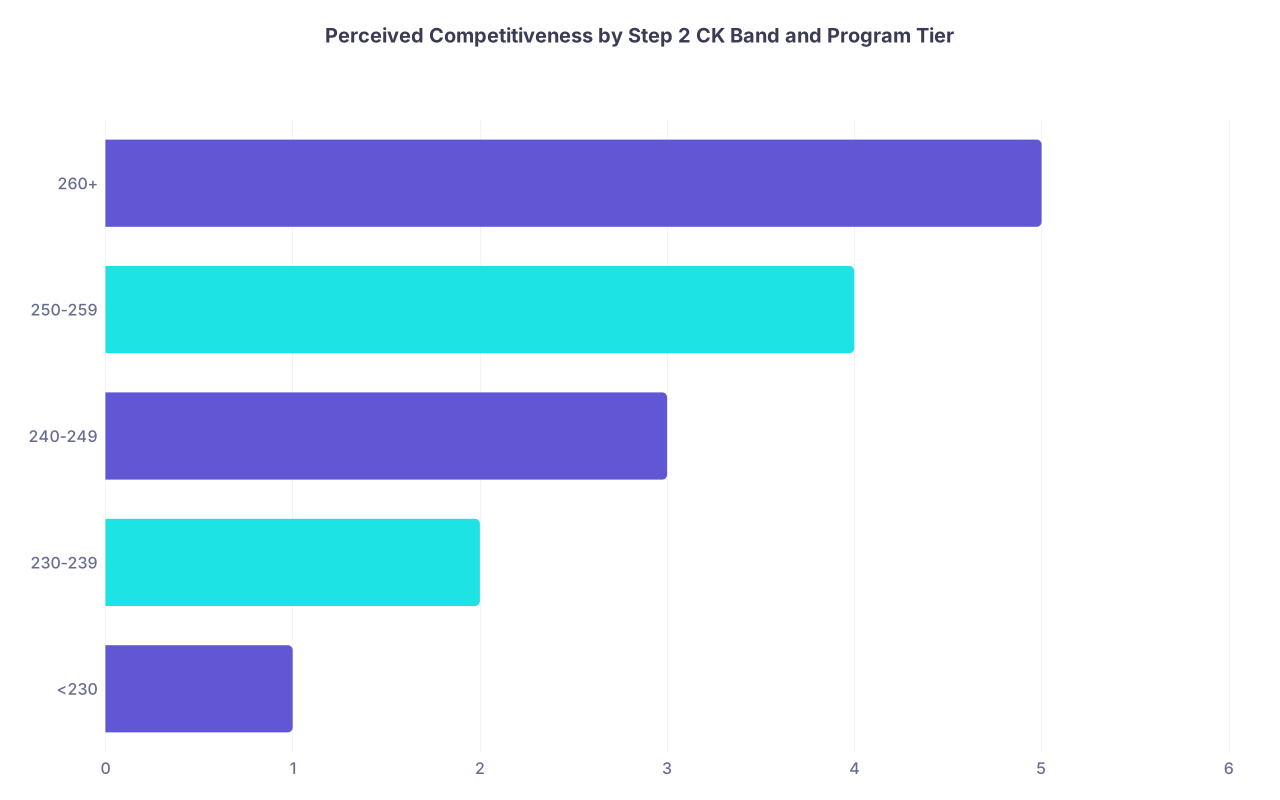
| Category | Value |
|---|---|
| <230 | 1 |
| 230-239 | 2 |
| 240-249 | 3 |
| 250-259 | 4 |
| 260+ | 5 |
(Think of 1 as “weak for most academic programs” and 5 as “very strong for virtually all programs,” broadly speaking.)
If your band is:
- One or more levels below the typical mean for your specialty → you need to expand your program list and lean hard on letters, research, and clinical performance.
- At the same or slightly below the typical mean → you are competitive, but not distinguished by score. Application strategy must be broad and balanced.
- Above the mean by 10+ points → your score becomes an asset that can offset weaker pieces elsewhere.
8.2 Avoid overfocusing on 2–3 point differences inside a band
The data shows match outcomes correlate with being in a band, not with micromovements within it. No one cares that you are a 252 instead of a 249 as much as they care that you are safely above a 240/245/250 cutoff.
Whereas the difference between 239 and 241 can literally be the difference between being filtered out or seen.
So if your practice exams suggest a realistic range of 245–255, the shrewd move is: hit that test as prepared as you can to make sure you do not underperform into the 230s, not chase 260 at the cost of sanity.
8.3 If your score is below your desired band, act like a statistician
Do not guess your chances. Quantify them.
- Look at past match data for your school in your specialty.
- See the Step 2 CK distribution of matched residents if programs share it.
- Estimate your percentile versus matched applicants.
Then adjust:
- Apply more broadly in geography and program tier.
- Emphasize any non‑score strengths: research, away rotations, strong home letters, leadership.
- Be realistic about where your profile aligns statistically, not aspirationally.
9. The Bottom Line: What Actually Moves the Needle
Strip away the noise and the Step 2 CK story looks like this:
Programs primarily use bands and thresholds for Step 2 CK, not fine-grained point‑by‑point comparisons, especially in the screening phase.
Being above or below common cutoffs for your specialty and program tier matters far more than whether you scored 247 or 251. The key transitions are between major bands like <230, 230–239, 240–249, 250–259, 260+.
Exact numbers influence borderline filtering, internal ordering, and tie-breakers, but they are secondary to the big-band question: “Are you in the competitive range for this specialty at this level of program?”
If you treat Step 2 CK as a band-placement problem rather than a perfection contest, you will make smarter decisions—about when to take it, how aggressively to study, and which programs to target.