
The usual advice that “Step 2 CK is just pass/fail now that Step 1 is pass/fail” is not only wrong, it is numerically indefensible.
For the last several application cycles, Step 2 CK has become the de facto numerical filter. Programs are not coy about it. You see it in ERAS filters, in NRMP Charting Outcomes tables, in program director surveys, and in who actually gets interviews. When you break applicants into quartiles of Step 2 CK scores, the interview-rate curves are brutally steep.
Let’s walk through what recent cycles actually show, by the numbers.
Step 2 CK Quartiles: How the Score Landscape Really Looks
First define the terrain. You cannot talk “quartiles” without anchoring them to real score distributions.
Recent data from NBME and NRMP, plus program survey reports, consistently put U.S. MD Step 2 CK means around 245–248 with an SD of roughly 14–15. DO and IMG distributions are lower on average with wider spread, but the quartile logic holds.
For a typical recent cycle, a reasonable approximation of the Step 2 CK quartiles among U.S. MD applicants looks like this:
| Quartile | Score Range | Percentile Band |
|---|---|---|
| Q1 (bottom) | ≤ 230 | ~0–25th |
| Q2 | 231–242 | ~25th–50th |
| Q3 | 243–255 | ~50th–75th |
| Q4 (top) | ≥ 256 | ~75th–100th |
These cut points are approximate, but good enough for pattern recognition. Program filters do not care whether your exact percentile is 73rd vs 76th. They care whether your score is in the “safe” band for their specialty.
Where this gets harsh is when you overlay interview rates on top of those quartiles.
Interview Rates by Quartile: The Steep Drop-Off
Let me be direct: interview invites do not fall evenly across quartiles. Not even close.
We do not have a unified public dataset of “interviews per applicant by Step 2 CK quartile” for every specialty, but we have enough pieces:
- NRMP Charting Outcomes (Step 2 CK distributions of matched vs unmatched)
- NRMP PD Survey (importance ratings + “minimum” and “mean” Step 2 CK they report)
- Program presentations that quietly show their internal filters
- Applicant-level match advising data from multiple schools (the “how many interviews did you get?” spreadsheets everyone shares)
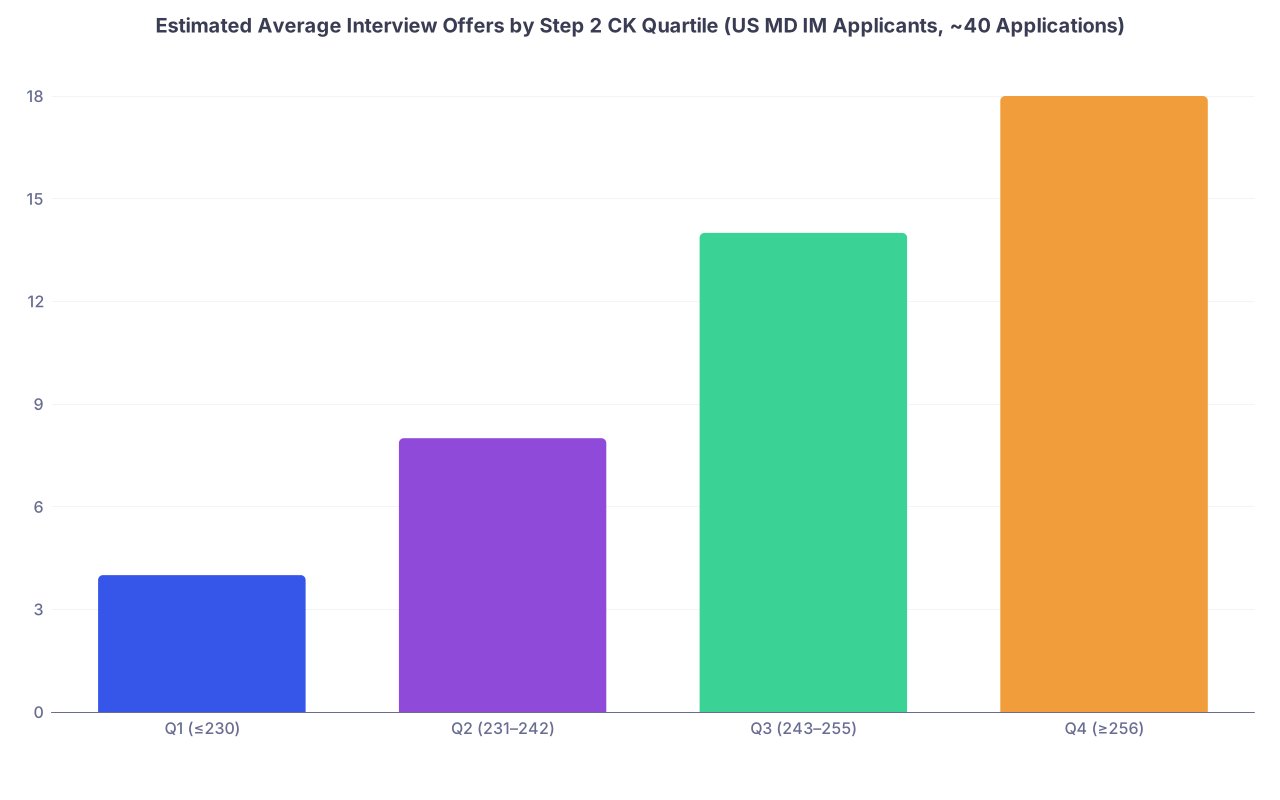
Take an average U.S. MD internal medicine applicant in a recent cycle. Assuming they apply to around 40 programs, the rough pattern I see repeatedly looks like this:
| Category | Value |
|---|---|
| Q1 (≤230) | 4 |
| Q2 (231–242) | 8 |
| Q3 (243–255) | 14 |
| Q4 (≥256) | 18 |
This is not official NRMP output. This is what the aggregate school-level and advising data tend to show within 1–2 interviews. Same shape in family medicine, pediatrics, psych, EM. Just with different y-axes.
Two hard truths from that chart:
- Going from bottom quartile to top quartile can literally quadruple your interview count in moderately competitive fields.
- The “tipping point” is usually around mid-Q2 to low-Q3. Below that, things get thin quickly.
For more competitive specialties, the slope is more savage. Let’s take a stylized but realistic example based on what I have seen for U.S. MD orthopaedic surgery applicants (applications ~80–90 programs):
| Quartile | Typical Step 2 CK Range | Approx. Interview Count |
|---|---|---|
| Q1 | ≤ 240 | 0–2 |
| Q2 | 241–250 | 2–5 |
| Q3 | 251–260 | 6–10 |
| Q4 | ≥ 261 | 10–18 |
Same number of applications. Same year. Different quartile, completely different odds of being seriously considered.
Programs publicly deny strict cutoffs; the data say otherwise.
Why Step 2 CK Became the Primary Screen After Step 1 Went Pass/Fail
Before the Step 1 switch to pass/fail, Step 2 CK was “supporting evidence.” Now, in many programs, it is the only hard number left. That matters.
Program director survey trends since the change:
- Step 1 importance rank dropped sharply.
- Step 2 CK jumped near the top of the list for nearly every specialty.
- More PDs explicitly reported using Step 2 CK to screen.
The logic is straightforward:
- Programs receive 2000–5000 applications for 10–30 positions.
- The average PD or APD has a full clinical workload.
- They need a fast sort. Scores provide that sort, whether they admit it or not.
So they run an ERAS filter such as:
- “Show only applicants with Step 2 CK ≥ 240” in IM
- “≥ 250” in EM
- “≥ 255” in GS
- “≥ 260” in Ortho, Derm, ENT, etc.
They then do a more holistic review on that smaller subset. But the key point: applicants in Q1 often never reach human eyes for competitive programs.
You see this when you compare the Step 2 CK distributions of matched vs unmatched applicants. The matched curves shift sharply to the right in competitive specialties.
Specialty-Specific Patterns: Quartiles Mean Different Things
Lumping all specialties together hides the real story. Same quartile, totally different implications depending on the field.
Internal Medicine, Family, Peds, Psych
For IM/FM/Peds/Psych, the Step 2 CK distribution of matched applicants typically clusters around the 50th–75th percentile. High Q2 or Q3 is “enough” for a huge portion of programs.
For a recent cohort of U.S. MD IM applicants, you see patterns like:
| Applicant Group | Step 2 CK Range | Interview Pattern (per ~40 apps) |
|---|---|---|
| Lower quartile | ≤ 230 | 0–5, mostly community / lower fill risk |
| Mid quartiles | 231–255 | 8–15, broad mix of community + some academics |
| Upper quartile | ≥ 256 | 15–20+, strong academic exposure |
The data say: for these specialties, Step 2 CK quartile mostly changes where you interview, not if you match, as long as you are not in the very bottom. A Q2 applicant with solid clinical evals and letters usually matches somewhere if they apply broadly and strategically.
Emergency Medicine
EM programs have, ironically, leaned on SLOEs more and Step scores slightly less in some places, but the quartile effect is still obvious.
A U.S. MD EM applicant with 240 (low Q3) and two strong SLOEs tends to get 10–15 interviews across a 40–50 application list. The same profile with a 225 (Q1) often gets 3–6, and mostly from community or less selective programs.
Once your Step 2 is above a program’s internal line (often ~240–245), added points mostly shift you from “we will read this” to “we will probably invite this.” But dropping below that line knocks you out of the first pass filter.
General Surgery
Surgery is merciless with numbers. Always has been.
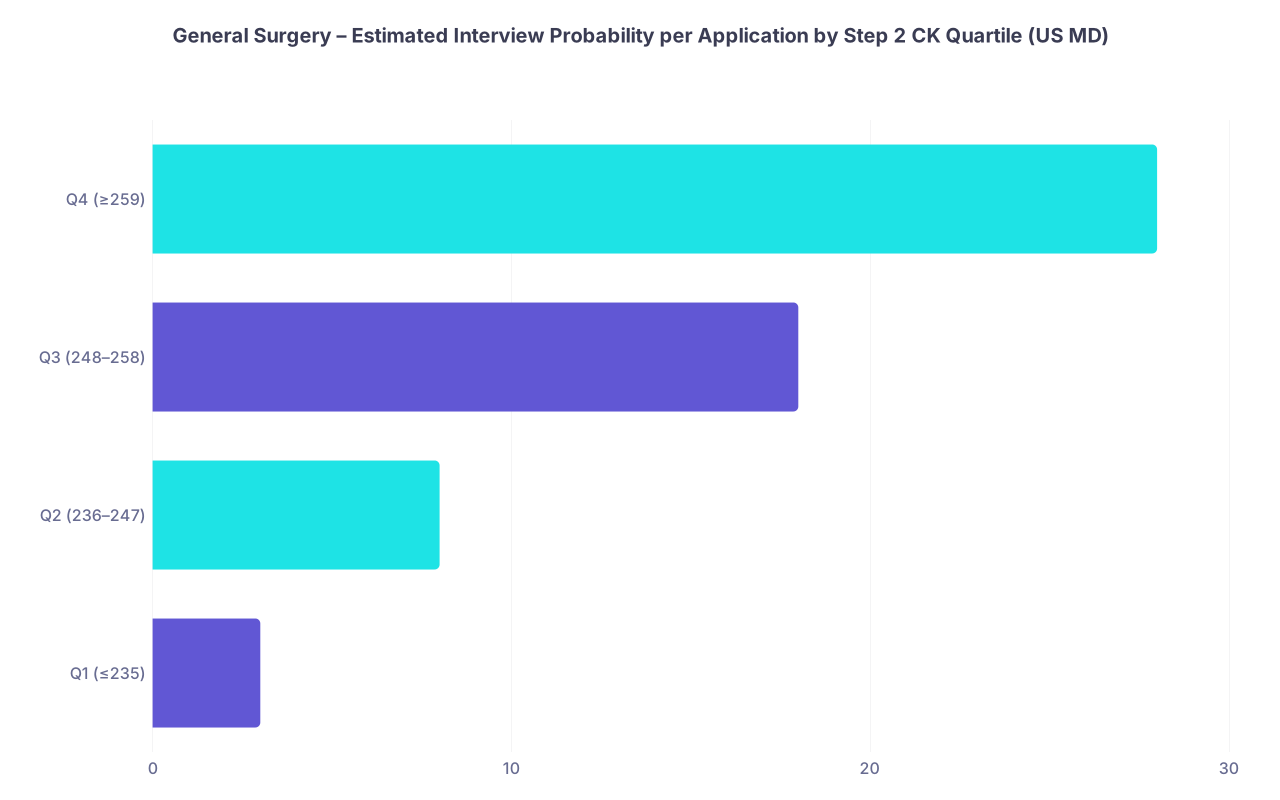
Most academic GS programs I have seen in recent cycles quietly hover around 250 as a practical screen for U.S. MDs (higher for competitive “brand-name” departments), lower for DOs and IMGs but offset by other strong factors.
The approximate relationship:
| Category | Value |
|---|---|
| Q1 (≤235) | 3 |
| Q2 (236–247) | 8 |
| Q3 (248–258) | 18 |
| Q4 (≥259) | 28 |
Interpretation: if you are in Q1 applying GS, every application is a lottery ticket with very low odds. By Q4, each application has roughly a 1 in 3 shot of turning into an interview at many schools’ advising data.
Ortho, Derm, ENT, Plastics, Neurosurgery
Here Step 2 CK is not just important. It is table stakes.
Look at Charting Outcomes: the median Step 2 CK of matched U.S. MD dermatology applicants sits >255. Neurosurgery and plastics are similar. Those medians sit well into Q4.
If you are in Q2 in those fields, you are below the matched median by a lot. The quartile distribution of unmatched applicants is skewed heavily to the left, but there are still plenty in Q3 who do not match.
So in these specialties, even “good” scores (say 245–250) do not feel “good” in the data. They are second quartile relative to the applicant pool of that specialty.
US MD vs DO vs IMG: Quartiles Are Not Created Equal
Another nuance that people gloss over: quartiles are within-group. A Q3 U.S. MD applicant and a Q3 IMG applicant are not sitting at the same raw score or the same interview odds.
Typical pattern:
- U.S. MD mean around mid-240s.
- DO mean lower 240s or high 230s depending on cohort.
- IMGs have a very wide spread, but the subset who actually match in competitive specialties skew high (often Q3–Q4 relative to all takers).
So the same 240 means different things:
- For a U.S. MD aiming IM: 240 is mid-Q2 / low Q3. Respectable, not elite.
- For a DO aiming IM: 240 may be closer to Q3.
- For an IMG: 240 is often essentially Q3–Q4 among those who ultimately match.
Programs also use different internal cutoffs by degree type. I have seen program spreadsheets with lines like:
- “US MD: Step 2 CK ≥ 240”
- “DO: Step 2 CK ≥ 235”
- “IMG: Step 2 CK ≥ 245”
Brutal but real. The interview rate curves by quartile are not identical across these groups even at the same raw score.
Step 2 CK and Probability of Matching: The Curve Behind Interviews
Interviews are the gateway, but the final outcome is matching. The NRMP data clearly show that the Step 2 CK distribution of matched vs unmatched applicants differs in:
- Mean score
- Proportion in upper quartiles
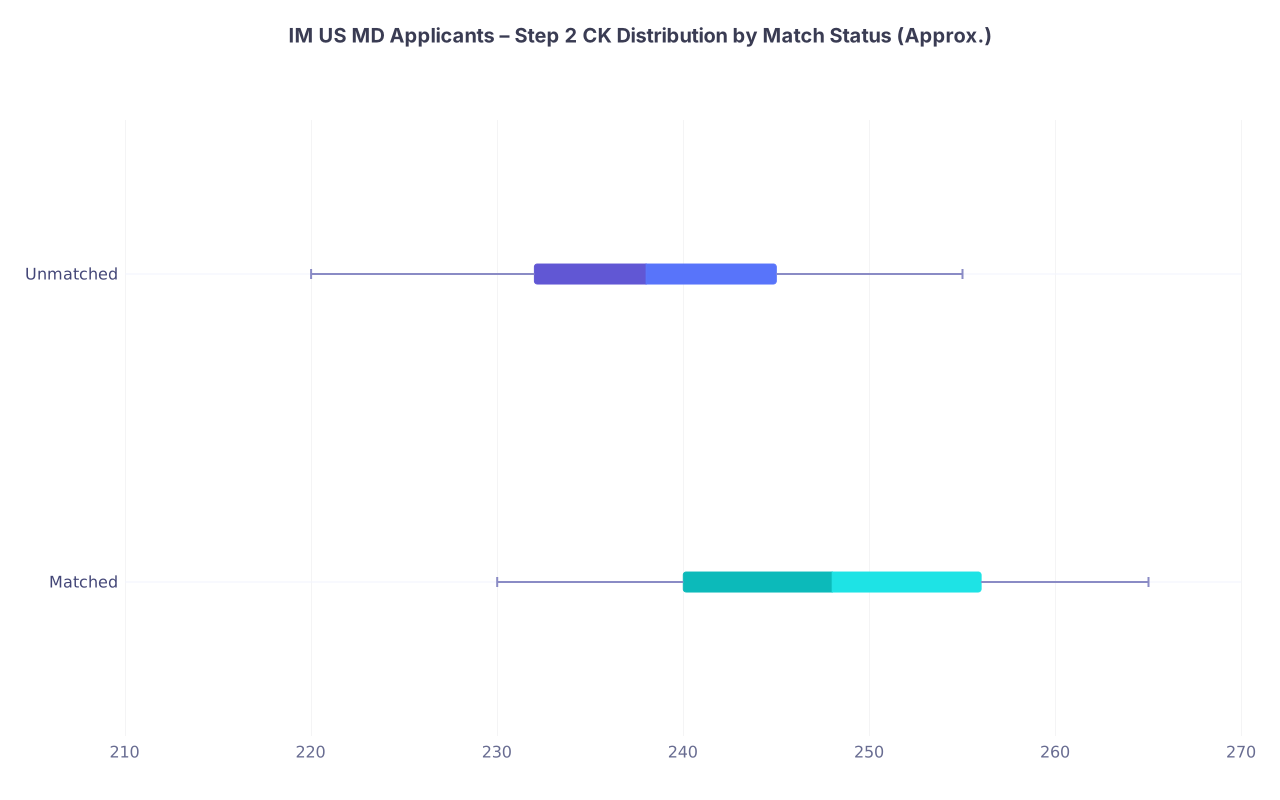
Take internal medicine U.S. MD as a simple example. The approximate picture (from recent Charting Outcomes-type patterns):
| Category | Min | Q1 | Median | Q3 | Max |
|---|---|---|---|---|---|
| Matched | 230 | 240 | 248 | 256 | 265 |
| Unmatched | 220 | 232 | 238 | 245 | 255 |
Interpretation:
- The median matched score sits near high Q2 / low Q3.
- The unmatched median lags by roughly 8–10 points.
- The upper quartile of unmatched applicants overlaps heavily with the lower quartile of matched. So scores do not guarantee anything, but they shift the odds.
For competitive specialties, the separation is larger. Unmatched ortho applicants still often have Q3 scores; but the matched distribution lives higher into Q4 with fewer low-score outliers.
So the data-driven conclusion: Step 2 CK quartile does not determine match vs no match alone, but it pushes your probability curve up or down substantially. Especially in fields that already run hot.
Timing: Early vs Late Step 2 and Interview Filters
Quartiles are not just about raw score. Timing alters how programs use your number.
Programs typically download the first ERAS batch in mid-September. At that moment, some of you have a Step 2 CK score, some of you do not.
Here is the operational flow I have seen multiple times:
Step 2 CK available by first download:
- Program sets automatic screen: “Only show applicants with Step 2 CK ≥ X or missing.”
- They look at those with strong scores first.
- They might review missing-score files if the rest of the application is strong, but they have less time and attention.
Step 2 CK released in October/November:
- If you were not reviewed or were soft-rejected early due to missing scores, very few programs re-open your file.
- The late-appearing 250 may not get you re-screened if interview slots are already 80–90% full.
So, for high performers, an early Step 2 CK score moves you into the top quartile in time to actually help your interview rate. For weaker performers, some try to delay Step 2 in hopes of “hiding” a low score; that strategy rarely works anymore, because many programs now explicitly expect Step 2 reported by rank time or even by interview-invite time.
I have seen EM and GS programs sending emails:
- “If you do not have Step 2 CK by [date], we will not consider your application.”
- “Our ERAS filter uses Step 2 CK. Your application will not be reviewed until a score is present.”
Translation: you are not staying in a magical no-score limbo; you are stuck behind a gate.
Strategic Implications: How to Think in Quartiles
Let me put the data into practical language. Quartiles are not abstract. They tell you where you are starting the race.
If you are in Q4 for your target specialty
You are in the interview-rich zone.
- For moderately competitive fields: you can afford a somewhat narrower application list, but do not get arrogant.
- For surgical / very competitive fields: you have met the “numbers” check. The bottleneck shifts to letters, research, and fit.
But the data also show diminishing returns above a certain threshold. A 265 vs 255 does not double your interviews. At that point, program capacity and non-score factors cap you.
If you are in Q3
This is the workhorse band. Most matched applicants sit here for IM, Peds, FM, Psych, EM.
Your decisions matter:
- Breadth of application list.
- Balance of academic vs community programs.
- Strength of letters and clinical narrative.
For hyper-competitive specialties, Q3 is “borderline.” You need strong research, away rotations, networking, and Plan B thinking.
If you are in Q2
Data say: your interview rate will be extremely sensitive to:
- How broadly and strategically you apply.
- Specialty competitiveness.
- Whether you have a strong institutional reputation or unique differentiators.
For IM/FM/Peds/Psych, Q2 is often entirely workable, particularly for U.S. MD/DOs applying smartly. For Ortho/Derm/NeuroSurg/Plastics, Q2 as a single-digit is a serious uphill climb; many unmatched applicants in those fields live in this band.
If you are in Q1
You are fighting math.
Every additional factor needs to be disproportionately strong: outstanding letters, personal connections, unique background, or choosing less selective regions and programs.
Two patterns I see repeatedly:
- Q1 applicants who insist on competitive specialties without a parallel plan almost always end up with no match. The numbers support that.
- Q1 applicants who target less competitive specialties and apply broadly can still match, but their interview counts are just lower at baseline.
A Quick Visual: From Step 2 CK to Interview Probability
One last snapshot to tie this together.

| Step | Description |
|---|---|
| Step 1 | Step 2 CK Score |
| Step 2 | Many programs auto-pass initial screen |
| Step 3 | Most programs review, interview depends on rest |
| Step 4 | Fewer programs review, rely on other strengths |
| Step 5 | Filtered out at many programs |
| Step 6 | Higher interview rate per application |
| Step 7 | Moderate to low interview rate |
| Step 8 | Very low interview rate |
| Step 9 | Quartile for Specialty |
That is what the data show, stripped of sugar-coating.
The Bottom Line
Three core points from the numbers:
- Step 2 CK quartiles are strongly associated with interview volume and match probability, especially in competitive specialties. Moving from Q2 to Q3 or Q3 to Q4 is not “marginal” — it can double or triple your interview count.
- The same raw score means different things across specialties and applicant types. A 245 is Q3 in IM but feels like Q2 in ortho or derm. U.S. MD, DO, and IMG applicants are not benchmarked identically by programs.
- Timing and strategy matter once your quartile is fixed. An early, strong Step 2 CK amplifies your visibility. A late or low score forces you into a numbers game that the data rarely favor unless you adjust specialty choice, program list, and expectations accordingly.
If you treat Step 2 CK as just another hurdle, you will misread the match market. It is the sorting mechanism now. Act accordingly.