
The myth that one bad Step 2 CK day will destroy your entire residency future is wildly exaggerated—and also just believable enough to keep you up at 3 a.m.
Let me say it plainly: a disappointing Step 2 CK score can hurt. It can close some doors. But it does not erase everything else you’ve done or everything you can still do. It’s not a permanent tattoo on your forehead when you walk into interviews.
You and I both know how your brain is talking right now:
- “I blew it. Programs will auto-trash my app.”
- “I’ll never match in anything competitive.”
- “Everyone else did fine and I’m the only disaster.”
- “I should just change specialties, or drop out, or…something.”
Let’s pull this apart like someone who’s looked at a lot of applications and also sat in the exact same panic spiral.
What Step 2 CK Really Is (And Isn’t)
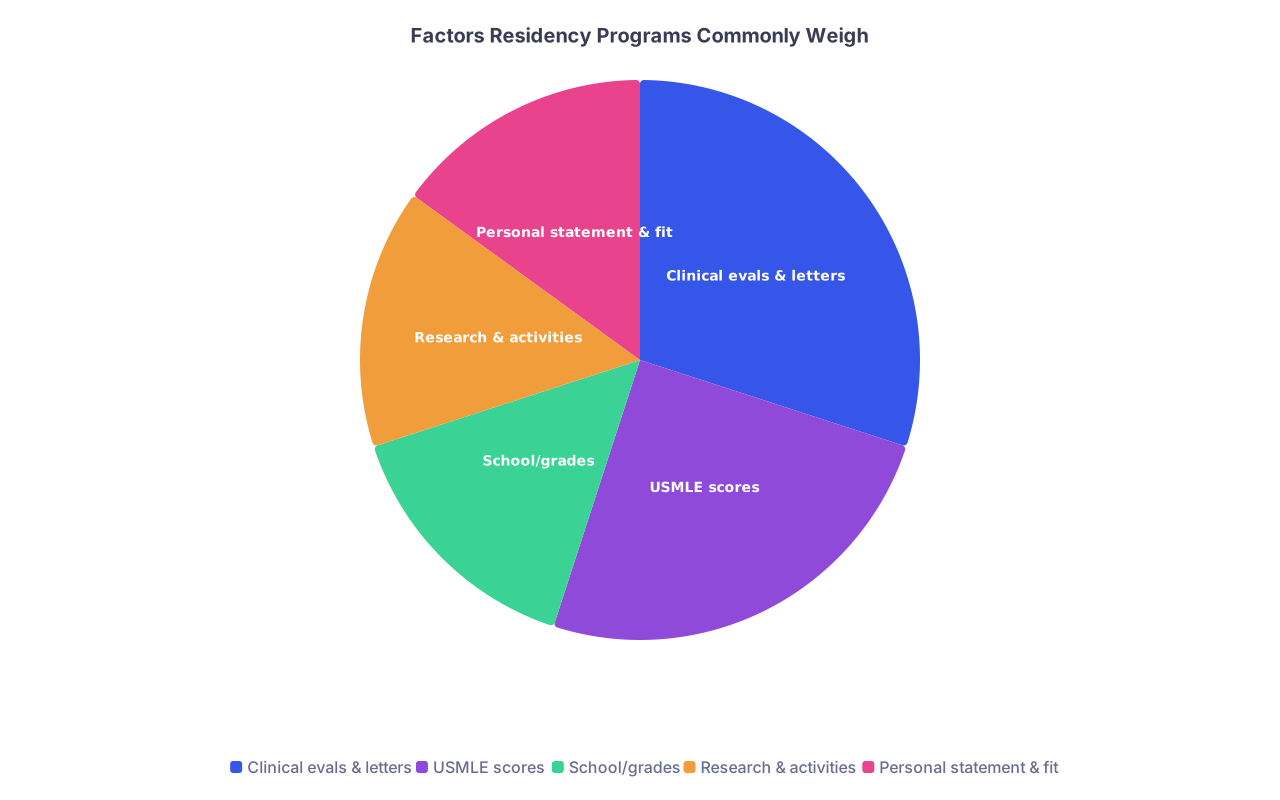
| Category | Value |
|---|---|
| Clinical evals & letters | 30 |
| USMLE scores | 25 |
| School/grades | 15 |
| Research & activities | 15 |
| Personal statement & fit | 15 |
Step 2 CK is:
- A big, standardized snapshot of your clinical knowledge
- A handy sorting tool for overworked PDs with 3 minutes per application
- One of several objective metrics they can compare
Step 2 CK is not:
- A measure of your actual value as a future doctor
- A perfect reflection of your clinical ability
- The only thing anyone looks at, despite what your panicked brain says
Programs care more about patterns than single data points.
If your transcript says: solid grades, strong clerkship evals, meaningful letters—and then one slightly weaker Step 2 score—most sane people on a committee don’t go, “Rejected forever.” They go, “Huh. Tough test day? Moving on.”
Where it feels worse is when:
- You were counting on a high Step 2 to “save” a weak Step 1 or low GPA
- You’re aiming for ultra-competitive specialties (derm, ortho, plastics, ENT, neurosurgery)
- Your score is significantly below your specialty’s average
That stings. But even then… it’s not over.
How Programs Actually Look At A Less-Than-Ideal Step 2
Here’s the part nobody tells you while you’re doomscrolling Reddit.

Most programs don’t sit there obsessing about how you personally disappointed them. They’re trying to triage hundreds or thousands of apps in a limited time.
Roughly, they’ll do something like:
Initial screen
- Filter by: “Is this score below an absolute cutoff?” (if they have one)
- Consider: Step 1 (if available), Step 2, failures, number of attempts
Context check
- Are there red flags? (multiple failures, huge drop from Step 1, no explanation)
- Is the score way below their historical range, or just “meh”?
Whole file review for those who pass the quick screen
- Clinical performance
- Letters (especially from known faculty)
- Research and commitment to the field
- Personal statement, life story, fit
So the key question becomes:
Are you “slightly below average” or “automatic cutoff fail”?
Let’s put some numbers to this.
| Specialty Type | Typical Competitive Score Range | How A Single Bad Day Plays Out |
|---|---|---|
| Very Competitive (Derm, Ortho, Plastics) | Often 250+ for strong apps | One low score can hurt a lot; need strong compensating factors |
| Mid-Competitive (EM, Anesthesia, Rads) | Many successful apps ~240–250 | Slightly low but passable score can be offset by rotations and letters |
| Less Competitive (FM, Psych, Peds) | Many successful apps ~220–240 | Wide range accepted; strong fit and letters often carry more weight |
If you’re:
- 5–10 points below a program’s usual average → annoying, but not fatal
- Below typical cutoffs by a big margin → that might block some specific programs, not all programs, and not forever
That’s the nuance people skip when they say “Step 2 is everything now that Step 1 is pass/fail.” It’s important. It’s not everything.
Worst-Case Scenarios (Because My Brain Always Goes There)
Let’s walk through the nightmare versions, because that’s what you’re already doing at night anyway.
Scenario 1: “My score killed my dream specialty”
You wanted derm. Or ortho. Or integrated plastics. Your Step 2 came back way below their typical match numbers.
Harsh truth:
For some of these specialties, yes, a low Step 2 can basically close that door at most programs for now. They have too many 260+ applicants to justify a big reach.
But here’s what does not automatically happen:
- You are not barred from all programs in that specialty
- You are not barred from ever doing something related
- You are not forced into a specialty you hate
What I’ve actually seen people do:
- Take a research year in that field, crush it, reapply with publications and strong letters
- Apply more broadly and strategically: smaller programs, less “name-brand” institutions
- Pivot to a related specialty (e.g., IM then cards; gen surg then fellowships) and still end up in a career they genuinely like
Does that feel like the straight, clean, perfect path you planned? No. It’s messier. But “my career is over” is just false.
Scenario 2: “My score is below average for my specialty but not catastrophic”
This is most people in panic mode.
Maybe you wanted EM, IM, peds, psych, OB/GYN. And your score is…fine-ish. Not flex-worthy. Not Reddit-brag-worthy. Just “meh.”
Programs will notice. But they’ll ask:
- Do your clinical evals show you’re strong on the wards?
- Did you honor in that specialty’s clerkship or do well on that shelf?
- Do your letters say “top 10%” or “average student”?
- Is there a clear trend: did you improve from Step 1? Did you handle harder rotations well?
You’re not out. You just might need:
- A wider application net (more programs, more range of competitiveness)
- Stronger narrative in your personal statement and MSPE to contextualize things
- Intentionally chosen away rotations where you can prove you’re better than your score
Scenario 3: “Multiple red flags + low Step 2”
This is the one people are actually thinking of when they say “you’re screwed”—multiple fails, huge drops, professionalism issues, and a low Step 2.
Even here, people still match. Usually by:
- Being brutally realistic about specialty choice
- Applying very broadly, including community programs
- Getting honest mentorship and letting advisors advocate for them
- Sometimes doing a preliminary year and reapplying with stronger performance
Is it harder? Yes. Does it equal “no future in medicine”? No.
How To Respond Strategically (Instead of Just Spiraling)

| Step | Description |
|---|---|
| Step 1 | Step 2 CK Score Released |
| Step 2 | Proceed with planned specialty |
| Step 3 | Get honest specialty data |
| Step 4 | Meet with advisor |
| Step 5 | Apply broadly and strengthen other areas |
| Step 6 | Consider alternative plans |
| Step 7 | Target rotations and letters |
| Step 8 | New specialty or research year |
| Step 9 | Below your target? |
| Step 10 | Still viable in chosen specialty? |
Your brain wants to either:
a) catastrophize, or
b) pretend it’s fine and do nothing different.
Both are bad.
Here’s what actually helps:
Get hard numbers for your specialty
- Look up NRMP Charting Outcomes. Find the matched applicant Step 2 ranges.
- Compare honestly: Are you within range? Slightly below? Way below?
Talk to a real advisor who knows your school’s match history
- Not a random Reddit user. Not your class group chat.
- Ask explicitly:
- “With this score and my transcript, where have students like me matched?”
- “Are there programs I should deprioritize?”
- “Do I need a backup specialty?”
Exploit your strengths aggressively
If your score is weak, everything else matters more:- Crush your sub-I/away rotations in that field
- Get at least one letter that says you’re in the top tier of students they’ve worked with
- Make your personal statement specific, not generic fluff—connect your story, your work, and your goals to that specialty
Control the narrative where appropriate
If there was a genuine reason for a bad test day (family crisis, major illness, etc.) and your school allows a short explanation in your MSPE or dean’s letter, use it. Briefly. No sob story. Just context.Apply strategically
- Don’t only apply to “dream” programs with sky-high averages
- Include a serious number of mid and lower-tier programs, community programs, and places that historically take a range of scores
- Think geography: some regions are less cutthroat than others
The Mental Side: Surviving The “I Ruined My Life” Loop

I’m going to say the part nobody usually says out loud:
Your anxiety about this score is probably going to be more damaging day to day than the score itself—if you let it bleed into everything.
Because here’s what tends to happen after a bad Step 2 day:
- You start showing up to rotations second-guessing yourself
- You hesitate to answer on rounds because “I’m the dumb one with the bad score”
- You withdraw from attendings and residents instead of building relationships
- You procrastinate on personal statements and ERAS because it hurts to look at
Then that becomes your new pattern: not the score. The fallout.
You need to interrupt that.
A few unglamorous but real steps:
Set a concrete “analyze then move on” window.
Give yourself 3–7 days to feel miserable, cry, vent, dig through data. After that, any time your brain goes, “You’re doomed,” you force yourself to do something active for your application instead: work on your CV, draft an email to a letter writer, read about a program.Separate “score” from “self.”
Your score reflects how you performed on one exam on one day after years of cumulative chaos. It’s not a referendum on your worth or even your ceiling as a clinician.Don’t isolate.
Confide in at least one classmate or friend who won’t turn it into competition. Say the number out loud. The shame shrinks when it’s not a secret.Do something you can win at right now.
Can you show up tomorrow on your rotation extra prepared? Can you email a potential mentor? Can you outline your personal statement? Collect small wins to counterweight the one big loss.
What Actually Defines Your Residency Future
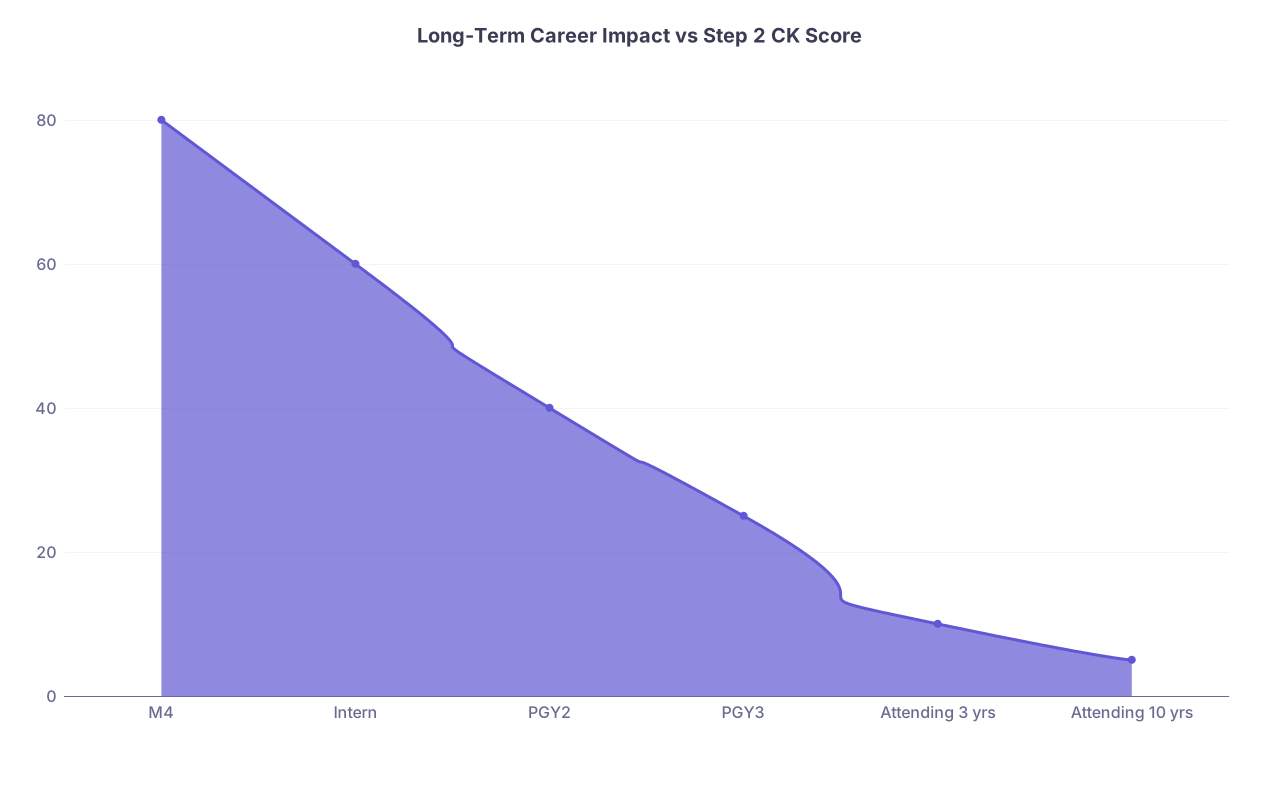
| Category | Value |
|---|---|
| M4 | 80 |
| Intern | 60 |
| PGY2 | 40 |
| PGY3 | 25 |
| Attending 3 yrs | 10 |
| Attending 10 yrs | 5 |
The farther you get from med school, the less anyone cares about your Step scores. Honestly.
What ends up mattering more:
- Your reputation as a resident (hard-working vs checked out)
- Your procedural competence and clinical judgment
- Whether attendings trust you to take care of their patients
- Whether you’re someone people want on their team at 3 a.m. on call
I’ve never heard an attending in the real world say, “Don’t let Dr. X take care of that patient, they got a 230 on Step 2.” I have heard:
- “I don’t trust that resident; they cut corners.”
- “She’s solid—knows her stuff and calls when she needs help.”
- “He’s great with patients, really thorough, and doesn’t disappear when it’s busy.”
Your Step 2 CK score influences which doors open first. It doesn’t control which rooms you eventually end up in, or how far you go once you’re there.
Concrete Next Steps (So You’re Not Just Nodding and Panicking)

Today—literally today—pick one of these and actually do it:
- Email your school’s advising office to book a specific appointment: “30-minute meeting to discuss residency specialty options with current Step 2 CK score of X.”
- Open NRMP Charting Outcomes and look up your specialty’s Step 2 range for matched applicants. Write your score next to it. Reality > vague dread.
- Make a list of 5–10 programs that might be “reach,” “target,” and “safer” based on your score and your other strengths.
- Start a rough draft of an email to a potential letter writer from your chosen specialty.
Don’t just reread this and then go back to spiraling on forums.
Open one tab—not Reddit, not SDN—your actual ERAS or a blank document. Type your Step 2 score at the top. Underneath it, list three concrete strengths you still have as an applicant (rotations, research, leadership, letters). Use that to anchor yourself while you plan.
Your Step 2 CK score is a loud data point. It is not your whole story.
FAQ (Exactly The Questions Your Brain Is Screaming)
1. Is my residency application dead if my Step 2 CK is below 220?
Not automatically. It depends heavily on specialty and context. For ultra-competitive fields, below 220 is usually a serious problem. For less competitive fields (FM, psych, some peds/IM programs), plenty of applicants match with scores in that range—especially if they have strong clinical performance, no failures, and solid letters. You’ll need to apply broadly, be realistic, and let advisors help you build a smart list. But “below 220 = dead” is just not universally true.
2. My Step 1 was pass/fail and my Step 2 is average. Am I now a “weak” applicant?
No. You’re…an average applicant on test scores. Which is most people. Programs will lean more on: clerkship evals, narrative comments, letters, and evidence that you actually care about the specialty. If your rotations are strong and your letters are enthusiastic, an average Step 2 doesn’t sink you. You’re just not getting in purely on numbers—which, honestly, almost nobody is anymore.
3. Should I delay graduation or take a research year just because of a mediocre Step 2?
Usually, no. A research year makes sense if:
- You’re aiming for a highly competitive specialty where your Step 2 is far below typical matches, and
- You can get meaningful research, mentorship, and strong letters out of that year.
If you’re going into IM, FM, peds, psych, etc., a research year just to “undo” a mediocre Step 2 is often overkill. Talk to mentors in your chosen field before you make a big life decision.
4. Do programs actually ask about a low Step 2 score in interviews? What do I say?
Some will, especially if there’s a noticeable gap from your other performance. You don’t need a dramatic speech. Something like:
“I was disappointed with that score—it doesn’t reflect how I usually perform clinically. I learned from the experience, adjusted how I study and manage stress, and since then I’ve [done well on rotations / taken on more responsibility / received strong feedback]. I’m confident in my clinical ability and work ethic.”
Own it. Don’t make excuses. Then pivot to concrete evidence you’re stronger than that number.
Now: open your score report, write the number down on paper, and then—on the same page—list three things you can do this week to strengthen the rest of your application. Don’t just think it. Write it. Then do the first one today.