
The idea that programs won’t notice a Step 2 CK drop is a lie we tell ourselves to sleep at night.
They will notice. The question is: what will they do with it—and what can you do now that the number is what it is?
Let me just say the sentence your brain has been screaming: “My Step 2 CK is lower than my Step 1. I screwed everything up. Everyone else improved. Programs are going to think I got lazy or peaked early or can’t handle clinical medicine. I’m done, right?”
No. You’re not done. But pretending this doesn’t matter is also dumb. So let’s walk through what’s real, what’s just anxiety noise, and what damage control actually looks like.
1. Yes, programs will notice the drop. No, it doesn’t automatically ruin you.
You know that moment when you open ERAS and your eyes go straight to your scores table? Faculty do the exact same thing.
They don’t skim it. They pause. They compare.
| Step | What They Glance For | Gut Reaction Scale |
|---|---|---|
| Step 1 | Pass / Fail, red flags | Low now (post-pass/fail) |
| Step 2 CK | Numeric strength, trend | High importance |
| Trend | Up, flat, or down | Used for narrative |
Here’s the blunt truth:
- A drop from Step 1 to Step 2 CK is noticeable.
- It can trigger questions.
- But it’s not a binary “you’re in” / “you’re out” signal.
Programs are pattern-readers, not score robots. They don’t just see “step down” and slam the reject button. They stack that information against everything else: your letters, your school reputation, your clerkship grades, your specialty, your personal statement, your red flags (or lack of them), your professionalism.
The drop matters more when:
- You’re applying to highly competitive specialties (derm, ortho, plastics, neurosurg, ENT).
- You were relying on a big Step 2 bump to “fix” a weak Step 1 story.
- The drop is large (think: 10–15+ points, not 1–2).
It matters less when:
- You’re applying to fields that already emphasize “whole applicant” (FM, IM, peds, psych, PM&R).
- Your scores are both still solidly above that specialty’s comfort zone.
- Your clinical narrative (evals, letters) is strong and consistent.
Programs notice everything. The real distinction is whether they see it as:
- A blip (hmm, interesting, but OK), or
- A signal (this changes how I rank this person), or
- A problem (this plus other issues makes me nervous)
Your job is to drag it out of the “problem” bucket and keep it in “blip” or at worst “signal, but still acceptable.”
2. How bad is your drop really? (Your brain is probably catastrophizing.)
Your mind loves extremes. “Everyone else went up 15 points and I’m the only failure.” No.
Let’s make this less emotional and more concrete.
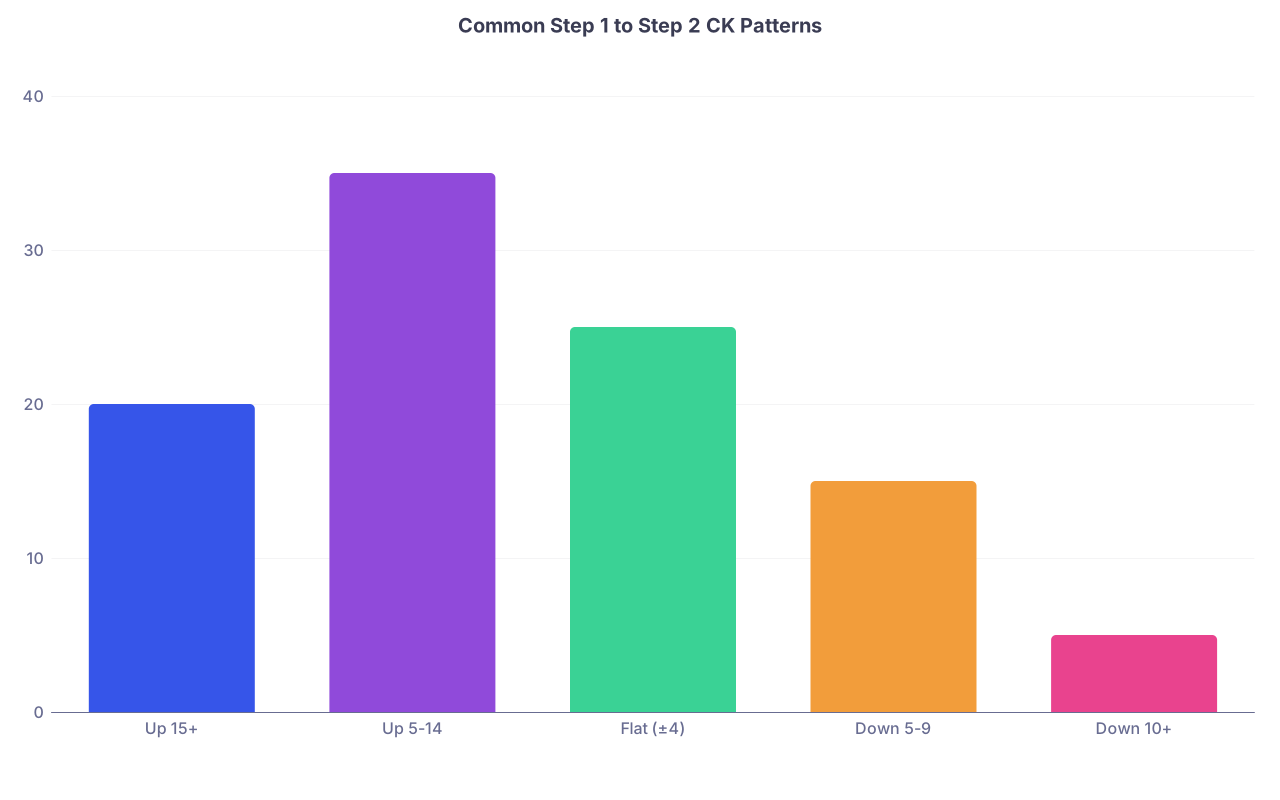
| Category | Value |
|---|---|
| Up 15+ | 20 |
| Up 5-14 | 35 |
| Flat (±4) | 25 |
| Down 5-9 | 15 |
| Down 10+ | 5 |
Obviously the exact numbers vary year to year, but patterns like this are what I keep seeing when I talk to students and PDs:
- Many students go up somewhat
- A decent chunk are roughly flat
- A minority go down, and only some of those are big drops
Programs know this. They read hundreds of apps. They’ve seen every combination: high Step 1, moderate Step 2. Low Step 1, massive Step 2 bump. Both meh. Both great. Step 2 nosedive.
Two questions to ask yourself honestly:
Are both your scores still in a “matchable” range for your specialty?
Example: Step 1 (pass) from a decent school, Step 2 CK 242 for IM. Not the 260 of your dreams, but not some flaming red flag either.Is the drop catastrophic or just psychologically painful?
The difference between 252 and 245 feels huge to you because you were emotionally attached to the 250+ identity. To a PD, 245 is still “strong applicant”.
You’re reacting to the story in your head: “I underperformed.” Programs are reacting to a spreadsheet and a human-shaped narrative. It’s different.
3. What programs actually think when they see a Step 2 drop
Here’s where your brain usually goes: “They’ll assume I’m lazy, not clinically strong, or burned out.” Sometimes, yes. But that’s not the default assumption.
Here are the most common interpretations I’ve heard from PDs and faculty when I ask this directly:
“Classic test ceiling hit.”
Applicant did great on Step 1, then plateaued. Still a strong test taker, just not infinitely upward.“Too much going on during third year.”
Heavy rotations, personal stuff, scheduling Step 2 at a brutal time. Not ideal, but human.“Maybe weaker at clinical integration than basic science.”
This bothers some specialties more than others. Surgery and EM might care more than FM or psych.“Let’s see if the rest of the file matches this trend.”
They’ll look at:- Shelf scores
- Clerkship grades (especially in your chosen specialty)
- Narrative comments (“reads around patient care,” “excellent clinical judgment,” etc.)
The worst interpretation is:
- “Trend plus other issues = consistent weakness.”
Example: Drop in Step 2 CK + marginal or failed shelf exams + lukewarm letters + professionalism comments. Then yes, your Step 2 drop can be the cherry on a very unfortunate sundae.
But if your only major concern is: “My Step 2 CK is 8–12 points below Step 1,” that alone rarely kills you.
It reshapes your “tier” for ultra-competitive places. It might cost you a few interview offers at certain name-brand programs. But completely dumpster-firing your match? That usually takes more than a single downtrend.
4. Specialty matters: some care a lot, some care a little
Let’s be honest: some fields are score-obsessed, and some really aren’t.
| Specialty | Step 2 CK Weight | Typical Reaction to Drop |
|---|---|---|
| Dermatology | Very High | Notice and care a lot |
| Ortho/Neurosurg/ENT | Very High | May hurt interview chances |
| EM/Surgery | High | Matters, but context counts |
| IM/Anesthesia | Moderate-High | Matters, but fixable |
| Peds/FM/Psych | Moderate | Look more at overall fit |
Are there low-score-friendly derm programs? Not really. Are there peds programs that will still love you with a drop and decent numbers? Absolutely.
If you’re in a hyper-competitive specialty and your Step 2 drop takes you from “top quartile” to “meh” for that field, you may need to:
- Add more mid-tier and safety programs
- Consider categorical vs prelim strategies
- Be brutally honest about geographic ego (e.g., maybe not just coastal powerhouses)
If you’re in IM, peds, FM, psych, PM&R, etc., a Step 2 dip is more often a small headwind than a brick wall.
5. Should you explain the drop? Or stay quiet and hope no one asks?
This is the part everyone overthinks.
Your instinct is to write a full essay: “I promise I studied, I just had X, Y, Z, also my dog was sick, also I was on surgery call, also…” That usually makes things worse.
Here’s a simple rule:
Explain the drop if there’s a clear, credible, contained reason
– Serious illness (you or close family)
– Documented mental health crisis
– Major life event (death, crisis, etc.) that directly impacted test prepDo NOT explain if the real reason is “I mis-timed my prep” or “I was burned out” or “I thought I could get by with less.” That just sounds like poor judgment.
If you do explain, it should be:
- Brief (2–3 sentences)
- Factual (no drama, no oversharing)
- Paired with evidence of recovery (e.g., strong clinical evals, solid recent performance)
For most applicants with a 5–10 point drop and both scores still in an acceptable range, I lean toward: don’t highlight it in your personal statement at all. Let it exist as data. Answer honestly if someone brings it up in an interview.
If a PD asks you directly: “Your Step 2 is a bit lower than your Step 1, what happened?” you want a calm, non-defensive script. Something like:
“You’re right, it is a bit lower. Third year was intense, and I scheduled Step 2 sooner than I should have between demanding rotations. That’s on me. I’ve focused since then on strengthening my clinical skills, which you can see in my [clerkship grades / letters / recent evaluations]. I’m confident in my ability to handle your program’s workload.”
Short. Ownership. Redirect to strength.
6. How to stop a Step 2 drop from defining your entire application
This is where you still have power.
You can’t change the score, but you can absolutely change the story around it.
The strongest antidotes to a Step 2 drop:
Stellar letters from people who actually know you
If an academic IM chair or residency PD writes “top 5% of students I’ve worked with in 10 years,” nobody is tossing you solely because you went from a 245-equivalent to a 238.Honest, specific clinical evaluations
Comments like “takes ownership,” “excellent fund of knowledge,” “asks insightful questions,” “will be an outstanding resident” carry real weight.Aligned experiences with your target specialty
Sub-Is, away rotations, meaningful research, leadership that fits your field—these all say “I’m serious” in a way no test score can fully erase.Smart application strategy
- Apply broadly, not just aspirationally
- Balance reach, middle, and safer programs
- Be realistic about region and program type

| Step | Description |
|---|---|
| Step 1 | Step 2 CK score lower than Step 1 |
| Step 2 | Focus on strong letters and clinical narrative |
| Step 3 | Broaden list and add less competitive programs |
| Step 4 | Do well on Sub I and get great LORs |
| Step 5 | Submit broad ERAS list early |
| Step 6 | Scores still competitive for field |
You’re not just a number drop. But if you act like a number drop—spiral, freeze, stop putting energy into rotations and relationships—that’s when the score starts to define you.
7. What about programs that screen hard by Step 2?
Some places absolutely have Step 2 CK cutoffs. They’ll say they don’t. Then they quietly filter the ERAS spreadsheet by score.
You might get filtered out from:
- A subset of brand-name university programs
- Some high-demand urban locations
- A few specialties or institutions that equate high scores with prestige
But here’s the thing no one tells you when you’re spiraling: you don’t need all of those programs to like you. You need enough places to interview you. You need one program to rank you high enough.
There are tons of solid mid-tier and community programs that:
- Don’t have hard cutoffs
- Care a lot about work ethic, personality, and “will this person be safe and reliable at 3 a.m.?”
- Are more flexible about score patterns as long as you’re not drastically below their usual range
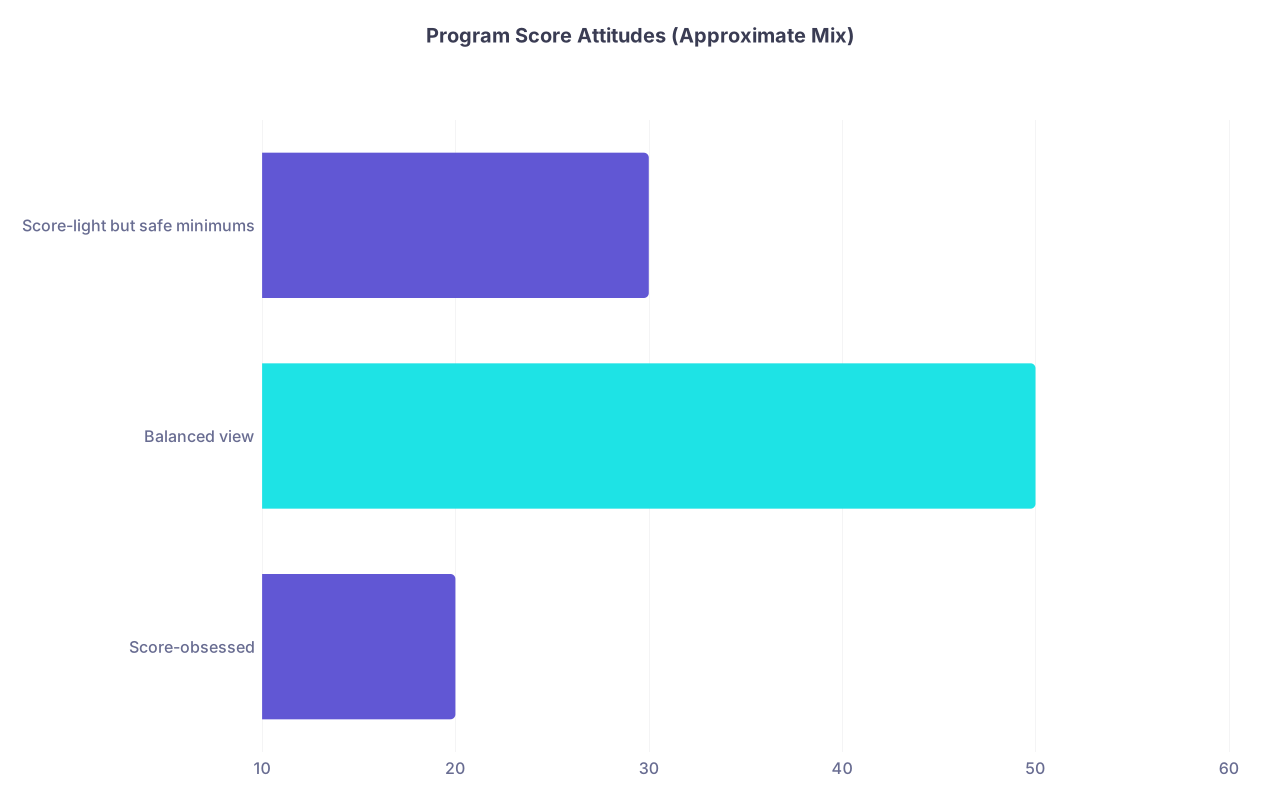
| Category | Value |
|---|---|
| Score-obsessed | 20 |
| Balanced view | 50 |
| Score-light but safe minimums | 30 |
Your anxiety is acting like 100% of programs are in the “score-obsessed” bucket. They’re not.
8. How to talk to yourself about this without going insane
The hardest part isn’t ERAS. It’s the voice in your head between 11 pm and 2 am.
You know, the one rehearsing imaginary PDs laughing at your score report.
Here are a few things that are actually true, even if they feel fake right now:
- PDs have seen high scorers fail as residents and average scorers thrive. They know scores are imperfect.
- A modest score drop is not a rare, bizarre anomaly. It’s common.
- They care more about:
– Are you safe?
– Are you teachable?
– Will you show up?
– Are you going to quit, implode, or be toxic?
Your Step 2 drop says absolutely nothing about those things. Your letters, evals, and interview behavior do.
You can be disappointed. You can be mad at yourself. But if you let that disappointment leak into everything—half-hearted rotations, avoidance of mentors, procrastination on ERAS—that’s the part that actually hurts you.
You got this far. You passed both exams. You survived third year. That already puts you ahead of a ton of people who never got this close.
FAQ (exactly 5 questions)
1. My Step 2 CK is 10+ points lower than my Step 1. Should I still apply to my dream specialty?
Probably yes—but adjust your strategy. If you’re aiming for something like derm, ortho, neurosurg, or ENT and your Step 2 drop puts you below that field’s typical range, you should:
- Apply more broadly and include a serious number of mid-tier programs
- Consider having a realistic backup plan (prelim surgery or IM, for example)
If you’re in IM, peds, FM, psych, anesthesia, EM, or PM&R, a 10-point drop hurts less. It might take some of the top-tier places off the table, but it doesn’t automatically kill your chances at matching in the field.
2. Should I delay releasing my Step 2 CK score to programs if it’s lower?
No. Delaying just looks weird and often triggers more suspicion. Most programs now expect Step 2 CK to be in early, especially with Step 1 pass/fail. If you hide it and then release it mid-season, it can look like you were trying to conceal something. It’s better to own the number and then make everything else in your application as strong as you can.
3. Will interviewers bring up my lower Step 2 CK? What do I say if they do?
Some will; many won’t. If they ask, don’t panic and don’t overshare. A good response is short, honest, and shifts focus to your strengths:
“Yes, it was slightly lower than my Step 1. I had a very demanding schedule around the time I tested, and I underestimated how much that would impact me. Since then, I’ve focused on my clinical growth, which you can see in my [Sub-I performance / specialty letters / recent evals]. I feel very prepared for residency-level work.” No drama. No excuses. Own it and move on.
4. My Step 2 CK is lower but still above the national mean. Does that still hurt me?
It hurts your ego more than your application, usually. Programs look at raw numbers and ranges, not just direction. If your Step 2 is, say, 245 instead of the 255 you dreamed of, most reasonable programs still see you as strong. The drop might matter at ultra-competitive name-brand places that have tons of 250+ applicants, but across the board, a score above the mean is still in the “we can absolutely work with this” zone, especially with good letters and clinical performance.
5. What’s one thing I can do this month to offset a Step 2 drop?
Crush your current or next rotation and secure a strong, specific letter from someone in your target specialty. Tell them directly you’d be honored if they’d write on your behalf. Ask for feedback during the rotation and act on it. A letter that says “this student is among the best I’ve worked with, I would be thrilled to have them as a resident” does more to dilute Step 2 anxiety than obsessively re-reading your score report ever will.
Open your ERAS (or draft) right now and look at your program list. Add 5–10 realistic, slightly “safer” programs that you’d genuinely be willing to train at—not just the shiny ones—and then email one attending today to ask about writing you a strong letter.