
The myth that Step 2 CK alone determines your match fate is lazy, wrong, and honestly damaging.
You and I both know what actually happens: you see that score, your stomach drops, and your brain instantly rewrites your whole future. “I’m not matching. I’m screwed. All those hours for this number?”
Let’s just say it out loud: you’re terrified your low Step 2 CK score just nuked your chances, and all those great rotation evaluations suddenly feel useless. Like no one will care what your attendings thought of you if there’s a “bad” number on your application.
I’ve watched people with lower scores and strong rotations match very well. I’ve watched people with decent scores and flat, generic evaluations struggle. So no, your Step 2 CK isn’t everything. But it’s also not nothing.
You’re in that messy middle. And that’s exactly what we’re going to sort out.
First: How “Low” Is Low, Really?
Here’s the part that messes with your head: you don’t actually know how bad your score is, you just feel like it’s bad.
You see that three-digit number and think:
- “Everyone else is probably in the 250s.”
- “Programs are going to throw my app out instantly.”
- “This number is now my entire identity.”
That’s the anxiety talking, not the data.
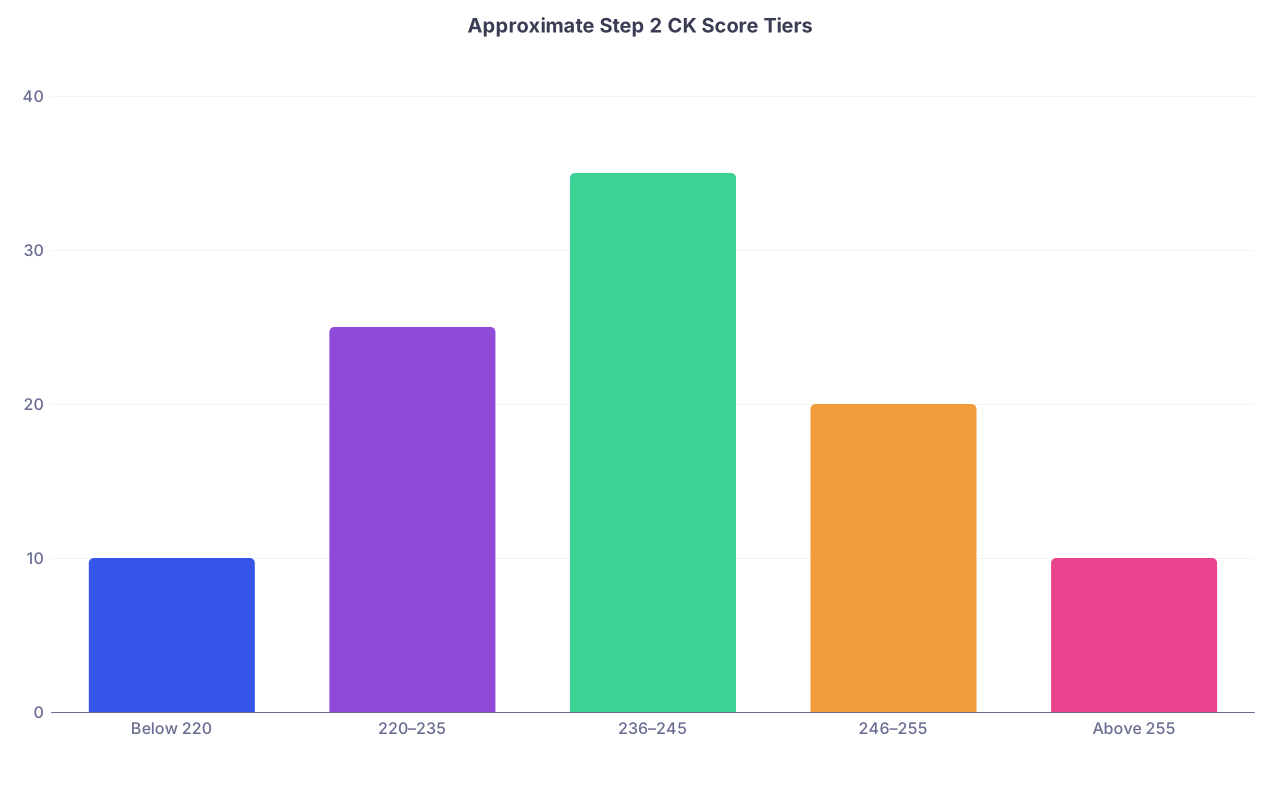
| Category | Value |
|---|---|
| Below 220 | 10 |
| 220–235 | 25 |
| 236–245 | 35 |
| 246–255 | 20 |
| Above 255 | 10 |
Rough reality:
- Below ~220: Programs notice. Some doors close, especially in very competitive specialties.
- 220–235: Not stellar for super competitive fields, but absolutely workable for many specialties, especially with strengths elsewhere.
- 236–245: Solid range. Most places won’t blink.
- 246+: Great, but not a magic golden ticket.
If you’re reading this, I’m assuming one of two things:
- You’re actually below your specialty’s usual ranges.
- Or your score is fine, but it’s lower than your classmates or what you expected, and your brain turned that into “low.”
Either way, here’s the bad and good news in one sentence:
Programs will notice your Step 2 CK score. But they will also notice everything else.
Your job now isn’t to pretend the score doesn’t matter. It’s to make sure it doesn’t become the only thing that matters.
How Programs Actually Weigh Step 2 CK vs Rotations
Programs don’t sit in a dark room chanting “Step 2… Step 2…” while tossing applications into the fire.
They’re asking:
- Can this person handle our workload?
- Are they safe with patients?
- Are they teachable, collegial, not a nightmare at 3 a.m.?
- Will they pass boards and not cause headaches with remediation?
Step 2 CK hits that last one. It’s their anxiety score. Your rotation performance hits the others.

Here’s the harsh reality and the hope, side by side:
- If you have a low Step 2 CK and bland or weak rotations, you’re in trouble. There’s nowhere to hide.
- If you have a low Step 2 CK but strong rotations, strong narrative letters, and people willing to go to bat for you, you’re not done. Not even close.
Program directors have said this out loud in meetings and panels: “I care more about what my colleagues say about working with you for 4 weeks than what you did on a single test day.”
But. That only helps you if:
- Your evals are genuinely strong (not just “pleasant to work with” on every line).
- Your letters actually say you’re excellent, not just “did well on the service.”
If you’ve done aways where attendings commented things like:
- “Top 10% of students I’ve worked with.”
- “I would be happy to have them as a resident in our program.”
- “Functions at or above the level of an intern.”
…that is currency. Real currency.
Specialty Reality Check: Are You Trying to Force a Bad Fit?
This is the part you’re probably dreading, so let’s rip it off like a bandaid.
Some specialties are cutthroat about Step scores. Not fair. But real.
| Specialty Type | Step 2 CK Sensitivity | Strong Rotations Can Offset? |
|---|---|---|
| Derm, Ortho, Plastics | Very High | Rarely, mostly no |
| ENT, Neurosurg | Very High | Occasionally |
| Radiology, Anesthesia | High | Sometimes |
| EM, Gen Surg | Moderate–High | Often helps a lot |
| IM, Peds, FM, Psych | Moderate | Yes, often significantly |
| Neuro, OB/GYN | Moderate–High | Depends on program |
If you’re going for:
- Dermatology with a 215 and no insane research, or
- Ortho with a 220 and no glowing letters from big-name people,
you’re not “a long shot.” You’re nearly locked out this cycle unless there are very special circumstances.
But if you’re aiming for:
- Internal Medicine
- Family Medicine
- Pediatrics
- Psychiatry
- Many community General Surgery or EM programs
…and you’ve got:
- Strong rotations
- A solid MSPE
- A coherent story in your personal statement
Then yes. You can absolutely still match. Even “safely,” if you apply smartly and widely.
What “Strong Rotations” Need to Look Like to Actually Help You
Here’s the thing that scares me: a lot of us say “my rotations were strong” when what we really mean is “no one yelled at me and I got mostly ‘Above Expectations.’”
Programs are reading hundreds of evals where:
- “Shows initiative”
- “Team player”
- “Arrived on time”
…are copy-pasted phrases.
You’re in genuinely good shape if:
- Attendings have told you to your face: “I’ll write you a strong letter.”
- Residents say things like: “If you apply here, let me know. I’ll email the PD about you.”
- Your rotation comments include specific praise: “Presented complex patients clearly,” “Exceptional ownership,” “Reads outside the hospital and applies knowledge.”
If you aren’t sure, you can still go back to those attendings and say something like:
“I’m applying to [X] this cycle. I know my Step 2 CK isn’t as strong as I’d hoped, but I worked really hard on your rotation and learned a lot. Would you feel comfortable writing me a strong letter of recommendation?”
The word “strong” forces them to be honest. If they hesitate or say something vague, that’s your answer. Don’t use that letter as your anchor.
So… Can You Still Match Safely With a Low Step 2 CK?
Let me define “safely” in a way that doesn’t sugarcoat anything.
You are matching “safely” if:
- You’re applying to a specialty where your score is below average but not catastrophic,
- You’re willing to cast a wide net geographically and include community and mid-range academic programs,
- You’ve lined up strong, personalized letters and a coherent application.
You’re not applying safely if:
- You’re banking on one city or one tier of programs “seeing your potential,”
- You’re clinging to prestige more than you’re clinging to actually matching,
- You’re ignoring your school’s advising office because you’re scared of what they’ll say.
The worst-case scenario in your head usually goes something like: “I don’t match. I have to explain this to my family. I reapply and look even worse. My career is over.”
Reality is rarely that dramatic. Most people with imperfect scores who strategize well… match.
Where they get burned is:
- Underapplying (“I don’t want to seem desperate so I only applied to 25 programs”),
- Overreaching (“Only top university programs in big coastal cities for me”),
- Hiding weaknesses (“I won’t address this at all and hope they don’t notice”).
Programs notice. But they also notice effort, self-awareness, and backup planning.
Concrete Things You Can Do Right Now To Rescue This Cycle
You don’t fix a low Step 2 with positive vibes. You fix it with aggressive, strategic action.

| Step | Description |
|---|---|
| Step 1 | Get Score |
| Step 2 | Reality Check by Specialty |
| Step 3 | Meet Advisor or Dean |
| Step 4 | Adjust Specialty List or Program Range |
| Step 5 | Secure Strong Letters |
| Step 6 | Rewrite Personal Statement to Address Strengths |
| Step 7 | Apply Broadly and Early |
| Step 8 | Prepare for Interviews with Clear Story |
Here’s what I’d actually do if I were you, like, this week:
Sit down with someone who knows match data. Not Reddit. Not your friend with a 260. Your dean’s office, advisor, or someone involved in residency selection. Ask them point blank:
- “With a Step 2 of X and my rotation performance, what range of programs should I realistically be targeting?” Write down numbers. Number of programs. Types. Not vibes.
Adjust your specialty list if needed. This is the part that hurts. You might need:
- A parallel plan (e.g., EM + IM, or Gen Surg + Prelim + IM).
- To consider community or smaller programs you ignored before. Humbling? Yes. But better than not matching and wishing you’d been less proud.
Weaponize your strengths in your personal statement. Not with cheesy overcompensation like:
“Although my Step 2 score does not reflect my true potential…”
Instead:
- Tell stories from your best rotations.
- Show how you function at the bedside, as a team member.
- Emphasize reliability, teachability, work ethic. You want PDs thinking: “Okay, the score isn’t great, but wow, this person gets it clinically.”
Get letters that explicitly counterbalance your score. Quietly tell your letter writers:
“I’m a little worried that my Step 2 score doesn’t fully reflect my clinical ability. If you’re comfortable, it would really help if your letter could speak to how I performed clinically and my readiness for residency-level responsibility.”
Some will actually write that, in almost those words. That’s gold.
Apply broadly. Wider than your ego likes. Think less:
- “Will I be happy here?” And more:
- “Will I be a doctor here?” You can love your career from many zip codes and hospital logos.
Show up big on interviews. A mediocre score plus a flat interview is forgettable.
A mediocre score plus a vivid, mature, self-aware interview? Remembered. Ranked.
The Anxiety You’re Not Saying Out Loud
Let’s be honest with the darkest thoughts for a second, because they’re there whether we name them or not:
- “I’m not actually smart enough for this.”
- “This score proves I’ve been faking it the whole time.”
- “Attendings liked me because I’m nice, not because I’m competent.”
- “I will be the weak link intern everyone gossips about.”
You know what I’ve actually seen?
Residents who:
- Had mid or low-ish board scores,
- Were the ones everyone trusted with sick patients,
- Became chiefs,
- Matched into solid fellowships later…
And on the flip side: People with monster Step scores who couldn’t function on the floor and scared nurses.
Step 2 is a data point. A loud one, yes. But not a final verdict on your future as a physician.
You’re allowed to be anxious. Just don’t make decisions only from that fear.
FAQ: Low Step 2 CK, Strong Rotations, and Matching
1. Should I mention my low Step 2 CK in my personal statement?
Usually no. Don’t drag a negative into the spotlight unless:
- There’s a clear, brief, resolved explanation (illness, family crisis, etc.), and
- You can tie it to growth, not excuses.
If you address it, one or two sentences max. Otherwise, focus on your clinical strengths and who you are as a future resident.
2. Will programs automatically filter me out based on my score?
Some will. That’s reality. Especially in competitive specialties or big-name academic centers. But not all programs have rigid filters, and many will still review you if:
- You’re from a known school,
- Your letters are strong,
- Your experiences and rotations look impressive.
That’s why applying broadly really matters—you need enough programs that actually read your file.
3. Do strong away rotations at specific programs actually help overcome a low score?
Yes, sometimes dramatically. If you rotated at Program X, worked like crazy, and they loved you, that can absolutely override a weak score for that program and sometimes sister programs. Programs trust their own people’s judgment way more than a test. The key is whether they’re actually willing to go to bat for you—ask residents and faculty honestly where you stand.
4. Should I delay graduation or take extra time to improve my application?
Only if doing so gives you something concrete, not just “time to feel better.” Good reasons:
- You can do a research year that meaningfully boosts your specialty chances,
- You can strengthen your clinical letters with additional rotations,
- You had major life or health issues and need time to stabilize.
Bad reason: “I just want a better vibe next year.” Talk to your dean before deciding; delaying has its own risks.
5. Is it better to apply to a less competitive specialty I’m lukewarm about, just to match?
This is the ugly trade-off. If your current specialty choice is truly unrealistic given your score and overall app, a more attainable specialty might be the safest path to being a physician at all. But don’t blindly jump; shadow, talk to residents, and make sure you can actually see yourself in that field. You can love specialties you didn’t initially consider. Regret usually comes from making fear-only decisions without exploring.
6. What’s one thing that actually moves the needle the most for me now?
Honestly? A brutally honest sit-down with someone who knows your school’s match data and will not sugarcoat things. In 30 minutes they can:
- Recalibrate your expectations,
- Suggest a realistic program list,
- Identify gaps you still can patch this cycle.
That conversation often does more for your match odds than weeks of spiraling on Reddit.
Open your Step 2 CK score report again, and then, right after, pull up your best rotation evaluations. Read them side by side. Then email one trusted advisor today and schedule a meeting to talk about an actual, numbers-based program list—before your anxiety writes your whole story for you.