
The fantasy that your application will be perfectly consistent is a lie.
Scores, narratives, MSPE, letters — they rarely line up in some clean, satisfying way. And when Step 2 CK doesn’t match your great letters and a glowing MSPE? That disconnect feels like a siren screaming: “They’ll see I’m a fraud.”
You’re probably here because something doesn’t fit:
Your Step 2 CK is lower than programs would expect based on how strong your letters/MSPE are.
Or it’s higher, and now you’re panicking they’ll think your letters were pity-written fluff.
Either way, the mismatch is freaking you out.
Let me be blunt: programs will notice big inconsistencies. But they don’t automatically treat them like red flags. The real question is whether the story of your application makes sense.
Let’s unpack this without the sugarcoating — but also without the panic spiral that’s currently living rent-free in your head.
The Ugly Truth: PDs Do Compare Your Score to Your Story
Programs don’t just see “250” or “225” and move on. They’re looking at patterns.
They see:
- Your Step 1 (if applicable)
- Your Step 2 CK
- Your clerkship grades
- Your narrative comments
- Your MSPE summary boxes
- Your letters (especially from core rotations and your chosen specialty)
And they’re asking: “Does this all line up, or is something off?”
They know what a “coherent” applicant typically looks like. For example, if your MSPE says things like:
“Top 5% of the class, consistently honors-level performance, outstanding clinical reasoning.”
…they’re not expecting to see a 214 on Step 2.
Likewise, if your comments are full of:
“Requires additional supervision, sometimes struggles with clinical decision making.”
…and then there’s a 268 staring at them, that also raises eyebrows.
But here’s the part your anxiety keeps editing out:
Programs see weird combos every year. They’ve matched people with low Step 2 and elite letters. They’ve rejected people with monster Step 2 and meh evaluations. The mismatch isn’t automatically fatal — it just demands an explanation.
And you actually have more control over that explanation than you think.
Scenario 1: Great Letters/MSPE, Disappointing Step 2 CK
This is the classic “I tanked Step 2 compared to the rest of my app” nightmare.
Usually looks like:
- Strong clinical comments (“outstanding,” “excellent team member,” “ahead of peers”)
- Mostly honors/high pass
- Strong home department letter in your chosen specialty
- Then: a Step 2 score that’s below the average for your target specialty or meaningfully lower than expected based on the rest of your file
You’re thinking: “Everyone said I was one of the strongest students. Now programs will think my school just hands out praise like candy and I’m actually mediocre.”
Here’s what programs actually think when they see this combo:
“This student is better clinically than this score suggests.”
For many PDs, strong narrative + weak score is better than strong score + weak narrative. Residency is clinical, not multiple choice.“Did something happen?”
They’ll wonder: bad test day? Family emergency? Health issue? Massive anxiety? Burnout from rotations + studying?“Is this a pattern or a single blip?”
They’ll scan: Step 1, clerkships, shelf exams (if mentioned), any failures, your research, your responsibilities. If everything else is solid, one lower-than-expected Step 2 is often seen as… one lower-than-expected Step 2.
What feels catastrophic to you often registers to them as “Huh, that’s unusual, but the rest looks strong.”
The real danger isn’t the number in isolation — it’s when your Step 2 is low and you give them no context and no one else does either.
What actually helps in this situation
You can’t go back and change the score, but you can shape the story around it.
Use your personal statement strategically, not as a confessional dump.
If your Step 2 truly doesn’t reflect your abilities because of something specific — and real — you can briefly acknowledge it. One or two sentences. Not a sob story.Something like:
“My Step 2 CK score does not represent my typical performance and occurred during a period when I was balancing significant personal circumstances. My clinical evaluations and clerkship performance better reflect my consistency and abilities as a team member and learner.”
That’s it. You don’t need every detail. You just need to break the silence.
Lean heavily on strong letters and clinical stories.
Ask your letter writers (if still possible) to emphasize:- Complex cases you handled well
- Your reasoning on rounds
- How you did compared to peers
- Reliability, ownership, follow-through
Concrete examples balance out one bad test day better than vague “hard worker” fluff.
Target your programs intelligently.
Some specialties worship Step scores more than others. You know this. If you’re sitting on a 220 applying ortho, yes — that mismatch is brutal. But for fields like FM, psych, peds, IM, EM (depending on the program), strong clinical reviews can go a long way.Don’t pretend your score doesn’t matter. It does. Just don’t ignore all the programs where your score is good enough and your clinical strengths become the deciding factor.
Be prepared to answer it on interviews.
They might ask directly:
“Can you tell me about your Step 2 CK performance?”The wrong answer:
“Yeah, I don’t know what happened, I just freaked out, I’m bad at tests, I was burned out, etc.”The right answer:
- Own it briefly.
- Give concise context if there is any.
- Pivot quickly to evidence of your strength (clerkships, concrete feedback, responsibilities).
For example:
“Step 2 CK was lower than I’d hoped. I took it during a time when I was managing some personal circumstances and I didn’t give myself adequate time to recover between rotations and studying. Since then, I’ve focused on applying the material clinically, and my evaluations on [X rotation] and [Y rotation] reflect the growth in my reasoning and reliability.”
Not perfect. But human. Programs recognize human.
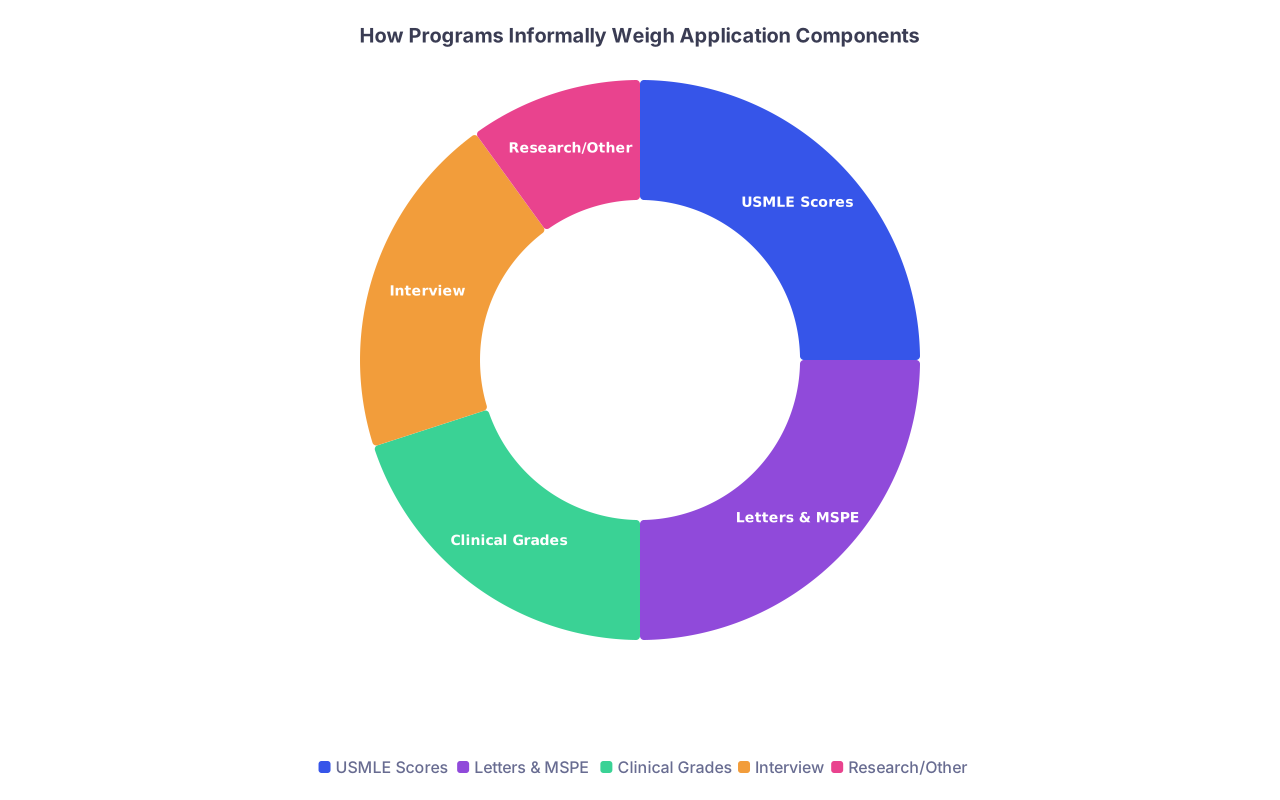
| Category | Value |
|---|---|
| USMLE Scores | 25 |
| Letters & MSPE | 25 |
| Clinical Grades | 20 |
| Interview | 20 |
| Research/Other | 10 |
Scenario 2: Lukewarm MSPE/Letters, Strong Step 2 CK
This one messes with your head differently.
Set up:
- Step 2 CK is strong (often significantly above average for your specialty)
- Step 1 maybe average or okay
- MSPE has bland or mixed comments
- Letters are… fine. Not glowing. Sometimes vague or short. Maybe one lukewarm or subtly negative one.
You’re scared programs will think: “This person is just a good test-taker, but not actually good with patients or teams.”
Sometimes, that’s exactly what they suspect. But it’s not always the conclusion.
Strong Step 2 can make PDs ask: “Is this student under-evaluated at their school? Did grading screw them? Did they grow later in med school? Are they awkward clinically or just unlucky with evaluators?”
Here’s what I’ve seen happen:
- People with mid-tier clinical comments and strong Step 2 still matching into solid programs — because interviews showed they were normal, thoughtful, teachable humans.
- People with amazing Step 2 but repeatedly flagged professionalism/attitude issues in MSPE getting screened out hard. The MSPE wins that fight.
If your mismatch is “numbers great, narrative meh,” then your entire job is to prove you’re not just a multiple-choice machine.
How to compensate when your letters/MSPE don’t match your score
Show growth and self-awareness.
In your personal statement, you can quietly frame things as a trajectory:“Earlier in clinical training, I focused heavily on knowledge acquisition and test performance. Over time, especially during [later rotations], I realized how much I needed to develop my communication and team skills. Working with [specific patient/situation] pushed me to…”
That tells them: “Yeah, I used to be a bit of a test gremlin. I’m getting better.”
Get at least one truly strong recent letter.
If there’s any attending who saw you later in your training when you were more comfortable clinically, beg them (politely) for a letter. Tell them you’re hoping for something that really reflects your day-to-day work, not just a generic rec.A single, detailed, recent letter can “overwrite” some earlier bland stuff in PDs’ minds.
Absolutely nail the interview.
This is where you live or die. If your file says: “May be just a test scorer,” and then you get on Zoom and you’re:- Warm
- Reflective
- Non-defensive
- Able to talk through cases and decisions calmly
…you can flip the narrative.
Don’t overcompensate by talking about your score.
You don’t need to say “As you can see by my Step 2 score…” They already saw it. Lean into stories that prove you’re a decent human who can function on a team at 3am, not just someone who can crush UWorld.

How Big Does the Mismatch Have to Be Before Programs Care?
You’re probably obsessively doing this mental math:
“My MSPE says ‘top third’ but my Step 2 is [score]. Is that inconsistent? Does [specialty] expect my score to be higher if my letters are this strong?”
There’s no one formula, but let’s make this less abstract.
| Pattern | How It Often Lands |
|---|---|
| Strong MSPE + 1 substantially lower board score | Usually seen as a blip, especially with good clinical comments |
| Strong boards + repeatedly mediocre or negative narrative | Much more concerning than a single low score |
| Great everything except one slightly below-average rotation | Usually ignored unless it’s your target specialty |
| Target specialty rotation with lukewarm comments but high Step 2 | Makes them cautious; they will watch you closely on interview |
| Big improvement Step 1 → Step 2 with better later comments | Often interpreted very positively as growth |
A mismatch becomes a big deal when:
- There’s a pattern (e.g., multiple rotations note the same concerning thing), or
- The MSPE hints at professionalism or attitude issues, or
- Your story in person directly contradicts what they read
One “off” number in an otherwise coherent file? Annoying, yes. Defining, no.
So… Will This Mismatch Tank My Chances of Matching?
You want a binary answer: yes or no.
You’re not going to get it, because the real answer is worse and better at the same time:
It might hurt you at some programs. It will barely matter at others. And you won’t always know which are which.
But here’s what it doesn’t mean:
- It doesn’t mean every PD will assume you’re a fraud.
- It doesn’t mean your interview invites are doomed.
- It doesn’t mean your letters “don’t count” anymore.
Programs are trying to assemble a functional team, not a perfectly symmetrical dataset. They deal with mess. In fact, everyone’s file is messy when you actually read it.
The applicants who get hurt the most by mismatches aren’t the ones with bad luck. They’re the ones who:
- Pretend the weirdness doesn’t exist
- Get defensive or weird if it’s brought up
- Fail to show any insight about themselves during interviews
If you can do the opposite of that, you’re already in better shape than your anxiety is telling you.

| Step | Description |
|---|---|
| Step 1 | Review Application |
| Step 2 | Standard consideration |
| Step 3 | Look for context |
| Step 4 | Interpret as single issue |
| Step 5 | Check letters more closely |
| Step 6 | Lower on rank list or screen out |
| Step 7 | Invite to interview and assess |
| Step 8 | USMLE scores match narrative? |
| Step 9 | Any explanation in MSPE or PS? |
| Step 10 | Red flags in narrative? |
Concrete Things You Can Do This Week To Help Yourself
You can’t rewrite your MSPE. You can’t retake Step 2 right now. But you’re not powerless.
Here’s what I’d actually do if I were in your shoes and spiraling about this:
Print (or open) your MSPE and 1–2 key letters if you’ve seen them summarized.
Read them like you’re a PD. Circle or highlight:- Phrases that sound strong
- Phrases that sound vague or concerning
- Any mentions that hint at explanations (“during a difficult personal time,” “improved significantly,” etc.)
Put your Step scores next to that.
On a single page, just write:- Step 1: X
- Step 2: Y
- General MSPE vibe: [strong / mixed / lukewarm]
- General letters vibe (from what you know): [strong / mixed / lukewarm]
Look for the main tension point. Not 50 little things — the one big mismatch.
Write a 3–4 sentence, brutally honest explanation for yourself.
Not what you’ll say to programs yet. What’s actually true?Example:
- “I was clinically strong but overextended and didn’t study enough for Step 2.”
- “I was burned out; I didn’t respect the exam and got hit.”
- “I focused too much on scores early and came off stiff/awkward clinically.”
No one else has to see this. But you can’t explain what you won’t even admit to yourself.
Now, rewrite it in a professional, non-dramatic way you could use if asked.
One or two sentences max. Practice saying it out loud until it doesn’t make you flinch.Adjust your program list if you still can.
Add:- A few more programs slightly below your ideal tier
- Some where your score is comfortably within or above their typical range
- Places that emphasize “holistic review” across their website/socials (yes, some of them actually mean it)

You’re Not the One Weird Applicant. This Happens Every Year.
Residents you admire? Attendings you respect? A bunch of them have “inconsistencies” in their application history that would horrify current-you.
The difference is:
- They didn’t let a mismatch freeze them.
- They kept applying.
- They owned their story, didn’t overexplain, and showed up as the same person on paper and in person.
You’re allowed to be anxious about this. Honestly, if you weren’t worried, I’d question whether you understood how competitive this whole thing is.
But being worried is not the same as being doomed.
So here’s what I want you to actually do today — not “sometime later when it feels less overwhelming,” but today:
Open your personal statement or interview prep doc and write two sentences that calmly acknowledge your biggest mismatch (low Step 2 with strong MSPE, or the reverse). Then rewrite those two sentences until they sound like a competent, self-aware version of you said them — not the panicked version that’s been yelling inside your head.
That tiny bit of control over the narrative? That’s how you start pulling yourself out of the “what if they see through me” spiral and into “here’s who I actually am as a future resident.”