
The belief that a strong Step 2 CK score can magically erase a weak clinical record is fantasy. Comforting fantasy, but fantasy all the same.
Programs are not stupid. They know exactly what Step 2 CK can and cannot tell them. And they’re increasingly good at spotting the applicant who used CK as a last-ditch cover for mediocre clinical performance.
Let’s dismantle this myth properly.
What Programs Actually Use Step 2 CK For
Step 2 CK is powerful. Just not in the way students like to imagine.
Program directors consistently report three core uses for Step 2 CK:
- A screening filter when Step 1 is pass/fail or weak
- A consistency check against the rest of the application
- A tie-breaker among otherwise similar applicants
That’s it. Not a neuralyzer for bad clerkship evals. Not a reset button for shaky professionalism. A data point.
Look at the NRMP Program Director Survey (pre-Step 1 pass/fail and post-). When Step 1 went pass/fail, what shot up in importance? Step 2 CK. But it didn’t replace the rest of the application; it just filled the “standardized number” hole.
Programs still rank these very highly:
- Clerkship grades
- MSPE narrative and summary phrases
- Class ranking/quartile
- Professionalism concerns or leaves of absence
- Course failures / remediation
Those things are about how you function on real wards with real patients and real teams. No 260 on Step 2 CK overwrites a pattern of “below expectations” in clinical teamwork or professionalism.
Here’s the uncomfortable truth: a strong Step 2 CK score can reframe a weak record, but it rarely erases it.
The Fantasy: “High CK Score = Clean Slate”
Let me show you the myth in its purest form, because I hear it every year:
“My clerkship grades are mostly Pass, some HP. But if I crush Step 2 CK and get, like, 260+, I’ll be fine. Programs will know I’m actually strong clinically.”
No. They’ll know you’re strong at taking standardized tests.
Think like a program director for a minute. You’re looking at an applicant with:
- Mostly Pass-level core clerkship grades
- A few evaluations noting “needs more initiative” and “inconsistent follow-through”
- MSPE hinting at “growth in professionalism over time” (translation: there was an issue)
- But a 260+ on Step 2 CK
What do you actually conclude?
“Smart. Capable of learning. Possibly late bloomer. But there are real questions about day-to-day reliability.”
Step 2 CK measures knowledge application on vignettes. Clerkship grades and MSPE measure whether you show up, follow through, communicate, work with nurses, own your patients, handle stress, and don’t melt down or go missing post-call.
Those domains are not interchangeable.
What Step 2 CK Can Fix – And What It Cannot
There is some redemption power here. Just not the kind most students imagine.
Where Step 2 CK actually helps
Step 2 CK can meaningfully help you in a few specific scenarios:
Low Step 1 / pass-fail Step 1 anxiety
If you had a weak Step 1 or no numeric score at all, a strong Step 2 CK reassures programs that your fund of knowledge and test-taking ability are solid. It can pull you back into consideration at mid to high-tier places that might otherwise be nervous.Slightly underwhelming clerkship grades without red flags
Example: Mostly High Pass with a couple of Passes in tougher rotations, but narrative comments are fine. A strong Step 2 CK (say, above the mean for your target specialty) supports the story that your knowledge is ahead of what your grades alone suggest.Borderline competitiveness for your specialty
For something like IM or Peds, a strong Step 2 CK can offset a few weaker elements. For highly competitive fields (derm, ortho, plastics), it can at least prevent you from being instantly screened out.
This is where Step 2 CK acts as a credibility booster. It tells programs, “Whatever happened earlier, this person has the raw knowledge and test endurance to handle the didactic side.”
But it’s a booster, not a clean-slate generator.
Where Step 2 CK does almost nothing
There are several things Step 2 CK cannot fix, and programs know this:
Pattern of weak clinical performance
Multiple “pass” core clerkships plus narrative concerns about reliability, communication, or ownership of patients. CK can’t erase that You-On-The-Wards data.Professionalism issues
Remediation for unprofessional behavior, MSPE flags, repeated concerns from multiple sites. A 270 doesn’t change the fact that residents are employees, not just test takers.Repeated failures / withdrawals
Course or clerkship failures, LOAs not clearly medically explained, or multiple exam failures. CK can’t rewrite that timeline.Late or missing Step 2 scores
Some applicants think, “I’ll apply, see if I get interviews, then use a CK score to save me later.” Programs increasingly require Step 2 CK before ranking. If it’s not there early, it doesn’t help your initial screen.
How Programs Actually Weigh Step 2 CK vs Clinical Record
Let’s be blunt: USMLE scores are still heavily used. But they’re not used alone.
Most programs have a rough mental matrix like this:
| Step 2 CK & Clinical Profile | How Programs Often Interpret It |
|---|---|
| High CK + Strong clinical record | Green flag, likely screened in, interview-worthy |
| High CK + Mediocre but clean clinical | Mixed, worth a look, may interview depending on tier |
| High CK + Red-flag clinical/professional | Concern, interview only if desperate/unique reasons |
| Average CK + Strong clinical record | Very workable, often safer resident than test star |
| Low CK + Strong clinical record | Worrisome but sometimes still considered, esp. less competitive specialties |
The important row is the third one: High CK + Red-flag clinical record. That’s where the myth dies.
Program directors have been burned by the 260+ applicant who turned out to be a nightmare intern. Enough times that many now explicitly prioritize reliability and teamwork over pure test brilliance.
I’ve heard variations of:
- “Give me the 235 who works hard and shows up, not the 260 diva.”
- “We’re staffing a hospital, not building a USMLE team.”
They mean it.
Specialty Differences: Where CK Matters More (and Still Doesn’t Erase)
Different specialties use Step 2 CK differently. But none of them truly let it erase a bad clinical record.
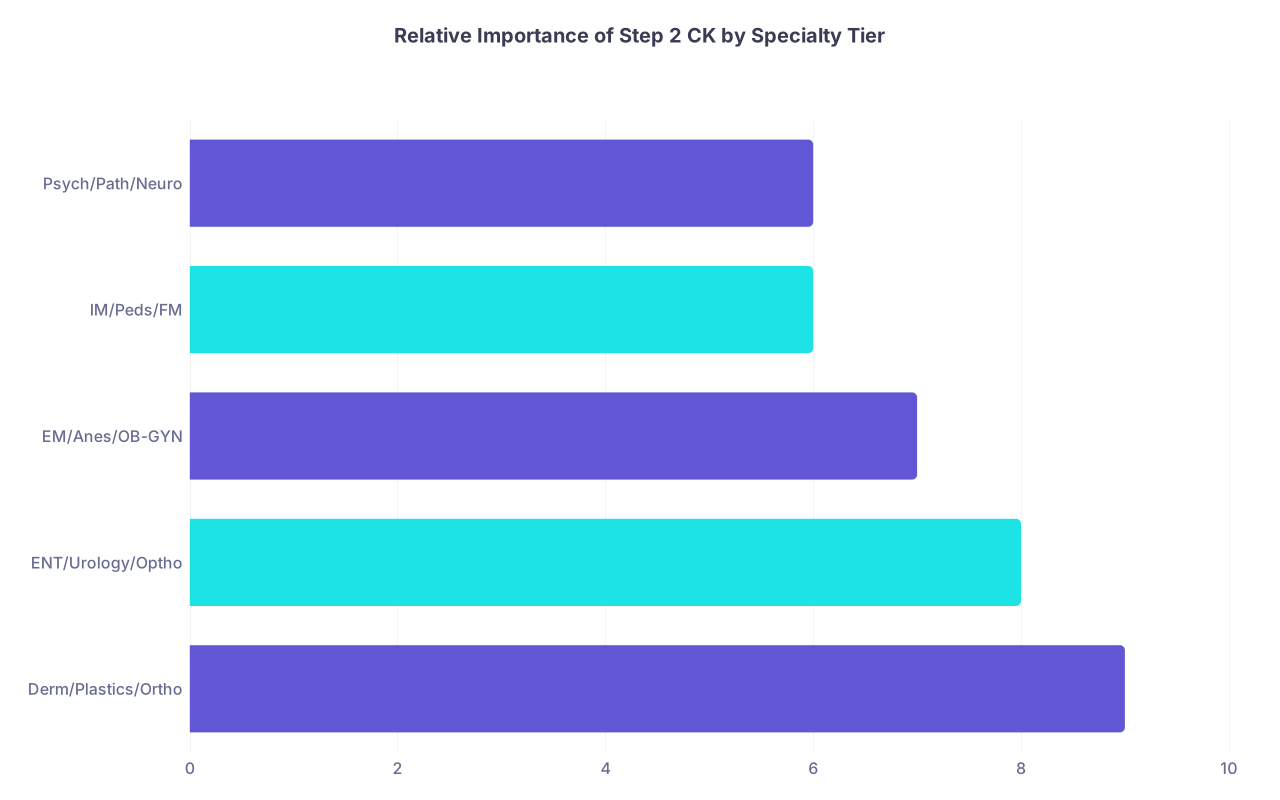
| Category | Value |
|---|---|
| Derm/Plastics/Ortho | 9 |
| ENT/Urology/Optho | 8 |
| EM/Anes/OB-GYN | 7 |
| IM/Peds/FM | 6 |
| Psych/Path/Neuro | 6 |
Rough, but directionally right.
Hyper-competitive (Derm, Ortho, Plastics, ENT, Urology)
Here, a high CK is almost mandatory. But these programs are flooded with applicants who all have high scores. What separates them? LORs from rotations, clinical performance, research fit. If your clinical record is weak, the high CK just keeps you from being instantly deleted; it doesn’t automatically earn interviews.Competitive but broader (EM, Anesthesia, OB-GYN)
Step 2 CK is heavily weighted, especially now that Step 1 is pass/fail. But they care a lot about how you functioned on their specific rotations and your SLOEs/letters. A lukewarm EM rotation plus a 260 CK is still lukewarm.Core specialties (IM, Peds, FM, Psych)
Slightly more forgiving, but don’t kid yourself – they still see through the “I’m a great clinician, ignore my record, look at my CK” narrative. They actually care more than you think about being a good teammate and safe, consistent clinician.
Concrete Scenarios: Who Actually Gets Helped By High Step 2 CK?
Let me draw some real-world composites I’ve seen.
Scenario 1: The Late Bloomer
- M2: Mediocre pre-clinical grades
- Step 1: Pass (barely, or pass-only school)
- M3: Starts rocky, then picks up – early Pass, later HP/Honors, comments show clear improvement
- Step 2 CK: 250+
Here, CK supports the story the MSPE is already telling: “This student grew, figured it out, and is now strong.” Programs like this arc. You’ll get real benefit.
Scenario 2: The Quiet Underperformer
- M3: Mostly Pass, maybe one HP, comments are bland “pleasant, quiet, did assigned tasks”
- No major issues, but no one seems excited about you
- Step 2 CK: 260
This is the fantasy case for many students. The reality? Mixed.
You get credit for being smart. Some programs will bite and interview you. But at better programs, you’ll lose to applicants with 240s and strong narratives like “integral team member,” “owned her patients,” “outstanding communicator.”
The CK helps. It does not transform you into a star.
Scenario 3: The Red Flag
- One failed clerkship, remediated
- MSPE diplomacy that clearly hints at professionalism concerns
- Step 2 CK: 255
Programs do not say, “Never mind the professionalism, look at that CK.” They say, “Can we trust this person at 3 a.m. with a full list?” The score is background noise against that question.
The Timing Trap: “I’ll Use CK as My Rescue After I Apply”
Another myth: “I’ll submit ERAS without a CK score, then take Step 2 late, crush it, and rescue my application.”
That used to work more, pre-Step 1 pass/fail. It works less and less now.
Here’s how the timing reality plays out:
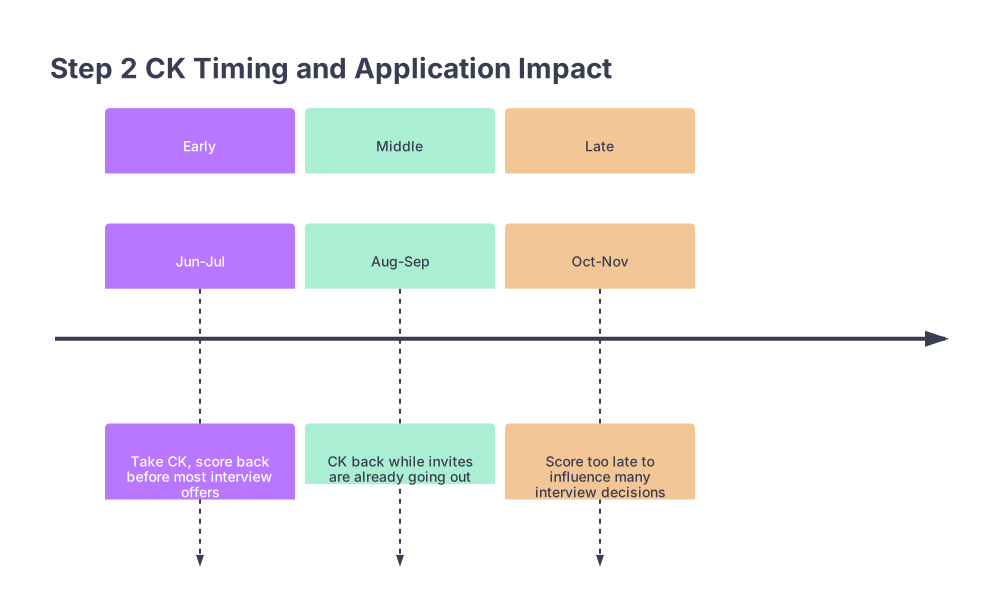
| Period | Event |
|---|---|
| Early - Jun-Jul | Take CK, score back before most interview offers |
| Middle - Aug-Sep | CK back while invites are already going out |
| Late - Oct-Nov | Score too late to influence many interview decisions |
If you take CK late:
- Many programs have already used prelim data to screen
- Your file may have been quietly moved to the “unlikely” pile
- Some programs will not re-review just because a new score showed up
A late high score can help for rank ordering or a few late invites, but it rarely rescues a fundamentally weak clinical record if your initial file didn’t inspire confidence.
If your whole strategy is “my CK will save me,” but you schedule it so late that no one even sees it in time, that’s not strategy. That’s denial.
What Actually Improves Your Chances More Than a Heroic CK Score
Here’s the part applicants underestimate badly.
There are things that often matter more than an extra 10–15 CK points once you’re in “respectable” territory:
- Anchoring a glowing home rotation in your target specialty
- Getting strong narrative letters that talk about you owning patients and being the go-to intern-level student
- Fixing real-world behavior: showing up early, following up, actually calling consultants yourself, writing good notes
- Strategically applying to programs where your overall record (not just CK) fits their typical resident profile
I’ve seen applicants with 240–245 on CK and elite clinical narratives beat out 255–260 scorers with generic comments and no one excited to work with them again.
Programs are slowly but surely moving away from pure-score worship. They still care. Of course. But CK is moving into the “minimum competence + nice bonus” bucket, especially now that they’ve been forced to look more carefully at the rest of the application.
The One Thing a High CK Score Absolutely Does Do
Let me give Step 2 CK its due.
What a strong score definitively does is this:
It closes the door on the narrative that you “can’t hack” the cognitive side of residency.
If your preclinical years or Step 1 were shaky, a solid CK says, “I can learn. I can sit for long exams. I can process complex clinical questions under time pressure.”
That’s not trivial. It often moves you from “probably no” to “maybe yes, let’s look deeper.”
But that’s where the clinical record takes over. Because the rest of the question is: “Can we trust you on the team?”
And there is no multiple-choice exam for that.
Summary: Stop Treating Step 2 CK as a Magic Eraser
Three core points and then you can go back to UWorld:
Step 2 CK amplifies the story your application is already telling; it does not rewrite a bad one. It’s a credibility booster, not a record expunger.
Programs trust longitudinal clinical data and professionalism history more than one test score. Repeated weak clerkship performance or behavior issues are not fixed by any three-digit number.
If you want to “redeem” a weak start, combine a solid Step 2 CK with genuinely improved clinical performance and strong narrative letters. The rescue comes from your behavior on the wards, not just from your score report.